The U.S. Government Staged an Apple-Style Keynote: Launching America.gov to Replace 29,000 Websites with an AI Chat Box
The U.S. government consolidated service information scattered across departmental websites into a single AI chat box. While Q&A is live, demos of name changes, Medicare, and passport applications show what lies ahead—with the real hurdles in each agency's operating rules.
The U.S. government has officially launched America.gov. Before this, interacting with the federal government was notoriously cumbersome for everyday Americans: agencies operated thousands of fragmented websites. Getting a passport required visiting the State Department; checking Medicare coverage meant going through the Centers for Medicare & Medicaid Services; and updating an address after moving required individual notifications to the Postal Service, the IRS, and the Social Security Administration. Each agency ran its own systems and login credentials, forcing citizens to repeatedly fill out the same personal details. America.gov aims to place a unified "digital front door" ahead of all these agencies, enabling the public to explain what they need in everyday language through a single search box.
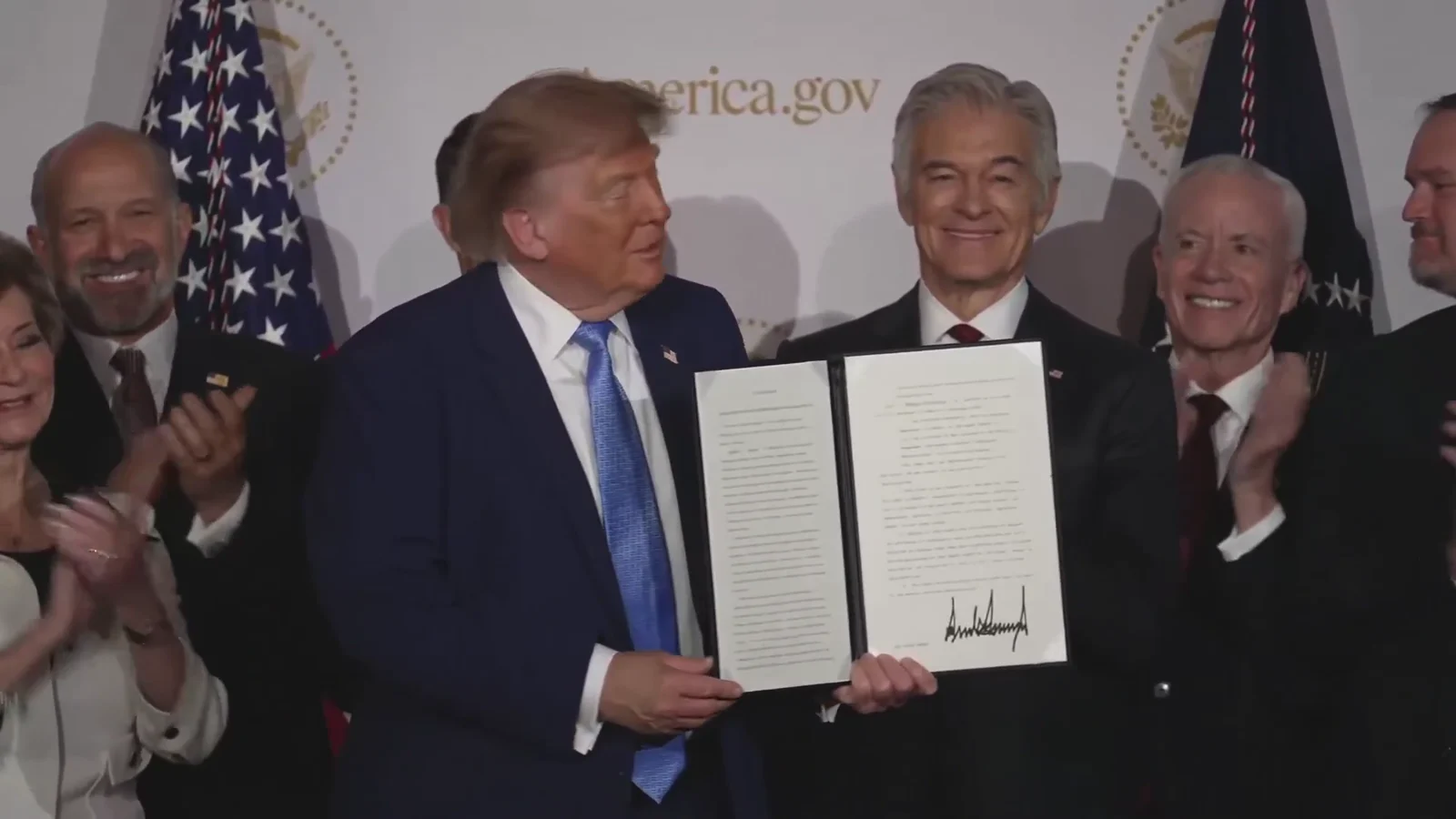
The event took place on the same day as OpenAI's DevDay. On the West Coast in San Francisco, OpenAI hosted its developer conference, unveiling agents capable of operating autonomously in the background; on the East Coast in Washington's Andrew W. Mellon Auditorium, the Trump administration delivered a tech-heavy keynote of its own. Yet conversational or form-filling AI alone is far from sufficient. For a model to actually complete real-world tasks on someone's behalf, it must first verify identity, obtain authorization, and submit records directly into agency backend systems. That is why Trump signed an executive order onstage, directing federal agencies to progressively integrate their service interfaces with the platform.
Currently live features and characteristics include:
- Policy and Eligibility Inquiries: Answers questions regarding federal policies and benefits, such as Medicare eligibility, veteran benefit qualifications, and passport requirements for minors.
- Step-by-Step Guidance and Official Links: Outlines specific application procedures, required documentation, and fees for various services, while providing direct links to the relevant official agency websites (such as applying for TSA PreCheck or booking national park campsites).
- Consolidated Official Government Sources: The search backend indexes approximately 29,000 federal government websites, retrieving information directly from existing official pages and attaching source links to every answer.
- No Registration and Ad-Free: The public can start typing questions immediately without creating an account or logging in, with no commercial ads anywhere on the page.
- On-Page Privacy Commitments: The site states that it does not retain conversations, and AI service providers do not keep queries or answers; responses may be cached temporarily for up to two hours, indexed by a hash of the inquiry.
Future roadmap items include the following transactional services, though the site currently focuses on Q&A and navigation:
- Unified Account Login: Integration with the federal government's existing digital identity service, Login.gov, eliminating the need to manage multiple usernames and passwords.
- Cross-Agency One-Stop Name Changes: For post-marriage name changes, users will only need to upload their marriage certificate once to synchronize updates across the Social Security Administration, IRS, and Passport Office, targeted for launch in 2027.
- Online Application and Tracking for Passports and Medicare: Future iterations will allow users to submit Medicare applications or apply for a first-time passport directly on the platform, take ID photos with a smartphone with real-time passport-page previews, and track physical document delivery like a parcel shipment.
Onstage: Staging a Government Briefing Like a Tech Product Launch


Dubbed “Hello, America,” the event was held at the Andrew W. Mellon Auditorium in Washington. It was hosted by the National Design Studio, established in 2025 to redesign federal digital services and web interfaces. Led by Airbnb co-founder and Chief Design Officer of the United States Joe Gebbia, the studio absorbed several alumni from the Department of Government Efficiency (DOGE). During his remarks, Trump thanked lead engineer Edward Coristine (known online as “Big Balls”) and Elon Musk, noting that Musk had championed using technology to overhaul government workflows early on.
The event carried every hallmark of a Silicon Valley product keynote: minimalist dark backdrops, oversized projection screens, and live product walk-throughs. Former White House Press Secretary Karoline Leavitt and motivational speaker Tony Robbins opened the stage, followed by Gebbia explaining the product's design philosophy. Dr. Mehmet Oz, Administrator of the Centers for Medicare & Medicaid Services (CMS), and Secretary of State Marco Rubio then demonstrated specific workflows. The event also featured industry panel discussions attended by Nvidia CEO Jensen Huang, Elon Musk, and representatives from tech firms including Meta and Palantir.
The Models and Data Behind the Chat Box
The prompt box on the homepage reads: “Whatever you need from the government, start here.” Gebbia noted that Americans make approximately 40 million visits to government websites every day.


Explaining the backend architecture in an interview with CNBC, Gebbia stated that upon receiving an inquiry, the system searches federal websites, extracts only official content directly relevant to the question, generates an answer, and appends the source links. Gebbia emphasized that the system relies solely on official federal sites to avoid outdated or promotional material from third-party commercial portals, adding that changes made to agency websites are detected and synchronized in real time.
The chat box's underlying model capabilities are powered by Google's Gemini and Elon Musk's Grok (now operated under SpaceXAI). Jim Kelly, Vice President of Google Public Sector, issued a statement confirming the partnership, noting that Gemini would help over 100 million people access public resources; xAI did not respond to press inquiries. Nextgov noted that Grok had previously generated controversy over deepfake image generation.
While the platform published its privacy policies on the site, tech publication FedScoop reported that the White House, the General Services Administration (GSA)—which operates the site—Google, and xAI have not disclosed procurement details, contract terms, or contract values.
Integrating Federal Agencies: How the Executive Order Drives Implementation
Onstage, Trump signed an executive order establishing America.gov, designating the platform as the “unified digital front door of the federal government.” It aims to provide the public with accurate information and, as capabilities come online, allow them to complete transactions through a single portal without jumping between disparate agency sites. In a fact sheet, the White House estimated that the American public spends nearly 10 billion hours each year completing federal paperwork.

The order established a clear threshold for services eligible for integration: only public-facing services that served more than 100,000 users over the preceding 12 months and already offer online application or access are included. Tax-filing systems at the IRS, the Department of War (formerly the Department of Defense), and intelligence agency services were explicitly excluded. The Office of Management and Budget (OMB) may update the list of covered services via subsequent memoranda.
In terms of division of labor and implementation steps, the order directs the GSA, in coordination with the National Design Studio and OMB, to build and operate America.gov while integrating Login.gov. Within 90 days of signing, OMB will issue implementation guidance to executive agencies; agencies must inventory eligible services, expose existing public APIs, dashboards, and online forms to the platform, implement Login.gov authentication standards, and regularly report usage metrics and operational health data to the GSA and OMB.
Even with a unified front door, individual agencies will retain custody of records and responsibility for adjudications, avoiding a centralized database of personal information. Physical service counters, phone lines, mail-in channels, and agency-specific legacy web portals will all remain operational.
That same day, Trump signed a separate executive order directing federal agencies to cease using the term “artificial intelligence” (AI) across non-legal communications, including official documents, websites, and reports, replacing it with “super intelligence” (abbreviated as SI). The order also instructed the Assistant to the President for Science and Technology to draft a proposed federal legislative definition for the term within 60 days.
Live Demonstrations: Name Changes, Medicare Enrollment, and First-Time Passports
Onstage, presenters walked through several proposed civic workflows centered on Login.gov and a unified interface.
Gebbia demonstrated the post-marriage name change process slated for launch in 2027. Historically, changing a surname after marriage required visiting multiple agencies with physical documentation. In the demo, a user typed “I just got married, how do I change my name?” prompting an intake flow. The user could check off every agency requiring updated records—such as the Social Security Administration, the IRS, and the Passport Office—and upload a marriage certificate in a single submission, eliminating the need to log into multiple agency websites to re-enter information.


In his speech, Trump tied the unified digital front door to the SAVE America Act pending in Congress (a bill requiring photo identification to vote), arguing that streamlining document issuance lowers barriers to obtaining valid ID, leaving no excuses.
In the healthcare segment, CMS Administrator Dr. Oz invited Lisa, an audience member, onstage. Lisa explained that despite working in the tech industry, she found navigating Medicare daunting. Split into Parts A, B, and C, with varying enrollment windows, late-enrollment penalties, and coverage gap concerns, the process had left her paralyzed. She noted she had even consulted Claude, but still put off enrolling.
Dr. Oz demonstrated how the system could untangle rules based on Lisa's personal background and generate an enrollment plan, displaying a physical Medicare card printed with her name onstage. He added that future releases will allow users to search for clinics accepting Medicare, book appointments directly, and compare prescription drug prices across pharmacies. Dr. Oz noted that CMS currently spends nearly $100 million annually just printing and mailing paper Medicare handbooks; accessing personal records will require user consent.
Secretary of State Marco Rubio highlighted the digitization of passport issuance. The State Department previously launched online passport renewals for adults, issuing millions of passports under that system; Rubio showcased an online workflow for first-time passport applications, which historically required in-person visits to acceptance facilities. Logging in via Login.gov, the system pulls existing profile data to eliminate redundant manual data entry. Applicants can snap a photo with their phone or upload an existing picture, preview the final layout on a passport page in real time, and retake it as many times as needed. Once verified, users pay online with a credit card, then track application processing and estimated delivery.
The White House and Rubio offered timelines for several services: the White House fact sheet noted that passport renewals and Medicare applications would be supported later in the year, while the more complex “First Time Digital Passport Application” Rubio demonstrated was slated on slide decks for December 2026. Rubio stated the rollout would begin next year, with the goal of enabling the vast majority of Americans to apply for a new passport book or passport card online by late 2027.


Rubio also unveiled the redesigned 2028 U.S. passport, co-developed by the State Department and the National Design Studio. The redesign moves “United States of America” to the top of the cover and enlarges the Great Seal in the center. Interior illustrations have been completely redrawn; flipping through the pages creates a flipbook animation of a bald eagle in flight against historic scenes spanning 250 years of American history. Additionally, packaging will be upgraded from the current Priority Mail adhesive plastic envelopes to a white hard-shell presentation box.


Media Testing: Handling Controversial Issues and Niche Regulations
On launch day, Newsweek submitted 15 queries to America.gov to test its performance on politically, legally, and policy-sensitive topics.
Regarding the 2020 election outcome, the system stated unequivocally that Joe Biden won, citing the certified Electoral College tally of 306 to 232 and attaching records from the National Archives and Federal Election Commission. When asked whether widespread fraud altered the outcome, the response cited official investigative findings indicating no evidence of widespread fraud was found. Asked whether Trump could run for president again in 2028, the system cited the 22nd Amendment to explain that a president cannot serve a third term. On Trump's two impeachments and the 34 felony counts decided by a New York state jury, the platform cited judicial and congressional records, noting that the latter was a state-court rather than federal case.
Where federal agencies hold diverging views, the system presented public literature from different departments side by side. For example, on whether climate change is driven primarily by human activity, the answer cited long-standing scientific conclusions on greenhouse gas emissions from the National Oceanic and Atmospheric Administration (NOAA) and the Environmental Protection Agency (EPA), alongside an assessment report focusing on uncertainties published in July 2025 by the Department of Energy's Climate Working Group. Rather than resolving the divergence, the system presented both positions. When asked about the Pentagon's organizational affiliation, the top line answered “Department of War (formerly Department of Defense),” while noting that this designation was a secondary title authorized by executive order, and that the statutory name enacted by Congress remains the “Department of Defense.”
For routine civic inquiries, testing revealed detailed rule-matching capabilities. For an interstate move from New York to Virginia, the system explained that no unified federal address database exists and that updates must be submitted separately to the Postal Service, IRS, Social Security Administration, and Department of Veterans Affairs, while noting driver's licensing and state taxes fall under Virginia state jurisdiction. Asked whether a 12-year-old minor could qualify for Medicare, the platform noted that minors are generally ineligible, but identified an exception for end-stage renal disease (ESRD) and suggested exploring Medicaid or the Children's Health Insurance Program (CHIP).
Screen recordings shared by users on social platforms showed that while the system answered questions on the 2020 election and inflation trends based on official data, it declined to elaborate on queries regarding records related to Jeffrey Epstein. Broadly, testing indicated that even when querying only official government websites, differing agency stances can produce conflicting information—a nuance reflected in the system's answers.
Unifying Logins Is One Thing; Reconciling Agency Rules Is Another
Public technology veterans who have led government digital transformations offered measured assessments of America.gov's rollout.
Mikey Dickerson, former head of the United States Digital Service (USDS), observed that placing a conversational box on top of the web only addresses front-end interactions. While previous portals like USA.gov and Benefits.gov attempted to aggregate information, the true bottleneck has always been siloed agency jurisdictions and conflicting operational definitions.
Dickerson pointed to a tangible example: both filing taxes and applying for Medicaid require reporting income, yet the two programs define “income” differently. Even with a shared Login.gov credential, the platform cannot simply import tax numbers to determine Medicaid eligibility. It must still interpret which income streams count and how they are calculated under program-specific rules before submitting documentation to the adjudicating agency. A single login verifies identity, but determining eligibility remains an agency-by-agency affair.
Christopher Whitaker, executive director of the Alliance of Civic Technologists, tested a disability compensation claim for veterans and found that the platform simply directed him to an external link on the VA website. He noted that while wrapping existing websites in an AI shell is quick, enabling full, end-to-end processing across agency backends by 2027 requires massive underlying engineering.
Amanda Renteria, CEO of Code for America, emphasized that government modernization should be judged by how effectively it delivers support during critical life transitions. Nicol Turner Lee, senior fellow at the Brookings Institution, cautioned that the government must maintain robust human oversight and accountability to ensure vulnerable populations do not lose statutory benefits due to algorithmic errors, stressing that digital initiatives must not come at the expense of brick-and-mortar service counters and staffed helplines.
Investor Balaji Srinivasan took an optimistic view, arguing that placing the government's front door under public scrutiny helps expose and resolve bugs, and that once cross-agency workflows migrate online, the momentum toward transparency and modernization will be difficult to reverse.
A White House Luncheon and Voluntary Pledges from Tech Leaders
At midday on launch day, Trump hosted a White House luncheon with leaders from major tech companies, including Jeff Bezos, Jensen Huang, Satya Nadella, Dario Amodei, Mark Zuckerberg, Elon Musk, and OpenAI co-founder Greg Brockman. Following the meeting, the White House released the White House Accord on Super Intelligence and an accompanying Joint Frontier Responsibility Commitments document signed by participating companies.

The accord establishes four tiers of safety governance:
- Instituting internal controls across model training and deployment to track capabilities and safety metrics across cybersecurity, biological, and chemical threat vectors;
- Establishing internal execution teams to enforce risk mitigation mechanisms and correct anomalies;
- Engaging independent third-party auditors for external safety evaluations;
- Creating independent board committees within each company dedicated to reviewing internal and external risk reports.
Because the accord represents a voluntary industry pledge, it carries no binding legal force. Trump signed alongside Sundar Pichai, Dario Amodei, Mark Zuckerberg, Greg Brockman, Elon Musk, and Jensen Huang.
Reactions following the meeting were mixed. Pichai described the accord as a clear starting point for governance; Musk likened collaborative oversight and independent reviews to tech firms “grading each other's homework,” arguing it is superior to evaluating models behind closed doors; Amodei acknowledged that frontier risks are real and that specific mitigation mechanisms remain under discussion; Trump called the agreement morally binding and later told reporters he envisions an oversight committee of around ten members.
Members can copy or download the full Markdown, and let their AI subscribe and ask.
Found this useful? Leave your email — every new explainer, the moment it's out. Unsubscribe anytime.