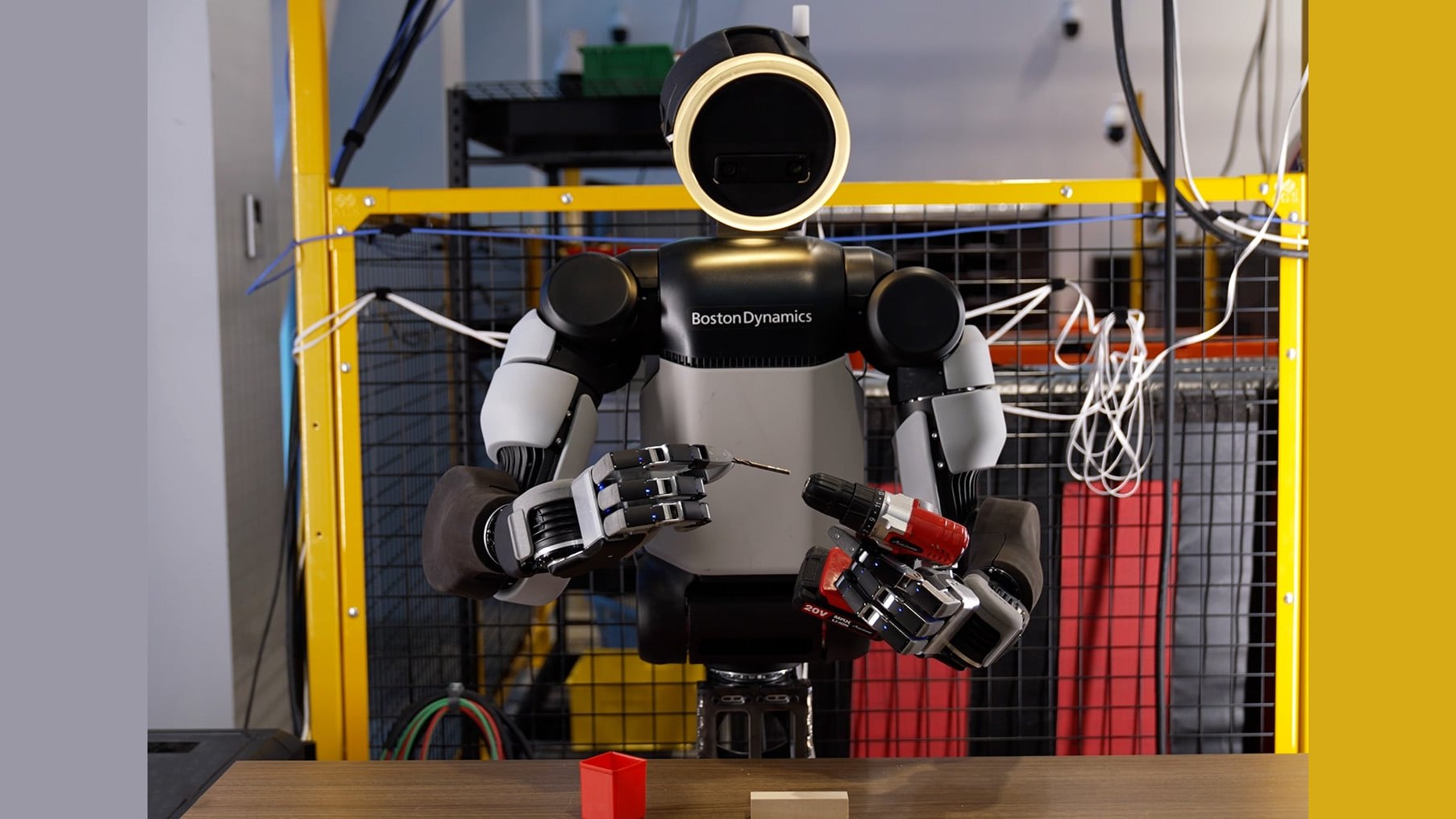
Why Does Atlas’s New Robot Hand Have Only Four Fingers? Boston Dynamics’ Industrial Trade-Offs...
From grasping objects to reorienting them in hand, Boston Dynamics co-designed mechanical structure, force feedback, and simulation training, moving Atlas closer to using tools and adapting to real-world industrial workstations.
In the race toward humanoid robotics, a common industry design choice is equipping robots with a five-fingered hand closely resembling the human hand. This intuition makes sense: humans possess both remarkable fine and gross motor skills, countless existing tools are tailored to human hands, and human demonstrations provide an abundance of starter data for robot learning.
Atlas is Boston Dynamics' humanoid robot. The dexterous hand developed for the new-generation Atlas adopts a four-fingered design, sized slightly larger than an average human hand and with slightly higher average strength. It features 13 degrees of freedom (DOF), with a focus on enabling the robot to reorient objects after grasping them and pull triggers while firmly gripping tools.
In an in-depth technical article and design retrospective, Boston Dynamics noted that developing a practical robotic hand goes far beyond pursuing theoretical capabilities; it is an engineering trade-off among dexterity, strength, robustness, cost, serviceability, and sensing. If the goal is entering industrial and logistics facilities to perform demanding physical labor, the hand must meet the demands of diverse tasks while remaining rugged, durable, and manufacturable at scale.
How Much Complexity Does Omitting One Finger Save?
During the early stages of hand design, intense internal debates arose within the team over whether to include a fifth finger.
From the perspective of modular hardware design, adding a pinky finger is not difficult and brings the morphology closer to a human hand. However, in the early exploration phase, the team faced architectural choices with no obvious answers—such as whether the hand should feature one thumb or two, and whether a pinky was truly necessary. The team evaluated these alternatives using simulations, 3D-printed prototypes, and hands-on trials to weigh functionality against complexity.
During hands-on trials, Boston Dynamics Chief Technology Officer (CTO) Zack suggested that team members tape their pinky fingers to their adjacent ring fingers for an entire day to observe what tasks they actually could not accomplish. This direct personal experience guided the team’s trade-off: an extra finger would require adding 3 degrees of freedom and 3 actuators, accompanied by additional volume, power consumption, cost, and risk of failure. The marginal dexterity and task capability provided by a pinky could not offset the engineering complexity and volumetric penalty of 3 extra degrees of freedom.

Embracing the philosophy that "the best part is no part," the team ultimately settled on a four-fingered architecture. Degrees of freedom (DOF) refer to the independent directions of motion the robotic hand can actively control. The new hand has a total of 13 degrees of freedom: the opposing thumb features 4 degrees of freedom, closely mirroring human morphology, while each of the remaining three fingers possesses 3 degrees of freedom (4 + 3 × 3 = 13). Their joint configuration permits lateral finger splaying and precise fingertip positioning.
The previous-generation GR2 featured 7 degrees of freedom and was primarily designed to grasp a diverse range of objects; this generation, the GR3, upgrades to 13 degrees of freedom, shifting the focus toward continuing to manipulate objects after grasping them.
This four-finger configuration is sufficient to cover the core dexterous manipulations prioritized by the team:
- Interdigital sliding and pinch opposition: The tip of the thumb can slide along both the length and width of the other three fingers, and achieve dexterous pinching against any individual finger;
- Tripodal grasp: The thumb coordinates with two other fingers to form a stable grasp, holding objects with substantial force while retaining the ability to adjust them;
- In-hand reorientation and slip recovery: Workpieces can be reoriented directly inside the grasp, and dynamically recovered if minor slipping occurs;
- Tool holding and triggering: Firmly gripping a tool handle while activating switches or triggers (such as drills, electric screwdrivers, angle grinders, nail guns, and welding torches).
The team chose to demonstrate "in-hand reorientation"—adjusting an object's pose while holding it—because these motions are representative of both using tools and assembling parts. Honing hand manipulation on these tasks now lays the groundwork for long-term tooling and assembly capabilities.
Capable of Fine Manipulation, Built for Heavy Loads and Impacts
In demanding industrial and logistics environments, the robotic hand must perform delicate operations while enduring heavy physical labor. Boston Dynamics engineered an actuation approach tailored for practical work:
1. Fully enclosed joint packaging with unified actuator types
The hand could not simply grow larger to increase strength: Atlas needs to use human-designed items and reach into spaces designed for human operation. Maintaining the proportions of a large human hand also minimizes discrepancies with human demonstration movements; the trade-off is that actuators must fit inside a strictly constrained volume.
All 13 degrees of freedom across the hand utilize the same actuator type, delivering direct actuation at the joints. Like the Atlas torso, all actuators are fully enclosed and sealed, with no fragile external cabling routing across joints. The unified actuator type and design with no exposed cables aim to support reliable, low-cost mass production and maintenance in the future.
2. Maintaining heavy-payload strength comparable to the previous generation
The new hand is slightly larger than an average human hand and has slightly greater average strength. Thanks to several unique actuation technologies, the new hand preserves payload strength comparable to the previous-generation gripper while expanding dexterity. As an example of whole-robot payload capability—rather than single-hand payload alone—Boston Dynamics demonstrated carrying a mini-fridge weighing over 100 pounds (>45 kg) filled with items, showing that the new hand can pair with Atlas's own 100+ pound torso payload capacity to meet strength demands for handling heavy tools and transporting bulky objects in rigorous tasks.
3. Backdrivability and impact protection
In industrial workflows, the hand frequently experiences violent impacts. Boston Dynamics made actuator backdrivability and force-control transparency core principles across the machine:
- Impact yielding: When fingers suffer severe external impacts, joints with high backdrivability can accelerate smoothly under external forces and yield to dissipate energy; compared to high-inertia or high-friction transmissions, this compliant yielding significantly reduces the risk of impact damage to gearboxes;
- Proprioception: Borrowed from biology, proprioception refers to a system's ability to sense the spatial position, motion state, and external load experienced by its own body or muscles. The high transparency of the drive mechanism allows external forces exerted by the environment on the fingers to be captured directly through actuator proprioception, while actions applied by the robot to the environment are transmitted directly as well;
- Complementary tactile sensing: Operating separately from and complementary to actuator proprioception, the engineering team covered the fingertips and palm surfaces with dense arrays of high-density pressure tactile sensors, dedicated to detecting subtle contact events and changes in pressure distribution.
Why Human Demonstrations Alone Are Not Enough: Combining Simulation and Reinforcement Learning
Directly imitating human manipulation is an important aid in training robotic manipulation. Currently, an effective way to scale data collection is using wearable devices such as gloves or Universal Manipulation Interfaces (UMI). Such devices are intuitive enough to allow human demonstrators to perform tasks naturally, and they are equipped with sensors to capture critical signals like contact events and rapid adjustments in pressure distribution. Furthermore, keeping the new robotic hand morphologically close to a human hand minimizes morphological and kinematic gaps with human demonstration data. Large-scale human demonstrations are particularly adept at helping the robot learn the complex visual context surrounding manipulation.
However, Boston Dynamics points out that direct imitation has limitations. Contact and pressure data recorded by wearable devices are valuable for pre-training physical interaction intuition, but they remain "proxy signals" that cannot be directly translated into high-speed action commands for the dexterous hand's actuators. Fast, agile dexterous manipulation relies heavily at its core on high-frequency closed-loop control and force regulation.
Boston Dynamics draws an analogy to the humanoid robot's whole-body control roadmap: a robot's dynamic whole-body behaviors are typically deployed atop a whole-body controller responsible for handling high-dynamic responses—such as maintaining balance, stepping to recover from tripping, and compensating for gravity, self-collisions, or external pushes. In Boston Dynamics' technical roadmap, these whole-body controllers are trained via reinforcement learning (RL) in simulation environments. The team argues that for dexterous hand manipulation, reinforcement learning in simulation is equally an indispensable, core methodology.
| Learning Material | What It Helps the Robot Learn | What Still Needs to Be Solved |
|---|---|---|
| Human manipulation demonstrations | Visual context of manipulation, along with cues for contact and pressure changes | Recorded human signals differ from robot actuator actions |
| Simulation reinforcement learning | Fast closed-loop control under varying physical conditions | Dynamics in simulation must transfer to the real robot |
To make reinforcement learning effective and support synthetic data generation, Boston Dynamics treated high-fidelity simulation as a primary objective from hardware through control, emphasizing bidirectional matching between simulation and hardware:
- Kinematic modeling: Accurately defining the geometric architecture of the robotic hand, including link positions and joint distributions;
- Dynamic modeling: Meticulously simulating friction, joint torques, and transmission backlash. Because internal magnetic poles create uneven resistance when a motor rotates (known as cogging), the team compensates for friction and cogging through control algorithms, making the system's dynamics much easier to simulate with high fidelity;
- Contact dynamics: Modeling contact interactions between the robotic hand and its environment.
Building on this foundation, the team introduced domain randomization into simulation, perturbing motor torque curves, surface friction coefficients, object geometries, and external force disturbances during training so that the policy does not merely adapt to a single ideal condition.
Real-world progress published by Boston Dynamics shows that by training in simulation with domain randomization, the team achieved promising initial sim-to-real transfer on dynamic tasks. On the real robot, these initial dynamic tasks rely solely on high-frequency actuator proprioception for feedback. The team is continuing to scale up this training paradigm.
Tools Enable a Reliable Hand to Accomplish More
Hand design always demands trade-offs; a truly all-purpose, universal hand is unrealistic. Any design will be better suited for certain tasks and less suited for others: soft fingers are sometimes needed to avoid scratching delicate surfaces, while rigid, plier-like fingers are required to apply greater force; tweezer-like fingertips are needed for delicate pinching, while wide, clamp-like contact surfaces are necessary for secure gripping.
The human hand obeys the exact same rule. The ancient Greek philosopher Aristotle once called the human hand the "tool of tools"—it is not itself a dedicated, specialized tool, but rather unlocks infinite possibilities by operating all manner of tools. Tools function as capability multipliers.
In today's industry, tasks such as picking and placing rigid parts have been effectively automated via dedicated solutions, yet this often relies heavily on strictly controlled part presentation, as well as customized fixtures and dedicated workstations tailored to specific components. The true value of humanoid robots lies in generalization and flexibility: if deploying a humanoid robot still demands custom tooling fixtures, specialized end-effectors, and dedicated work cells, its inherent generalization value is undermined.
Looking across workflows that existing automation has yet to conquer, the need for dexterous manipulation is far more pronounced. These manual tasks heavily involve complex scenarios: sorting and picking jumbled parts from racks, crates, bins, slots, cubbies, or cluttered piles; assembling components; handling deformable flexible cables; and most importantly—using tools.
Thus, the ultimate general-purpose manipulator for a humanoid robot is not an overly complex hand architecture, but a hand that is intrinsically robust and capable of skillfully using tools. Reliably grasping and triggering diverse tools is precisely what the Boston Dynamics team values most in their hardware and algorithmic trade-offs—and remains their core direction for advancing general-purpose physical labor.
Members can copy or download the full Markdown, and let their AI subscribe and ask.
Found this useful? Leave your email — every new explainer, the moment it's out. Unsubscribe anytime.