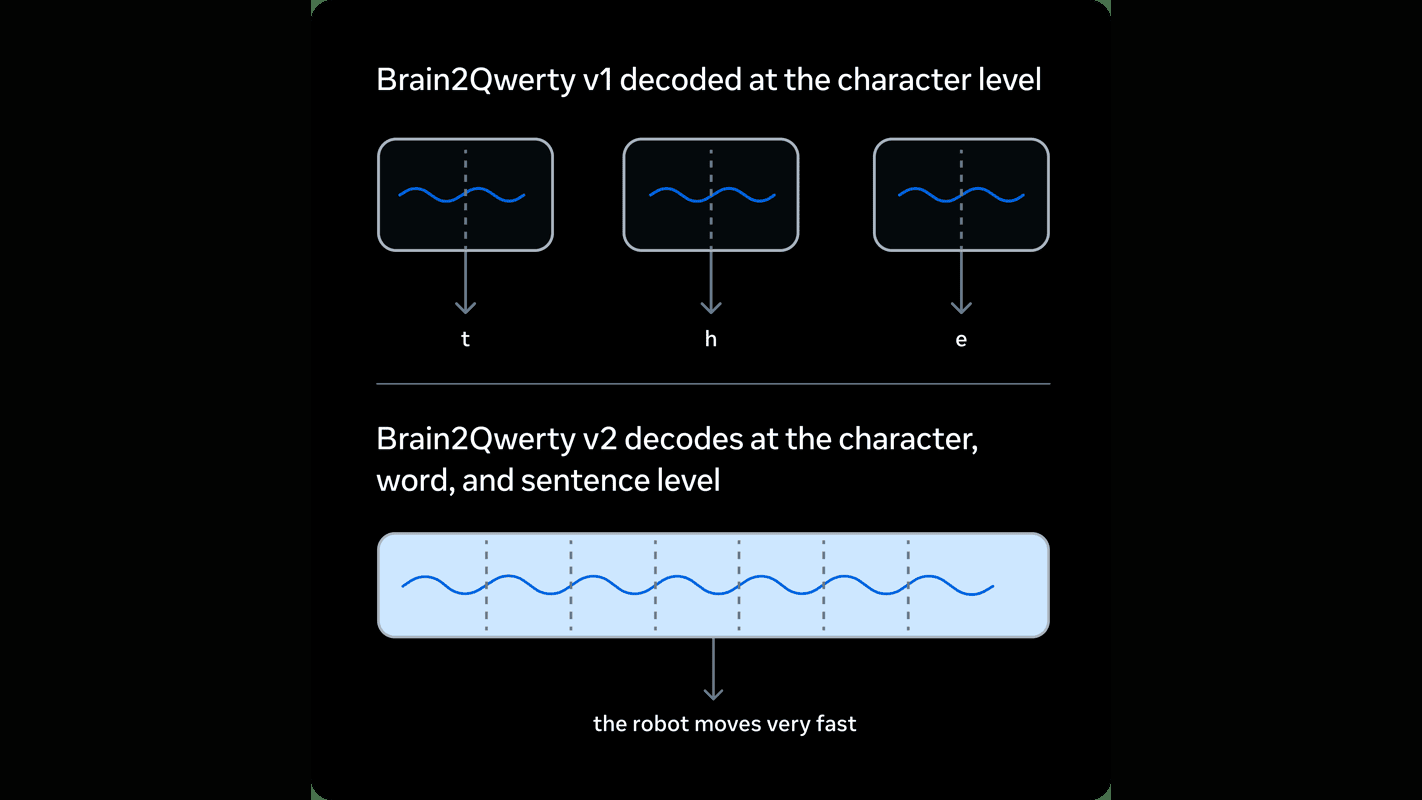
No surgery needed to read brain signals — Meta's non-invasive system hits nearly 8x the accuracy of prior methods
- Meta released Brain2Qwerty v2 — wear an MEG (magnetoencephalography) headset and it decodes the brain's magnetic signals into coherent sentences in real time, with zero surgery required.
- Word accuracy hits 61%, about 7.6x other non-invasive brain-computer interface methods (8%); the best participant reached 78%, with over half of sentences off by just one word.
- The core is a two-layer stack: an end-to-end deep learning model decodes directly from raw brain signals, then a large language model fine-tuned on neural data does semantic correction on top.
- 9 participants each recorded about 10 hours of typing tasks, totaling roughly 22,000 sentences of training data; accuracy scales log-linearly with data volume.
- The v1/v2 training code is fully open-sourced, and partner institution BCBL simultaneously released the v1 dataset — aimed at the millions of patients worldwide who've lost the ability to communicate due to brain injury.
Put on a helmet, and brain waves turn into text
In June 2026, Meta AI released Brain2Qwerty v2, currently the highest-performing non-invasive brain-computer interface system, capable of decoding MEG (magnetoencephalography) signals into coherent sentences in real time — and it simultaneously open-sourced the complete v1 and v2 training code.
Put on a helmet — no surgery, no skin contact — and the system takes the faint magnetic signals your brain produces while typing and reconstructs them into text in real time, hitting 61% word accuracy for full sentences.
Prior non-invasive methods — the kind that need no surgery — topped out at just 8% word accuracy, barely usable at all. v2's 61% is roughly 7.6x that. This is the first time a non-invasive brain-computer interface has closed in on real-time full-sentence decoding once thought achievable only with technology that requires implanting electrodes in the brain.

Old methods either didn't work, or required opening the skull
To see why this number matters, look first at where brain-computer interfaces have long been stuck. Turning brain signals into text has historically had only two paths, each blocked by a different wall: one accurate but requiring surgery, one safe but not accurate.
| Dimension | Invasive (SEEG / ECoG) | Old non-invasive methods |
|---|---|---|
| Word accuracy | High — already able to restore communication | Only 8%, essentially unusable |
| Surgery required? | Yes — electrodes implanted in or placed on the cortex | Just wear a helmet, fully non-invasive |
| Signal quality | Clean, high signal-to-noise ratio | Noisy, heavy loss of detail |
| Scalability | Surgical risk, hard to scale up | Safe and easy to use, but accuracy can't support real applications |
Invasive methods — stereo-EEG (SEEG) and electrocorticography (ECoG) — have already proven that feeding neural signals to an AI decoder can help people who've lost speech communicate again. The problem is it requires surgery, which can't scale to tens of millions of people. Safety and usability have historically been a trade-off — and closing that gap is exactly what v2 set out to do.
Invasive is like putting a microphone directly into a singer's throat — it records clearly, but it takes surgery. Non-invasive is like recording from outside the concert venue — safe, sure, but through the skull and scalp the noise is heavy and details get lost. The hard part is: how do you make out every word sung inside, from a noisy recording taken outside?
Two-layer innovation: self-learning plus an LLM to fill in the meaning
v2 pulled accuracy from 8% to 61% through two stacked changes. One layer lets the model learn the patterns itself directly from raw signal; the other uses a language model to stitch guessed fragments into full sentences.
The old approach was a multi-step, hand-built pipeline: hand-coded rules first detected "this magnetic fluctuation equals pressing a certain key," then feature engineering, then a classifier — every step was a guess at the signal's meaning, and errors piled up layer by layer. v2 threw all of that out. Raw brain magnetic signals go directly into a deep learning model, which learns the mapping from signal to text on its own from 22,000 sentences across 9 people, with no manual intervention in between.
What gets squeezed out of the noise is often a string of ragged, fragmented text. v2 stacks on a large language model fine-tuned on neural data, which pulls in context and uses semantics to fill in and correct the fragments — bridging the gap between noisy brain signal and a fluent sentence.
On the subway, someone says something and you only catch half of it — but from context and experience, you can guess the whole sentence. That's exactly what this LLM layer does: the raw decoding hands over half a garbled sentence, and it uses semantics to restore the complete one.
Old pipeline vs. new model — click to see the structural difference
About seven manual stages chained end to end — every seam is a guess at meaning, and errors compound at each step.
Raw signal goes straight into one model, then a language model fills in the meaning — no manual pipeline in between.


The old method was like teaching a student to solve equations: explain the formula, walk through the steps, drill by problem type — feeding it piece by piece. End-to-end is like handing over 100,000 problems along with their answers and letting it figure out the pattern on its own, without telling it how to solve anything.
A detail on AI-assisted tuning
Meta also used AI agents to explore directions for optimizing the decoding pipeline, but the final training configuration was manually selected by engineers — not fully automated.
Where the signal comes from: 10 hours of typing in a helmet
No matter how smart the model, it needs data to learn from. v2's data comes from a straightforward paradigm: have people actually type, while an MEG records the changes in the brain's magnetic field with every keystroke.
One key point worth noting: participants were actually typing, not "imagining speech." The neural signal from the act of typing is more stable and reliable, and keystroke timing can be precisely aligned with the resulting text — producing higher-quality paired training samples.
MEG is a helmet-style sensor array that uses ultra-sensitive magnetometers to capture the extremely faint magnetic field changes produced when neurons fire — with higher precision than an ordinary EEG cap. Think of it as fitting the brain with an array of magnetic-field microphones: what it records isn't sound, but the "electromagnetic hum" of firing neurons.
61%, 78%, off-by-one-word — how solid are these figures
Lining up three numbers side by side makes clear both the scale of this jump and what 61% actually feels like in practice.
61% means that in a 10-word sentence, on average 6 come out right. At the best participant's 78%, the experience is genuinely usable: over half the sentences are either off by exactly one word or entirely correct — out of a 10-word sentence, only 1 wrong.
The proportion of correctly predicted words out of all words in the decoded sentence. 61% means about 6 out of 10 words right on average; 78% means nearly 8 out of 10.
Meta also found a pattern: decoding accuracy scales log-linearly with data volume — every time the data doubles, accuracy climbs a steady notch. That means simply scaling up data systematically could keep narrowing the remaining gap with invasive surgical solutions.
Who can use this, and how far from practical use
This research points most directly at people who "want to speak but can't," and at the thresholds it hasn't cleared yet.
- Direct beneficiaries: patients who've lost the ability to speak due to brain injury — stroke, ALS (amyotrophic lateral sclerosis), and similar conditions — but whose motor cortex remains intact. That's millions of people worldwide. Non-invasive means they could potentially use this without taking on the risk of open-skull surgery.
- Current limitation: the system currently needs to be custom-trained per person — about 10 hours of individual data must be recorded first. It's not yet a plug-and-play, general-purpose system.
- Path forward: open-sourcing the training code, the BCBL dataset, and the $5 million fund Meta set up through the Digital Brain Project — all aimed at pushing the system toward generalizability using larger-scale open data.
What was open-sourced, and where to find it
To let more teams pick this up directly, Meta released both the training code and the dataset this time.
- Training code: the complete training code for both Brain2Qwerty v1 and v2 has been open-sourced.
- Dataset: partner institution BCBL (Basque Center on Cognition, Brain and Language) released the v1 dataset, hosted on HuggingFace (repo bcbl190626/SpanishBCBL).
Background: Meta's open brain-science foundation model suite
This work is part of Meta's broader effort to build open brain foundation models, alongside: Tribev2, for perceptual encoding; NeuralSet, for processing brain data at scale; and NeuralBench, for systematically evaluating models. Meta says it hopes open collaboration can identify, diagnose, and treat neurological disease faster than working behind closed doors.
Brain2Qwerty v2 is currently the highest-performing end-to-end system capable of decoding full sentences in real time from non-invasive brain recordings, approaching accuracy levels once achievable only with technology that requires brain surgery. Meta AI Blog · From Brain Waves to Words (June 2026)
Reading brain waves without surgery: non-invasive brain-computer interfaces go from "barely readable" to "reads full sentences in real time"
Meta released Brain2Qwerty v2 — wear a helmet, and it reconstructs the brain's magnetic signals from typing into coherent sentences in real time. Word accuracy: 8%→61%. One page, with a diagram, covers it all.
↓ Read the whole thing in one page · one diagram animates
Brain-computer interfaces (technology that turns brain activity directly into text or actions, no hands or speech needed) have long been a hope for people who've lost speech to communicate again. But turning brain signals into text has historically had only two paths, each blocked by a different wall: either open-skull surgery, or accuracy too poor to use.
✘ But what it reads out was only 8% correct — barely usable
Picking up signal through skull and scalp, the brain signal is weak and noisy, losing a lot of detail; to read it accurately, the only option used to be open-skull surgery to implant electrodes (invasive) — surgical risk, can't scale to millions of people.
Meta's newly released Brain2Qwerty v2 pulled this off: still a helmet, still no surgery, but the non-invasive method's word accuracy (the share of words correctly read out) went from 8% to 61%, with the best participant hitting 78% — the first time a non-surgical approach has closed in on what open-skull methods can do. It's aimed at the millions worldwide who've lost the ability to speak due to stroke, ALS (a disease that gradually takes away muscle control), and similar brain injuries.
So here's the question: same helmet, same noisy signal — how did accuracy jump several times over? The answer is in the method.
The jump from 8% to 61% didn't come from fancier hardware — it came from two stacked changes in method: first, "end-to-end" — instead of humans guessing the signal's meaning step by step, raw brain magnetic signal is fed straight into an AI that learns the mapping to text on its own; second, a language model (the kind that writes sentences, like ChatGPT) uses context to stitch the ragged fragments read out into a fluent, complete sentence.
61% accuracy sounds abstract — converted into "in a 10-word sentence, how many words are actually wrong," it becomes tangible; shorter bars are better here.
only two roads so far —
opening the skull
just doesn't read right...
Basically unusable.
7.6x the old method.
did the brain level up?
step by step — it learns the pattern itself.
"I ... water ... some"
on the subway and still guessing the rest.
typing for 10 hours.
off by just one word.
but mind still sharp —
millions worldwide.
reads out as full sentences, closing in on surgical solutions.
- × Numbers are Meta's own test, just 9 people
- × Each person needs ~10hrs of custom recording first
- × Not yet plug-and-play
Members can copy or download the full Markdown, and let their AI subscribe and ask.
Found this useful? Leave your email — every new explainer, the moment it's out. Unsubscribe anytime.