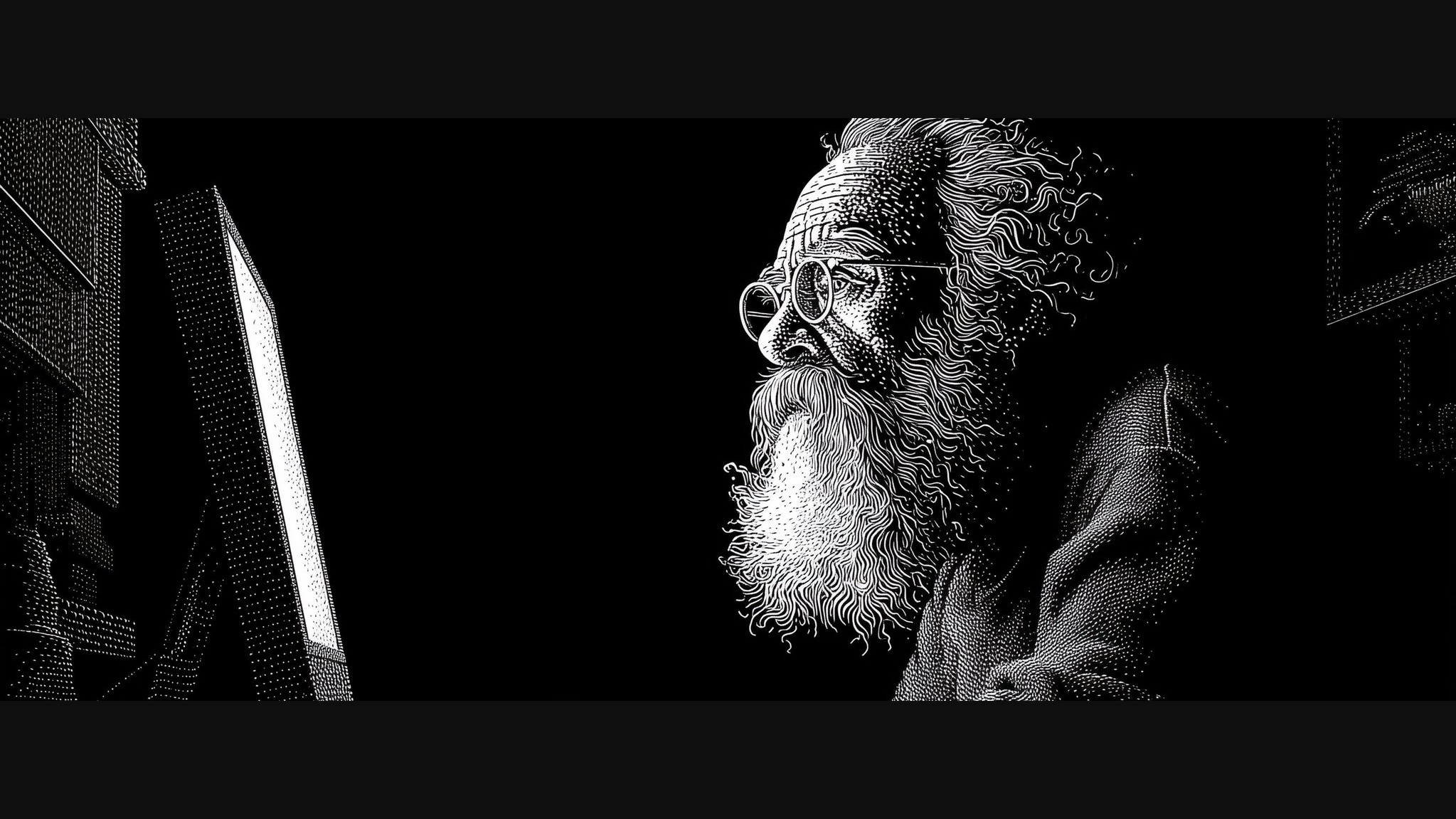
Who Won't Be Replaced by AI?
The industrial age rewarded people who mastered a single standardized step, but AI is making routine execution cheap. Dan Koe argues that the next phase favors those who can combine multiple skills around a core business, use AI to manage the full workflow, and still keep their taste, judgment, and personal agency.
- AI is reducing the scarcity of standardized execution, so people who combine multiple skills around a core business and personally own direction and quality will gain more room to act.
- The irreplaceable skill stack has three layers: human and business fundamentals, a unique intersection of personal interests, and specific technical tools. Taste is built through apprentice-style imitation and real projects.
- When using AI, explore the unknown first, define success criteria, iterate continuously, then turn high-frequency tasks into repeatable processes. Boosting efficiency on a specific task does not mean one person can broadly replace 10 to 50 people.
Dan Koe writes extensively about personal growth, creator businesses, and one-person companies. On August 27, he published a long essay on the “digital renaissance person,” exploring who gets weakened by AI tools and who uses them to amplify their own capabilities.
His core argument is clear: we are entering a second digital renaissance. The industrial age broke complex production into roles, making one person a permanent “cog” in a machine. AI, in turn, has driven down the cost of writing basic code, organizing information, building pages, and handling routine processes. Deep expertise still matters. What gets squeezed is the specialist model that ties a career to a single standardized step in a chain.
A digital renaissance person combines multiple abilities around one core pursuit. They can understand users, write, design, build products, code, and handle distribution all at once. They use AI to manage what used to require a team, while personally setting direction, establishing quality standards, and owning the outcomes. Breadth serves a long-term vehicle. AI magnifies execution, while taste and judgment steer.
This framework connects career, learning, business, and life into one thread: secure your agency first, then build cross-disciplinary skills, then cultivate taste through real projects, turn AI into an iterative work system, and finally draw clear boundaries between work and life.
Three kinds of people in the future world, and your choice
Koe divides people into three categories. They work better as behavioral patterns than as fixed demographic groups. The same person might shift between them depending on the task.
The first group is the purists. They reject AI, choosing a life of nature, simplicity, and no screens. An offline life is not inherently a problem. But when rejecting technology becomes an identity, whether a task actually calls for tools stops mattering. Keeping the ideology clean replaces real-world judgment. When physical, work, or financial problems require external solutions, this identity blocks those options as well.
The second group is the robotized. They chase frictionless efficiency, handing search, writing, scheduling, and even goal selection to models. Productivity may rise, but judgment atrophies from lack of use. Without AI, they cannot start. They lose the ability to recognize what good looks like or to tell their own choices apart from the model’s default output.
The third group is the digital renaissance person. They use AI to expand what they can do, while holding on to goals, trade-offs, taste, and responsibility. During work, they bring in technology. Away from work, they return to exercise, reading, nature, and real relationships. They do not measure progress by how much AI they use. Instead, each task determines where tools enter and where they step back.
Use the four views below to focus on each mode in turn, while keeping the other two visible for comparison.
The line isn't about using AI; it's about who holds the decision
Click through four views to see how each mode uses AI, who does the judging, and what's gained or lost.
Showing full comparison: all three modes weighted equally.
Rejecting tools
Purist
Turning distance from technology into an identity, so practical tasks bend to faction loyalty.
- Relationship with AI
- Total rejection
- Who does the judging
- Faction identity
- Daily reality
- Offline, but prone to technophobia
- Lost / preserved
- Real-world tools and external progress
- Self-check signal
- Not using AI matters more than task outcomes
Outsourced agency
Automaton
Pursuing frictionless convenience and endless optimization by handing thinking and deciding to the model.
- Relationship with AI
- Outsource whenever possible
- Who does the judging
- Model defaults
- Daily reality
- Always online, always optimizing
- Lost / preserved
- Judgment muscle and life boundaries
- Self-check signal
- Can't start or sign off without the model
Wielding the tool
Renaissance
Using AI per task, while setting goals, standards, and accepting consequences yourself.
- Relationship with AI
- Task-based use
- Who does the judging
- Human sets goals and standards
- Daily reality
- Leverage at work, go offline to rest
- Lost / preserved
- Taste, responsibility, and a full life
- Self-check signal
- Can explain where AI should enter and exit
The line between the three modes is agency. Purists let group identity make decisions for them. The robotized let model defaults make decisions for them. Digital renaissance people set their own goals and standards first, then choose tools accordingly.
This dividing line also connects four dimensions that pull on each other: mind, body, spirit, and money. Developing only the inner world can let practical capability collapse. Chasing only money, efficiency, and progress lets life get consumed by endless optimization. Multidimensional growth does not require equal effort on all four fronts. It requires seeing what one dimension's gains are doing to the others.
Why generalists will rule the AI era
Koe uses industrialization to explain how the specialist model took shape. Complex production got broken into fixed roles, and education and employment systems trained people to become skilled executors of one step. As a result, it is easy to know how to do your assigned part, but hard to see how a piece of work moves from problem to solution to production to distribution to value exchange.
The Renaissance workshop offers a different kind of capability structure. Leonardo da Vinci entered Verrocchio’s studio to learn painting, and in that context encountered anatomy, engineering, optics, and bronze casting. These bodies of knowledge connected around real works. They were not separated into unrelated certificates. The craftsman was both thinker and maker, understanding complete operations rather than isolated actions.
This historical narrative is a little too tidy. Pre-industrial societies also had specialization, poverty, and status restrictions. Modern professional education has produced a great deal of reliable knowledge. But the contemporary point still stands: AI lowers the barrier to trying steps you have never done before, letting one person move faster into unfamiliar parts of a process.
Koe summarizes the second Renaissance in three shifts: proven work replaces resumes, audiences replace employers, and taste replaces credentials. Increasingly, a person’s ability is seen through the work itself. The internet lets that work reach audiences directly, and AI helps one person cover research, design, code, pages, and operations.
As mechanical execution gets cheaper, human responsibility moves upward.
AI devalues mechanical execution first, pushing human responsibility upward
- Tool operationSoftware commands, format conversion, standard procedures
- Cross-domain assemblyCombining research, design, code, and distribution into a result
- Quality judgmentKnowing what good looks like, catching errors, and iterating
- Direction and accountabilityChoosing problems, making trade-offs, owning outcomes
Operating the tool stops being the end of professional value and becomes the baseline. You still need to understand tools and domain knowledge, or you cannot even spot errors. What becomes more scarce is the ability to assemble across domains, judge quality, choose direction, and take responsibility for outcomes. An AI can generate a page, but a person still has to decide who the page serves, whether the information is trustworthy, whether the experience works, and who answers when it fails.
Existing studies support gains on specific tasks. A Harvard Business School and BCG experiment with 758 consultants found that, within AI’s capability envelope, speed increased more than 25%, task completion rose more than 12%, and manually evaluated performance improved more than 40%. Tasks outside that boundary saw no equivalent gains. HBS research
Another study covering 5,172 customer service agents found that AI assistance raised average productivity by 15%. The biggest gains went to less experienced and less skilled workers. The most skilled agents saw only marginal speed improvements and a slight dip in quality. Generative AI at Work
The generalist advantage comes from closing the loop across multiple stages quickly within one person’s control. Research, production, publishing, and feedback lose their handoffs. This makes it easier for a discovery in one phase to immediately change the next. More skills are not automatically better. Breadth only compounds when each capability reinforces the others around the same project or business.
This structure culminates in the one-person business. Here, being a creator does not mean being an influencer. It means being someone who can find problems, build solutions, help people, and complete value exchange. Publishing work consistently shows an audience what you stand for. That understanding becomes trust. Trust lowers the friction of selling products, services, and partnerships. That is why “audience replaces employer” is more than just having a distribution account.
A solo business gains end-to-end control, not infinite independence
- Domain knowledge
- Content
- Audience
- Product / service
- Revenue
- Feedback
The one-person business gains more control over the full value chain. Domain knowledge decides which problem to solve. Content reaches the audience. Feedback corrects the understanding of need. A product or service codifies the solution. Revenue funds the next round of investment. Models, social platforms, payments, cloud services, and specialist partners remain part of the external infrastructure.
Koe argues that one person can now do the work of a 10-to-50-person team, and he points to James Clear’s newsletter, books, and content as an example of how a personal brand distributes a long-term body of work. That multiplier only applies to certain low-coordination, heavily digital tasks. Existing evidence does not support one person broadly replacing dozens of people. The essay also ends by pulling this logic toward the author’s own Creator Bootcamp—it is both what he believes in and the demand his product answers.
Building an irreplaceable skill stack in three layers
Being a generalist is not about chasing every interest at once. Koe insists that writing, design, marketing, programming, fitness, and philosophy all flow into a single core vehicle: a product, a course, a consulting service, a research program, or one long-term content theme.
A core skill set must satisfy three requirements at once. You have to care about it for the long haul. You have to be able to combine skills in a way that differs from others. And other people have to be willing to pay for the result with money, time, or attention. Without long-term commitment, nothing compounds. Without a distinctive combination, you fall into homogeneous competition. Without value exchange, an interest cannot become a sustainable business.
One core craft, supported by three layers of capability
Writing, expression, marketing, sales, psychology, attention
Personal long-term accumulation: philosophy, fitness, design, education, programming, etc.
Software, platforms, syntax, and specific operations
The first layer is understanding human nature and how business works. Writing, expression, marketing, sales, psychology, and attention mechanics determine whether you can see a need, explain a value, and get someone to act. These abilities are not tied to any specific piece of software, and they transfer most easily.
The second layer is the intersection of personal interest and direct experience. Philosophy, fitness, design, education, programming, or nutrition—each is common by itself. The combination creates a distinct way of seeing problems. A philosopher who trains adds a layer of real-world testing that a purely book-bound thinker lacks. A designer who codes handles both function and experience at the same time.
The third layer is specific tools and technologies. Email software, Photoshop, no-code tools, social media management, and code syntax all belong here. They still need to be learned well enough to make requests, spot errors, and edit results. But a professional identity cannot rest entirely on a single tool interface. As mechanical parts get automated, the human role moves up from operator to editor, director, and system owner.
A skill stack also needs a method for developing taste. Project-based learning exposes problems. Apprenticeship builds a sense of quality. Start by selecting a master practitioner worth emulating. Study their structure, trade-offs, and standards. Then reproduce those patterns in real projects. Where the imitation fails, knowledge gaps become visible. External results then force you to revise what you think you know. Through repeated comparison and production, judgment moves from “does this look like the expert’s?” to “why is this version better?”
Apprenticeship-style project learning: imitation builds taste, projects test knowledge
- 01Pick an expert sample
Study structure, trade-offs, and quality standards
- 02Imitate and try immediately
Use real deliverables to expose gaps
- 03Pinpoint specific obstacles
Identify knowledge, execution, or judgment gaps
- 04Targeted learning and redo
Bring books, mentors, videos, or AI back to the project
- 05External validation
Test with running, explaining, using, or paying
Learning therefore starts from real delivery. Make a page, write an article, build a product, or automate a process first. Let the first attempt reveal what you actually do not know. Then learn only what is needed to clear that specific obstacle. Put the new knowledge back into the project, and validate it through running results, reader understanding, user behavior, or payment. Books, mentors, YouTube, and AI can all offer suggestions. Those suggestions still need to be tested and reviewed.
Practical AI usage principles
The value of AI goes beyond search and one-off generation. It can help decompose an unfamiliar domain, plan a page or a piece of software, build a first draft, execute repetitive steps, and keep iterating after feedback. Effective use depends on four consecutive actions.
First, use AI to discover what you do not know yet. When entering a new field, you often cannot even ask the right questions. Start by asking the model to list typical workflows, required capabilities, success examples, failure modes, and validation methods. Then cross-check against real work and reliable sources. AI is a discovery tool here, not the final judge.
Second, define the goal and what a good result looks like. Spell out whom you are solving for, what the final deliverable is, the minimum quality bar, which facts must be verified, and what counts as failure. Koe compares AI to a bag of water that has to be shaped. When direction is vague, the model falls back on common patterns, and the output stays at the average.
Third, refuse to treat the first draft as the final result. Pages, software, copy, and automations usually start rough. Skilled people keep revising design, functionality, structure, facts, and language. Each round targets one clear class of problem, and the before-and-after difference stays visible. AI shortens execution time, but market understanding, taste, and trust still take time to build.
Fourth, try automating your own routine tasks. Pick a high-frequency job, write out the inputs, steps, outputs, and check conditions, then ask AI whether it should become a prompt, skill, tool, or software. Run it, log the errors, revise the process, and run again. An automated system is also a first draft. A single failed run only means the current process is not good enough yet. It does not prove that the entire task cannot be automated.
Three real-world tests
First, have AI map the domain and unknown questions, then define users, deliverables, quality standards, and failure conditions.
Pass: you know what to ask and can accept according to standards.Treat the first draft as recon results; fix one clear category of issue per round.
Pass: each round shows observable before/after differences.Gradually codify high-frequency tasks into prompts, skills, tools, or software, then run them for real to map the human-machine boundary.
Pass: inputs, outputs, owners, and checks are repeatable.| Task characteristics | Recommended division | Minimum check |
|---|---|---|
| Repetitive, low cost of error | Automate first | Spot-check |
| Repetitive, high cost of error | AI executes + deterministic verification | Tests, rules, or peer review |
| Judgment-heavy, reversible outcomes | AI proposes, human decides | Keep trade-off rationale |
| Identity, relationships, or high-stakes responsibility | Human-led, AI-assisted | Clear owner |
Tasks eventually fall into different human-machine splits. Repetitive, low-cost-of-error work can be automated first. Repetitive work with high cost of error needs deterministic checks. Judgment-heavy work with reversible outcomes suits AI-generated alternatives. Work involving identity expression, important relationships, or high-stakes responsibility stays with the human.
Koe himself has AI scan large volumes of information and trends, but he keeps writing personal. On one level, he enjoys the process. On another, an article’s value lives in word choice, rhythm, and how it feels to read—things that require fine control. The automation boundary is set jointly by what the task demands and what parts of life the person wants to keep.
A high-output daily rhythm: learning from Darwin’s contrast-driven life
The digital renaissance person lives between two intensities. During work, they use the most advanced tools and concentrate on hard problems. Away from work, they stop optimizing and inputting, returning to exercise, nature, reading, relationships, and rest. A constant half-work, half-scrolling, half-anxious state weakens both modes.
Koe places meaning in that contrast. Difficulty gives accomplishment its weight. Engagement makes rest feel complete again. High output comes from alternating deep focus with full recovery, not from keeping every minute busy.
This rhythm also lets work bend to the task and your energy. A fixed eight-hour day is only one way industrial organizations structured work. For people centered on projects and problems, a more practical schedule gives the most demanding judgment the freshest hours, stops when the task is done, and treats recovery as the precondition for the next round. If every hour saved by AI gets refilled with more notifications and more generation, the leverage only raises throughput. It does not improve life.
Koe uses Darwin to illustrate the pattern: first work session from 8:00 to 9:30, then correspondence and family matters, work again from 10:30 until noon, then a walk, reading, and rest. The official Darwin Correspondence Project broadly confirms two morning work blocks and frequent walks, and it also records afternoon work on daily affairs around 4:30 to 5:30. Darwin’s daily schedule
This example supports giving your best hours to core work and using walks and rest to aid thinking. It does not prove that working only three hours a day reproduces Darwin’s output. Correspondence, reading, observation, and afternoon work were all part of his labor.
What to adopt now, and what is still prediction
You can adopt these practices directly: point multiple abilities at one core pursuit; develop taste through real projects and studied exemplars; define quality before letting AI execute; turn routine tasks into repeatable processes; and deliberately separate deep work from complete rest.
What still needs further validation is the author’s extrapolation about scale and history.
| Author's strong claim | Independent verification | Reasonable conclusion |
|---|---|---|
| One person can do the work of 10–50 people | Customer support research shows average 15% gains; consulting experiments show >25% speedup within capability limits | Significant gains on specific tasks; cannot generalize to broad 10–50x replacement |
| Darwin worked about three hours a day | Two deep-work sessions in the morning are real; official records also show 4:30–5:30 PM work | Adopt the rhythm, not the magical hours |
| Global population near 7 billion | UN records hit 8 billion in 2022 | Old citation can keep the vision; the number is outdated |
| Industrialization turned humans into single-function operators | Industrialization did restructure production and work; pre-industrial societies also had division and limits | Treat as interpretive metaphor, not full historical causality |
| Portfolios, audiences, and taste will replace resumes, employers, and certificates | Increasingly true in some digital creative fields; heavily regulated professions still rely on credentials and institutional accountability | Adopt in limited industries; don't extrapolate broadly |
The claim that one person can replace 10 to 50 others only holds for certain digital tasks. In writing, design, software, and marketing, it's increasingly common to hear that portfolios outweigh resumes and taste beats credentials. But medicine, law, aviation, and structural engineering still depend on licensing, peer review, and institutional accountability.
The idea that modern work is only about 250 years old is also too neat a historical generalization. The Industrial Revolution certainly pushed agrarian and artisanal economies toward machine manufacturing and factory systems, reshaping vast amounts of labor. Yet it didn't create the first professional jobs in human history, nor can it single-handedly explain every shift in education, freedom, or taste. Britannica's overview of the Industrial Revolution
The original piece quotes Naval Ravikant's vision of "nearly 7 billion people, and in the future nearly 7 billion companies." That population figure is already outdated. UN records show that in 2022, in November, the world population reached 8 billion. UN population data This doesn't undermine the broader vision of more people gaining independent productive capacity, but it does suggest that vision remains a directional goal rather than a current, universal reality.
The people who are hardest to replace in the AI era aren't those who prove their purity by rejecting tools, nor those who chase efficiency by outsourcing all thinking. They choose problems worth solving, marshal different skills to get results, hand off mechanical execution to systems, and then personally judge, verify, and take responsibility for the outcome.
Members can copy or download the full Markdown, and let their AI subscribe and ask.
Found this useful? Leave your email — every new explainer, the moment it's out. Unsubscribe anytime.