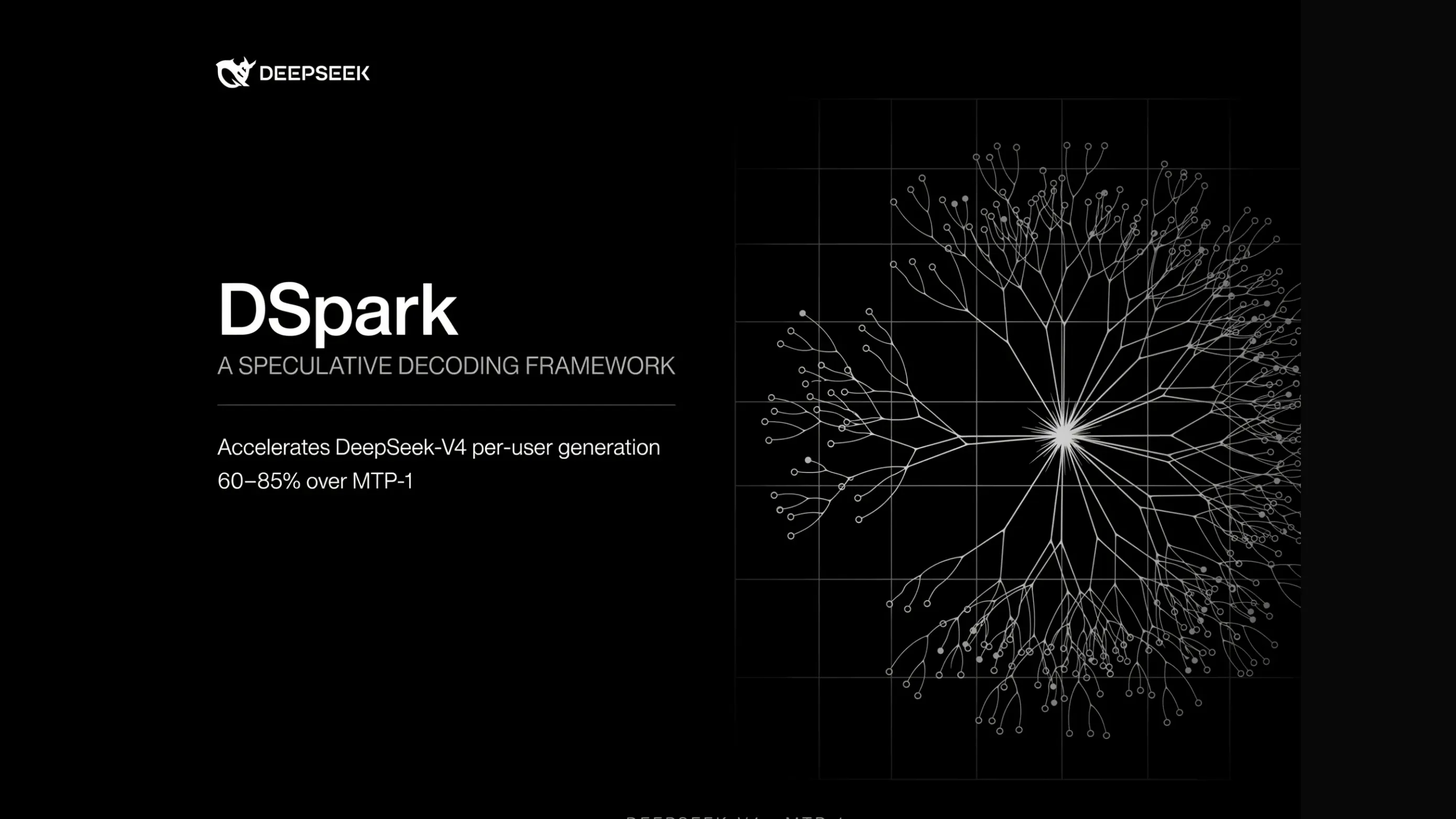
Doing More Actually Makes It Faster: DSpark Boosts DeepSeek V4's Per-User Generation Speed by 85%
- DeepSeek releases DSpark, a speculative decoding acceleration framework built specifically for DeepSeek-V4
- Compared to the MTP-1 baseline already running in production, per-user generation speed is up 60–85% (DeepSeek self-reported data)
- Core mechanism: a lightweight draft module guesses several words ahead, the main model verifies them in a batch, and correct guesses are all accepted at once
- Key improvement: the draft-generation and main-model-verification steps are pipelined and run in parallel, eliminating serial waiting
- A pure inference-side system optimization — model weights are unchanged, so it drops straight into existing DeepSeek-V4 deployments
What DeepSeek Released, and How Much Faster
DeepSeek recently released DSpark, a speculative decoding acceleration framework for DeepSeek-V4, delivering another 60–85% boost to per-user generation speed on top of the existing MTP-1 baseline.
The real point here is what baseline it's being compared against. It's not measured against "no acceleration at all" — it's measured against MTP-1, the speculative decoding scheme already running in DeepSeek-V4 production. In other words, it's squeezing another 60–85% out of a scheme that's already been sped up once. This is a second round of system-level acceleration, which DeepSeek says is already in use in V4's production service.
Why Large Models Spit Out One Word at a Time
When a large model generates text, it produces one word after another. To spit out each word, it has to run the entire model start to finish (one forward pass); only once it has that word can it compute the next one.
Words have a strict order dependency: each one depends on the one before it, so there's no skipping ahead. No amount of compute can save this one sentence for a single user — piling on more GPUs lets the model serve more people at once, but for any one user, it's still stuck going one step at a time. A hundred-word sentence means a hundred full start-to-finish computations, queued up one after another.
But there's a loophole to exploit hiding here. Having the model "verify" a batch of already-written words costs almost the same compute as having it "generate" one new word. Generation is stuck on step-by-step dependency, but verification can check an entire batch in parallel, all at once.
Must wait for the previous word first — one full forward pass buys back exactly one word. Expensive, and strictly serial.
Feed the whole batch in at once and check it in parallel — compute cost ≈ one forward pass. Check a whole string of words in one shot.
Speculative decoding is exactly what slips through this gap.
Guess a Batch First, Then Confirm It All at Once
The idea behind speculative decoding runs against intuition: instead of having the large model dutifully write one word at a time, have a fast-running "draft writer" guess several words ahead in one go, then let the large model verify the whole batch of guesses at once.
Cost of verifying K words ≈ cost of generating 1 word. So as long as the draft writer guesses accurately enough, every verification pass by the main model can confirm several words at once — effectively merging several steps into one. Adding the extra "guessing" step actually cuts total time.
Who's the Draft Writer, and How Accurate Are Its Guesses
This "draft writer" isn't some separate small model — it's an extra module attached during training on the DeepSeek model itself, called an MTP (Multi-Token Prediction) head. It's lightweight, can predict the probabilities of several upcoming words simultaneously, and runs much faster than the main model — a natural fit for the job of "drafting quickly."
The share of the draft writer's guesses that the main model endorses is called the acceptance rateThe proportion of the draft head's guessed words that the main model verifies and accepts. It depends on how close the draft head's distribution is to the main model's — the higher the acceptance rate, the more effective words net-gained per round.. The higher the acceptance rate, the more words each verification round nets, and the bigger the speedup. It comes down to how well the draft writer and the main model are "on the same wavelength."
Grading exams is faster than writing questions. Batch-writing K questions at once and having the teacher grade them all together is far more efficient than writing one question, grading it, then writing the next. Speculative decoding is exactly this: let a fast-handed draft writer batch-write "questions," and let the large model "grade" them all at once.
MTP-1 Was Already Running — So Where Does DSpark's Extra Speed Come From
MTP-1 is the scheme already running in DeepSeek-V4 production, and it only guesses one step at a time: guess one word, wait for the main model to verify it, then guess the next. DSpark makes two cuts on top of that.
The draft head probes multiple words ahead in one go, so each verification round can confirm more words.
The "guess" and "verify" steps go from taking turns to running as a pipeline — while one batch is being verified, the next batch is already being guessed.
Most of the 60–85% gain comes from the second cut. In MTP-1, there's a window of idle waiting between "finish guessing, wait for verification" and "verify, then guess again" — both streams take turns sitting idle. DSpark fills in that window: the draft stream and the verification stream overlap on the timeline, neither one waiting on the other.
An auto assembly line. While the previous car is getting its wheels mounted, the next car's chassis is already being painted — no one waits for the previous car to fully finish before starting the next. DSpark makes the GPU work the same way: while the previous batch is being verified, the next batch has already started being guessed, so the machine never sits idle.
One Round of Inference, From Guess to Final
Putting it all together, here's how one complete DSpark cycle turns.
Verification compares from the start: every consecutive correct guess is accepted; the moment it hits the first wrong guess, it truncates there. At the position of the error, the main model volunteers the word it thinks is actually correct (that one's a free bonus too), everything the draft writer guessed after that error is discarded, and the next round restarts from that position.
This round: 4 correct guesses plus 1 word the main model corrected on the spot, for a net gain of 5 words — all for the cost of a single verification pass. The more accurately the draft writer guesses, the more green there is and the less gets discarded, and the faster things go overall.
Just How Much Faster Is It
Back to that figure. On top of MTP-1 — a baseline that's already been sped up once — DSpark lifts per-user generation speed another 60 to 85%.
These figures are DeepSeek's self-reported data for its DeepSeek-V4 production environment. Note that both ends of the comparison are already in an "accelerated" state — the range itself is the additional gain stacked on top of MTP-1.
Who Actually Benefits From This
This is an inference-side system optimization, and its practical value splits into two sides: the user and the service provider.
For users. What you see is streamed output — the reply appears word by word. When generation speed goes up, that word-by-word waiting feeling gets lighter — a difference you can feel directly.
For service providers. DSpark doesn't change the model weights, so existing DeepSeek-V4 deployments can adopt it directly, with low migration cost. The same batch of GPUs can either handle higher concurrency, or hit the same service level with less hardware.
DeepSeek Releases DSpark, a Speculative Decoding Framework That Accelerates DeepSeek-V4 Per-User Generation 60–85% Over MTP-1. Original title · MarkTechPost / DeepSeek
Doing More Actually Makes It Faster: DeepSeek Gives V4 a "Guess First, Verify After" Way of Writing
DeepSeek releases the acceleration framework DSpark: without changing the model, just changing how it "writes," it's another 60–85% faster on top of the already-accelerated MTP-1 (vendor self-reported). One page with a diagram to make it clear.
↓ One page, done reading · includes an animated diagram
DeepSeek-V4 is a large model (it can chat, write code, answer questions). It has an inherent flaw: when it replies, the words come out one at a time.
To spit out each word, it has to run the whole model from scratch, and only after getting that word can it compute the next one. Each word depends on the one before it, so there's no skipping ahead — meaning no matter how many GPUs you stack, it can't speed up this one sentence for you as an individual user.
✘ But it can't save the speed of your one sentence, alone
Every word requires recomputing the entire model, and it still has to wait for the previous word first — a hundred-word sentence means a hundred full computations, queued up one after another.
DSpark doesn't touch the model itself — it just changes how it "writes" — and that alone gets a single user's reply 60–85% faster.
The key is seeing clearly what it's being compared against. It's not compared to "no acceleration" — it's compared to MTP-1, which is already running in V4 production (an existing acceleration scheme). It's squeezing another 60–85% out of a foundation that's already been sped up.
Guess a batch → stop and wait for the main model to finish verifying → guess the next batch. The two steps queue up, always with an idle gap in between.
Guess several words further ahead at once, and "guess" and "verify" run at the same time: while one batch is being verified, the next is already being guessed — neither waits for the other.
So here's the question: adding this extra "guessing" step out of nowhere — how can that make things faster instead? The next diagram makes it clear.
The trick lies in a counterintuitive fact: having the large model "verify" several already-written words costs nearly the same effort as having it "generate" one new word. So let a fast-running "draft writer" guess a batch first, then have the large model verify it all in one go, keeping whatever guesses are correct — this "guess first, verify after" approach is called speculative decoding.
The draft writer isn't some separate small model — it's a lightweight extra module attached to the model itself when DeepSeek trained it, built to run fast and dedicated to the job of drafting. Verification compares from the start: every consecutive correct guess gets accepted, and the moment it hits a wrong one it truncates right there and starts over next round. The more accurately the draft writer guesses, the more words survive and the faster it goes.
"60–85% faster" sounds abstract. Turn it into how long the same reply takes with each approach, and it becomes tangible.
All these figures come from DeepSeek's internal testing on its DeepSeek-V4 production environment, with no independent third-party reproduction seen yet.
- × Every word means
redoing the whole model - × Has to wait for
the last word first - × A hundred words means
a hundred queued runs
it's squeezed out on top of
an already-accelerated MTP-1
and it's FASTER?!
Guess accurately, and it's pure profit.
Plus "guess" and "verify" run at the same time — neither waits.
and it's faster
gets there faster.
Members can copy or download the full Markdown, and let their AI subscribe and ask.
Found this useful? Leave your email — every new explainer, the moment it's out. Unsubscribe anytime.