Anthropic's official playbook: use Claude Fable 5 as an "advisor," let Claude Sonnet 5 do the work and eat most of the bill
- Anthropic's official developer account, @ClaudeDevs, shared two multi-model collaboration patterns the team uses internally on July 7, 2026: advisor mode and orchestration mode.
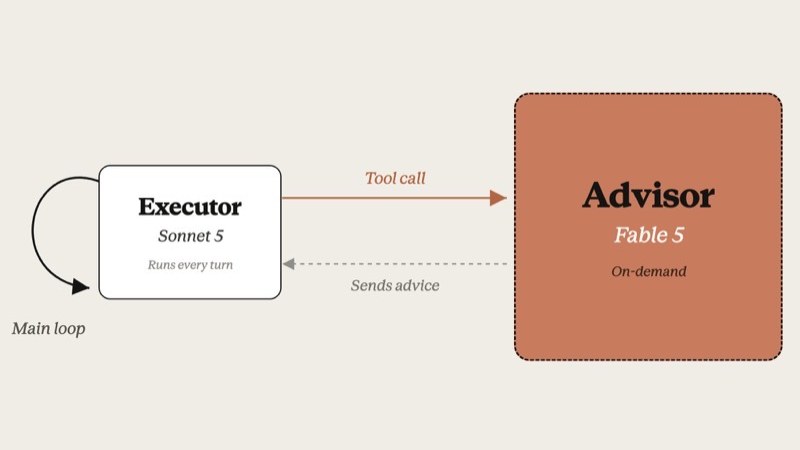
- Advisor mode: the executor model, Claude Sonnet 5, only calls in the advisor model, Claude Fable 5, for critical judgment calls. On SWE-bench Pro, this combo hit about 92% of Fable 5's solo score at about 63% of the cost — with Fable 5 consulted roughly once per task on average.
- Orchestration mode: Claude Fable 5 acts as coordinator, breaking down the task and dispatching it to Claude Sonnet 5 worker sub-agents running in parallel. On BrowseComp, this combo hit about 96% of Fable 5's solo score at about 46% of the cost.
- Both patterns rest on Anthropic's official Claude Managed Agents (multi-agent sessions) capability: advisor mode maps to a specific beta API tool (the advisor tool), orchestration mode maps to the multi-agent coordination feature — both have official docs and sample code, not something the team hacked together on its own.
- Sub-agents and advisors each get their own independent session thread, and the thread itself persists — going back to the same sub-agent with a follow-up question doesn't mean re-feeding the whole history and paying full price again.
Who's behind this advice
Anthropic's official developer-facing account, @ClaudeDevs, shared two multi-model collaboration patterns the team uses internally on July 7, 2026.
How the advisor model and worker model split the labor
Advisor mode isn't something the team cobbled together on its own — it's a formal beta feature of the Anthropic API, the advisor tool. The executor model, Claude Sonnet 5, takes the task and works through it on its own, only consulting the advisor model, Claude Fable 5, once at a point where a judgment call is needed — then, armed with that judgment, finishes the task.
Split advisor and executor roles: let the more capable Claude Fable 5 handle only "giving advice," not "writing content." All the token-heavy generation work is left to the lower-priced Claude Sonnet 5, so most of the bill lands at the executor's price point.
This isn't something you cobble together yourself by firing off two manual requests: you declare a tool of type advisor_20260301 in tools, specify which model the advisor uses, and the rest is handled entirely server-side by Anthropic. The executor decides when to ask for advice the same way it would call any ordinary tool; the server spins up a separate inference pass on the advisor model, which sees the executor's full conversation so far (system prompt, tool results, content already written), returns its judgment, and that judgment is fed straight back into the executor's conversation for it to continue writing with. The whole thing happens within a single API request:
response = client.beta.messages.create(
    model="claude-sonnet-4-6",
    max_tokens=4096,
    betas=["advisor-tool-2026-03-01"],
    tools=[
        {
            "type": "advisor_20260301",
            "name": "advisor",
            "model": "claude-opus-4-8",
        }
    ],
    messages=[{"role": "user", "content": "Build a concurrent worker pool in Go with graceful shutdown."}],
)
There's a hard rule for pairing models: the advisor must be at least as capable as the executor, never the other way around. The docs give two typical setups: if you're already running Sonnet on complex tasks, pair it with Fable 5/Opus as the advisor for a quality bump; if you're on Haiku but want a bit more smarts, pair it with an Opus advisor — cheaper than swapping the executor itself for a bigger model.

Why it's cheaper: the advisor's output is typically only 400 to 700 text tokens (1,400 to 1,800 including its reasoning), since it's only responsible for one key piece of advice, not writing the final answer start to finish. On the bill, advisor calls are billed separately at the advisor model's rate and logged under usage.iterations[] — they don't get folded into the executor's totals. The original post's line that "Fable 5 is called only rarely (about once) per task" is exactly this cost-saving mechanism playing out in practice.
The official best practice is to call the advisor before writing, not after the fact. For Haiku executors, which tend to "not ask when they should," Anthropic provides a system prompt template (reminding the model to proactively consult the advisor when writing files, making judgment calls, or getting stuck) that raised the pass rate on Anthropic's internal coding benchmark by about 7.5 percentage points for Haiku — a concrete, measured number, not a vague suggestion.
The other split: skip the consulting, delegate the task directly
In advisor mode, Fable 5 never touches the work itself — it only ever says a single line when asked. Orchestration mode is different: Fable 5 starts out as the "coordinator," breaks the task into pieces, and dispatches them to multiple Sonnet 5 "worker" sub-agents to run in parallel, while it only handles planning and aggregating results, never doing the work itself.

This orchestration capability also has formal official backing — Claude Managed Agents' multi-agent sessions feature. When you define a "coordinator" agent, you declare its dispatchable roster with the multiagent field (up to 20 agents, delegation goes only one level deep, no infinite nesting):
coordinator = client.beta.agents.create(
    name="coordinator",
    model="claude-opus-4-8",
    tools=[{"type": "agent_toolset_20260401"}],
    multiagent={
        "type": "coordinator",
        "agents": [{"type": "agent", "id": research_agent.id}],
    },
)
session = client.beta.sessions.create(agent=coordinator.id, environment_id=environment.id)
Each worker sub-agent runs in its own independent "session thread," with its own model, system prompt, and tool config, fully isolated from the others (up to 25 concurrent threads supported). The official docs summarize three scenarios well suited to delegation: parallel decomposition (looking up multiple sources or analyzing multiple files at once, with the coordinator aggregating at the end), delegation by specialty (handing off work like security review or documentation to a domain-specialized agent, instead of having one agent do everything), and capability escalation (escalating only the small handful of especially hard sub-tasks to a more capable agent).
Anthropic's official cookbook has a concrete, runnable example called the "coordinator pattern" (CMA_plan_big_execute_small.ipynb): the task is verifying 20 facts across 10 national parks against official sources. It compares having a top-tier model read through every webpage on its own to verify facts, versus having the top-tier model only handle breaking down the task while dispatching the page-reading grunt work to multiple cheaper worker sub-agents running in parallel:
The official result: the delegated team was about 2.5x cheaper and about 3x faster than going solo. But the notebook also candidly lays out four hard-won lessons — all measured, not just talking points:
The notebook also gives guidance on when not to use this split: if the task itself is low on information — not much to look up — splitting it into coordinator + workers just wastes an extra coordinator round-trip; if the coordinator never actually delegates and just answers from memory, that's a top-tier model fee spent for nothing; and if the task requires a top-tier model to personally grasp subtle nuance in the source material (not just simple fact-checking), cheaper worker sub-agents may lose key information when summarizing.

Why repeated calls don't mean paying full price again
The original post's line that "every sub-agent keeps its own cache" maps to two distinct mechanisms underneath — one for each mode.
On the orchestration side: every worker sub-agent runs in its own session thread, and the thread itself is persistent. When the coordinator comes back later with a follow-up question for the same worker, that worker remembers what it did and said before — no need to re-feed the entire history just to keep the conversation going.
On the advisor side, there's a more specific switch: the advisor tool supports independent prompt caching. Because the advisor, when consulted multiple times within the same conversation, sees a stable prefix of the transcript each time (the Nth consultation = the (N-1)th's content plus a bit more appended), turning on caching means the repeated portion is billed only at the cache-hit rate. The official guidance: if the advisor is consulted fewer than two times in a conversation, turning on caching isn't worth it (the cost of writing to the cache outweighs the savings) — it only starts paying off around the third call, and is worth it mainly for long conversations with multiple rounds of consultation.
Advisor mode or orchestration mode — what to look for
Both modes follow the same principle — "let the stronger model do less, and hand the grunt work to a cheaper model" — the difference is whether the stronger model touches the work itself at all.
| Advisor mode | Orchestration mode | |
|---|---|---|
| Role of the stronger model | Never writes content — only gives a judgment when asked | Never writes content, but proactively breaks down the task, dispatches it, and aggregates the results |
| Best-fit work | A single main-line task with a few critical judgment points along the way | Work that splits into several relatively independent sub-tasks that can run in parallel |
| How it's triggered | The executor model decides for itself "whether to ask" | The coordinator plans up front "who does what" |
| Corresponding official capability | advisor tool (beta tool) | Managed Agents multi-agent sessions |
The task itself is a single main line (say, a continuous stretch of code changes, or one ongoing conversation) with high output volume, but only a handful of forks genuinely need stronger judgment.
The task naturally splits into several mutually independent sub-tasks that can run at the same time (say, checking multiple pieces of information at once, or analyzing several files in parallel), with someone needed to aggregate the results afterward.
Advisor mode is like a team that's hired a senior advisor: they don't take part in day-to-day writing or emailing, and only get pulled into the room at key decision points to answer "is this the right direction." Orchestration mode is like a project manager leading a team of interns: the manager doesn't do the work themselves, but splits the task into pieces, hands them to different people to do at the same time, then aggregates and checks the results. In both setups, most of the team's cost still lands on the lower-paid side.
Want to try it — where to start
The minimal implementation for both modes takes just three steps — pick whichever matches your own scenario and give it a try.
advisor_20260301 tool to tools, specify the advisor model (must be ≥ the executor model's capability), and by default let the executor model take the task and carry it through to completion.multiagent roster declaring which worker agents it can dispatch; configure each worker independently with its own model and tool scope.Use Fable 5 as an "advisor." The executor model (Sonnet 5) consults it. Most tokens get billed at the executor's lower rate. @ClaudeDevs, July 7, 2026 (X)
- Claude Platform Docs · Advisor tool: the official API docs for advisor mode, with code samples, billing details, and best practices
- Claude Platform Docs · Multi-agent sessions: the official API docs for orchestration mode, including how to configure a coordinator
- GitHub · claude-cookbooks / CMA_plan_big_execute_small.ipynb: an official, runnable example of the coordinator pattern (real cost comparison for verifying national park facts, plus four hard-won lessons)
The multi-model money-saving trick: from "use the priciest model for everything" → "the pricey model just advises, the cheap model does the heavy lifting"
Anthropic's official developer account lays out two setups: who gives advice and who types get split apart — one page with a diagram covers the whole thing.
↓ Read it in one page · there's an animated diagram
More and more people are using AI to build "systems that can work through a task step by step on their own" (in the industry these are called AI agents). Building one means picking a model — models come in tiers, and the stronger, the pricier. The strongest, Claude Fable 5, can handle any hard problem thrown at it, but if it's used to carry an entire batch of work start to finish, the bill blows up fast.
✘ Letting it type out every single character start to finish: every character billed at the priciest rate.
Most of any given batch of work is "grunt work" that doesn't need top-tier judgment — using the pricey model for all of it means paying a fortune just for typing.
@ClaudeDevs is Anthropic's official account for developers (Anthropic makes Claude). On July 7, 2026, they shared a fix: the pricey model only steps in when a decision is needed, while the cheaper Claude Sonnet 5 does the heavy lifting of writing out the content.
Officially there are two concrete setups — the difference is whether the pricey model touches the work itself at all. One diagram makes it clear.
Both setups make the pricey model do less. Advisor mode: the cheap model works through the task on its own, only asking the pricey model a question at a critical judgment point. Orchestration mode: the pricey model splits the task into pieces up front, hands them to several cheap models to work on at the same time, and only handles the breakdown and the wrap-up itself.
The official numbers are measured against two public benchmarks. Treat "use the strongest model for everything" as costing 100 units, and see how much each split spends and how much score it gives up:
All of the above numbers are Anthropic's own internal testing, with no independent third-party reproduction.
billed at the top rate
deciding and typing
→ all top price
Sonnet 5 types the bulk
→ bulk is cheap
cheap model types it out!
(SWE-bench Pro)
no third-party reproduction
just let it only advise;
hand grunt work to the cheap model,
the bill saves itself
Members can copy or download the full Markdown, and let their AI subscribe and ask.
Found this useful? Leave your email — every new explainer, the moment it's out. Unsubscribe anytime.