Video generation faster than playback: fal makes MiniMax H3 real-time through post-training
Fal continues post-training on the open-weight MiniMax H3 and co-optimizes the model with its own inference stack: a 5-second clip returns in about 3 seconds, and the system can start generating the next segment before the current 15-second clip finishes playing.
- H3 Max delivers a 5-second, 768p clip in about 3 seconds, so generation can outpace playback on some requests.
- Fal post-trains the open-weight MiniMax H3 model and tunes it together with its own inference stack.
- H3 Max leads the image-to-video-with-audio leaderboard and supports text, image, first/last frame, and reference-material-driven generation.
- Standard 768p pricing is $0.08 per output second; the real-time system relies on buffering, caching, failure fallbacks, and cost controls to keep running.
Independent developer Pieter Levels shared a Twitch clip that wasn't a pre-arranged playlist. The animation on screen was being generated segment by segment, in real time, by a video model. In the demo, Rehan Sheikh wired fal's MiniMax H3 Max into the livestream pipeline, letting viewers watch a "cross-dimensional TV channel" that could keep generating itself.
Levels called it a historic moment for AI video generation and sketched out a mind-bending workflow: generating a 15-second video once often meant waiting 2–5 minutes; this system needed 9 seconds to return 15 seconds of content. With that speed, the next clip can be ready before the current one finishes playing, so a live broadcast doesn't depend on pre-produced segments. Viewer votes, chat messages, and choices can all feed into the next round of generation. The same character can wander into different worlds, and each viewer could even have a channel that grows solely for them. Video shifts from a file you watch after it's done to a content system that runs as you watch, opening up a much wider range of play and imagination.
This livestream setup runs on fal's H3 Max, which is built on the open-weight MiniMax H3. H3 can take text, images, video, and audio in a single context and directly generate video with synchronized sound. fal continued post-training from that base, then co-optimized the model with its own inference stack.
H3 Max's speed comes from the multimodal capabilities already present in H3. The unified input, 2K generation, native audio, and open weights determine what fal can continue training on, and they also define which tasks H3 Max and standard H3 are each best suited for.
When generation is faster than playback
If a 15-second clip takes two minutes to generate, a product either makes users wait or relies on pre-batched production. When generation takes only 9 seconds, the system can generate clip B while clip A is playing; clip B slips into the buffer before clip A ends. As this loop continues, the generation model stops being a tool that delivers individual video files and becomes a real-time component that continuously supplies frames.
This kind of "real-time" doesn't require frame-by-frame rendering like a game engine. It only requires that production speed can keep pace with consumption over the long run. With 15-second clips and end-to-end generation under 15 seconds, the system has a positive time margin. Adding one or two clips of buffering can absorb some of the latency jitter.
Running continuously also means keeping characters, visual style, and plot continuity intact; playing fallback clips when requests fail; converting chat input into the next prompt; and keeping content and costs under control. The livestream system also has to handle peak concurrency and always-on reliability.
Where H3 Max comes from
fal Research took the open-weight MiniMax H3, added new data for post-training, and focused on improving prompt adherence, visual aesthetics, and audiovisual quality. Meanwhile, fal's inference team tuned both the model and the serving path around its own inference engine.
Unified multimodal + native audio
Prompt adherence and aesthetics
Throughput and latency
Managed endpoints
Post-training determines what the model tends to produce. fal incorporated real generation workloads, human preferences, and verifiable reinforcement learning tasks into its training data, then evaluated overall preference, prompt understanding, and aesthetics separately. Inference optimization, by contrast, makes the same request complete faster, touching model execution, the sampling process, and the underlying system.
The two teams tuned quality and speed together before the model was finalized. While the research team brought latency targets into post-training, the inference team did specialized optimization around the final weights. fal's goal was to raise throughput while keeping its internal quality benchmarks competitive, not to simply cut sampling steps.
The base H3's unified multimodal context and native stereo audio are retained as well. Inputs can describe visuals, camera work, and sound all at once, and the output comes with synchronized audio built in. Short video production no longer needs separate steps for generating voiceover, ambient sound, and aligning audio tracks.
fal showed off a 15-second "1984" video that demonstrates combined control over text, composition, and continuous motion: the typography, stamps, and characters on screen morph continuously through the shot.
fal then used six clips to show low-angle tracking shots, first-frame-to-last-frame transitions, the same character across six different scenes, native synchronized audio, style consistency across shots, and following a complex prompt in sequence.
fal also showcased six sets of finished results from "one prompt, one generation, no post-processing": a continuous disaster long take, retro pixel parkour, a character speaking to camera with lip sync, claymation, a slow-motion hummingbird, and a coffee product close-up. Together, they cover six use cases: cinematic shots, game visuals, character performance, stylized animation, nature photography, and commercial product work.
These capabilities can be written into a prompt using a three-layer structure: "subject and source material, camera and motion, sound and rhythm." That way, the model knows what to shoot, how to shoot it, and how the audio should follow the visuals.
What 2.5 seconds, 3 seconds, 9 seconds, and 35 times mean
In fal's examples, a 5-second, 768p text-to-video request logged timings.inference = 2.5286 seconds; the image-to-video equivalent came in at 2.7652 seconds. The standard spec is a wall time of under 3 seconds. timings.inference measures the backend denoising step, while the end-to-end experience also includes queueing, network transfer, input upload, and prompt expansion.
Levels showed a 15-second clip returning in 9 seconds; fal's own general expectation for 15-second generation is around 15 seconds. The two numbers may come from different requests, prompt complexity, system load, and measurement methods. Interactive products can treat 9 seconds as a best-case demo result, use 15 seconds as a more conservative initial expectation, and calibrate with their own request logs.
fal measured H3 Max's throughput at roughly 35 times that of the official MiniMax H3 endpoint, and on average 15 times faster than models of comparable quality. Real-world products should still log timings.inference for each response, along with end-to-end P50, P95, failure rates, and queueing time.
Prompt expansion also changes the perceived speed. fal recommends 768p, 5–10 seconds, and the balanced mode. fast expansion adds about a second; quality mode can use up to 30 seconds on rewriting alone. Interactive apps should separately track prompt processing, queueing, inference, transfer, and first-frame playback.
H3 Max leads two image-to-video leaderboards
fal ran H3 Max through a pairwise comparison against 12 other video models, evaluating overall preference, prompt adherence, and visual aesthetics, then aggregated the results with Bayesian Elo and 95% confidence intervals. H3 Max ranked first on all three axes and won the majority of one-on-one matchups against every model tested.
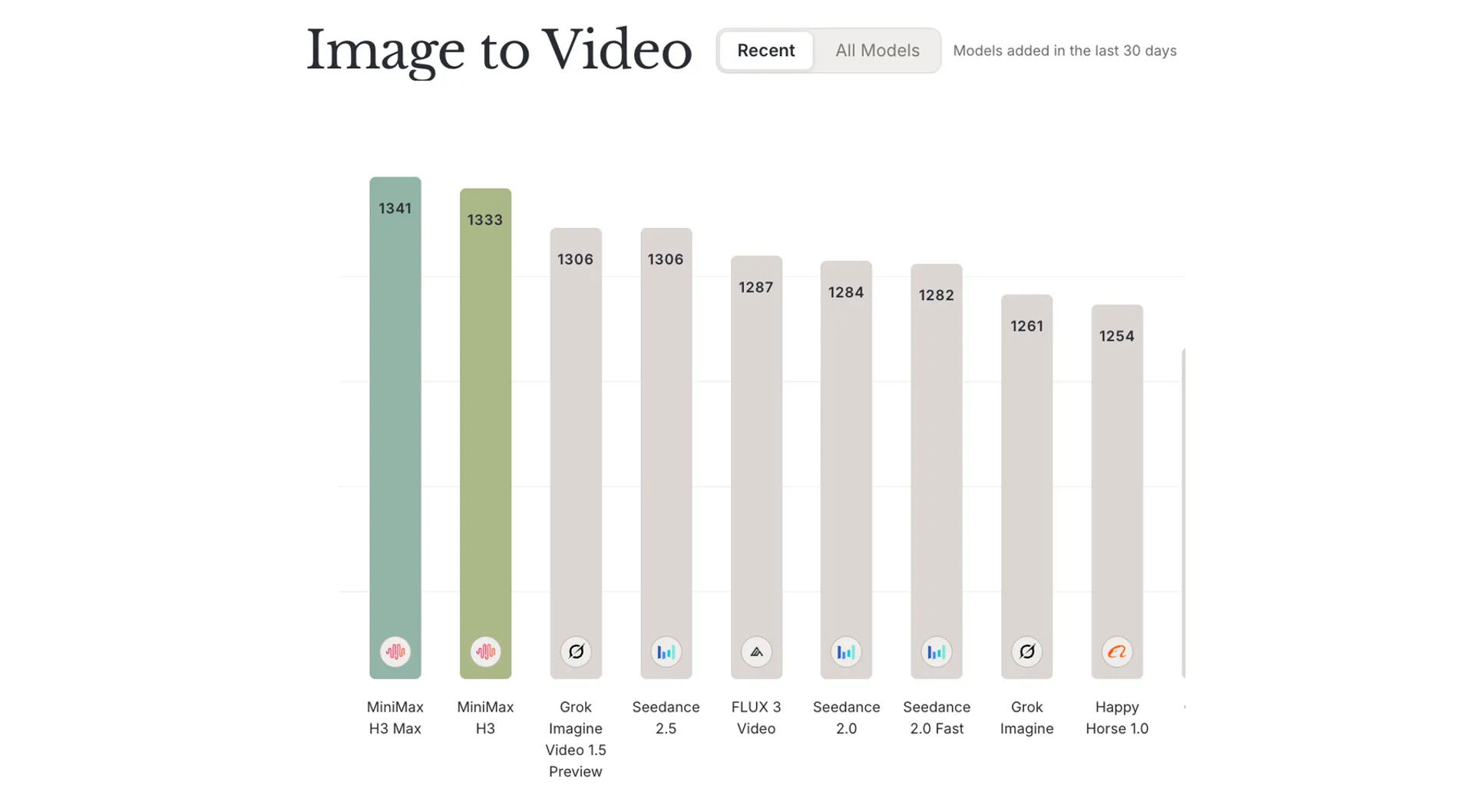
Design Arena placed H3 Max at the top of its image-to-video leaderboard at the time, with an Elo of 1341. Artificial Analysis recorded it under the name "H3 Turbo 768p" at 1201 Elo, ±11, based on 2177 samples.
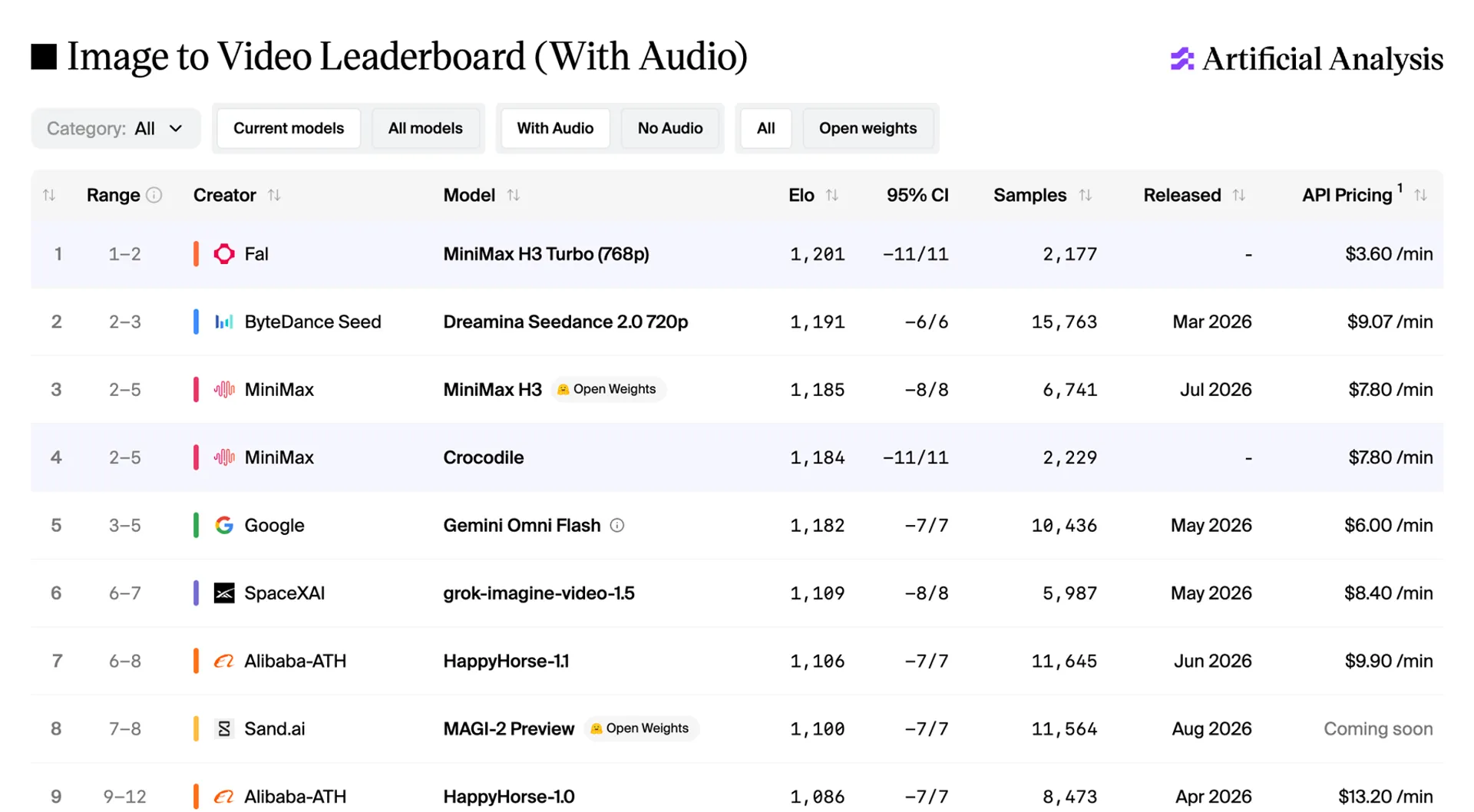
As of 2026-9-1, Artificial Analysis's "image-to-video with audio" leaderboard lists H3 Max in first place with 1203 Elo, a 95% confidence interval of ±9, and 5400 samples. Second place went to Dreamina Seedance 2.0 at 1190, followed by the standard MiniMax H3 at 1185 and Gemini Omni Flash at 1179. The board continues to update as new votes come in.
Compared against 12 modelsOverall preference / prompt understanding / aesthetics
5,400 samplesTop of the image-to-video with audio leaderboard on 2026-09-01
Artificial Analysis's evaluation covers image-to-video with audio. Text-to-video, video editing, 15-second long takes, and character consistency across clips are separate tasks that need their own tests.
How to choose between H3 Max and standard H3
H3 Max primarily runs at 480p and 768p, with 768p as the tuned sweet spot. Its 16:9 output is 1344×768 at 24fps, with individual generations of 5–15 seconds and native synchronized audio. fal already offers text-to-video, image-to-video, first-and-last-frame control, and reference-to-video endpoints.
The standard MiniMax H3 supports 2K output, up to 15 seconds per clip, and offers a more complete set of multimodal reference and video editing capabilities. Its base weights are already open, making it a fit for teams that want to self-host, do research, or run custom training. H3 Max uses the same open base and is currently available through the fal API.
| Requirement | Better choice | Why |
|---|---|---|
| Quick previews, interactive storytelling, livestream clips | H3 Max | 5-second clips in about 3 seconds, with prompt adherence and 768p output prioritized |
| 2K finished videos | Standard H3 | H3 Max is capped at 768p |
| Self-hosting, research, custom fine-tuning | Standard H3 | Standard H3 has open base weights; H3 Max is a hosted API |
| Fine-grained video editing | Standard H3 | Standard H3 has a more complete set of editing endpoints |
| Fast generation from reference images, video, or audio | H3 Max reference-to-video | The endpoint is already live; reference inputs are billed separately |
Interactive prototypes need low latency, adequate clarity, and reliable response times. Commercial spots, cinematic shots, and post-production work, by contrast, place more weight on resolution, editability, and cross-shot control. Teams can use H3 Max for fast exploration and then hand the few shots that really matter to standard H3 or a later production pipeline.
Price determines how long it can run
fal's standard price for 768p output is $0.08 per output second: 5 seconds cost $0.40, 15 seconds cost $1.20. On 9/1, the endpoint still showed a half-price launch discount at $0.04 per second, with a note that the discount would end that day. Free credits vary with login status and output resolution; check the account panel at the time of use.
Sustaining a continuous stream at standard prices means 3600 seconds of video output per hour, or about $288 in model costs. Running around the clock comes to roughly $6912 per day, before adding retries, reference inputs, orchestration services, and streaming. Reference-to-video charges by reference input tokens, and reference video can push input costs above output costs.
A continuous livestream can reduce cost by adding user triggers, pre-generating branches, caching popular clips, slowing generation when the audience is less active, and rolling back on failure, so compute spending tracks the amount of actual viewing or interaction.
Building a prototype can start with five steps:
- Establish a stable baseline with 5 seconds, 768p, and the
balancedmode. - Write the subject, action, camera movement, time rhythm, and sound into the prompt in one pass.
- Save the
expanded_promptand confirm the expansion didn't change the intent. - Log end-to-end latency alongside
timings.inference, and check the P95 after dozens of consecutive runs. - Reserve at least one clip of buffering for continuous generation, and prepare fallback content that can play on timeout or failure.
Video models are entering the runtime
Video models have traditionally focused on shortening production time: a few minutes later, you get an ad spot, a shot, or a concept version. H3 Max brings a different timescale into product design: the model can keep making the next segment while the user is watching, choosing, or typing.
Continuous livestreaming is just the most obvious example. An interactive story could generate the next scene based on viewer votes. A game could pre-generate three branches in parallel while the player reads the options. E-commerce and advertising tools could let creators keep trying shots without leaving the current workflow. Educational content could rewrite the next part of a demonstration on the fly based on the learner's answer.
A continuously running video system also has to maintain world state, decide what goes into each prompt, check the output, stitch together sound and picture, control the budget, and keep playing when latency spikes. H3 Max provides the rarest piece of that puzzle: a high-quality short-video model with a production speed that approaches—and on some requests exceeds—the speed at which it's consumed.
When that inequality holds steady, AI video stops being a unit of finished files. It becomes a medium that software can call on continuously, like any other runtime resource.
Members can copy or download the full Markdown, and let their AI subscribe and ask.
Found this useful? Leave your email — every new explainer, the moment it's out. Unsubscribe anytime.