MIT builds a robot bird that swims and flies without paddling
A 250-gram robot uses one pair of flexible wings to move through water and air, taking off from a lake at a 70° angle after just 8–10 wingbeats
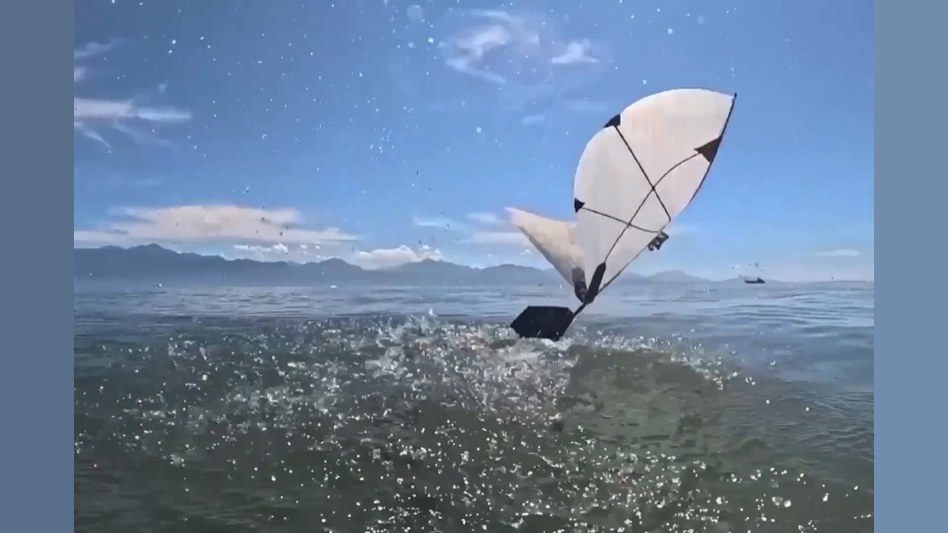
Researchers from MIT and EPFL dropped a roughly 250-gram flapping-wing robot into Lake Geneva. It swam up from below, broke the surface, kept flapping the same pair of wings, and flew away. No propulsion swap, no running start across the water.
- Water is about 1,000 times denser than air, so the same wings have to handle two wildly different loads.
- The flexible membrane wings passively bend underwater, shrinking the wingtip stroke amplitude by 60% to 90%. Once clear of the water, they recover enough amplitude and lift.
- All tests at a 70° emergence angle succeeded, with the robot leaving the water in about 8–10 wingbeats.
- The paper proves trans-media locomotion is possible. Wind, waves, turning, autonomous sampling, and long-duration ocean missions remain untested.

A robot bird flies straight out of a lake
The robot has a fuselage, two membrane wings, and an adjustable tail. A waterproof motor drives the wings up and down via a crank, while the tail controls pitch for climbing or diving. A hydrophobic nanomaterial coat on the wings sheds water quickly after breaking the surface.
It can also reverse course: dive into the water at about 5 m/s, rapidly slow to roughly 0.5 m/s, and continue swimming with the same wings. The paper dubs this machine the FAAV, for “flapping-wing aerial-aquatic vehicle.”
The hard part is one pair of wings working in two worlds
Flying robots are common, and swimming robots aren’t rare. Combining both in one machine creates friction from the moment the wings touch the water.
Air is thin, so the wings must sweep a larger volume quickly to generate enough lift. Wings that are too small or too soft simply can't hold the robot up.
Water is roughly 1,000 times denser than air. Flapping at air-style amplitudes drives drag through the roof, and the motor hits its torque limit fast.
Scaling purely for fluid dynamics, you’d expect a roughly 12-fold change in flapping frequency to maintain similar propulsion efficiency between water and air. But diving birds like auks and petrels typically vary it only 2 to 4 times. They tuck their wings tighter and adjust wing area, keeping their muscles in a narrower frequency band.
The team treated the robot as a tunable “robot bird”: three wingspans, five stiffness levels, and separate control over flapping frequency and tail angle. Animals can't be instructed to repeat a specific motion on cue; a robot can.
| Previous Approaches | How They Cross Mediums | The Cost |
|---|---|---|
| Two propulsion systems | Rotors in air, propellers underwater | Added weight, drag, and complexity |
| Extra emergence hardware | Buoyancy, combustion, or catapults for leaving water | Hard to repeat continuously, limited biomimetic value |
| Complex folding wings | Active wing folding underwater, unfolding in air | More joints, seals, and control loops |
No folding needed: The wings deform under load
The core idea is a passive compromise: the wings don’t need a “water entry – fold now” command. The water itself bends them.
In experiments, the small wing was fastest underwater at 5 Hz, reaching about 0.95 m/s, but couldn't generate enough thrust for a slow takeoff. The large wing flew better but dropped underwater speed to around 0.64 m/s. The medium size and stiffness hit the sweet spot: roughly 0.79 m/s underwater and an average of 6.3 m/s in the air.

A 70° angle, and emergence in three stages
Flexibility alone isn’t enough. The angle at which the robot approaches the surface has to leave room for the wings. Too shallow, and the wingtips keep slapping the water. Too steep, and the body pitches backward.
The tail pitches the body up to about 70° while the wings keep pushing upward underwater.
The first four wingbeats rely mainly on hydrodynamic thrust. The fifth begins skimming the surface and shedding water.
Around wingbeats six to seven, frequency climbs to 10 Hz. Two more wingbeats fully clear the tail from the water.
During lake trials, the robot typically took 8 to 10 wingbeats to complete its takeoff. All tests at the paper’s reported 70° angle succeeded, and “flight within 1 second” is listed as a result. It never used its feet, unlike auks or ducks.
No foot paddling doesn’t mean an easy exit. At roughly 2.6× the power of air cruise and over 10× underwater cruise, peak power during emergence is the most demanding part of the whole sequence.
It proves trans-media locomotion works, not ocean readiness
This research matters on two levels. On the engineering side, it delivers a lightweight flapping-wing platform that can repeatedly cross between water and air. On the biology side, it lets researchers systematically vary wingspan, stiffness, frequency, and emergence angle to test why diving birds use similar motion strategies.
Measured in the Paper
- Multiple tests in wind tunnels, water tanks, flumes, indoor flights, and a natural lake
- Three wing sizes, five stiffness levels, and multiple flapping frequencies
- 11 lake emergence trials plus 15 flume angle tests
- Flight, swimming, emergence, and diving all captured on the robot
Not Shown in the Paper
- Consistent emergence in wind, waves, or turbulent conditions
- Active wing turning and full autonomous navigation
- Endurance and reliability while carrying sampling gear
- Long-duration ocean monitoring and high-frequency repeat missions
The paper estimates that with current batteries, power, and speed, the robot could fly about 6 kilometers on a single charge, or swim roughly 2 kilometers horizontally underwater at low flapping frequency. These numbers come from power models, not from completing those full distances in a test.
The team envisions it flying from shore or a ship to icebergs, port facilities, or near whales, diving in to measure or sample, then flying back to deliver data. Getting there will require solving turning wings, stability in wind and waves, autonomous control, communication, and sensor payloads.
Key Takeaway: The breakthrough isn't adding a separate underwater thruster. It's allowing the same flexible wings to use fluid loads to change their own state, creating a continuous transition from hydrodynamic thrust to aerodynamic flight.
Primary sources: MIT News; Zufferey et al., “Leaping out of the water: aerial-aquatic locomotion with flapping wings,” Science 393, 207–211 (2026); MIT open paper and supplementary material.
Images and video belong to the original authors and MIT. Speed, power, frequency, emergence angle, and trial counts are from the paper and its supplementary materials.
MIT builds a robot bird that swims and flies without paddling
MIT and EPFL got a 250-gram robot to swim, emerge, and fly with the same wings. Here's the mechanism in one illustrated page.
↓ One page, with an animated diagram
MIT and EPFL researchers put a 250-gram robot into Lake Geneva. It swims underwater, bursts through the surface, and flies off with the same wings — no component swaps, no tucked wings, and no paddling.
Water is about 1,000 times denser than air. The same wings need large, fast strokes to generate lift in air, but slamming into water with that amplitude creates massive drag and maxes out the motor's torque. You can't win with one wing.
Separate propulsion systems for air and water, or add extra catapult/folding mechanisms. Each medium gets its own hardware, and the robot carries all of it.
The same flexible wings. No swaps. They bend in water and spring back in air.
The wings don't need motors to fold. When the load increases underwater, the water pressure bends the flexible membrane, and the wingtip's actual stroke amplitude shrinks. When the robot breaks the surface, the load drops instantly, the wing snaps back to full amplitude, and propulsion shifts from hydrodynamic to aerodynamic. The team tested three wingspans and five stiffness levels — too soft couldn't fly, too hard had huge drag underwater. The medium option won.
The body first rises at a 70° angle, skimming the surface. The first few wingbeats are pure hydrodynamic thrust. Then the wingtips start to shed water, frequency increases, and two more beats fully clear the robot. The whole process takes about 8–10 wingbeats, roughly a second.
This work proves one pair of wings can move continuously from water to air without foot paddling. But it's a long way from ocean duty.
Wind tunnel, tank, flume, and lake trials
3 wingspans, 5 stiffness levels tested
11 lake emergence tests + 15 flume angle tests
70° emergence angle: all successful
Stable emergence in waves or turbulence
Wing turning & full autonomous control
Endurance with sampling payloads
6 km flight / 2 km swim are power model estimates, not test results
by the shore,
studying the water
250 g total
big & fast
to stay up
Flap hard,
motor stalls.
- ✗ Two propulsion systems, carry both
- ✗ Catapults or buoyancy boosters
- ✗ Active wing folding, more joints
to ~70°
skim surface,
shed water
and flying
11 lake emergences
70°: all successful
- ✗ Emergence in waves & turbulence
- ✗ Wing turning, full autonomy
- ✗ Endurance with sampling payload
Members can copy or download the full Markdown, and let their AI subscribe and ask.
Found this useful? Leave your email — every new explainer, the moment it's out. Unsubscribe anytime.