The More You Use AI, the More You Need Second-Order Thinking
Answers show only the immediate payoff; skills, judgment, habits, and data shift slowly with repeated use. One simple question helps you see those consequences before they arrive.
- Second-order thinking asks not just whether AI delivered, but what repeated use makes stronger or weaker in you.
- Research offers no single 'use AI less' answer; taking finished outputs and using AI as a learning scaffold can produce opposite effects.
- Split tasks into those that only need delivery and those that must build capability; keep at least one independent attempt, check, recap, or rebuttal for the latter.
You ask the AI a question, and the answer arrives before your coffee reaches your lips. It's fluent, complete, and, most of the time, good enough. After a few weeks, that speed starts to feel as natural as a keyboard or a search box.
The screen only shows what happens first: the task is done. The slower changes happen elsewhere—whether you still start writing from a blank page, whether you double-check a confidently stated answer, whether you unknowingly leave sensitive information in a public link, and whether you use AI to learn things you wouldn't have otherwise.
In a long X post, AI Guides ties these changes together with "second-order thinking." The framework comes from investing, but it fits the AI habits people repeat every day surprisingly well.
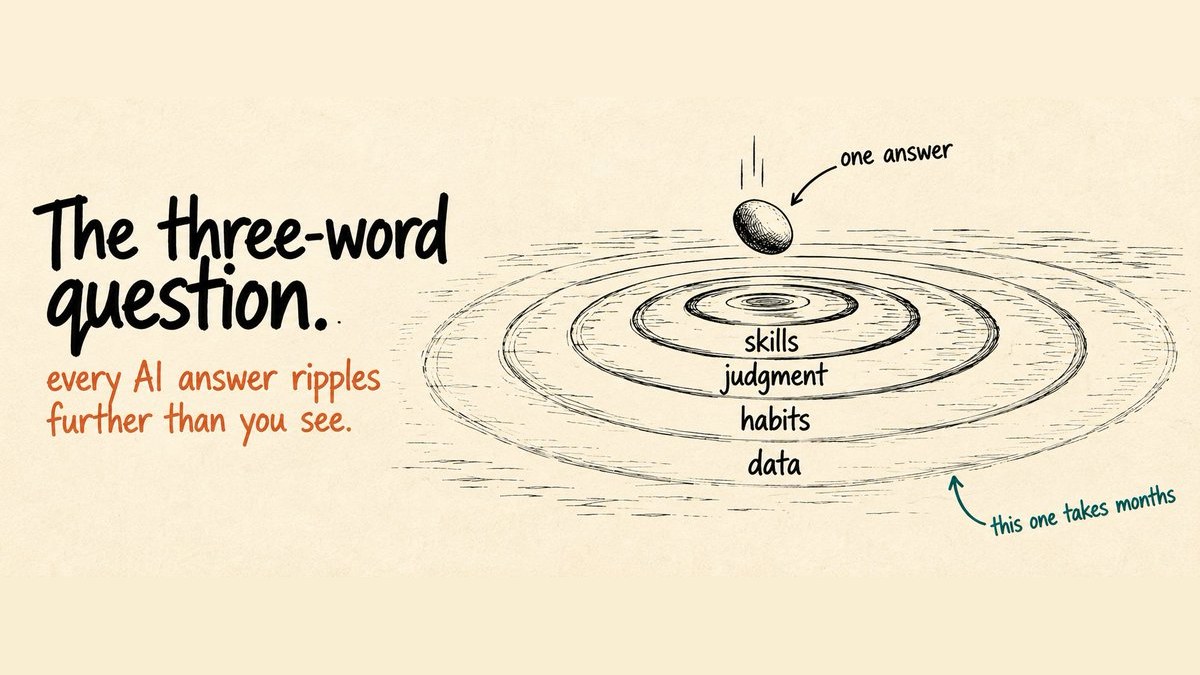
After an answer lands, the ripples keep spreading
First-order thinking asks: What happened?
Second-order thinking goes further: Because this happened, what happens next?
Howard Marks uses "first-level thinking" and "second-level thinking" in investing to distinguish between quick, surface-level judgments and those that consider more downstream variables. Shane Parrish of Farnam Street distills it into a more usable phrase: and then?
One answer is just the first ripple
Applied to AI, the first-order results often look great: the email is written, the report is shortened, the code runs, and the tough problem has an explanation. Second-order results don't show up on the screen at the same time. They only emerge through repeated use, and what they change is usually the user.
Five changes, all landing on the person
Skills: the deliverable is done—but did the capability stick?
A team at MIT Media Lab had 54 participants write with the help of a large language model, a search engine, or on their own. The group using the LLM felt the least sense of ownership over their writing, and some struggled to accurately cite what they had just written. EEG results also showed different patterns of neural connectivity across the tool conditions.
This study is a small-sample preprint, and the task only covers short-term essay writing, so it can't support the claim that "AI writing permanently erodes ability." What it does offer is a concrete reminder: delivering text is not the same as building the capacity to organize ideas, remember content, and complete the work independently again later.
Judgment: where you place trust shapes how much you verify
Research from Microsoft Research and Carnegie Mellon University collected examples from 319 knowledge workers across 936 real tasks. The more confidence participants had in AI, the less critical thinking they reported investing; the more confidence they had in their own task abilities, the more critical thinking they reported.
What's measured here is self-reported thinking activity and effort, not objective capability decline. Still, the mechanism it reveals is useful: after ten consecutive correct answers, the most likely thing to disappear on the eleventh is the verification step.
Habits: outsourcing shifts from a one-off decision to a default move
A study by Michael Gerlich, based on 666 valid responses, found that frequent AI use was associated with lower critical thinking scores, with cognitive offloading playing a mediating role. Cognitive offloading is common in everyday life: taking notes, using a calculator, and checking a map all delegate some mental work to external tools.
The difference lies in how you use it. You can deliberately decide "this isn't worth my personal effort," or you can let AI answer first for every question that comes up. The former frees up attention; the latter skips the judgment process entirely. This study provides correlational evidence—it can't prove AI use caused the lower scores—but it accurately describes how habits form: repeated shortcuts gradually become the default entry point.
Data: better answers usually demand more context
In 2025, ChatGPT offered an optional feature that let users make shared conversations discoverable by search engines. Some public conversations subsequently appeared in Google and other search results, and OpenAI quickly removed the feature.
Current official documentation is explicit: a shared link is not a private link. Anyone with the link can forward it further, and copies saved by recipients can outlive the original link. A single share takes seconds, but the reach and lifespan of that information can far exceed those few seconds.
Learning: the same technology can also compound capability
Greg Kestin, Kelly Miller, and colleagues at Harvard designed an AI tutor with instructional scaffolding for undergraduate physics courses. 194 eligible students participated in a randomized controlled crossover experiment. In two specific class sessions, the AI tutor group achieved significantly higher learning gains in less time, with a median learning gain more than double that of the active learning condition in the classroom.
This tutor is far more than a blank chat box that "just gives the answer." It uses course-specific prompts, step-by-step guidance, practice, and feedback to keep students engaged in reasoning. The research only covers two sessions of one course, so it can't speak for all subjects, but it demonstrates a possibility: AI can deliver finished products, or it can provide scaffolding—and the latter leaves the thinking with the learner.
Six choices you face every day
Second-order effects rarely announce themselves as "big events." They hide in the small choices repeated throughout the day.
| The choice right now | Asking "and then?" once more |
|---|---|
| Writing an email in 90 seconds | Months later, will a blank page feel harder to start on? |
| Accepting an answer that's been right for the last ten times | Are you saving verification time, or canceling the verification habit? |
| Using a summary instead of the original | Can I still paraphrase it and challenge the underlying argument? |
| Pasting personal information for tailored advice | Where is it stored, who can access it, and can it be forwarded? |
| Asking AI to explain step by step | After the conversation ends, can I redo it on my own? |
| Writing goals, constraints, and evaluation criteria first | Do these two minutes let me keep ownership of the question and the judgment? |
There's no single correct answer for these choices. A routine notification might only need fast delivery; a professional judgment you'll have to own independently later can't just leave behind a deliverable.
The research shows two opposing paths
Looking at these studies together, a clear fork emerges.
The speed at which AI delivers finished products is both its value and the main reason people skip participating.
Receiving finished products directly: human participation gets compressed
One path is receiving the finished product directly. The low sense of ownership in the MIT writing study, the "more trust in AI, less reported thinking" relationship in the Microsoft/CMU survey, and the cognitive offloading in Gerlich's research all appear after human participation gets compressed.
Structured participation: AI becomes thinking scaffolding
The other path is letting AI organize exercises, provide feedback, and expose reasoning steps. The Harvard AI tutor follows this path. Gerlich's follow-up experiment with 150 people also compared no AI, unguided human-AI collaboration, structured human-AI collaboration, and AI-only responses. The structured group first reflected independently, then did targeted research, constructed arguments, critically reviewed, and did a final debrief; they produced stronger arguments on the political reasoning task and reported higher cognitive engagement.
This experiment tested only one type of task, and it was completed in a single 60–75 minute controlled activity. Still, it offers a transferable set of actions: form your own question and preliminary judgment first, then let AI in.
Quiet drift: changes need active measurement
Some changes are so quiet that individuals barely notice them. An observational study published in The Lancet Gastroenterology & Hepatology compared unassisted colonoscopies across four Polish endoscopy centers in the three months before and after AI assistance was introduced. The adenoma detection rate—the proportion of exams finding at least one potentially precancerous lesion—dropped from 28.4% to 22.4%, an absolute decline of 6.0 percentage points.
This study can only show that AI exposure and a drop in unassisted detection rate occurred together; workload, case mix, and temporal changes could all still influence the results. It doesn't prove AI has "de-skilled" doctors. What it demonstrates is why second-order effects need active measurement: the tool works normally, users don't necessarily feel a difference, and yet long-term capability may have already shifted.
Put "and then?" before you accept the answer
Second-order thinking doesn't require slowing down every task. It requires making a deliberate choice before you hand over your thinking.
Before accepting an answer, complete the question: If I adopt this without participating, what gets stronger and what gets weaker?
Four steps before you accept
- 01Assess the task
Do you just need a deliverable, or do you need to build capability?
- 02Assign accountability
Which tradeoff, standard, or conclusion has to be yours?
- 03Keep a human move
Answer it yourself, check it, restate it, or push back—keep at least one.
- 04Handle the data
Strip sensitive details and treat any shared link as public information.
1. Decide whether this task is just about delivery or needs to build capability
Formatting, rewriting routine notices, and generating meeting titles are usually just about delivery. But when you're writing an opinion you'll own long-term, evaluating evidence, or learning a skill, something needs to remain with you after the task ends.
2. Assign one responsibility that can't be outsourced
Let AI gather options, but you explain the final trade-off; let AI draft code, but you set the testing standards; let AI summarize an article, but you can still restate the core argument. The clearer your responsibility, the more the tool becomes an amplifier.
3. Keep one cognitive move
Write three lines of your own answer before looking at AI; ask AI for evidence, not conclusions; find a counterexample after receiving the result; close the conversation and redo it in your own words. A single move is enough to stop "outsourcing by default" from quietly taking over the whole process.
4. Handle the data boundary before you hit send
Remove identifying details, replace specific names, account numbers, and amounts with roles and ranges; when dealing with company, client, medical, or financial material, check the product's data retention, training, and sharing settings first. Treat shared links as public information and don't rely on "nobody knows the link" as a form of access control.
The AI answer is the first-order result. After repeated use, what you retain—your skills, judgment, and habits—is the second-order result.
Before each accepted answer, ask one more time: and then? Those few seconds force you to decide which work can be handed off and which capabilities stay with you.
Members can copy or download the full Markdown, and let their AI subscribe and ask.
Found this useful? Leave your email — every new explainer, the moment it's out. Unsubscribe anytime.