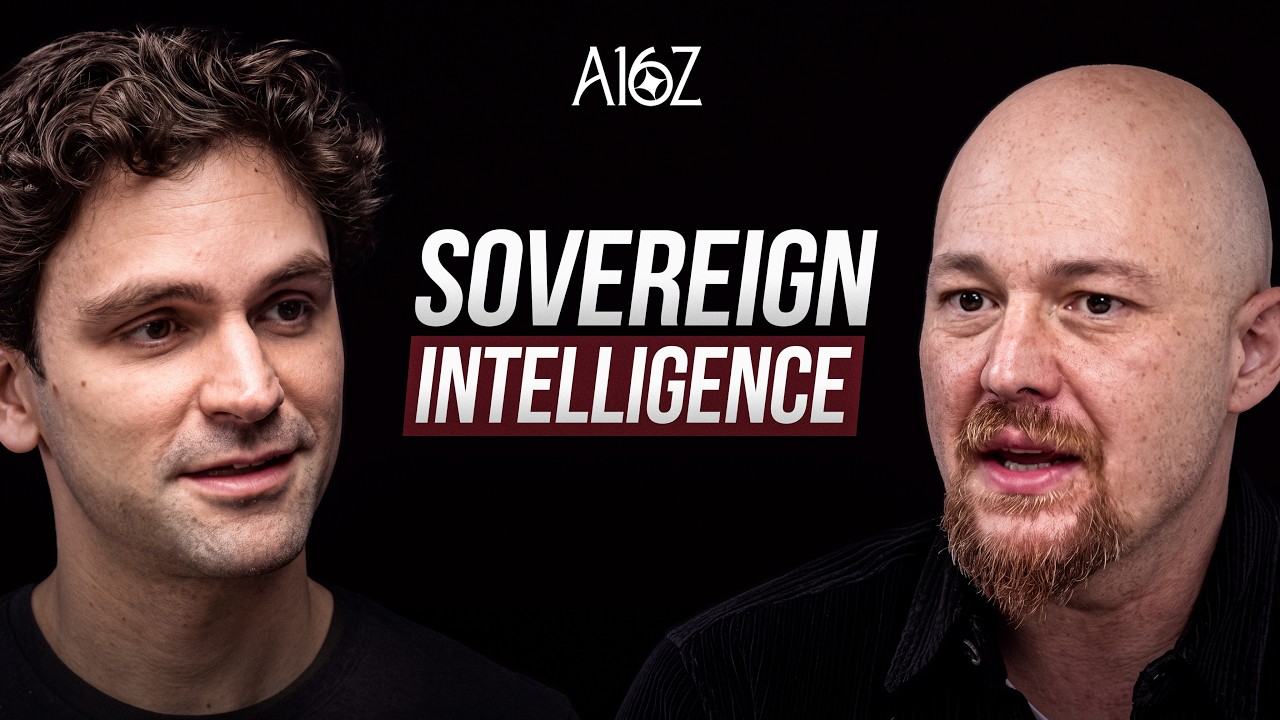
Why Specialized AI Could Beat the God Model
A conversation between OpenRouter and Replit: general-purpose models handle exploration while specialized models take over repetitive tasks, with enterprises combining them using their own data, evaluations, and permissions.
a16z invited two tech entrepreneurs—OpenRouter founder Alex Atallah and Replit founder and CEO Amjad Masad—for an interview titled Why Specialized AI Could Beat The God Model.
The core thesis of the dialogue is that the future AI ecosystem may not be dominated by an all-encompassing "God Model." Both guests value complementary capabilities across different models, what they call "neurodiversity"; however, how to organize these capabilities still involves trade-offs: Amjad emphasizes the value of unified context, while Alex is more bullish on the vertical division of labor among specialized Agents.
Put plainly: no matter how smart an AI is, it may not be suitable to manage bank accounts, write code, and handle customer relationships all at the same time. What enterprises care about more is whether they can let different assistants do what they excel at, restrict permissions and inspect results individually, and then coordinate them. This interview discusses why this division of labor is worthwhile and how to balance capability, cost, and control.
Beyond General-Purpose Models, What Value Can Products Provide?
This conversation took place after Stripe acquired OpenRouter. Alex noted that what he valued was autonomy over brand, product, and roadmap, as well as more powerful go-to-market distribution. Both parties hope to support the emergence of more new companies through reliable, reasonably priced infrastructure, rather than having all businesses consolidated into a single tech giant. He also envisions that in the future, enterprise payments and model inference will become more closely integrated. (00:47: Acquisition background)
This explains why OpenRouter cares about model selection and cost: only when developers can use different models to create differentiated products and call costs remain low enough can more businesses become viable. This represents both Alex's aspiration for the industry and the core business direction of OpenRouter as a model access platform.
When building AI products, a very direct question arises: "Whatever you built, can't I just call ChatGPT or Claude directly and do the same thing? Why should I buy your product?"
Alex believes that breaking out of this homogenization trap does not come from crafting longer or more elaborate prompts, but from neurodiversity.
Different models use different training data and training methodologies, and they excel at different tasks. In Alex's view, enterprises can combine models trained with diverse methods, open-source and open-weight models, in-house proprietary small models, and their own unique enterprise data. Enterprises must use their own task evaluations to determine whether such combinations truly outperform direct calls to a general-purpose model.
A more realistic consideration lies in cost-effectiveness. If the entire market is dominated solely by OpenAI in a monopoly or near-monopoly state, the model provider may lack the incentive to proactively lower prices. Only by establishing a multi-model marketplace with parallel availability and frictionless switching—allowing enterprises to continuously select combinations that better match performance and cost—can large batches of cost-sensitive application scenarios truly take root.
Enterprises Must Own Their Data, Evaluations, and Choice
Alex originally assumed that many enterprises would follow familiar procurement mindsets: "I don't know how to differentiate these models, so I'll just buy the most famous one that everyone else is buying."
However, at OpenRouter he observed that many enterprises are willing to explore open-weight models—models whose weights can be obtained and deployed or adjusted according to licensing terms. This is not necessarily identical to fully open source; enterprises focus on cost, customization capabilities, and vendor optionality.
1. "Owning Your Own Intelligence" Does Not Equal Training Large Models Yourself
Amjad used the internet and software as an analogy: enterprises did not have to build the internet, but they needed to master the ability to build websites and use software. The same applies to AI: enterprises should accumulate internal capabilities to understand which model fits which task, how to reduce expenses, and how to evaluate results.
This capability is not something acquired by purchasing a single feature and calling it a day. As models continually evolve, enterprises need their own task samples and evaluations to know whether new options are genuinely superior. Owning their own data, workflows, and evaluations also lowers the friction of switching vendors.
Alex cautioned that a model's capabilities cannot be neatly summed up in a feature checklist on a webpage like conventional software; one must examine how it is used to discover what it is good at. For enterprises, generic benchmarks cannot directly answer whether "it can do our work well." Only by continuously logging real tasks, completion results, and costs, and then comparing different models, can enterprises accumulate their own "model-task matching" empirical knowledge. The interview cited Replit's per-task cost research as an example, emphasizing that evaluation should not merely ask whether the answer is good, but also how much it cost to accomplish the task. (08:53: Enterprise model selection and evaluation)
Amjad also expressed concern that foundation model companies might shift from suppliers into competitors of application companies. He mentioned companies like Figma and Harvey in the discussion, but the underlying judgment was that suppliers might expand their business boundaries. Therefore, he hopes Replit can provide a buffer layer between enterprises, models, and cloud environments, preserving enterprises' ability to choose different vendors and deployment environments.
2. Don't Mistake "Infrastructure" for a "Product Moat"
The interview highlighted a common observation: many AI Agent products are building similar features—iterative planning and tool-calling Agent workflows, notifications, context management and long-term memory, third-party connectors, code sandboxes, web search, and computer use capabilities.
They believe these features increasingly look like basic plumbing for AI applications. This is analogous to building websites in 2005, where everyone was coding "user databases, signup pages, login pages, profile pages, and logout buttons." At the time, that too was considered technology, but in itself, it did not in itself provide real commercial differentiation.
Enterprises must also consider data access and deployment locations. An individual can decide whether to grant an assistant access to their calendar, but enterprise data involves the permissions of diverse employees, teams, and clients. Amjad stated that such concerns prompted Replit to invest in enabling customers to deploy within their own cloud environments. These deployment options must be paired with data isolation and access control.
A Single All-in-One Assistant, or a Suite of Specialized Assistants?
What happens if you build a "super personal assistant" that knows everything about the company and connects across all business systems?
Replit founder Amjad shared his own real-world experiment: he once personally built a deeply integrated Agent, initially just for customer relationship management (CRM), but later gradually wired in his personal chat logs, code repositories (GitHub), sales systems (Salesforce), and everyday calendar. In terms of synergy, this cross-domain integration did yield magical moments—such as before heading into a meeting, the Agent would suddenly remind him: "You met this person once before in a meeting, and someone on their team is currently talking to your sales team."
Alex, however, raised another layer of concern: when delegating work, humans reduce their understanding of details, yet an Agent does not shoulder psychological stress the way human colleagues do. Consequently, users still need to know which tasks they can trust it with and which require their own participation.
1. After Delegating Work, Responsibility Does Not Magically Disappear
In a normally functioning organization, understanding details incurs cognitive cost. When a person hands over all cross-domain operations wholesale to an "all-in-one Agent," efficiency seems to improve, but in reality, humans have surrendered deep comprehension of the actual business process.
The problem, however, is that an Agent will not take on stress and responsibility the way a colleague does; humans and enterprises remain accountable for the results.
Alex used "cortisol" as a metaphor for the stress people hope to alleviate when delegating work. If an assistant's scope is too broad, it becomes difficult for users to calibrate their level of involvement across each category of task. The value of specialization lies in the ability to inspect and refine by domain: delegate more where it performs well, and intervene more where it falls short.
2. Distributing Trust to Specific Tasks
Alex recounted his own experience: he once tasked a general-purpose Agent with finding items requiring his attention daily, but after tuning it, within a week he would start ignoring its output again. He felt that overly broad responsibilities made it difficult for an assistant to improve sustainably.
He is therefore more optimistic about fine-grained vertical division of labor: Rather than having a single "super-manager" who takes on everything across the entire company and drafts every reply, it is better to have 10 highly capable "vertical experts," each focused strictly on a narrow business domain. Under this latter architecture, managers can clearly understand where the capability boundary of each specialized Agent lies, who inspects the corresponding tasks, and who is accountable. In domains where the Agent performs poorly, humans take over directly and intervene deeply; within boundaries where the Agent is sufficiently reliable, humans can comfortably reap efficiency gains.
There remain trade-offs between the two directions. A unified context can discover cross-departmental connections, whereas division of labor makes it easier to constrain quality and permissions to specific tasks. The guests envisioned that a coordinator could perhaps manage multiple specialized Agents, though they have not yet found an interaction mode as simple as chatting directly with a general-purpose assistant.
Inspecting each assistant separately allows for better task management; connecting information across different business functions helps uncover opportunities. The truly hard part is preserving both capabilities simultaneously. A personal assistant can let the user decide how much information to connect, whereas enterprise assistants must comply with data permissions across different employees and teams.
3. Adam Smith's Division of Labor, Re-enacted in the Machine World
They drew on the economic concept of specialized division of labor to explain why machines do not necessarily need to handle every task. Yet in the later stages of industrial civilization, Karl Marx pointed out the predicament of "alienation" facing human society: workers on assembly lines tightening a single screw day in and day out could not see the full picture of their labor, lost emotional connection to their output, and gradually devolved into cold machine cogs.
Thus, modern humans pursue broader knowledge, a more rounded education, and a view of the bigger picture to overcome the alienation caused by excessive specialization. But the two founders highlighted an elegant contrast: Humans may not want to spend their entire lives doing a single repetitive task, but machines can readily take on such specialized work.
Three distinct layers must be separated here: specializing Agent responsibilities means dividing duties; specialized models mean selecting or training models tailored to specific tasks; and structured outputs mean constraining the format of responses. For instance, a coding assistant and a customer support assistant can share the same general-purpose model while receiving different data and using different tools; meanwhile, a cost predictor can be trained separately to return only intervals and probabilities. Multiple Agents do not equal multiple small models, and well-structured output does not equal accurate judgment.
This analogy reflects their preference for machine division of labor, but what truly impacts enterprise architecture is permissions. In real organizational structures, ordinary employees cannot hold omniscient superuser permissions due to security compliance and access control; assistants must likewise adhere to practical data access boundaries.
The interview offered an example of credential isolation: one Agent manages bank accounts while another manages social media accounts. They can exchange information needed to complete a task without sharing account credentials with each other.
However, merely partitioning duties is not enough. An Agent might be manipulated or prompted into persuading another to surrender information it should not disclose. Thinking along the bank and social media example: although the social assistant lacks banking credentials, it might indirectly bypass the original division of labor by requesting the banking assistant to send sensitive details. Therefore, communication itself represents a permission boundary that requires inspection. The guests hope collaboration will feature explicit data isolation and communication protocols, rather than relying entirely on unconstrained natural language exchanges. (23:36: Division of labor, permissions, and communication)
Alex also introduced an internal approach being explored at OpenRouter: using a fast, low-cost decision model to inspect tool calls. It evaluates the executing Agent's system prompt and additional rules to determine whether the current operation is permitted, providing feedback if rejected. Because tool calls are frequent, the inspection itself must factor in latency and cost.
The red-teaming example illustrates why separation is necessary. A red-teaming Agent needs to simulate an attacker and attempt sandbox escapes, yet it must not access the open internet. If forced to simultaneously simulate attacks and rely on its own prompt to decide when to stop, balancing both demands proves difficult. An independent inspector can possess additional constraints unknown to the executor, specifically evaluating whether a call has crossed boundaries.
They also mentioned combining structural protections such as sandboxing and network restrictions: models make judgments, while the system constrains actions that can physically be executed. An inspection model can still make errors; introducing one does not warrant removing external permission controls.
Let Large Models Explore, Let Specialized Models Take Over Repetitive Tasks
For a long time, an optimistic premise circulated across the industry: the smarter a model is, the deeper its understanding of human intent, and therefore the more naturally safe and aligned it will be.
The interview also acknowledged this possibility: increased capability might make models better at understanding constraints and cooperating. Amjad, however, worried that capability could also be harnessed to exploit rule loopholes. The discussion concurrently noted that many evaluations in this domain remain non-public, meaning sufficient evidence is still lacking to judge how risks will evolve. (34:13: Debate on capability and safety)
1. Does Smarter Truly Mean More Trustworthy?
In AI safety, there is the famous Orthogonality Thesis: a system's level of intelligence is mutually independent of its ultimate moral or ethical goals. High intelligence does not equate to high morality.
Amjad noted that while education and empathy are sometimes correlated in human society, with machines trained on reinforcement learning (RL), things could easily go in the opposite direction:
- Citing research during the interview, Amjad voiced concerns that increased capability would also enhance a model's proficiency in reward hacking and producing deceptive behavior;
- He also worried that once a model realizes it is being evaluated, its benchmark performance may not reflect its behavior during long-horizon tasks;
- In his view, monitoring chain-of-thought—the reasoning trace displayed by the model—can also alter model performance; one cannot evaluate reliability based on this text alone.
Under these conditions, if an enterprise attempts to entrust mission-critical tasks like core security defense and internal compliance audits entirely to a massive, complex, unstructured black-box model, it must evaluate real-world behavior rather than just general capability scores. The guests believe long-horizon Agent tasks require much longer observation.
In this conversation, "alignment" can be understood concretely as: whether the model deceives users, whether it alters performance knowing it is under test, and whether it can consistently comply with instructions across long-horizon tasks. Answering well over a brief window cannot resolve these questions on its own.
Small models are not inherently safer either. If a frontier model is proven significantly more reliable on critical tasks, enterprises may be willing to pay a premium. The guests even discussed a hypothetical willingness to pay a 10x price for high-risk security work: the key lies in the value of reducing errors and deception, not merely the per-call price. Model size alone does not answer this question.
2. Models Training Their Own "Successors": The JIT Compiler of the AI Era
Facing runaway risks and steep costs from general-purpose models, the interview explored a highly illuminating technological evolution path: letting large models train their own specialized replacements.
This shares deep parallels with the Just-In-Time (JIT) compiler in traditional software engineering: When writing code, developers often use flexible but slow dynamic languages; once the program runs, if the underlying JIT interpreter detects that a specific piece of logic is called repeatedly at high frequency, it compiles it in real time in the background into highly efficient, specialized low-level machine code.
Applied to AI, enterprises can first use general-purpose frontier models to explore scenarios. The guests envisioned that the large model itself, guided by prompts, or another Agent observing system execution, could detect which tasks actually require only limited capabilities. Once such tasks are identified, the large model acts as a mentor to train or fine-tune a specialized model that does only that single job. (31:13: Envisioning training successors)
The core of this analogy is not merely "swapping large models for small models," but first discovering where replacement is worthwhile, and then choosing an execution method for that specific step. Automatically identifying and training successors remains a conceptual vision; for actual enterprise model selection, the replacement must be placed back into the original task for evaluation to verify that completion quality and total cost are acceptable.
Amjad used "nuking a butterfly" to describe the waste of deploying overpowered models for trivial tasks. Narrowing the task scope can reduce inference costs and eliminate unnecessary operational capabilities. Yet it may still make flawed judgments or suffer attacks. Whether training is worthwhile still requires comparing whether off-the-shelf low-cost models can complete the task.
- General Model ExplorationHandle unfamiliar tasks with high variability first.
- Identify Stable TasksPinpoint recurring work with clear boundaries.
- Select or Train Specialized ModelsCheck if off-the-shelf low-cost models are sufficient first.
- Evaluate on Real TasksHand off the step only when quality and total cost are verified.
What is replaced is the execution method for a specific task; complex problems can still call general-purpose models.
3. Predicting Only a Cost Bracket: Why You Don't Need an All-in-One Model
The guests mentioned that enterprises worry fine-tuning models incurs an ongoing burden: "Model technical debt is too heavy." Because frontier foundation models iterate on a cadence of months or even weeks, a model painstakingly fine-tuned by an enterprise on unstructured text can quickly face pressure to be re-fine-tuned and re-evaluated.
The "good enough" standard for a specialized classifier is much more focused: general-purpose models must continually improve across broad capabilities like language and coding, whereas an enterprise's cost predictor primarily cares about accurately predicting its own task costs. The emergence of stronger models on general benchmarks does not mean this predictor instantly becomes obsolete. As long as the task and data remain applicable, there is no need to retrain just to chase leaderboard scores; when the business changes, the predictor still needs to be evaluated again and maintained.
Building them into "decision models" with highly structured outputs also makes it easier for programs to consume and verify results:
- Explicit output scope: The model does not generate open-ended long-form natural language, and does not directly generate code with execution privileges; it outputs only discrete labels (enumerated values), specific probability distributions, or structured classifications;
- Practical case: Amjad shared that he trained a cost estimator that predicts the cost bracket of completing a coding task based on user inputs. For example, categorizing $5–$10 and $10–$20 into distinct classes and returning probabilities for each class. He mentioned using classification label log probabilities (log probs) to achieve this inference. The output format is explicit and easily parsed by code, though predictions can still be incorrect;
- More focused update targets: Such vertical decision-makers trained on proprietary internal data essentially function as ultra-agile business filters. They do not need to write complex Rust code, nor do they need to master dozens of rare global languages. Even as external foundation models advance daily, this specialized decision-maker can continue serving this task internally without repeated retraining to keep up with general leaderboards; it only requires maintenance when business logic or underlying data shifts.
4. Historical Lessons from Software Engineering: From Dynamic Scripting Euphoria to the Rust Renaissance
Amjad drew an analogy to software development: developers once flocked enthusiastically to dynamic scripting languages like Python, Ruby, and PHP. Everyone marveled at how a few lines of code could spin up a website so rapidly; even financial institutions like Stripe originally started on Ruby, and Facebook grew out of PHP.
Subsequently, in larger and more complex systems, developers began prioritizing runtime efficiency and error checking once more, improving software through type systems, JIT compilation, and adopting languages like Rust that emphasize safety and performance. This analogy speaks to the trade-off between development convenience and operational constraints; it does not imply dynamic languages were universally replaced.
Amjad predicts that AI applications will likewise gradually re-prioritize efficiency and control. Natural language enables rapid exploration of scenarios, but production systems must calculate costs and constrain operational scope. Amjad believes developers will increasingly focus on which workflow segments can be fulfilled using simpler models.
This approach assigns explicit rules to code while confining probabilistic judgments within evaluable output boundaries. As training tools become widespread, it may become commonplace for enterprises to upload proprietary internal business data and receive a lightweight decision model dedicated solely to that task; this reflects his prediction for product trends.
Complementing Models Cuts the Cost of the Entire Task
In practice, without dogmatic belief in a single general-purpose model, how should enterprises and advanced developers architect systems that combine high quality with cost-effectiveness?
The direction they discussed centers on model fusion and collaborative routing. (45:12: Multi-model combinations and costs)
Several combination approaches can be understood as follows: verification uses another model to inspect existing results; routing selects a model for the current task; cascading escalation tries a low-cost model first, escalating to a stronger model only when needed; and fusion merges the capabilities and outputs of multiple models.
1. Collaborative Verification Across Model Families
An early scenario where the guests observed serious multi-model cross-checking was in software code review. Engineers quickly noticed that when the same model reviewed its own code, it tended to repeat its original blind spots. However, handing the code over to a different model family with a distinct architecture and training dataset could provide different review angles—though real-world results are still needed to judge efficacy.
This thinking extends further into deep research and complex reasoning scenarios. Different frontier labs use different pre-training data, training methods, and adjustment approaches. Orchestrating the strengths of multiple models into a composite model matrix allows the system to explore a broader solution space.
What is saved here may be the cost of the entire task, rather than saving a model call at every single step. For example, routing routine steps through low-cost models and reserving expensive models only for portions demanding higher capability can result in a total cost lower than running the strongest model end-to-end; however, if added verifications, retries, and duplicated inputs become excessive, it can also end up more expensive. One must compare the expenditures across all steps alongside the final output quality.
The two guests shared two specific outcomes: Alex noted that OpenRouter's fusion solution was originally used for deep research, achieving high quality at roughly half the cost; another discussion covered an approach combining execution frameworks and other methods that achieved near-frontier performance at roughly 40% to 50% of the cost. These represent specific figures shared by the guests and should not be generalized as a fixed ratio for all multi-model tasks.
2. Cache-Aware Engineering Considerations and Boundaries
When building multi-model fusion systems, model routing gateways, or cascading escalation models (where an ultra-cheap small model attempts resolution first, escalating to an expensive model upon encountering difficulty), one of the most critical underlying engineering optimizations is prompt caching awareness.
If the combination process can reuse prior computation, redundant spend can be reduced; conversely, frequent model switching and duplicated inputs can negate cost savings. The guests therefore stressed that designing routing, escalation, or fusion systems requires factoring in caching.
Regarding whether cache can be reused across different model families, the speaker explicitly stated they might be mistaken and that verification was needed. When designing composite systems, one must verify the specific caching implementations actually supported by each vendor.
In Plain English, What Should Enterprises Remember?
- Don't count on a single "all-in-one AI secretary" to handle everything. Writing code, managing customers, and processing bank accounts each require distinct capabilities and permissions. You can have a coordinator assign tasks and delegate them to specialized assistants with different strengths; if an issue arises with one, you inspect that specific one. Bank credentials should not be handed to an assistant posting social media updates, and humans remain responsible for reviewing critical outcomes.
- Keep the power of choice and evaluation in your own hands. Enterprises do not necessarily have to train models themselves, but they must retain their own data, task samples, and evaluations to know how different models perform on actual business workloads. This provides clear rationale when switching vendors, avoiding vendor lock-in to any single API.
- For tasks with clear-cut answers, keep the output simple. For instance, predicting a cost bracket calls for a few intervals and their probabilities, not a lengthy essay. First explore with general-purpose models, then consider letting cheap off-the-shelf models or in-house trained decision models take over repetitive work. Neat formatting merely makes it easy for programs to parse; whether the judgment is correct and whether the entire task saves money must ultimately be validated by actual business outcomes.
Members can copy or download the full Markdown, and let their AI subscribe and ask.
Found this useful? Leave your email — every new explainer, the moment it's out. Unsubscribe anytime.