How to Write Articles with AI That Don't Sound Like AI: Organize Your Material First, Then Let the Model Write
From shared common knowledge and personal experience to original thinking: understanding Nicolas Cole's division of labor between human and machine, plus three ready-to-use templates.
- Common knowledge remains valuable for beginners and for clarifying thought; when rewriting it yields no new insight, let AI assist in reorganizing it.
- Personal experiences, stances, and voice samples must come from you, accumulated continuously into a reusable material library.
- Offload repetitive formatting to AI so you can invest saved energy into new observations and ideas; these templates are tailored specifically for experiential and opinion-driven writing.
If you frequently use ChatGPT or Claude to assist with writing, you have likely encountered this scenario: you enter a common topic—such as "how to master time management" or "how a beginner can conduct an industry analysis"—and the screen quickly generates an article with a tidy structure and polished phrasing. It lays out several pieces of advice: define clear goals, build a schedule, prioritize tasks, and so forth.
The piece has no glaring flaws, yet it feels hollow, mechanical, and generic—what people often describe as a telltale AI tone.
Many attribute this to uninspired prompt engineering, or assume the fix is simply instructing the model to emulate a particular tone. In his long-form column essay The Right Way to Write with AI, digital writing consultant and veteran ghostwriter Nicolas Cole offers a different diagnosis:
When language model output feels hollow, it is rarely because the model lacks phrasing ability, but because the human has not provided concrete context. If the article does not sound like you, it is fundamentally because you have not fed it your own genuine experiences, observations, and viewpoints as raw material.
Drawing on his early career writing online articles and his stated experience ghostwriting for more than 300 industry leaders (including Silicon Valley executives), Cole maps out the hierarchy of written content and explains how to build a workflow where humans and machines each lean into their respective strengths.
1. Commodity Knowledge vs. Authorial Distinctiveness
To grasp the boundary between human and machine collaboration, one must first distinguish between two fundamentally different types of content.
1. Shared Language and "Commodity Content"
Cole likens shared human language to an open-source system: letters, vocabulary, and standard grammar belong to everyone. No single word gives an individual a distinct identity. When different people write the same everyday phrase, that generic expression alone cannot establish authorial distinctiveness.
Basic truths assembled from this standard vocabulary fall largely under Commodity Content. For example:
- "The key to marketing is understanding your customer."
- "The foundation of healthy weight loss is maintaining proper nutrition while controlling caloric intake."
- "Long-term saving requires starting early and staying disciplined."
These sentences are logically sound and offer genuinely helpful guidance to beginners. However, because they are composed of universally shared concepts, if you mask the author's name, a reader cannot tell whether the words came from a seasoned industry veteran or a novice who just entered the field. They represent shared knowledge within an industry, devoid of personal authorial signature.
2. Why Machines Process Commodity Content More Efficiently
Large language models excel at computing probabilistic associations across familiar sentence patterns. When handling widely circulated common knowledge, basic conceptual overviews, and standardized step-by-step instructions, a machine's rewriting and restructuring speed far outpaces human typing.
Cole recalls his freelance experience in 2014, one year after graduating from college: a travel agency hired him at $20 per article to write 600-word SEO posts about restaurants and hotels in cities like Chicago and Milwaukee. By his own account, he did not know those cities, nor could he afford the venues he wrote about. He had to look up existing public material online, swap synonyms, adjust adverbs and sentence structures, and piece together a "new article."
Today, this sort of routine rephrasing and sentence substitution based on public information can be completed by a machine in seconds. If a writer continues spending all their energy manually typing out well-known common knowledge—and mistakes that physical typing effort for unique creative work—they are squandering energy on the lowest-leverage part of the process.
3. When Is Commodity Content Valuable? When Should It Be Handed to the Machine?
This does not mean common knowledge has no value. In Cole's framework, writers should view the lifecycle of commodity content pragmatically:
- The Learning and Exploration Stage: Beginner readers need foundational common knowledge to build a mental framework. Writing and articulating this knowledge by hand helps writers clarify their own thinking, stress-test logic, and consciously commit to professional stances they endorse. Simultaneously, exploring and refining diverse ways of expressing these concepts builds an authentic sample base of personal writing style for future reuse.
- The Positioning and Distribution Stage: Moderately reiterating common baseline viewpoints in public writing helps readers understand your domain and primary areas of focus.
- The Tipping Point for Delegation: Once you have repeatedly articulated these fundamentals in your field, writing yet another variation by hand no longer sharpens your thinking, nor does it add useful voice samples to your material library. The task has entered diminishing returns. At this point, offloading structural outlining, contextual background filling, and paragraph reassembly to a machine frees human writers to ponder deeper questions.
2. Giving Writing Its Identity: Personality Material
If common knowledge can be so effortlessly rearranged, what is the core element that gives a piece of writing genuine texture and distinctiveness?
Cole argues that the answer lies in the concrete context surrounding the common knowledge—namely, Personality Content. Commodity content answers What and How, while personality content answers Why: Who are you? Under what specific circumstances did you arrive at this conclusion? Why do you subscribe to this view rather than another?
1. A Hypothetical Case: From Hollow Advice to Experiential Narrative
To illustrate this, Cole shares a hypothetical example involving a financial advisor.
Consider this familiar piece of generic financial advice:
"Don't trade stocks on leverage. Buy the S&P 500 index and hold it for ten years."
If a young person posts this directly on social media, it is just conventional wisdom. Even if uttered by a licensed financial advisor, its credibility relies almost entirely on professional credentials.
Now, imagine that advisor writes it like this:
"Don't trade stocks on leverage. That was a mistake I made in my early twenties working on Wall Street, back when stress was making my hair fall out. Only later did I realize that the most reliable way to build wealth is simply buying the S&P 500 index and holding it for ten years."
The core generic recommendation has not changed, but it is now anchored by specific life context (early twenties, Wall Street, hair loss from stress). The authenticity and credibility that readers perceive stem directly from these personal experiences, which cannot be fabricated out of thin air.
Boundary Reminder: Infusing personal details makes an article more recognizable and warm, but personal details do not automatically equal objective truth. Sharing lived experience and constructing rigorous empirical proof belong to different dimensions and must be balanced thoughtfully depending on the writing context.
2. Differentiation Comes from Combining Detail Variables
Many writers worry that because they lack world-renowned achievements, they have no unique material to offer. Cole contends that authorial distinctiveness rarely comes from an isolated, extraordinary label; rather, it is produced by combining multiple ordinary life variables.
He uses the thoroughly generic life topic of "how to fry an egg" as an example:
- Pure Commodity Level: Heat the pan, pour the oil, crack the egg, flip it, serve. Any guide looks virtually identical.
- Introducing an Identity Variable: Suppose two writers both specify that they are "single fathers." This label introduces differentiation, but there are still many single fathers in the world.
- Introducing Concrete Subjects and Everyday Context: The first father writes about frying an egg for his son every morning before school; the second father writes about cooking an egg as an after-school snack for his daughter.
As life facts, specific individuals, and daily routines layer on top of one another, two articles teaching the exact same steps to fry an egg naturally take on completely distinct characters. The keys on a piano are shared by all, but different sequences, tempos, and pauses combine into a performer's unique melody.
3. The Five Core Assets of a Personal Material Library
Large language models possess an immense inventory of public linguistic patterns, but they cannot magically guess your personal life. Building your own material repository requires deliberately logging and curating these five non-commodity variables:
1. Life Facts
Core Focus: Your coordinates and life trajectory
Self-Check Prompts: Where did you grow up? What did you study? What distinct jobs have you held? These objective facts cannot be inferred by a machine.
2. Opinions
Core Focus: Your active stances on contested ideas
Self-Check Prompts: Among several widely accepted approaches in your industry, which do you endorse, and which do you oppose? For instance, in personal finance, do you favor "saving money on daily lattes" or "focusing on expanding primary income"? Your deliberate commitments shape your professional posture.
3. Insights
Core Focus: Contextualized interpretations of universal truths
Self-Check Prompts: Many insights are common knowledge at their core (e.g., "the key to leadership is leading by example"). What gives them true weight is your personal context and concrete cases: in what specific setting did you truly experience and grasp that principle?
4. Stories
Core Focus: Events with time, setting, and tension
Self-Check Prompts: When, where, and with whom? What was initially expected, and what actually occurred? Real-world events from life and work provide the strongest narrative anchors.
5. Lessons
Core Focus: Behavioral shifts resulting from specific experiences
Self-Check Prompts: Following a particular setback or turning point, in what specific area did you permanently alter your process or decision-making criteria?
3. Clarifying Voice and Collaboration Mechanics
Many writers attempt to "tune the voice" through elaborate prompts, instructing the model to "sound witty and humorous" or "write with rigorous academic gravity." In practice, superficial stylistic decoration detached from real content yields minimal results.
1. Voice Arises from Concrete Linguistic Actions
In Cole's writing framework, "Voice" is not an ethereal aura; it is forged by three concrete linguistic behaviors:
- Vocabulary: What words do you naturally reach for? Do you lean toward colloquial, conversational phrasing or precise academic terminology? Your vocabulary choices directly communicate your expressive habits and analytical perspective to the reader.
- Rhythm: The alternating length of sentences and the use of punctuation create the musicality of prose. Hemingway favored clipped, direct, punchy sentences, whereas Faulkner favored dense, polyphonic phrasing.
- Sentence Intent (The EDAN Framework): The communicative purpose behind each specific sentence:
- E (Explanation): Explaining mechanisms and objective principles to the reader (abstract telling);
- D (Description): Evoking concrete scenes using sensory details (concrete showing);
- A (Action): Conveying behavior and advancing the sequence of events;
- N (Narration): Background narration, internal reflections, or hypothetical scenarios.
Cole points out that voice is not a static nature one must struggle to find, but an intentional creation by the writer—much like a painter mixing red, green, and blue. You can adjust your voice sentence by sentence according to its purpose. The same author explaining a mechanism and painting a scene can freely employ different intents, vocabulary, and rhythm without forcing the entire piece into a single monotonous register.
Moreover, Cole stresses that voice is a secondary variable in an article; content itself remains decisive. When establishing background or conveying basic concepts, common phrasing is often unavoidable and still effective—it is not inherently "AI slop." Conversely, in personal writing aimed at distinctiveness, swapping vocabulary cannot bridge the gap if authentic personality traits and concrete facts are absent. Furthermore, if you want a machine to emulate your tone, you must have already produced writing samples exhibiting your personal habits and stored them in your material library; otherwise, the model will simply default to an average, generalized tone.
2. The Ghostwriter's "Sculpting Method"
As a professional ghostwriter, Cole outlines the collaborative mental model he developed while serving clients:
Clients (such as domain experts or corporate executives) often possess rich professional expertise but lack the time to manually type their thoughts into polished essays. An exceptional ghostwriter never invents a life out of thin air for a client. The core process is:
- Dictation and Capture: Through interviews or voice notes, prompt the client to recount authentic experiences, mistakes made, core principles, and operational insights, converting them into written transcripts.
- Pruning and Sculpting: With raw material containing core viewpoints in hand, the ghostwriter acts like a sculptor carving marble—pruning repetitive ramblings, cutting off-topic digressions, and drawing out a coherent logical thread.
- Supplying Common Framing: Around the core experiences, judiciously integrate industry background knowledge and baseline concepts, ultimately shaping an article that is both authoritative and readable.
In this process, a human ghostwriter provides human leverage, while a large language model provides technological leverage. Both share the exact same collaborative logic: The human supplies the irreplaceable, authentic raw material; the tool (human or machine) handles structural organization, redundancy removal, and formatting standards.
As Cole repeatedly emphasizes as a golden rule:
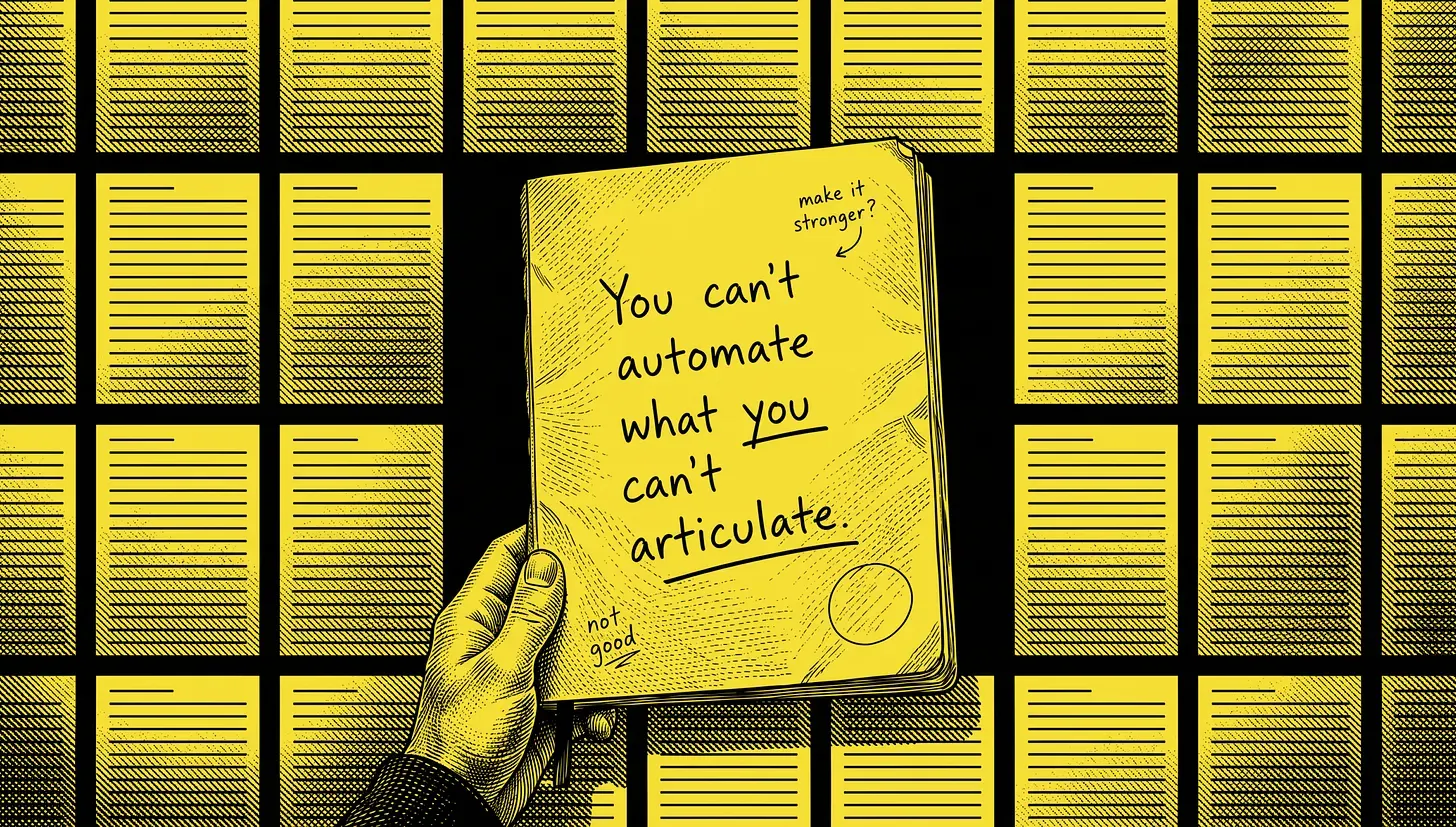
"You can't automate what you can't articulate."
If you have no clear grasp of what you experienced or what stance you hold, asking AI to do your thinking will inevitably produce nothing but generic, boilerplate platitudes.
4. The Ultimate Value: Moving Toward Genuine Original Thinking
Distinguishing between common knowledge and personality material is not just about writing a smooth essay; it is about establishing a long-term virtuous cycle of accumulating personal assets and deepening your thinking.
1. The Reuse Cycle of a Personal Material Library
What Cole calls a "Personal Language Model" or "Digital Brain" refers fundamentally to a long-accumulated, personally validated repository of your own written and spoken material—it does not require training a new technical model from scratch.
This cycle repeats continuously:
- Capture and Document: Translate your experiences, lessons, and endorsed viewpoints into text.
- Machine Reuse: Let AI assist in reorganizing, formatting, and distributing known material.
- Free Up Capacity: Relieved from repetitive typing, the human author re-invests in living new experiences and forming new thoughts.
Those new experiences and reflections flow back into documentation, continuously enriching the repository.
Beyond serving as AI input, making these assets public creates high-leverage assets directly for your readers. In day-to-day life, you might find yourself repeating the same anecdote or perspective during one-on-one coffee chats with different people; once documented as public material, anyone can asynchronously access your "digital brain" anytime, anywhere, without requiring your personal repetition.
Once a writer establishes this accumulation mechanism, past stories and core stances can be read directly by readers or remixed by machines, freeing up the writer's time for higher-value creative endeavors.
2. The Two Paths to Original Content
Above common knowledge and personal stories, the pinnacle of writing is producing Original Content. While personal experience creates differentiation, true originality demands that an author contribute incremental, novel understanding.
Cole summarizes two paths to achieving original thought:
- Say something different: After diving deeply into a specialized domain, arrive at a new thesis or perspective that predecessors have not articulated.
- Say the same thing in a meaningfully different way: For a truth everyone already acknowledges, provide an entirely new body of supporting evidence, a novel structural framework, or a model with superior explanatory power.
Original thinking cannot be achieved by flitting across superficial topics; it requires continuous depth and writing within a few focused verticals. Delegating the reassembly and formatting of foundational common knowledge to AI ultimately serves one goal: giving humans the cognitive bandwidth to refine new ideas and uncover novel connections, thereby expanding the frontier of knowledge in their field.
5. Reusable Practical Toolkit (Takeaway Toolkit)
Note: This toolkit is adapted from Nicolas Cole's five material variables, the sculptor's workflow, and the integration of common knowledge with personality material. It is designed for direct implementation in your human-AI writing workflow.
Scope of Application: The following workflow is especially suited for personal essays, business commentary, retrospectives, and opinion-driven articles that depend heavily on authorial distinctiveness. If you are writing objective status reports, standard technical documentation, or pure reference compilations, your priority should be clarity and accuracy; you should not force personal narratives where they do not belong.
Tool 1: Personality Material Self-Extraction Checklist (Spend a Few Minutes Before Writing)
Before handing a task to AI, quickly work through these 4 questions. It is entirely acceptable to answer "None" or "Not applicable"; if you lack experience in a certain area, leave it blank. Never fabricate stories for narrative effect.
## Writing Topic: [e.g., How to handle communication pressure when managing a team for the first time]

1. My Factual Life and Work Experience (Life Facts):
   - In what context did I engage with this? (e.g., Became a team lead 6 months ago, managing a team of 4)
   - [If no specialized background, simply write: Standard process followed, no unusual background]

2. My Stance on Common Industry Wisdom (Opinions):
   - What are the prevalent generic recommendations on this topic?
   - Which one do I personally endorse? Why? (e.g., Rather than "increasing 1-on-1 meeting frequency," I favor "defining task boundaries first")

3. A Concrete Experience with Real Context (Stories & Insights):
   - What specific complication or unexpected situation did I encounter in practice? (Specify time, parties involved, initial plan vs. actual outcome)
   - [If there were no major complications, describe the actual workflow of a routine collaboration]
   - Which principle did this experience help me understand more concretely? Which detail supports this insight?

4. How This Changed My Practice (Lessons):
   - Following this event, how has my workflow or review checklist changed compared to before?
Tool 2: "Marble Sculpting Method" Human-AI Collaborative Prompt Template
Paste your notes from Tool 1 or a raw dictation transcript into the prompt below and send it to your AI. The primary purpose of this prompt is to establish clear factual boundaries and prevent the model from hallucinating details:
You are an expert developmental editor and editorial consultant.

[Background & Objective]
I am writing a piece on "[Insert Your Topic]".
I do not want this article to be filled with generic platitudes. Grounded in my personal experiences and positions, I want to create a tightly reasoned, naturally narrated in-depth essay.

[My Raw Material Input]
Below are my core notes on this topic (including my experiences, opinions, and concrete observations):
---
[Paste your notes from Tool 1 here, or paste a raw dictation transcript directly]
---

[Processing Rules & Constraints]
1. Strict Prohibition on Fabricating Facts and Experiences: All personal stories, workplace examples, concrete metrics, and key lessons mentioned in the text must be strictly derived from my [Raw Material Input]. If there are gaps or logical leaps in the material, ask me in the outline or insert placeholders. Under no circumstances should you invent life details, professional history, or business figures not mentioned by me.
2. Act as a Sculptor: Clean up my raw notes, eliminate repetitive ramblings, and clarify the progressive logical flow of the article.
3. Sensibly Incorporate Generic Background: To ensure readability and coherence, you may integrate necessary baseline background knowledge or standard frameworks, but keep them secondary—use them only to contextualize and elevate my authentic experience.
4. Tone and Style:
   - Reject bureaucratic jargon: Avoid empty clichés like "it is evident that," "in conclusion," "it is undeniable that," or "a double-edged sword."
   - Maintain a natural, conversational tone: Use active voice and direct, concrete phrasing.

Please first provide a structural outline and core paragraph concepts. Wait for my confirmation before proceeding to write the full draft.
Tool 3: Four-Step Post-Draft Self-Checklist
After receiving a draft generated or edited with AI assistance, evaluate it against this checklist:
- [ ] The Masked-Name Test: If your name were removed, could a colleague or friend recognize that this piece was drawn from your experience? If the entire piece could just as easily apply to anyone in your industry, it lacks personality material and needs more concrete context from you.
- [ ] Factual Fabrication Audit (Critical): Carefully review every anecdote, timeline, team size, and causal story in the text. Did the AI invent events or stances you never experienced or expressed just to heighten drama or smooth transitions? If found, edit or remove them immediately.
- [ ] Commodity vs. Personality Balance: Does the piece spend the majority of its length rehashing universal common knowledge? Ensure that generic concepts are distilled concisely, leaving ample room to unpack your specific methods and firsthand observations.
- [ ] Genre Appropriateness Check: Verify whether the format calls for personal experience. For purely objective research summaries or technical manuals, cut out unnecessary personal musings to maintain factual clarity and retrieval speed.
Practical takeaway
Scroll through the Markdown, then copy and adapt it to your team.
Loading Markdown…
Members can copy or download the full Markdown, and let their AI subscribe and ask.
Found this useful? Leave your email — every new explainer, the moment it's out. Unsubscribe anytime.