a16z Report: Neoclouds Are Raking In Capital—Will Horizontal SaaS Disappear?
Across 16 charts, a16z examines Neocloud infrastructure, horizontal SaaS, enterprise Token usage, and the talent race among frontier AI labs—and asks how massive AI spending turns into durable returns.
- Neoclouds are growing at exceptional speed, but depreciation, financing costs, utilization, and customer concentration determine whether that growth becomes durable cash flow.
- AI is not erasing SaaS evenly: products with proprietary context, trust, or AI-created demand have a stronger position than generic tools built mainly around seats and interfaces.
- Cheaper Tokens do not guarantee a smaller bill. Routing can lower cost per task while lower prices unlock more workloads and expand total usage.
- High compensation can attract scarce AI talent, but salary and hiring-flow charts cannot prove culture, research quality, or a lasting organizational moat.
a16z Puts Four Battlegrounds on the Same Ledger
a16z's latest weekly chart report uses 16 charts to examine four battlegrounds: Neocloud compute providers, horizontal SaaS, enterprise Token usage, and the competition for talent among AI labs. They may look unrelated, but all record the same transition: AI capital is moving from "believing in the future" to "checking the books."
That does not mean the four sectors can be measured with the same ruler. Neoclouds must be judged by whether heavy assets earn their cost back; SaaS by whether workflow value is being redistributed; Tokens by both unit price and volume; and talent data can show only compensation and movement. The shared question is merely a map: the spending has happened, and now we must ask how it becomes revenue, efficiency, and durable advantage.
The most important investment, and the one that needs to be explained clearly first, is the computing infrastructure.
What exactly is Neocloud? Don’t rush to see growth yet
01 · Let’s look at the most important sum of money first
Suppose a AI company wants to train a model. It requires not just a batch of GPU, but also enough power, a data center that can put down the machines and continuously dissipate heat, a high-speed network connecting thousands of cards, and an operation and maintenance team to make the entire system run stably. Of course, it can build it from scratch, or it can directly rent a set of computing power that is already ready for construction from a company like JIEDU PROTECTAEND.
**Neocloud is the latter business. ** It is not a trendy nickname for "small AI", but a new group of cloud vendors that organize their capabilities around AI and high-performance computing. They package GPU, power supply, computer room, network and operation and maintenance into usable computing power, and then sell it to model companies and enterprises. CoreWeave, Nebius, Applied Digital, IREN are the companies focused on in this set of data. This name is not a strict regulatory or accounting classification, but a common label given by the market to a group of similar companies.
Drop the unfamiliar words to the ground first
Traditional cloud sells "general computing", Neocloud first solves "GPU production capacity"
AWS, Azure and Google Cloud provide complete services such as database, storage, network and general computing; Neocloud has a narrower starting point and first solves the most urgent needs of GPU, power and high-density computer rooms. Narrow means that it can expand faster around an explosive demand; it also means that revenue is more easily tied to a few large customers, a few chip suppliers and a hardware cycle.
Neocloud is not the first time that old infrastructure has been turned into a starting point for new industries. There have been at least three similar asset revaluations in history: railroad companies converted land rights along the routes into communication lines; natural gas companies turned idle pipelines into fiber optic channels; and cable TV companies upgraded coaxial cables into broadband networks.
The underlying assets existed first, then new communication needs broke out, and those who could complete the transformation and operation turned it into another business.
Four asset revaluations share the same structure
The underlying asset exists first; demand surges later. The scarce capability is not owning a particular asset, but converting and operating it as new productive capacity.
This historical analogy explains why they took off so quickly, but it does not prove that they will become the next generation of large clouds. Railway rights-of-way and underground pipelines can be used for decades, but GPU will quickly depreciate after the emergence of new generations of chips; communication networks face a wide range of customers, and Neocloud's early revenue may also be highly dependent on a few large customers. The analogy should stop here, and we must look at the data next.
Look at Neocloud, don’t just focus on one curve
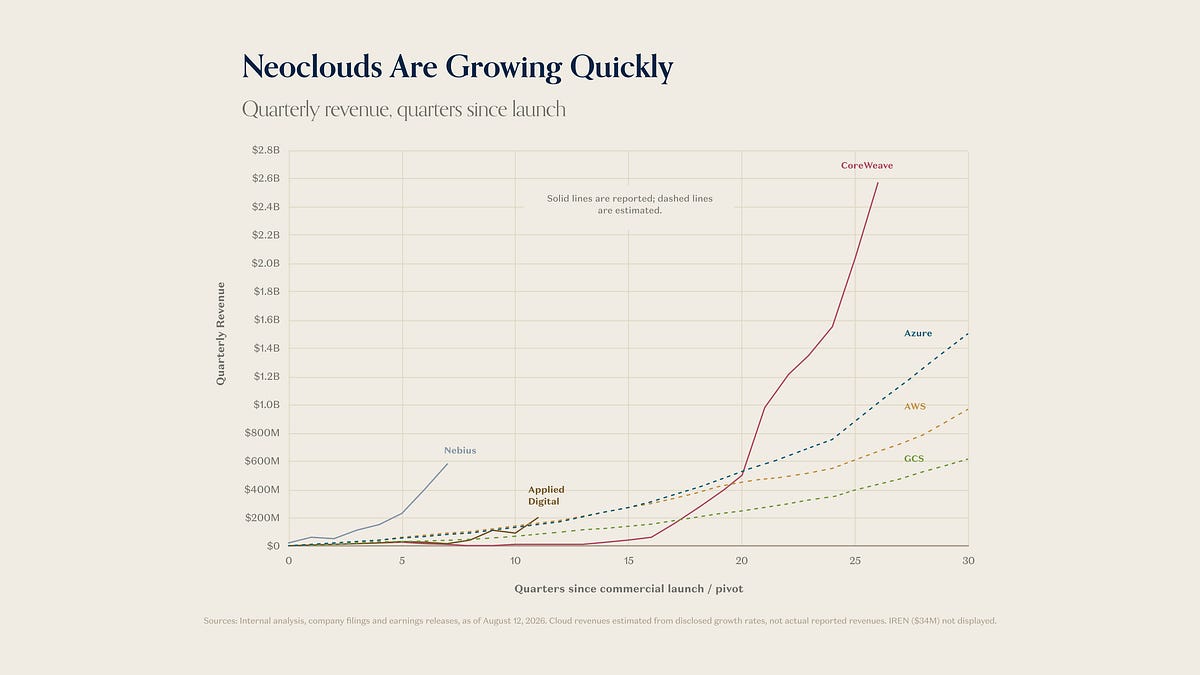
Start with speed. Figure one compares the early revenue trajectories of CoreWeave, Nebius, and Applied Digital with the quarterly revenue paths of Azure, AWS, and Google Cloud after their respective launches. To make the comparison fairer, the horizontal axis is not calendar time but "quarters since each cloud business launched." In about 25 quarters, CoreWeave reached roughly $2.6 billion in quarterly revenue; early AWS did not reach a similar level until around quarter 40.
This is indeed a rare growth curve, but it also depends on how the graph is drawn. The solid line is realized data, the dashed line contains estimates; inverse values are also available for early large clouds. Therefore, it can answer "who ran steeper in the early days" and cannot be used as an audit of the same caliber, nor can the dotted line be regarded as the future that has already happened.
Data graphs · Click on any graph to see a larger version


Figures two and three bring the excitement back to earth. The first chart answers "how steep is the slope?"; the next charts answer "how large is the business today?" AWS, Azure, and Google Cloud each generate tens of billions of dollars in quarterly revenue, while the Neoclouds still represent only a small part of the cloud market. Both statements can be true: their early growth is unusually fast, and they are still nowhere near becoming another AWS.
If the runway is so large, why have the stocks not risen together? Because stocks trade not on whether demand exists, but on how much of that demand is already priced in. Figure four shows sharply different one-year share-price paths for the four companies; figure five plots revenue growth against EV / trailing-twelve-month sales. Smaller companies growing fastest receive higher multiples. CoreWeave is still roughly doubling, but its valuation is not as steep as companies growing 400%—450%.
There is another accounting issue that is easily overlooked: sales multiple is suitable for visual comparison, but it is not the best tool for evaluating asset-heavy companies. If a software company sells one more subscription, the new cost may be very low; if Neocloud delivers an additional batch of computing power, it often needs to first buy GPU, expand the computer room, connect electricity and raise financing. Two companies that increase their revenue by the same dollar may end up with completely different amounts of cash.
Figure six finally puts cost beside growth. From the third quarter of 2025 to the second quarter of 2026, CoreWeave's quarterly revenue rose from roughly $1.4 billion to $2.6 billion. In the same charts, Capex rose from about $2.7 billion to about $7.1 billion and reached roughly $8.2 billion in between. Capital expenditure remained above quarterly revenue throughout this expansion period.
But you cannot subtract $7.1 billion directly from $2.6 billion of revenue and declare a $4.5 billion quarterly loss. Capex purchases assets used across multiple quarters; it does not enter the income statement all at once. Its cost returns gradually through depreciation and financing expense. CoreWeave's primary filings show second-quarter 2026 revenue of $2.575 billion, net interest expense of $0.640 billion, and a net loss of $0.626 billion. Based on the half-year totals, quarterly depreciation and amortization works out to about $1.393 billion, close to 54% of quarterly revenue. That final amount is calculated from cumulative disclosures; it is not a standalone quarterly line item directly reported by the company.
That still doesn't automatically prove it's a bad business. High capital expenditures may also be ahead of schedule in building earning capacity for the next year. The real question is how long these machines can be used in the future, how high the utilization rate can be maintained, at what price they can be rented, and how much financing costs will be incurred before the revenue comes in.
Neocloud is not "growth is still fake, costs are real". Quite the contrary: growth and costs are both real, and the suspense is whether growth can ultimately outperform capital consumption.
This business ultimately has to calibrate three clocks simultaneously: demand fulfillment, asset recovery, and capital repayment.
The same batch of assets must outperform three clocks
If any one falls behind, the already built computing power may turn from a barrier into a burden.
Will the planned changes of a few large customers suddenly make new production capacity available?
Now that a new generation of chips has emerged, for what price will the old GPU still be available for rent?
How much funding will be needed for the next round of expansion?
Three bell bite:Demand, utilization and cash flow must arrive in the correct order.
The judgment obtained in this chapter is: when looking at JIEDU PROTECTAEND, you can't just look at the growth rate, nor just the debt. Demand realization, asset recovery and fund repayment must be placed on the same table.
AI does not “kill SaaS” {#saas} evenly
02 · After production capacity, see how software is revalued
If Neocloud sells the production capacity required by AI, then SaaS sells the workflow that companies use every day. Horizontal SaaS refers to general-purpose software that can be used across industries, such as collaboration, project management, CRM, or HR tools; as opposed to vertical software that only serves specific industries such as hospitals, restaurants, construction companies, etc.
Why is horizontal software first viewed with suspicion by the market? Because their most common selling points, including interface, common processes, information organization, and per-seat pricing, also happen to be the easiest parts of generative AI to remix. Investors are worried that enterprises may use AI Agent to complete part of the work in the future, reduce software seats, or even spell out lightweight tools that they originally had to purchase. This collective concern has an exaggerated name: “saaspocalypse.”
Note that this discount does not necessarily come from the current performance being broken. The software company's quarterly revenue may still grow, and renewals may be normal; the market is worried about a few years from now: if JIEDU PROTECTAEND reduces development costs, makes switching easier, and compresses the value of seats, can today's high gross profits continue? So the stock price will move before the problem actually arises in the earnings report.
In the past month, Atlassian's horizontal stock rebounded, and Atlassian also gave a set of interesting counter-evidence: both revenue and profit exceeded expectations, and the company subsequently raised its guidance; the cloud business grew 31% year-on-year, and the backlog of orders grew faster. Even more critical is Rovo: Customers using this AI assistant saw spending grow nearly twice as fast as customers who didn’t.
This data is important not because it proves that all AI features make money, but because it shows another path: AI does not necessarily bypass existing software, but can also increase the depth of usage and customer spending of existing software. Atlassian already has customers, permissions, work records, and collaboration relationships. Instead of finding context from scratch, Rovo calls them within the existing work system.
So the question changed from "Will AI kill SaaS" to "Which software can turn AI into an increment, and which software will be deprived of value by AI".
Three pictures should be read in succession: rebound, discount, and category differentiation


Figure seven shows that horizontal SaaS stocks have indeed rebounded recently. Figure eight, however, shows that most still sit below the trend line when next-quarter revenue growth is compared with forward revenue multiples. The charts do not conflict: one says the market corrected its most extreme pessimism; the other says the long-term doubt remains. One good month does not mean the "saaspocalypse" has been cancelled.
Figure nine separates software by category. Cybersecurity and observability clearly led over the past year—not because they suddenly stopped being SaaS, but because AI acts more like a demand amplifier for these products. More generated code, more Agents, and more system connections increase both the attack surface and the difficulty of troubleshooting. Companies will not stop buying security products merely because employees can vibe-code.
An earlier set of software differentiation data adds another layer: Vertical JIEDU PROTECTBEND often has industry-specific processes, data and customer relationships, and network security has a trust threshold; general horizontal tools are more likely to be considered that "the software itself is not a moat". This is still a market judgment, not the final fact, but it explains why the valuation of the same JIEDU PROTECTAEND will go in a completely different direction.
Also called SaaS, AI may push it in three directions
The number of seats and the value of standalone tools may be compressed.
As products become more usable, customer usage and spending increase.
Categories such as security and observability gain new reasons to buy.
The verdict for this chapter is: AI does not kill or save SaaS equally. It's redistributing value by workflow: products that provide proprietary context, trust, or new needs have a better chance, and products that only charge for generic features and seats have a harder time explaining the future.
Token The cheaper it is, the smaller the bill may not be
03 · Behind the software, the units that are really consumed
When an enterprise first connects to AI, the simplest strategy is to hand over all tasks to the strongest model, or give engineers a budget to decide on their own. But the mission is different. Changing a date format and locating a complex code fault require different reasoning capabilities. If all the most expensive models are used, a large amount of budget will be spent on areas that do not require the strongest capabilities; if all cheap models are used, difficult tasks may fail.
Why is there Smart Router?
Not every question deserves the most expensive model to answer.
Simple format conversion can be left to cheap models, and complex code problems can be left to strong models. Smart Router of Databricks will first determine the task and then route it to the appropriate model. On this set of coding tasks, it averages about 2.13 dollars per question, and the problem solving rate is 92.3%; compared with the reference strong model combination, the cost is about 35% lower, and the problem solving rate is 1.3 points higher. These are specific test results and do not represent all real-world workloads.
This is the so-called efficiency frontier: spend as little as possible for the same quality, or maximize the quality for the same budget. It is not about finding a model that is always the best, but about arranging different models for different tasks. So cheaper, less powerful models have not lost value as cutting-edge models advance; instead, they have become the layer in the entire routing system that handles a large number of common tasks.
Do the math with your own hands: Why does the bill get bigger when the unit price drops?
50% is that the unit price is reduced by half.
More employees, processes, and agent loops all increase usage.
The four pictures answer in turn: how to save, how prices change, where the money is spent, and whether it is related to growth.


Figure eleven discusses Token price intensity, not how much the market spends in total. An index can fall as cheaper models gain share even while Token volume and total dollar spending continue to rise. The claim "each Token is cheaper" does not imply "AI company revenue will fall" unless usage is included.
It's a lot like the Jevons effect. After steam engines became more coal-saving, coal did not stop people from buying it; higher efficiency made it worth using in more scenarios, and demand may eventually expand. Same thing with AI: going from ten dollars to a dollar for a task not only saves nine dollars on the original task, but it also potentially brings nine tasks that weren't worth automating before into the budget for the first time.
Figure twelve shows the real-world distribution. In Ramp's sample, per-employee AI spending is rising at every tier, but the gap between leaders and ordinary companies is enormous: spending per employee among the top 10% is about 50 times the median, and the very top tier is again well above the top 10%. "Enterprise AI adoption" is not a switch. Some companies buy a few chatbot seats; others integrate models into products, support, R&D, and automation workflows.
Why are leading companies willing to spend so much? One explanation is that they have already found workflows that create value: deeper use makes the returns clearer and supports the next round of investment. BCG grouped 107 listed technology companies with more than $500 million in annual revenue. Median revenue growth was about 5.1% in the lowest quintile of Token use and about 16.5% in the highest. Figure thirteen is therefore tempting—and demands the most restraint.
It does not prove that "buying more Token will increase your income." Companies with faster growth and stronger technical capabilities are likely to adopt AI earlier; industry structure, capital strength and management level may also affect both. What is confirmed here is a correlation and a direction worth pursuing: high-intensity usage does not come with obvious growth penalties, and at least some companies are already willing to vote with real budgets.
Putting the four pictures together, the logical chain is complete: routing reduces unit task costs; lower costs allow more common tasks to be available; new scenarios increase the total amount of Token; companies that use it the most have more reasons to continue investing. Efficiency and demand are not seesaws; they may reinforce each other.
The judgment obtained in this chapter is: "Token becomes cheaper" only describes the price, not the market. What really determines AI spending is how quickly prices drop, how quickly usage grows, and whether businesses can find enough rewarding new tasks.
High salary can buy talents, but it cannot prove the moat
04 · The last money, buy the most scarce people
The “AI Lab” here is not the AI department of an ordinary company, but a laboratory for training cutting-edge basic models such as Anthropic and OpenAI. They are not just calling ready-made models, but deciding how to train the next generation model, what data to use, and how to evaluate and deploy it. There are very few people who can understand research, distributed systems, and productization at the same time, so talent has become another scarce capacity in addition to computing power.
Anthropic CEO Dario Amodei was worried that employees in the industry were starting to put money before mission. The data submitted by Levels.fyi shows that the total salary of Anthropic's engineers is at a very high level. The two things are not contradictory. The mission helps the organization attract fellow travelers, and high salaries ensure that candidates do not have to pay a huge market opportunity cost to join the mission.
To read figure fourteen, first understand "total compensation." It is not only salary, but base pay plus equity, bonuses, and other awards. In the chart, Anthropic's total compensation rises from roughly $375,000 at a lower engineering level to about $1.3 million at a senior level. Equity and bonuses matter more at higher levels. The figures are striking, but equity valuation, vesting schedules, and liquidity all affect what that compensation is ultimately worth.
The three pictures only answer "how much, relative amount, and where it comes from", but do not directly answer "whose organization is stronger?"


Figure fifteen tries to make the comparison fairer by aligning roughly comparable engineering levels at Anthropic, Google, and Tesla. Anthropic is clearly higher in the chart, but "comparable level" does not mean identical jobs, and private-company equity is harder to price than public stock. Levels.fyi data is user-submitted and the sample is small, so it is useful for judging the order of magnitude—not as a complete compensation census.
Figure sixteen asks a different question: where do these labs recruit from? OpenAI and Anthropic both draw talent from large technology companies, other AI teams, and software companies such as Salesforce and Stripe; Databricks, Snowflake, Palantir, and DeepMind appear as shared sources. In the chart, Anthropic draws more from SaaS companies, while OpenAI draws more from consumer internet, marketplaces, and ad-tech companies, with hiring from Nvidia and Tesla during the period shown.
This difference makes it easy to speculate: Is Anthropic more focused on enterprise software culture, or is OpenAI more focused on consumer products and large-scale distribution? But the data don't yet support a single explanation. The source of recruitment can only indicate the flow of personnel, but cannot independently prove the strategy, let alone whose research quality is better.
Real organizational advantage also depends on how these people collaborate, how computing resources are allocated, whether research results make it into products, whether key personnel stay on long-term, and whether teams can make consistent choices between security, speed, and business pressures. These are outside the scope of proof of salary diagrams and recruitment flow diagrams.
Salary graph can answer what order of magnitude the market is willing to pay for scarce talent You can also see changes in the composition of cash and equity.
The salary chart cannot answer who has better culture and stronger research There are limitations to the sample, job matching and equity valuation.
The flow chart can answer from which industrial experience talents move in It can help formulate hypotheses about organizational capabilities.
The flow diagram cannot answer What results did these experiences finally produce The source company is not a surrogate indicator of the performance of the new organization.
The conclusion drawn from this chapter is: money is the ticket to cutting-edge laboratories, not proof of championship. Salary can buy talent options, and it is the organizational mechanism that determines whether these options can eventually be turned into sustained research and product advantages.
AI Didn’t cool down, just started to change the way of accounting
05 · Putting the four chapters back together
This is a multi-topic weekly report, not a paper that proves one thesis from beginning to end. The four sections examine different objects and cannot be measured with one ruler: Neocloud is an asset-intensive business; SaaS is about software moats; Token analysis is about price and volume; and the talent charts observe only compensation and employee flows.
But when we put the four chapters side by side, we can still see a common change: AI is moving from the first stage of "who dares to invest" to the second stage of "who can turn investment into returns." Common questions are just a map and are not a substitute for each chapter's own answers.
How fast does computing power account** income go? ** Also ask how much headroom is left for depreciation, interest and customer concentration.
Is software account **AI a replacement or an increment? ** The answer depends on the specific category, not the big label SaaS.
How much cheaper is Token account** per call? ** It also depends on whether usage expands faster.
Can the talent account** recruit experts? ** It also depends on whether the organization turns compensation into continuous output.
Therefore, the most important value of this 16 chart is not to predict which stock will rise, nor to prove that AI has delivered on all its promises. They give readers a more mature method of asking questions: when they see the amazing growth, look at the cost and payback cycle; when they see the rebound of the software, they look at the specific workflow; when they see the JIEDU PROTECTAEND price reduction, they look at the usage; when they see the high salary, they look at how the organization turns people into results.
In the first stage, capital believes in AI, so money pours in; in the second stage, money has already come in, so every transaction must begin to explain itself.
Four Ledgers for Following AI Capital
The 16 charts appear to cover compute, software, tokens, and talent. They are really asking one question: capital has gone in—can it come back as revenue, efficiency, and durable advantage?
Four arenas, four ways to keep score
- NeocloudsRevenue growth must be read alongside what GPUs, data centers, depreciation, and interest consume.
- Horizontal SaaSAI may replace features, strengthen workflows, or create demand. The sector cannot be written off as one block.
- TokensA lower unit price does not guarantee a smaller bill; usage and new tasks may expand faster.
- AI talentPay and hiring flows show competitive intensity, but not research output or an organizational moat.
Neocloud growth must pass four ledgers
- GrowthEarly revenue curves are steep, but realized results and estimates must remain distinct.
- ScaleRunning fast is not the same as already being large; absolute scale still trails the hyperscalers.
- ValuationStrong demand does not guarantee a rising stock price when growth is already priced in.
- CostCapex returns over time as depreciation and financing cost; it cannot simply be subtracted once from revenue.
SaaS is splitting by workflow, not disappearing wholesale
- ReplacedGeneric features, lightweight tools, and value tied only to seats are easier to displace.
- EnhancedSoftware that already owns customers, permissions, and work history can deepen usage with AI.
- New demandMore code, agents, and system connections expand demand for security and observability.
The token bill has one core equation
- Unit price fallsRouting and cheaper models reduce the cost of each task.
- Usage expandsTasks that were not worth automating begin to enter the budget.
- Total spend resetsSpend equals price times usage. Halve price and quintuple usage, and the bill still reaches 2.5 times the original.
Take away one rule
When growth looks astonishing, add cost and payback. When software rebounds, inspect the workflow. When tokens get cheaper, check usage. When pay soars, ask how the organization turns people into output. AI is not cooling; every dollar invested is simply being asked to explain itself.
The Money Is Already in AI—How Do We Audit the Returns?
The four arenas need different yardsticks, but all must answer: how does investment become return?
Growth and cost are both real. The question is whether demand can outrun the depreciation and financing clocks.
AI is not killing SaaS evenly; it is reallocating value workflow by workflow.
Halve the unit price and quintuple usage, and total spending still rises to 2.5 times the original.
High pay buys access to talent, but cannot by itself prove research output or a durable moat.
AI is not cooling. Capital is already in the market, and every dollar now has to explain itself.
Members can copy or download the full Markdown, and let their AI subscribe and ask.
Found this useful? Leave your email — every new explainer, the moment it's out. Unsubscribe anytime.