
Claude Opus 5.5 Released: Major Upgrades in Coding, Vision, and Writing, Beating Fable 5.1 Across Multiple Benchmarks at a Much Lower Price | Hands-On Case Studies
Combining official charts, X videos, and a week of hands-on testing by Every, see which longstanding issues it resolves, what creations it produces, and what it feels like in day-to-day use.
Anthropic has released Claude Opus 5.5. This upgrade spans complex coding, vision and interactivity, knowledge work, and the frequently criticized writing experience. In Anthropic's evaluations, its Terminal-Bench score reached 66.4%, beating Fable 5.1's 55.8%; CursorBench scored 57.8% versus 51.8%. Continuously solving problems across a codebase and delivering complete creations from a single prompt are its two most noteworthy capabilities.
Pricing also reshapes the equation: Opus 5.5's API input and output unit prices are $4 and $20 per million tokens, respectively—both 60% lower than Fable 5.1's $10 and $50. Compared with the previous-generation Opus 5, Anthropic claims typical task costs are roughly 40% lower, with output speeds more than 30% faster.
In daily workflows, these upgrades manifest as:
- Coding: Better suited for driving full tasks forward continuously. Multi-file edits and extended engineering tasks are more reliable; the default medium tier on CursorBench already surpasses Fable 5.1's highest tier. For general tasks, starting with medium is a solid choice.
- Vision and interaction: Moving from "building a page" to creating more complete works. An underwater exploration game, hand-drawn animation, an adjustable catapult, and brick-building tools connect visuals, controls, and feedback into a coherent experience.
- Knowledge work: Better retrieval, synthesis, and delivery of complex material. Performance has improved across earnings report verification, M&A modeling, and cross-application workflows; another professional benchmark reached 1846 Elo, topping Fable 5.1's 1735.
- Writing: Less beating around the bush, leading with key information, and greater adherence to your style rules. The new version is more receptive to feedback and relies less on clichés; in documentation and explanations, essential details surface earlier.
Writing Upgrades: Fewer Clichés, Leading with Clarity
The "AI-isms" of Opus 5 were a frequent complaint: answers led with extensive background, stacked jargon and clichés, and buried key takeaways at the end; ask it to revise a couple of sentences, and it might spend time defending and explaining its original wording. Testers at Every noted that explanations from the older model often "required an explanation of their own." In documentation or long-term collaboration, this meant spending excessive time following up and editing drafts.
Opus 5.5 primarily overhauls this communication dynamic. Anthropic claims it surfaces essential information up front, cuts convoluted phrasing, and adheres more faithfully to user-specified writing guidelines. The official billing debug example illustrates this shift clearly: the new model immediately identifies where the monetary discrepancy comes from before explaining what went wrong in the code.
Pinpointing the Same Bug, but Leading with Impact
Both models identified the exact same billing bug: the code set the end-of-month cutoff to "midnight at the start of the final day," omitting that entire day's usage.
The difference lies in narrative order. Opus 5 begins by identifying which commit introduced the issue, displays the code, explains the time window, and only then describes the impact of the omitted billing and why tests failed to catch it. Opus 5.5 states right from the start: of the billing drop, $1.50 stemmed from free-tier adjustments, while the other $9.92 resulted from the bug, which left the last day of the month unbilled. Readers grasp the magnitude of the impact first, before inspecting the code for the cause.

Anthropic also highlighted two other comparisons. In summarizing a Slack discussion, both models used a three-item checklist, but the new version clearly delineated assignees and completion statuses across "issue, immediate action, and long-term fix" for easier tracking. When explaining a chess program, the new version framed the design around "whether any piece blocks the path between two squares": recording intermediate squares with a bitmask, then counting blockers—an attack is valid only if that count is zero. It anchored technical mechanics directly to the core question readers need to understand.
More Natural Phrasing, but Long Forms Can Still Meander
Early tester Theo Jaffee compared responses from both models using the identical prompt: "explain how options work." He found Opus 5.5's prose more direct and natural, trimming distracting clichés. At the time of retrieval, the post had around 1,300 likes.
The previous version opened with "contracts for future transactions" and high-level concepts before laying out definitions, types, and extended arithmetic examples. The new version provides definitions and premiums right in the opening paragraph, then cleanly separates types, terminology, upside versus downside scenarios, and breakeven calculations. The difference is the reading sequence: grasp what an option is first, then explore classifications and worked examples.


Enterprise feedback mirrors everyday writing workflows. Ramp engineer John Ruelas noted that the new version adheres better to team writing guidelines, requiring minimal edits on design docs; a rewritten prompt it suggested was even preferable to his original. Box's Yashodha Bhavnani stated that in their internal evaluations, Opus 5.5 consumed roughly one-third the tokens of Opus 5 and reduced verbosity by about 40% while preserving accuracy.
Tech publication Every's hands-on evaluation placed greater weight on a smoother collaborative flow: the new version readily incorporates revision suggestions, builds smoothly on supplied materials, and articulates trade-offs more clearly.
Every measured an English Flesch-Kincaid Grade Level of 6.95, below Opus 5's 7.97 and Fable 5.1's 7.43—roughly corresponding to a US seventh-grade reading level; its Reading Ease score reached 68.4. This metric gauges how accessible English words and sentences are to read.

Writing still carries a noticeable blind spot: the language is easier to parse, but the main point does not necessarily arrive any sooner. In Every's article-opening test, the new model took 37–39 sentences to express what the author covered in 21; Dan Shipper also observed that while it successfully identifies the most compelling argument, it fails to position it at the very start.
This makes Opus 5.5 well-suited for bouncing ideas around and expanding initial drafts; finalizing a piece still requires checking whether the opening paragraph directly states the core thesis. While the writing upgrade is palpable in compliance and tone, ruthless concision and prioritization still require a human editor.
Demos on X: Games, Animation, and Visual Polish
Developers on X and the Anthropic team quickly shared tangible creations. Games and animations offer the clearest lens for evaluating this upgrade: did it actually bring scenes, controls, and feedback fully to life?
Underwater Exploration Game: Environment, Objectives, and Feedback Form a Cohesive Experience
A demo by Anthropic team member Edwin Arbus garnered around 1,315 likes. He tasked Opus 5.5 with creating a game inspired by the Antikythera mechanism, noting that the entire project is a single ~3 MB HTML file running in-browser via Three.js, with visuals and audio generated in real time purely by code.
The video opens with a boat and a diver before plunging underwater: schools of fish, sea grass, and light shafts establish the atmosphere; a "find three bronze fragments" objective, an oxygen countdown timer, and a sonar mechanic shape the gameplay; uncovering the puzzle reveals a gear mechanism and a completion screen. The significance of this demo lies in how disparate visual and interactive elements align around a shared exploratory goal.
Zombie Game Comparison: Visual Divergence on the Same Prompt
A comparison published by third-party evaluation account BridgeBench collected roughly 653 likes. The author stated both models were given the exact same prompt, explicitly indicating in the voiceover that Opus 5.5 is shown first, followed by GPT-6 Sol.
The first half showcases a more realistic urban shooter setting: reflective pavement, architectural depth, weaponry, and interface elements are notably richer; the second half transitions to simpler blocky characters and a grid-like arena. In a single demo, differences in scene density, art style, and user interface are immediately evident.
Hand-Drawn Animation: Steering Style and Transitions with Predefined Skills
An animation by developer superalesha gathered roughly 478 likes. He asked Opus 5.5 to illustrate the evolution of Claude models, noting that he used his own hand-drawn-canvas-animation skill, with the piece built entirely in vanilla JavaScript.
The video journeys from pencils, paper, and sparkle icons through page flips, pocket-watch gears, blueprint bridges, storms, and colorful transitions, culminating in a simple greeting. It demonstrates how a consistent artistic aesthetic can be sustained across multiple continuous scenes.
Eight Official Explorations: Making Capabilities Concrete
Anthropic also published an early exploration roundup, featuring continuous narrative animations as well as interactive prototypes that accept input and deliver feedback.
Continuous Narrative and Data Reconstruction
The Watermelon Story was created by Kevin Ngo. An ant carries food, plants seeds, weathers a storm, and shares the harvest, forming a roughly 29-second hand-drawn narrative. It showcases sequential storytelling across scenes rather than a single static illustration.
The Earthrise Reconstruction leverages visual cues and public datasets to recreate the historic moment Apollo 8 photographed "Earthrise." Starting from the original photograph, the demo walks through horizon line analysis, positioning, lens fitting, lighting, and film response curves before rendering the recreated view. It weaves visual observation, historical data, and geometric relationships into a single visualization workflow.
Turning Sketches and Visual Concepts into Interactive Interfaces
Kevin Ngo's Penpal reimagines Claude Code as a paper-and-pen styled interface: new sessions appear on a napkin, while project lists, session continuations, and usage metrics maintain concrete functional entry points. Despite the stylistic overhaul, the interface remains organized around real work.

The Catapult evolves from a pencil sketch into an on-desk 3D model. Users can pull back the throwing arm and adjust counterweights to watch projectiles launch and topple blocks. Beyond mere 3D modeling, it embodies an interactive loop of "adjust parameters, observe results."
Tyler Nishida's UI Slot Machine randomly combines interface elements to provide starting points for new applications. Another creation comes from thedesignely: a visual effects controller built around a beetle poster, where tweaking parameters updates textures and deformations in real-time preview. The former sparks novel combinations, while the latter aids in comparing modified effects.
Post-Generation Editing and Reusability
The Brick-Building App accepts a photograph or text prompt and outputs a 3D brick model alongside building instructions. The video displays castle variations after refining the description, layer-by-layer build steps, and parts guides: it attempts to bridge the gap between "looking like a model" and "showing someone how to build it."
Kevin Ngo's Algorithmic Drawing Program generates diverse compositions within a unified art style. Anthropic notes that each illustration uses a distinct random seed; in the sample showcase, the placement of waves, islands, and sunsets shifts continuously while pencil strokes and paper grain remain consistent. For workflows requiring cohesive visual assets, this holds far greater reusable value than a single static output.

How Much Did Coding Really Improve: Default Tiers Are Already Highly Competitive
Beyond visual demonstrations, official benchmarks offer another perspective. The matrix below covers coding, knowledge work, computer use, and chart reasoning. Among them, OSWorld uses partial scoring, while Chartography with tools improved from Opus 5's 83.4% to 89.0%.

"Effort" can be understood as the budget allocated to model reasoning. Higher tiers generally mean more time and cost, but do not guarantee higher scores across every task. A notable shift in Opus 5.5 is that the default medium tier can already accomplish many tasks that previously required high-effort models.
- Terminal-Bench 4.0 evaluates multi-step execution and problem-solving in a terminal environment. Opus 5.5 scored 66.4% at xhigh, compared to 52.3% for Opus 5, 55.8% for Fable 5.1, and 57.9% for Astra. At medium, it scored approximately 58%; according to Anthropic's comparison, this costs roughly one-fifth of Opus 5 max, and only about 40% of the cost for equivalent Astra performance.
- FrontierCode v1.1 examines whether edits meet repository merge criteria in addition to correctness. Opus 5.5 medium scored 54.6%, while max reached 54.4%; medium surpassed Astra's 53.3% at roughly one-fifth the task cost. For tasks like these, maxing out the budget is not necessarily cost-effective.
- CursorBench 4.0 draws from real-user complex multi-file tasks. The medium tier scored 52.5%, already beating Fable 5.1 max's 51.8% and Opus 5 max's 46.6%; relative to GPT-5.6 Sol's 41.7%, it costs roughly one-third as much. Opus 5.5 max pushed performance further to 57.8%, albeit at higher cost.


Feedback on long-running tasks reflects real-world engineering environments. Internally at Anthropic, the model was tasked with rewriting HAProxy from C to Rust: Opus 5.5 took 9.5 hours, compared to 12 hours for Fable 5.1; both passed virtually all regression tests, while Opus 5.5 cost 51% less. The announcement also cited early testers completing a 680,000-line codebase migration in under a day, and auditing and fixing 200,000 lines of legacy code in under 3 hours.
Stripe engineer Cristian Rivera described a different challenge: a complex rebase of 40 stacked PRs. A single Opus 5.5 session coordinated across over a dozen sub-sessions, articulating conflicts clearly; by the following afternoon, all 40 PRs passed CI. Sean Heintz of Clio reported that the model ran continuously for over 18 hours across six repositories, progressing milestones faster with less rework. Progress here encompasses not only sustained execution, but also allowing human engineers to step away and quickly reorient upon return.
Every's Kieran Klaassen also compared both models on an identical Ruby task: Fable 5.1 high wrote 26 lines, whereas Opus 5.5 extra-high wrote 14 lines, omitting explanatory comments he disliked. In his application performance benchmark, code generated by Opus achieved 427 requests/second, satisfying 17 of 20 response time thresholds; Astra's code clocked 463 req/s, meeting 14 thresholds. While Opus exhibited lower peak throughput, it met more latency requirements. This benchmarked the performance of the generated application; Kieran's statement that it had "about 90% of Fable's coding ability" reflects his subjective assessment.
Kieran also used it to build a webcam heart-rate monitor prototype and Cozy Island, a 3D island scene. He felt the extra-high island boasted finer detail and better camera controls, outperforming the Fable version he tested.


Yet polished visuals must still withstand core functional paths. Mike Taylor's voice form task ran for 30 minutes, consuming roughly 5.9 million tokens: while the landing and login pages looked sharp and passed automated checks, opening the build and interview pages threw errors, and the designated AI service was never invoked. Beyond inspecting code, one still needs to manually walk through an application's primary flows.
Knowledge Work: Clearer Research, More Complete Deliverables
On the GDPval-AA v2.1 professional knowledge work benchmark, Opus 5.5 achieved an Elo rating of 1846, surpassing Fable 5.1's 1735 and Opus 5's 1708. Elo reflects relative standing rather than raw accuracy. Based on official performance curves, the medium tier already beats Astra max at an estimated one-fifth the task cost.

Earnings report verification provides a tangible example. Anthropic designed a retrieval task using hard-to-locate web copies of earnings press releases, requiring the model to retrieve facts, author a quarterly report, and verify every number and citation individually. A single hallucination failed the entire report. Opus 5.5 passed in 16 out of 18 attempts, whereas neither Fable 5.1 nor Opus 5 passed this test. Another internal evaluation tasked the model with analyzing a merger between two fictional HR software companies, building an Excel financial model and executive presentation; while both models reached identical valuation conclusions, Opus 5.5 produced more comprehensive, readable deliverables in 63 minutes versus 93 minutes, cutting costs by 50%.
On the cross-application AutomationBench, its score climbed from Opus 5's 26.9% to 40.0%, though it still trailed Astra's 41.4%. Astra also scored higher on scientific agent evaluations: 64.6% versus 58.7%.

In large-scale data collection on the WANDR benchmark, Opus 5.5 climbed from ~31% at low effort to ~72% at max, indicating that complex retrieval can still benefit substantially from higher reasoning budgets.
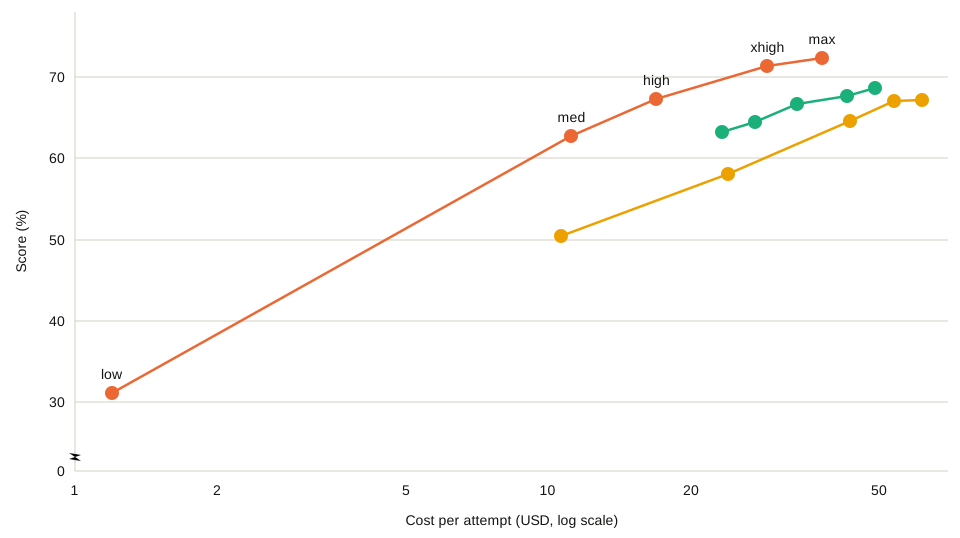
Every's consulting simulations revealed a different dimension: the model negotiated with an agent simulating Dan Shipper, iterating through 12 rounds of revisions before reaching consensus; however, when given a 10-minute time limit to produce a client training run of show, it spent nearly 5 minutes reasoning, then generated training datasets and cross-checked balance sheets, only drafting handouts in the 9th minute—ultimately failing to deliver the minute-by-minute schedule. Being able to iterate persistently does not guarantee prioritizing the right deliverables under tight deadlines.
Cost Reductions: Lower Unit Prices and Fewer Steps to Completion
Anthropic's claim that "typical task costs are roughly 40% lower" comprises two factors: cheaper pricing per token, and fewer tokens required to finish a task. Tokens are the text chunks models process and bill by, and together they determine the final invoice.

| Per Million Tokens | Opus 5.5 | Opus 5 |
|---|---|---|
| Input | $4 | $5 |
| Output | $20 | $25 |
| Cache Read | $0.20 | $0.50 |
| Cache Write | $5 | $6.25 |
Compared to Fable 5.1's $10 input and $50 output per million tokens, Opus 5.5's $4 and $20 rates are both 60% lower.
Agents repeatedly carry system prompts, tool definitions, and conversation context. When reusable prefixes hit the cache, they are billed at the much lower read rate. Consequently, cache share and the number of model turns within a task significantly shift total expenses. The billing calculator below illustrates how cache ratios influence costs under identical usage.
How Does Cache Share Change the Bill for the Same Token Usage?
Calculation example: 1 million input tokens and 100,000 output tokens accumulated per turn, comparing only standard mode unit prices; excludes cache write costs and does not assume the new model uses fewer tokens.
- Opus 5
- $3.90
- Opus 5.5
- $2.96
- Savings from Unit Price
- 24.1%
When 80% of inputs hit the cache, the cost for the same usage decreases by 24.1%.
Formula: Standard input volume × input unit price + cache read volume × cache read unit price + output volume × output unit price. Anthropic's claim of "typical tasks being 40% cheaper" also accounts for changes in token consumption and cannot be derived directly from this fixed-usage example.In standard mode, output generation speed is officially rated at over 30% faster than Opus 5. Claude Code and the developer platform also offer Fast mode, delivering up to 2.5× the generation speed of standard mode, with input and output priced at $8 and $40 per million tokens, respectively. This caters to scenarios where users are willing to pay a premium to minimize latency.
Putting It into Practice: Define the Goal, but Also the Stopping Point
With just a single prompt for a golf game, Every's Tyler Nishida watched the model assemble a collaborative team of one architect, three designers, and three judges, running autonomously for 1 hour and 52 minutes until his test access expired. Screenshots of the finished artifact show thunderstorms, floating islands, a shot clock countdown, and club controls.

Sustained execution also burns through quotas steadily. Testers at Every bumped against weekly usage limits; on another occasion, the model autonomously rejected over 90% of the UI components it had generated, with Tyler unable to discern clear evaluation criteria from its reasoning.
When assigning extended tasks, specify the final deliverables, time or financial budgets, and the exact conditions under which it should stop. Delivering a usable core result first before deciding whether to polish further is consistently more effective than letting the model continuously pile on tasks for itself. Preferences within the Every team varied: some switched back to Claude for vision and product prototyping, while others continue relying on Astra for article editing—the choice hinges on the specific workflow.
Opus 5.5 is now available on Anthropic's developer platform as well as AWS, Google Cloud, and Microsoft Azure, with the API model ID claude-opus-5-5. Five-hour rate limits have been increased across Pro, Max, Team, and seat-based Enterprise tiers, while subscribers receive a banked quota reset that can be activated on demand. Sonnet 5.5 and Haiku 5.5 will roll out in the coming weeks.
On the safety front briefly: Anthropic states its behavioral audit performance has further improved, with production guardrails configured for high-risk tasks; certain requests will be blocked or routed to other models depending on the product and integration surface. For day-to-day work, the most meaningful takeaways remain its heightened execution capabilities, clearer communication, and the reduced time and expense required to finish the exact same job.
Members can copy or download the full Markdown, and let their AI subscribe and ask.
Found this useful? Leave your email — every new explainer, the moment it's out. Unsubscribe anytime.