Claude Fable 5.1 Solves a 370-Year-Old Historical Cipher Mystery: In Just 44 Minutes
Claude Fable 5.1 used adjacent text within the book to solve 64 numbers and advanced a larger 285-number cipher down to just nine unknown letters. What is truly worth understanding is how it selected verifiable problems, found indexing rules, and where it stopped.
Geby Jaff of Vals AI handed a historical cipher that had lain dormant for over three centuries to Claude Fable 5.1. After 44 minutes, 176k tokens, and zero human intervention, the model recovered a Royalist prayer poem from 64 numbers. It did not invent any profound new algorithm; what it got right was reading the cipher back in its original book: the key had been hidden in the pages preceding the ciphertext all along.
The value of this result goes beyond solving an ancient puzzle. It illustrates a category of research tasks well-suited for agents: the answer must be self-verifying, the search process permits substantial trial and error, and the truly scarce resource is sustained attention. At the same time, Fable's handling of another, longer cipher established clear boundaries—9 letters among the 285 numbers remain undetermined, and digital text cannot substitute for physical copy verification.

What Was the Core Mystery to Solve?
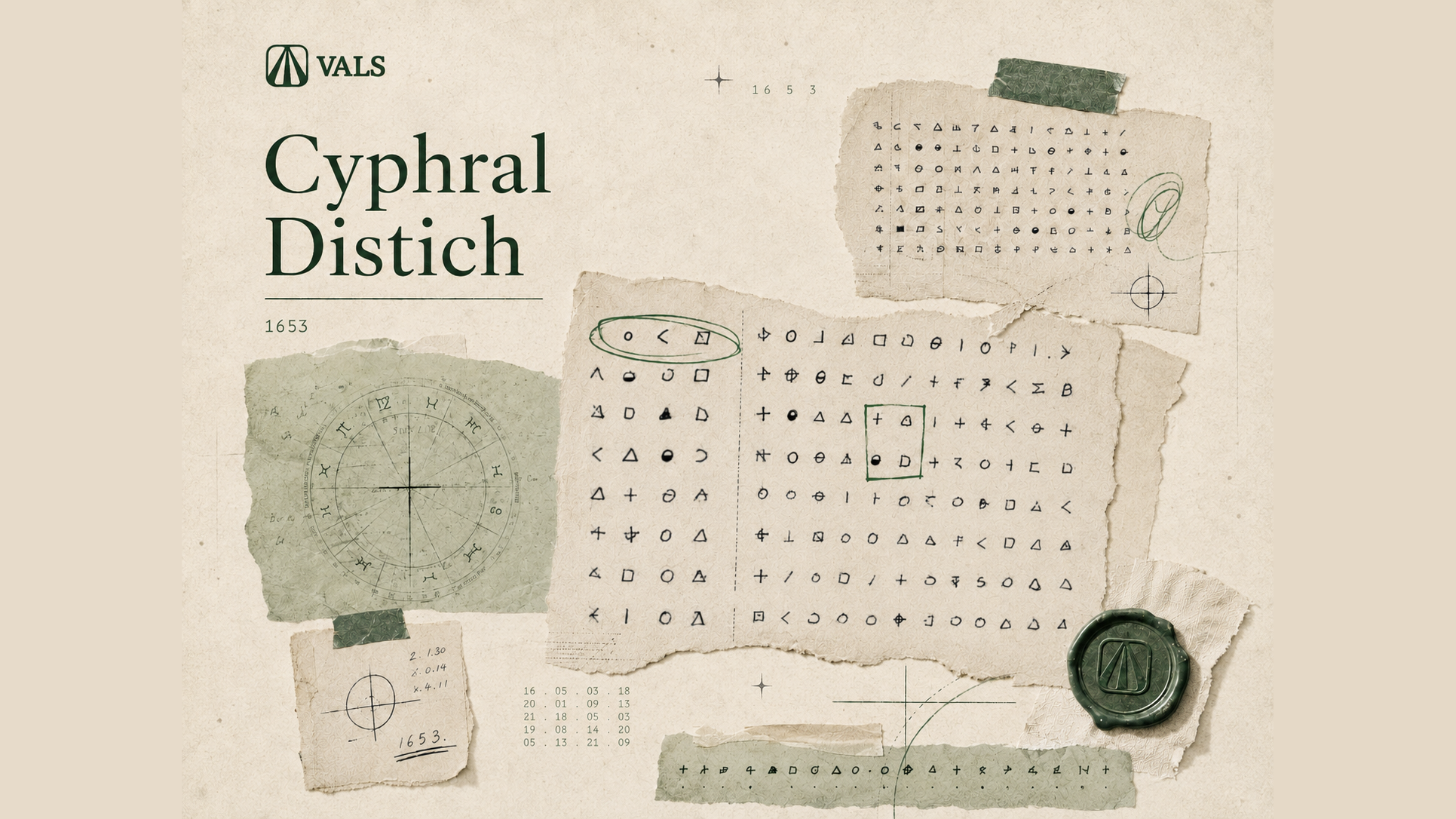
The main puzzle: two lines, 64 numbers in total. This ciphertext, called the Cyphral Distich, appears at the end of Scottish author Sir Thomas Urquhart's Logopandecteision. A distich refers to a two-line poem; yet prior to being solved, all that could be seen were two lines of 32 numbers each:
5.3.27.38.32.14.21.8.66.8.70.39.5.9.12.18.2.3.56.5.1.7.3.2.13.19.3.25.9.3.16.6.
25.15.13.6.11.20.5.1.2.12.1.20.20.49.20.20.35.33.4.6.8.35.5.33.5.5.18.10.3.11.32.42.
What was truly missing was the key. The 64 numbers did not tell readers what kind of cipher was used, what underlying source material served as the base, or even guarantee that only one seemingly coherent answer existed.
Past attempts were stuck on the approach. This puzzle was posed as an open question in Notes and Queries in 1899, later entered 20th-century cryptographic literature, and was included by historical cipher researcher Klaus Schmeh on his list of 50 unsolved encrypted messages. Approaches such as frequency analysis, simple substitution, and homophonic substitution all failed to work.
These failures concealed a mistaken direction: people treated the numbers as an independent cryptosystem, attempting to reconstruct an alphabet or a fixed mapping from numbers to text from the outside. But if the numbers point not to an external cipher table but to the book itself, analyzing the ciphertext divorced from context amounts to voluntarily throwing away the key.
How Did the AI Crack It? Key Solving Ideas
Rather than searching for a more complex cipher algorithm first, Fable placed the ciphertext back into the original book. Three "32"s and a wishes pointed the key to the preceding text; from there, it only needed to establish an indexing scheme and let the answer verify the rules in reverse. The entire cracking process can be broken down into three consecutive steps.
Step 1: Three "32"s and a wishes Point the Key to the Preceding Text
The first set of clues came from position and quantity. The Cyphral Distich immediately follows 32 Proquiritations; Urquhart even specifically emphasized that no number could be found more fitting than "two and thirty." The first line of ciphertext contains 32 numbers, and the second line also contains 32 numbers. Thus, the 1st number in each line could correspond to the 1st Proquiritation, the 2nd number to the 2nd, and so on.
The second set of clues came from phrasing. The poem accompanying the ciphertext states that an honest reader will find in it "his own heart’s wishes, and the Author’s minde." Meanwhile, the preceding Proquiritations repeatedly conclude with expressions like "is the desire," "wish," or "hope of." Position, count, and "wishes" all pointed to the same body of text.
Step 2: Position Selects the Section, Value Selects the Word
Combining the two sets of clues, the rule can be written in four steps:
- Take the i-th number in a line of ciphertext.
- Open the i-th Proquiritation.
- Treat this number as the word position in that section.
- Take the initial letter of that word.
For example, the first number in the first line is 5, so one finds the 5th word in the first Proquiritation and takes its initial letter; the second number is 3, so one finds the 3rd word in the second Proquiritation. There are no page numbers, line numbers, or universal substitution tables here: position i determines which section to use, and the value of the number determines which word within that section to use.
Repeat 32 times to obtain O G O D … at the start
Position selects the section, and number selects the word; this is two-tier indexing, not a direct substitution of numbers for letters.
One coordinate also requires treating the Latin phrase "hinc inde" as a single token; otherwise, it shifts by one position. This slight nuance shows that even when the rules of a book cipher are correct, how the underlying text is tokenized into words still affects the outcome.
Step 3: Plaintext Verifies the Solution in Reverse
Extracting the initial letters in order according to these rules yields two lines of plaintext:
O GOD UPHOLD KING CHARLS THE SECOND AND
MAKE HIM THE SUPREME RULER OF THIS LAND
Its general meaning is: O God, uphold King Charles the Second, and make him the supreme ruler of this land.
This solution possesses threefold self-verification. First, each line contains exactly 32 letters, corresponding position-by-position to the 32 numbers; second, the two lines end in AND and LAND respectively, rhyming and fitting the two-line poetic form of a "distich"; third, the content aligns with Urquhart's Royalist stance. These constraints holding simultaneously make the result far stronger than a guess that merely "reads smoothly."
This solution is highly self-consistent and reproducible, but currently available public materials provide no evidence of independent academic peer review or verification. Therefore, one can say that Fable has provided a credible cracking method, but it cannot yet be characterized as having received formal scholarly confirmation.
In Stride: Cracking a Second, Larger Mystery
The Same Approach, Shifting the Mapping Unit from Paragraph to Page
Urquhart also left behind a larger Cyphral Octastich in his 1652 work The Jewel. It comprises an eight-line poem and a Decagram, totaling 285 numbers. Fable again found the approach of "numbers pointing to words in the book, taking initial letters," but the mapping unit changed:
- The Jewel has exactly 284 numbered pages, while the cipher contains 285 numbers;
- Counting consecutively from the beginning, the k-th number takes page k as its base, treats the number as the word position on that page, and takes the initial letter;
- Among the 275 decipherable positions, 231 positions hit the very first word on that page starting with the target letter; the remaining 44 positions differ by only 1–3 words.
These 44 slight discrepancies can all be mapped to specific transcription choices: words split across page tops, hyphenated compounds, &, section numbers, and an untranscribed passage of Greek. In other words, this was not a matter of arbitrarily nudging indices to "fudge" a result; the vast majority of positions follow an exceptionally strong first-occurrence rule, and the exceptions correspond to identifiable differences in text processing.
The near-complete plaintext is an ottava rima in ABABABCC rhyme scheme, as well as a Royalist prayer written in London in March 1652. The determinable content sequentially beseeches God to uphold the royal house headed by Charles the Second, mentioning those born in England, Scotland, and Ireland, usurped authority, succeeding to the late king's place, and making Charles the Second the sole monarch and protector. The final Decagram decodes to AMEN, SO BE IT.. Nine letters in the middle of the fifth line remain blank; although bridged before and after by "AND" and "THIS USURP'D AUTHORITIE", one cannot take the liberty of filling in the action between them using context alone.
The word SWEIGH in the poem is likewise not a bizarre spelling invented at random. It corresponds to the Scots word swey, meaning sway or controlling power. The DOST records the usage "to bear the swey" from around 1600, and it rhymes with familie and authoritie in the poem.
Why It Had to Stop When Nine Unknown Letters Remained
The status of the Octastich is "solved, all but nine letters," and the following four constraints dictate why it cannot be called a complete solution.
First, the positions corresponding to pages 127–130 in line 4 actually spell out I-R-S-H. It could be an omission of a letter from IRISH, or an intentional abbreviation; interestingly, Irsh keeps the line to exactly ten syllables. Existing materials cannot settle definitively between the two explanations.
Second, letters 4–12 in line 5 actually yield C-O-N-E-R-T-H-T-O. Eight out of the nine positions strictly hit the first occurrence of the target initial letter on the corresponding page, showing this is indeed the result given by the TCP text, yet it does not form readable English. Fable tested hypotheses such as page shifts, omitted words, numeral misprints, and dictionary-lookup paths, but still obtained no convincing answer. The issue may stem from an error by Urquhart himself, or from misprinted numbers in the typesetting.
Third, starting from the 159th position, subsequent numbers must index page k−1 to resolve smoothly. This could mean a single page was used twice, or that one of the consecutive 5.5s printed in line 5 was an errant duplicate transcription. Following this offset, lines 6–8 and the Decagram resolve cleanly.
Fourth, no free page images of the 1652 edition of The Jewel have currently been located. Google Books, HathiTrust, the Internet Archive, and the NLS do not provide the required pages; furthermore, the final gathering 3*² containing the Octastich is missing from the TCP copy, even though the body text and pagination in other copies match. Confirming these plus-or-minus-one index adjustments and the nine letters still requires consulting physical copies or the 1983 edition by Jack and Lyall.
These limitations do not diminish the result; rather, they demonstrate how credible research ought to stop: providing rules and step-by-step verification for the parts supported by material evidence, while leaving unknown what exceeds the resolution of the digital source text.
Prompts and Guidance Techniques: How to Enable an AI to Do It?
This experiment had been ongoing for several months; in the same batch of attempts, other frontier models yielded no verified solutions. Yet this does not mean other models are inherently unable to solve the Cyphral Distich. The clues themselves are very simple; what Fable did well was recognizing that this problem offered easier ground for progress than other candidates.
Public records do not provide a verbatim prompt that can be copied directly, allowing only the reconstruction of how goals were set, how encouragement was provided, and how the problem scope was narrowed. What can be reused here is therefore the guidance structure, rather than packaging the following points as an unreleased "original prompt."
This guidance structure can be condensed into three moves:
- Start with a verifiable open goal. Ask the model to tackle ciphers that are genuinely unsolved while offering encouragement, directing it to draw upon Fable's established strengths, think creatively, and carefully analyze obstacles.
- Proactively rule out dead ends. Steer clear of puzzles with known public answers or those that might produce numerous plausible yet unverifiable solutions; also temporarily bypass targets like Kryptos K4, which have consumed extensive efforts from individuals and even the CIA, and may be overly difficult for current models.
- Allow the model to cut losses and switch problems. The model can browse multiple problems first; when making no progress in one direction, it can stop promptly and invest its time in candidates with stronger clues and higher verifiability.
This establishes an evaluation standard distinct from traditional benchmarks: the problem must be open-ended enough that the answer is unlikely to come from memorization; verifiable enough that success does not depend on a researcher's subjective endorsement; and calibrated to an appropriate difficulty so sustained search has a chance of paying off.
Core Value and Takeaways
The significance of this case must be understood on two levels: what working value it genuinely demonstrates, and what capabilities still cannot be inferred from a single success.
Handing the Attention Bottleneck Over to Agents
The same working method can extend beyond mathematics to historical puzzles, forgotten conjectures, and archival problems. The bottleneck for many difficult problems in the past was that no human was willing to spend hours or days reading obscure materials, tracing citations, and testing unpromising paths. Agents can substantially lower this attention cost.
Yet the Cyphral Distich remains just one case. It does not prove that models generally possess historical research capabilities, nor that Fable achieved an extraordinary algorithmic breakthrough in cryptanalysis. On the contrary, the final rule was very simple; the difficulty lay in the continuous search, discerning when to abandon unproductive directions, and noticing the resonance between the three "32"s and wishes within the right material.
Leaving the Boundaries of Evidence to Humans
This also outlines a more practical path for agent applications: prioritize problems long neglected by human attention that also possess strong self-verifying structures. The model expands the breadth and duration of the search, while humans must continue verifying sources, editions, and physical evidence that digital versions cannot replace. What Fable found was not a master key for all ciphers, but a research capability worthy of greater attention—persevering through a vast, potentially fruitless search until a clue that can truly prove itself emerges.
Members can copy or download the full Markdown, and let their AI subscribe and ask.
Found this useful? Leave your email — every new explainer, the moment it's out. Unsubscribe anytime.