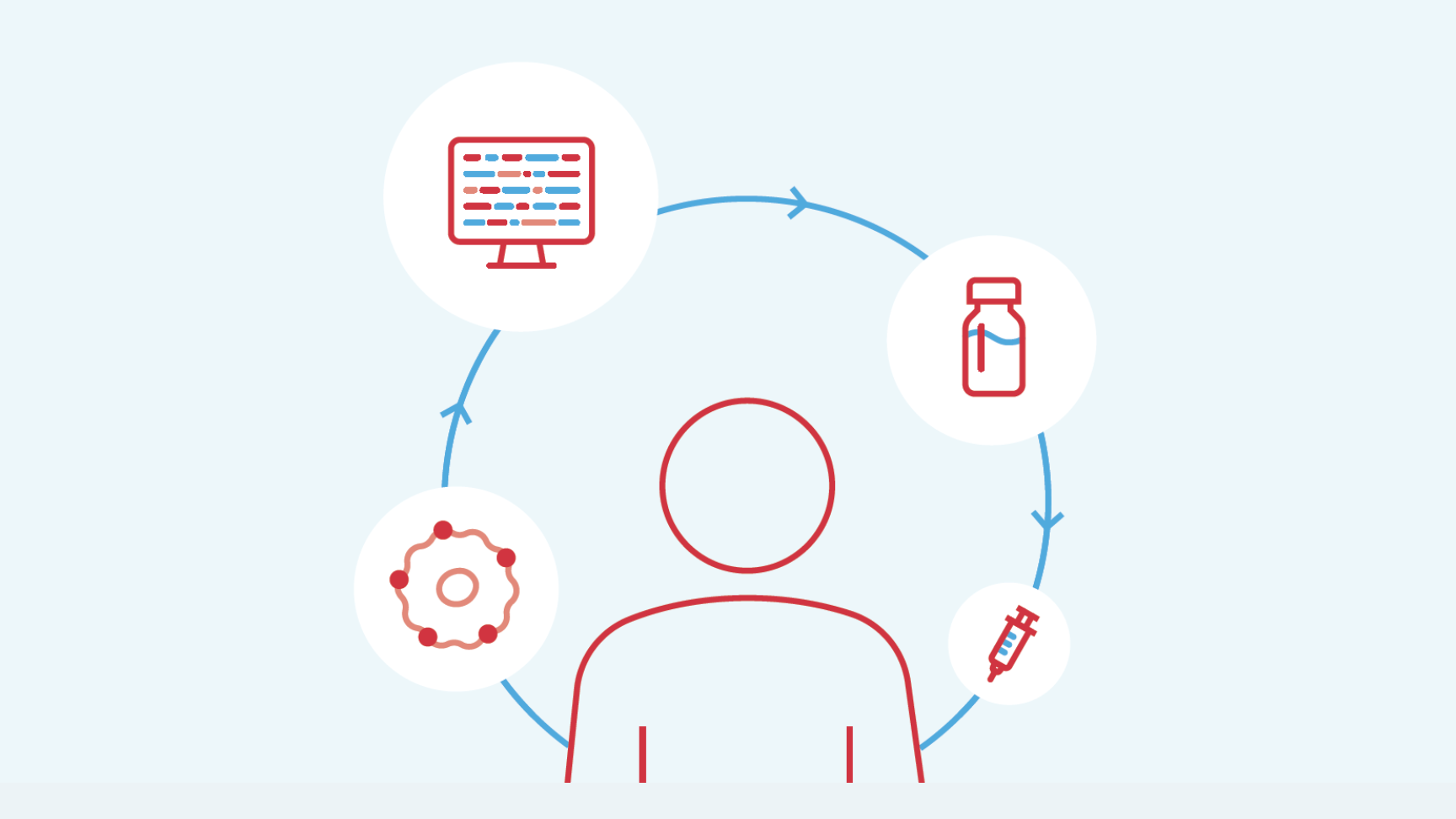
Personalized mRNA cancer vaccines pass a major milestone: AI helps design them, and the era of one drug per patient is getting closer
Moderna and Merck's personalized mRNA cancer vaccine hit positive results in a Phase 3 trial for melanoma. Algorithms help select each patient's tumor neoantigens, then a custom vaccine is manufactured for that individual. This is the first time a truly personalized approach has cleared a large-scale clinical hurdle, but widespread use still faces three big challenges: data, cross-cancer efficacy, and cost.
On August 19, Moderna and Merck announced a Phase III result never before seen in cancer treatment: their jointly developed personalized mRNA cancer vaccine, intismeran autogene, succeeded in a Phase III trial for melanoma.
This is not a vaccine to prevent cancer in healthy people. The trial enrolled 1,137 patients with high-risk stage IIB–IV cutaneous melanoma. Their tumors had been completely removed by surgery, but microscopic cancer cells could remain, carrying the risk of future recurrence or distant metastasis.
The question was: could adding a custom-made mRNA vaccine for each patient, on top of the standard postsurgical treatment Keytruda, meaningfully reduce that residual risk?
Tap each signal to see how it changes the assessment.
Why would a trial that hasn't even released its complete efficacy data trigger such a dramatic market reaction?
Because investors may be looking at more than just a new melanoma drug. They may be looking at a fundamentally different way of making medicine—one where algorithms take part in the critical step of designing a vaccine for each individual patient, and where this 'one drug per person' system has now, for the first time, shown efficacy in a Phase III trial with over a thousand participants.
This isn't AI suddenly curing cancer. The real story is that AI and computational biology are turning what was once an unscalable concept—truly individualized treatment—into a repeatable industrial process.
What was the actual breakthrough?
The major advance isn't just another mRNA vaccine posting positive Phase III results. It's that every single patient received a different mRNA sequence.
A traditional drugmaker can produce one million identical vials and ship them to hospitals. Intismeran, on the other hand, must wait for a specific patient, read their tumor, and then generate a treatment design unique to them. So this positive Phase III result validates not just one active ingredient, but an entire system—one that has to repeatedly handle individualized design, manufacturing, delivery, and treatment.
The real threshold crossed is that 'one drug per person' has finally moved beyond small-scale proof-of-concept into a rigorous clinical comparison involving over a thousand people.
How does AI get involved in vaccine design?
AI doesn't directly generate a finished vaccine. Its role is in the most critical and complex part of the design: sifting through a patient's many tumor mutations to identify the best targets for the immune system to attack.
Cancer cells originate from the patient's own body, and each patient's tumor mutations often differ. 'Personalized' means the drug must be redesigned around each individual's specific mutations.
Researchers first obtain the patient's tumor and blood samples: whole-exome sequencing identifies the mutations unique to the cancer cells, tumor RNA sequencing determines which of those mutations are actually expressed, and HLA typing assesses whether the resulting protein fragments have a chance of being presented to the immune system. There are many candidates, but only a subset are suitable as actual targets.
According to Moderna's public materials, its proprietary bioinformatics algorithms predict and rank candidate neoantigens, selecting up to 34 of them to encode into a patient-specific mRNA. More precisely, public information confirms that algorithms are involved in the vaccine design; the company has not disclosed the current algorithms' model architecture, training data, or per-module accuracy figures. The positive Phase III result should not be read as 'a generative AI model has been clinically validated.'
Tap any step to see what it takes in, what it decides, and what it puts out.
Whole-exome data from the tumor and blood are compared to find mutations that are present in the cancer cells but absent in normal cells.
RNA sequencing tells you whether a mutation is actually expressed. HLA typing tells you whether the relevant peptide fragment stands a chance of being presented to this patient's immune system.
Making it into the candidate pool doesn't mean the target is drug-ready. Expression, presentation, and potential immunogenicity continue to weed candidates out.
Public materials confirm the use of proprietary bioinformatics algorithms, but do not disclose the current model architecture, training data, or per-module accuracy.
The current product encodes up to 34 neoantigens. These come from the same patient, not a fixed set of targets shared by all patients.
The selected targets are encoded into a synthetic mRNA molecule, which is then manufactured, quality-controlled, and shipped back to the patient. The algorithm handles design, not the physical manufacturing.
The mRNA carries the instructions into the drug. After injection, the body's cells briefly read the mRNA to produce and present the corresponding neoantigens, training T cells to recognize cells bearing these tumor 'fingerprints.' The mRNA doesn't integrate into DNA, and it doesn't permanently alter the genome.
Keytruda takes the brakes off the immune system. It blocks the PD-1 inhibitory signal, giving the newly targeted immune cells a better chance to sustain their attack. The division of labor is clear: sequencing builds the candidate pool, algorithms set priorities, mRNA delivers the individualized target, and Keytruda improves the execution of the immune response.
Why start with melanoma?
If you want to prove out a personalized neoantigen approach, melanoma is one of the most logical starting points. These three reasons are based on a synthesis of published research and clinical context, not an official statement of Moderna's or Merck's only decision factors.
Tap each condition to see what it adds and what it can't prove.
These conditions aren't imagined: in 333 cutaneous melanoma samples, TCGA observed a mean of 16.8 mutations/Mb and common UV-associated mutational signatures. And early work in melanoma—the 2017 personalized neoantigen peptide vaccine and personalized RNA mutanome vaccine studies—already demonstrated the feasibility of manufacturing and inducing tumor-specific T cell responses in patients.
But improving the odds doesn't guarantee success. Not all melanoma patients respond to immunotherapy, and a high mutation burden doesn't guarantee that every predicted target will be presented, let alone generate an effective T cell response. A more accurate way to frame it: melanoma offers this approach a first testing ground with stronger signals and deeper historical data.
What did the Phase III trial actually prove?
INTerpath-001 enrolled 1,137 patients with high-risk cutaneous melanoma who had undergone complete resection and had not received prior systemic therapy. They were randomized 2:1. Both groups received Keytruda; the combination group also received up to nine doses of intismeran. The control was not 'no treatment'—it was a strong standard-of-care comparator.
High-risk stage IIB–IV cutaneous melanoma, fully resected, with no prior systemic therapy
Toggle between what's confirmed and what's still unknown to see the evidence boundary in this announcement.
2:1 randomization · Treatment runs about 1 year, up to roughly 56 weeks
The trial ultimately tested the whole package—intismeran, Keytruda, manufacturing logistics, and clinical execution—as a combined system. It did not compare different algorithms, different target counts, or different manufacturing processes head-to-head, and it did not separately measure AI's specific contribution.
So far, the company has only shared top-line results: no hazard ratio, absolute benefit, event counts, subgroup analyses, or full safety data. Overall survival (OS) is still being followed. In Phase II, the combination was associated with a 49% relative reduction in the risk of recurrence or death and a 59% relative reduction in the risk of distant metastasis or death, but those numbers can't be directly applied to Phase III.
What the capital markets are betting on, then, isn't an efficacy magnitude that's already public—that number hasn't been released. They're repricing the probability that this platform approach works at all.
Can this approach work for other cancers?
What makes this approach so appealing is the reusable software and manufacturing backbone. Switch the patient, switch the cancer type—the core steps remain: sequencing, HLA typing, neoantigen prediction, mRNA encoding, and small-batch manufacturing. The algorithms can also improve their ranking as more immunogenicity and clinical data accumulate.
Merck and Moderna are already running nine Phase II/III INTerpath trials covering melanoma, non-small cell lung cancer, bladder cancer, and renal cancer. Earlier-stage work also includes pancreatic and gastric cancers. Other companies are exploring similar approaches in solid tumors like breast cancer.
But what transfers is the workflow, not the efficacy.
Tap the three gates in order to see how the cross-cancer assessment changes as each condition is met.
Individualized manufacturing itself has two distinct hurdles. In the Phase II study, 185 tumor samples entered evaluation and 156 successfully completed the design stage—a success rate of 84.3%. Of the 105 attempts that moved into manufacturing for the combination arm, 104 were successfully produced, a rate above 99%. That suggests the backend manufacturing process is already quite reliable—but it doesn't mean every sample can find good enough targets in the first place.
Scaling to commercialization will require solving sample quality, turnaround time, region-by-region quality control and distribution, manufacturing capacity, pricing, and reimbursement. AI can make analysis faster and more accurate, but it can't automatically make a supply chain built around per-patient production cheap.
Is the era of one drug per person actually here?
It's getting closer, but it's not widespread yet.
This result offers a more credible template than 'AI discovers miracle drug': computational systems compress vast amounts of individual data that humans couldn't process by hand into executable treatment decisions, then feed those decisions into standardized manufacturing and clinical feedback loops.
Read a patient, predict a set of targets, manufacture a bespoke drug, observe the clinical outcome, then improve the next round of predictions—this is both a data loop and a production line.
The positive Phase III melanoma result is the first demonstration that this highly individualized system can do more than just manufacture a product or activate T cells—it may actually improve recurrence and metastasis outcomes in a large, controlled trial. It hasn't proven that AI has conquered cancer. It has proven that 'computational design + programmable mRNA + automated manufacturing + immunotherapy' has crossed the line from elegant concept to clinically testable reality.
So when people say 'the era of one drug per person is arriving,' that doesn't mean every cancer patient will receive a custom vaccine starting today. It means the model has, for the first time, earned its place as a legitimate therapeutic platform—one that can now be further tested, expanded, and scaled.
What determines whether this becomes a true platform revolution isn't the stock price. It's three things: how substantial the benefit is in the full Phase III data; whether the results can be replicated in other cancer types; and whether this one-patient-at-a-time production line can be fast, stable, and inexpensive enough to scale.
Members can copy or download the full Markdown, and let their AI subscribe and ask.
Found this useful? Leave your email — every new explainer, the moment it's out. Unsubscribe anytime.