Google Proposes Retrieve-for-Train Framework: Resolving the Conflict Between Rich Diversity and Ultra-Fast Response in Complex AI Search
General-purpose LLMs performing query fan-out easily fall into synonymous repetition and suffer from token-by-token generation latency. R4T shifts set-level policy exploration to offline training, handing execution over to a lightweight diffusion retriever for parallel generation.
In real-world complex search, users often need not just a single isolated result, but a rich, complementary, coherent set of items that actually exist in the database. Online search, however, demands sub-second response times; forcing a general-purpose LLM to perform deep, on-the-fly reasoning for every incoming request creates an immediate clash between token-by-token generation latency and real-time search requirements.
To resolve this contradiction, Google Research proposed Retrieve-for-Train (R4T) in an ICML 2026 paper: instead of having an LLM "think deeply" on the fly for every search request, it uses reinforcement learning offline to discover effective query decomposition policies, then distills this behavior into a lightweight 53.9-million-parameter diffusion retriever. The diffusion model generates multiple retrieval directions in parallel in a single pass, achieving massive speedups while preserving set-level quality.
This work does not target "finding the single most relevant result," but rather the more challenging problem of set retrieval: the returned group of items must be individually useful, mutually complementary, and collectively aligned with user intent and database contents. Such requirements are common in outfit matching, music playlists, content recommendation, and multi-branch recall for complex queries.

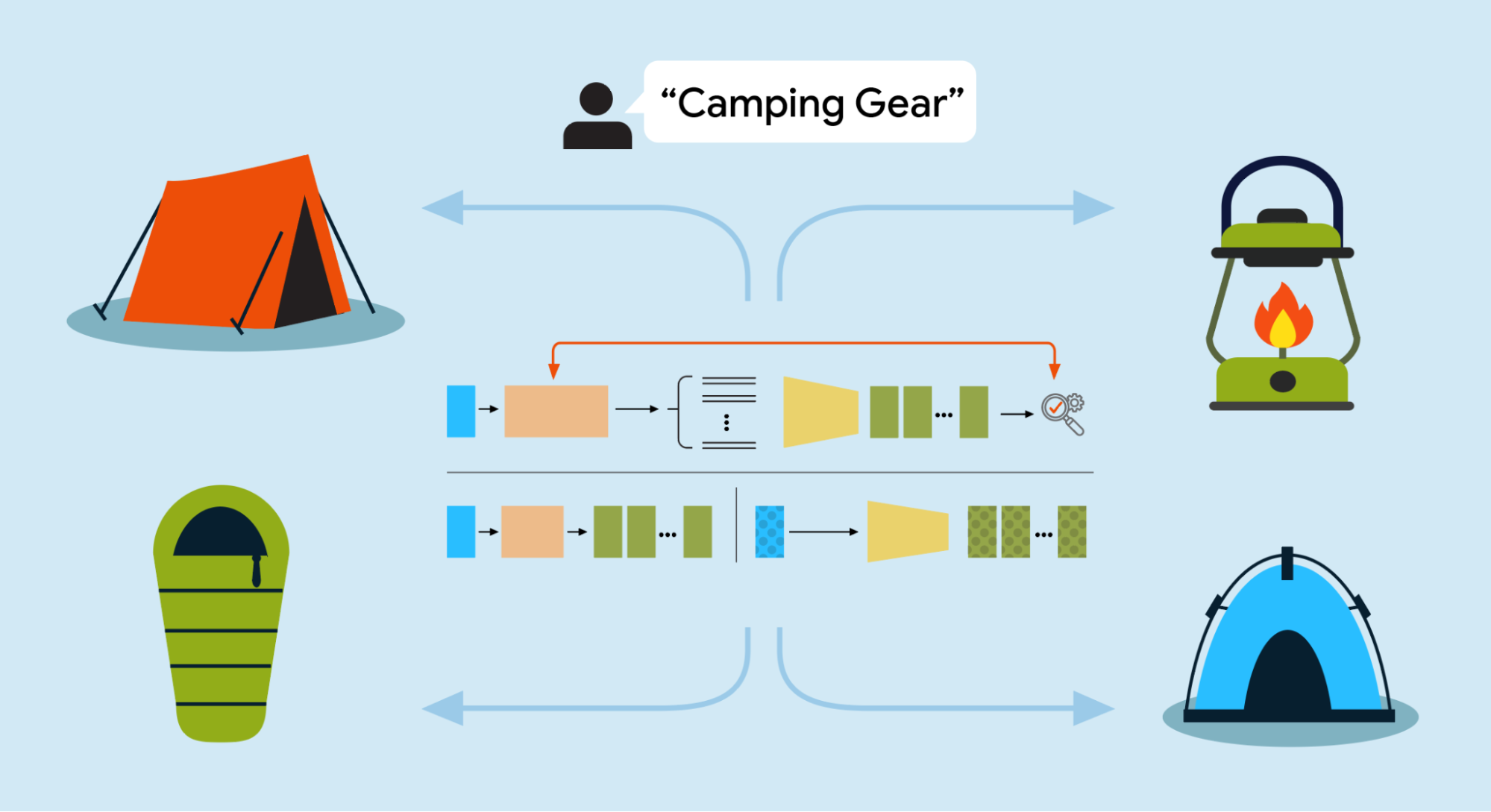
Figure: Google Research. The goal of complex search is to obtain a complementary set, not duplicate variants of the same item category.
The Pain Point: Where Do Conventional LLMs Get Stuck in Complex Search?
When searching for "camping gear," ten slightly different four-person tents do not make a good answer. A far more sensible result set is a cohesive kit consisting of a tent, a sleeping bag, a portable camp stove, and a headlamp. Search systems therefore first perform Query Fan-out: decomposing a broad query into multiple sub-queries, and then aggregating retrieval results across paths.
Directly relying on zero-shot LLMs to generate these sub-queries reveals two fundamental flaws in production:
- Paraphrase Collapse: When prompted with "bohemian festival style," models readily succumb to synonymous repetition, merely generating variations like "bohemian festival clothing" or "boho festival outfit," failing to propose genuinely complementary, distinct directions such as fringe jackets, crochet skirts, or suede boots.
- Autoregressive Latency Bottleneck: Models generate token by token and often consume hundreds of intermediate CoT (Chain-of-Thought) tokens. Inference latency scales with batch size, conflicting directly with the sub-second response times required by online search.
A more fundamental hurdle is that quality is determined by the entire result set. "Diversity," "complementarity," and "sufficient coverage" are set-level properties that can only be judged when multiple items are evaluated collectively. Open-ended retrieval lacks a single ground-truth answer, making it difficult to formulate with item-level ranking objectives, and the real world lacks off-the-shelf gold-standard sets for supervised training.
The Three Steps of R4T: Incurring RL Costs Only Once During Training
R4T treats reinforcement learning as an "objective transducer": it first uses reward functions to discover retrieval behaviors that satisfy set-level properties, and then compiles those behaviors into training data for a smaller model.
- Train the Fan-out Language Model (FOLM). The researchers use Gemma3-4B and Qwen3-4B, optimizing the 10 sub-queries generated per request via Soft-GRPO. Instead of scoring each result individually, the reward evaluates the entire group of sub-queries.
- Synthesize Supervised Data. Freeze the trained FOLM and generate offline "original query → target set" sample pairs. Because result sets have no intrinsic ordering, the target order is randomly permuted during diffusion training to improve robustness against permutations. While this step eliminates manual annotation, it still relies on the retriever and reward design from the previous stage, so it is not strictly "zero cost."
- Train the Diffusion Retriever. The 53.9M-parameter model learns to map an input query embedding into L retrieval direction vectors in a single forward pass, then uses nearest neighbor search to map them back to items in a fixed database, rather than directly generating products or songs. It emits no intermediate text sub-queries and outputs no sequential tokens, completing the fan-out in parallel in one shot.

Figure: Google Research. Only the final lightweight diffusion retriever is deployed online; expensive reward exploration is completed entirely offline.
The value of this design extends beyond simply replacing a large model with a small one. Crucially, the training phase can repeatedly query the database, calculate set-level rewards, and explore diverse decompositions. In production, the system merely samples from the learned distribution, eliminating the need to repeat this exploratory process for every incoming user request.
Three Rewards Must Counterbalance One Another
In Open-ended Abstract Retrieval (OAR), R4T simultaneously optimizes three types of rewards:
- Groundedness: Penalizes the distance between sub-queries and the database embedding manifold, ensuring queries correspond to content that is actually retrievable in the database.
- Diversity: Computes the Vendi Score over the full set of sub-queries, preventing multiple paths from collapsing into the same semantic mode.
- Alignment: Anchors the fanned-out directions to the original query, preventing topic drift in pursuit of diversity.
Ablation experiments explain why all three are indispensable. Optimizing only for groundedness leads the model to exploit reward loopholes, generating nonsensical strings like "line ending line ending" that happen to sit near specific database coordinates. Adding alignment alone leads to exploitation via repetitive paraphrasing of the original query. Diversity acts as the third counter-anchor, compelling the policy to find regions that are retrievable, on-topic, and mutually distinct.
Interactive Walkthrough · Paper Ablation Results
Remove One Anchor, Where Does the Policy Go?
Toggle reward combinations to see the training behaviors reported in the paper. This is a conceptual representation of the ablation results, not a reproduction of empirical curves.
All three counter-anchors active
Directions like "boho maxi dress", "woven straw boots", and "lace blouse" vary widely, yet all remain anchored to the original style and the database.
Result: Converges to a region that is retrievable, on-topic, and semantically diverse.
This also implies that higher reward weights are not unconditionally better. Weight ablation experiments in the paper show that excessive groundedness harms semantic alignment, while overemphasizing alignment and diversity suppresses exploration and coverage. R4T defaults to a 0.6 : 0.2 : 0.2 weighting for groundedness, diversity, and alignment in OAR; this represents the empirical setup for the reported experiments, rather than a universal recipe for all databases.
What Did the Experiments Actually Prove?
Evaluation was split across two types of tasks. OAR has no single ground-truth set and is evaluated on set diversity, query alignment, and groundedness. Weakly Supervised Combinatorial Retrieval (WSCR) provides a set of reference items and evaluates coverage and diversity using Recall@5K, Hit@5K, and Vendi Score. The paper validates on two datasets: Polyvore fashion data, comprising 21,888 outfit sets in OAR and 142,472 items in WSCR with CLIP-family vision-language embeddings; and music OAR, containing 8,522 playlist embeddings using MuLan audio-text embeddings. Notably, the music dataset consists of proprietary industry expert playlists unavailable to external researchers, limiting external reproducibility.
The three comparative baselines were: dense retrieval without fan-out; zero-shot fan-out directly using Gemini-2.5-Flash, Gemma3-4B, or Qwen3-4B; and Best-of-N, which independently executes fan-out 5 times and selects the highest-reward set. The results support three conclusions:
- Fan-out is inherently valuable, but zero-shot fan-out is insufficient. While it generally provides better coverage than querying directly with the original input, it frequently drifts away from the database manifold or generates near-duplicate phrasing.
- Rewards can identify better sets, but repeated online sampling does not scale. Best-of-N proves that reward signals are effective, but at the steep cost of running large models multiple times per request.
- R4T shifts the Pareto frontier of quality and efficiency, but its two deployment variants carry distinct trade-offs rather than "universal superiority across all metrics." In OAR,
R4T-FOLMyields more pronounced quality gains over same-sized baselines, but it still inherits the inference latency of autoregressive language models. The 53.9M-parameterR4T-Diffusionis the primary workhorse for low-latency serving: it preserves substantial diversity and improves coverage, though at the expense of slight compromises on certain alignment metrics. In WSCR, variants achieving higher recall may also exhibit lower Vendi Scores, as tightening coverage around reference sets can constrain divergent exploration.

Figure: Google Research. Metric definitions differ across tasks; the various bars should not be oversimplified into a single "accuracy" figure.
The True Scope of the 12–20× Speedup
The efficiency benchmark fixes the output to 10 retrieval directions per query and compares the wall-clock time between autoregressive LLM fan-out and the diffusion retriever across various batch sizes. At batch size 8, the autoregressive approach takes approximately 1.46 seconds compared to 0.07 seconds for the diffusion model; at batch size 1024, the former approaches 50 seconds while the latter finishes in 4.21 seconds. Overall, this delivers a 12–20× speedup.
Consequently, "sub-second" performance applies only to smaller batch sizes and cannot be generalized across all operating points. Furthermore, these figures represent relative measurements under the paper's specific hardware, model, and experimental pipeline, rather than an automatic SLA guaranteed for arbitrary search systems.
Shifting Costs Rather Than Eliminating Them
The most actionable engineering takeaway from R4T is decoupling "complex objective exploration" from "low-latency execution." Once a system can formulate desired set properties into reward functions, it can deploy LLMs and RL for offline exploration, then serve traffic online with a lightweight model structurally tailored for set generation. This architecture suits environments where high-order set properties matter, traffic volume is substantial, the database is relatively stable, and upfront training costs can be amortized over massive volumes of online queries.
It also carries four clear limitations:
- Reinforcement learning requires repeated interactions with frozen retrievers and continuous reward evaluation. For massive or rapidly updating catalogs, initial compute costs can be steep, and frequent retraining may be required.
- It assumes desired retrieval attributes can be expressed as explicit reward functions. Subjective qualities like creativity, novelty, and cultural nuances remain notoriously difficult to compress into scalar scores.
- OAR evaluation partially relies on LLM-as-a-Judge. Although techniques like shuffling item order, explicit rubric scoring, and requiring chain-of-thought justifications mitigate bias, the judge model's inherent inductive biases persist and cannot substitute for true user utility.
- Empirical evidence is confined to specific FOLMs, embedding spaces, diffusion architectures, and fashion/music domains. While logically extensible, this does not imply immediate generalization across other modalities, retrieval backbones, and business objectives.
This work is therefore best understood as a methodological paradigm: utilizing reinforcement learning to compile difficult-to-annotate, set-level objectives into training datasets, and leveraging diffusion models to swap costly online reasoning for rapid parallel sampling. It does not eliminate the overhead of objective definition, reward engineering, or catalog drift—but it decouples those costs from every live user request.
Members can copy or download the full Markdown, and let their AI subscribe and ask.
Found this useful? Leave your email — every new explainer, the moment it's out. Unsubscribe anytime.