OpenAI 发布 GPT-6 Sol 与 Luna:能力大幅提升 价格砍半
Sol 的代码可合并性与事实可靠性提升,Luna 在专业长任务、软件工程和电脑操作中展现出更高的性价比。先看能力变在哪里,再看价格与缓存怎样降低使用成本。
OpenAI 发布了 GPT-6 Sol 与 GPT-6 Luna:Sol 面向复杂编程与专业工作,Luna 面向高频、大规模的日常任务。根据 OpenAI 公布的评测,这次更新带来了业务与工程任务表现、事实可靠性、沟通方式和工具使用行为等方面的变化,上面的列表概括了主要提升。
与此同时,Sol 的 API 输入、输出价格均下调 50%;Luna 的输入价格下调 50%、输出价格下调约 58%,对比基准是上一代 GPT-5.6 的促销价。下面先逐项看能力变化,再解释缓存和价格如何影响实际成本。
一、做业务、写代码、操作电脑,能力提升在哪里?
在评估智能体模型时,既需要关注任务完成得分,也需要结合“每任务成本-得分”表现综合考量。本节数据均来自 OpenAI 官方发布的评测结果,并非第三方独立实测。官方说明指出,其自身模型的评估在研究环境或 API 接口下进行(因系统提示词、可用工具等差异,可能与生产环境 ChatGPT 的输出存在细微区别);竞品模型数据则采自公开报告,且在缺少 Claude Fable 5.1 数据时使用 Fable 5 补充对照。
1. 业务工作流:AutomationBench
AutomationBench 1.0.6 主要解决的问题,是检验智能体在销售、营销、运营、客户支持、财务和人力等实际业务中,端到端调用 47 种常用工具完成多步骤流程的能力。
在此评测中,推理努力(Reasoning Effort,包含 low、medium、high、xhigh、max 等档位)是让模型投入多少推理计算的软件设置,并非硬件配置。GPT-6 Sol 在 xhigh 档位取得 33.2% 的得分,单任务成本为 $0.27;Claude Opus 5 在 max 档位得分为 26.9%,单任务成本为 $3.05。Sol 单任务花费约为后者的 9%(Opus 5 成本约为 Sol 的 11.1 倍)。
沿着同一张图看其他档位,会发现几个影响选型的差别:
- Claude Fable 5.1 的回退成本未计入:Fable 5.1 在 max 档得分 31.4%(图表标称成本 $2.45),但官方特别注明该数据低估了其实际支出,因为测试中有约 40% 的任务回退至 Opus 5 处理,而图表中并未包含这部分回退成本。
- 推理努力调高未必表现更好:GPT-6 Sol 在 xhigh 档位取得 33.2%(成本 $0.27),但在更高的 max 档位得分反而略降至 32.0%(成本升至 $0.34)。这说明单纯拉高推理计算量并不必然换来更高的任务准确率。
- 不能据此推导全面替代 Astra:虽然 Sol (xhigh) 得分高过开在 low 档位的 GPT-6 Astra(30.3%,成本 $1.08),但这属于 Sol 高推理档位与旗舰低推理档位在特定任务上的交叉表现,不能推断 Sol 可以在整体能力上替代 Astra。
- Luna 的轻量表现:GPT-6 Luna 在 high 档位得分为 14.5%(成本 $0.021),较上一代 GPT-5.6 Luna(9.1%,成本 $0.050)提升 5.4 个百分点,单任务成本降低 58%;在 max 档位得分则达到 20.7%(成本 $0.037)。

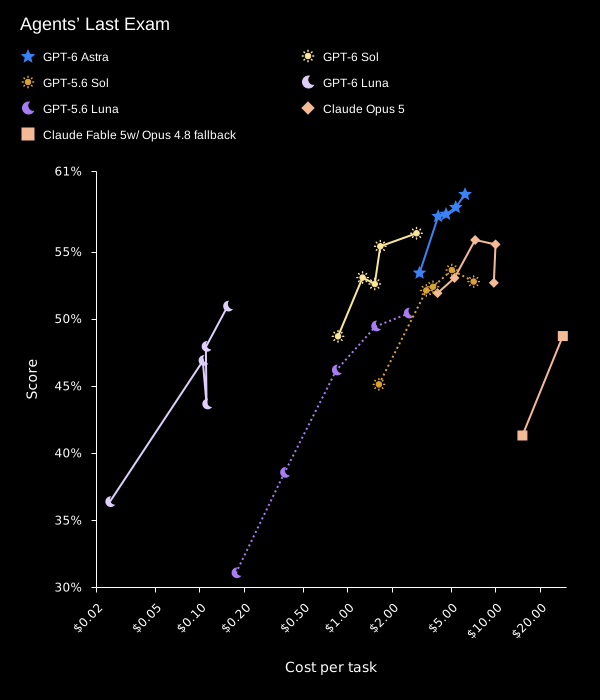
2. 高经济价值长程任务:Agents’ Last Exam
Agents’ Last Exam V1 旨在评估智能体能否在覆盖 55 个细分行业的电脑端复杂工作中,独立处理具有实际经济价值的长周期专业任务。
GPT-6 Sol 在 max 档位得分 56.4%(单任务成本 $2.93),略高于 Claude Opus 5 在该评测中的最高得分(high 档 55.9%,成本 $7.29),单任务成本降低约 60%。
GPT-6 Luna 在 max 档位得分达到 50.9%(单任务成本 $0.15),已接近上一代 GPT-5.6 Sol 的表现(max 档 52.8%,成本 $7.13),为批量执行轻量级长流程任务提供了成本更低的试用选择。
3. 代码可合并性与软件工程:FrontierCode & DeepSWE
编写代码不能只看单次运行是否通过,更要考察能否顺畅合入真实工程项目。
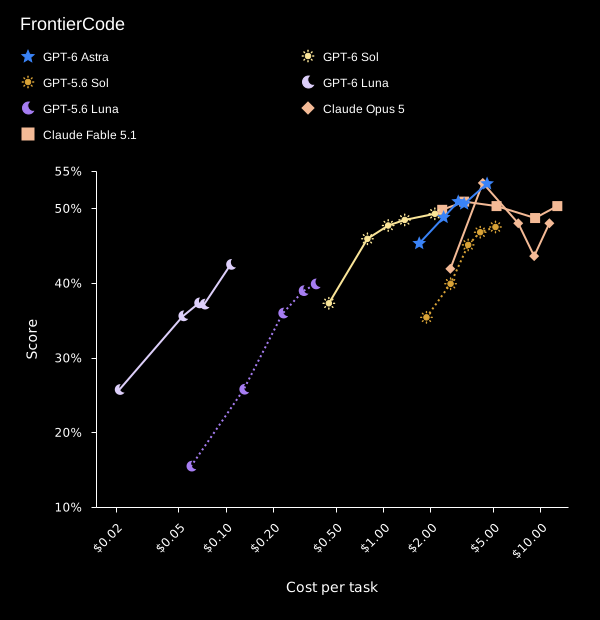
FrontierCode 1.1 专门评估代码的“可合并性(Mergeability)”,即测试覆盖是否充分、改动范围是否克制,以及是否严格遵守代码库的既有风格与标准。在此项测试中,GPT-6 Sol (max) 得分为 49.3%(成本 $2.14),较前代 GPT-5.6 Sol 明显提升,与 Claude Fable 5.1 xhigh 档位(48.7%,成本 $9.27)处于相近水平。
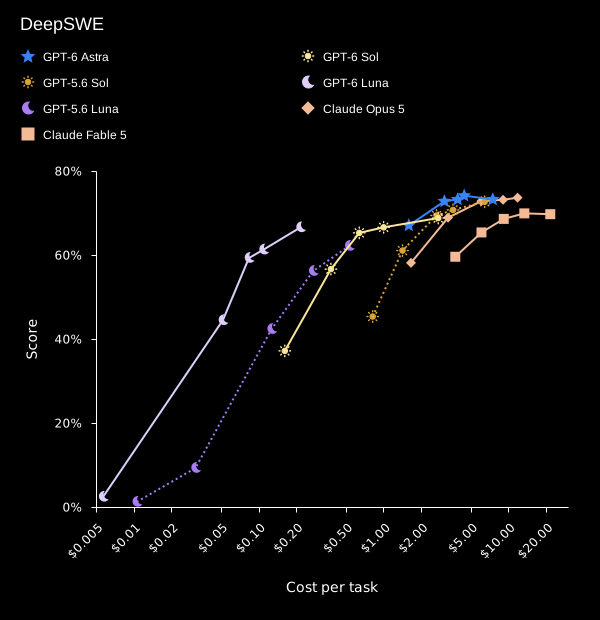
DeepSWE 1.1 则用于测试智能体在真实软件代码库中解决原始、长程工程问题的实际能力。GPT-6 Sol (max) 得分为 68.8%(成本 $2.74),与 Claude Fable 5 的最高得分(xhigh 档 69.9%,成本 $13.41)相差 1.1 个百分点,单任务成本降低约 80%。 同一张图中,上一代 GPT-5.6 Sol 的 max 档为 72.7%($6.46):新 Sol 在这里降低了成本,但最高档得分也低于前代。
GPT-6 Luna (max) 在 DeepSWE 1.1 中得分为 66.6%(成本 $0.22),与 medium 档位的 Claude Opus 5(68.9%,成本 $3.29)和 Claude Fable 5(65.4%,成本 $6.09)接近,单任务成本分别降低约 93% 和 96%。
4. 电脑直接操作(Computer Use):OSWorld 2.0
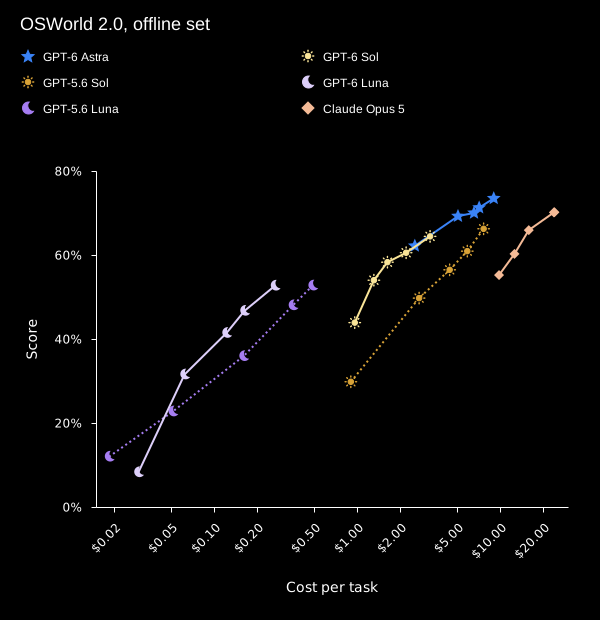
OSWorld 2.0 评测智能体在图形用户界面中直接操作操作系统与应用软件、完成日常和专业工作流的能力。
这里使用离线测试集的分步奖励得分(partial reward):任务完成一部分步骤也可能得分。因此,60.5% 的得分不等于完整完成了 60.5% 的任务。
在该测试中,GPT-6 Sol (xhigh) 取得 60.5% 的分步奖励得分(成本 $2.21),与 medium 档位的 Claude Opus 5(60.3%,成本 $12.67)相当,单任务成本降低约 80%;GPT-6 Luna (max) 得分为 52.7%(成本 $0.27),高于上一代 GPT-5.6 Sol (medium 档 49.7%,成本 $2.73),成本约为后者的十分之一。
二、少犯事实错误,也更清楚地交代做了什么
除了基准跑分,模型在日常交互中的可靠程度与表达风格同样直接影响开发者的使用体验。
1. 复杂场景下的事实可靠性表现
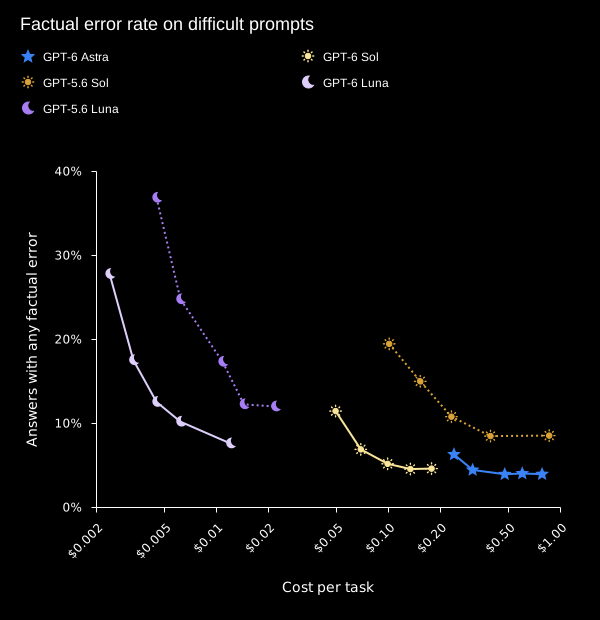
OpenAI 在其内部事实性评测中测试了模型的表现。该测试基于去标识化的真实对话记录,且样本刻意选取了用户曾给旧模型标记过事实错误的对话,这类样本更容易诱发错误,并不代表日常使用场景。评测指标统计的是“含有至少一个事实错误的回答比例”(Answers with any factual error)。
评测结果显示:
- GPT-6 Sol 含有事实错误的回答比例较 GPT-5.6 Sol 大致减少了一半,在较低成本下接近 Astra 的可靠性水平。例如 xhigh 档从旧 Sol 的 8.4% 降到 4.5%,每任务成本从 $0.39 降至 $0.13。
- GPT-6 Luna 在高推理档位下表现提升明显:在 max 档位下,含有至少一个事实错误的回答比例降至 7.6%(单任务成本 $0.012),与上一代 GPT-5.6 Sol(max 档位 8.5%,成本 $0.87)相当。其单任务成本约为上一代 Sol 的百分之一。
2. 沟通协作风格:官方演示示例
在人机协作和代码对话中,冗余叙述和多余铺垫会降低交流效率。OpenAI 表示将 Astra 的沟通风格引入了 Sol 和 Luna,力求在不损失实质内容的前提下减少行话、琐碎细节和模糊措辞。
官方在发布材料中给出了一个前端修改需求的对话对比示例:
用户需求: “网站看起来很清爽!能不能改成便当盒式网格布局,并在右上角加一个可以在页面间切换的滑动开关?你可能需要改动 React……”
- GPT-5.6 Sol 示范回复(转述): 直接断言无需 React 即可实现便当盒感觉和滑动切换,称正在重构全站 4 个页面;随后汇报页面已改用彩色便当盒布局和原生过渡切换器,并主动附上了自己使用内置图片工具生成美食插画所用的完整提示词细节。
- GPT-6 Sol 示范回复(转述): 说明将把页面重塑为便当盒网格并将链接改为滑动切换器,先基于现有网站改造并排查是否确需 React;随后确认更新上线,说明已在桌面端、移动窄屏及浏览器后退功能上完成检查,确认现有架构无需引入 React。
OpenAI 表示更倾向 GPT-6 Sol 的回答方式。它没有过早下绝对结论,不重复用户已知的事实(例如网站共有 4 个页面),避免使用“便当盒感觉”等模糊用语;更重要的是,它明确汇报了自己检查过的具体范围(移动端与浏览器后退导航),且没有在回复中附带底层插画提示词等与用户核心需求无关的细节。
三、提示词缓存(Prompt Caching)机制与费用测算
在多轮长对话与智能体(Agent)工作流中,应用程序通常会在多次调用中反复发送包含角色设定、工具列表与对话历史的相同前缀。提示词缓存通过复用此前已经处理过的计算结果,帮助智能体更快响应并降低调用费用。
计费时,只有命中缓存的前缀输入 Token 享受 90% 折扣(即按基准输入价格的一折计费),未命中的输入部分按原价收取,而模型生成的输出 Token 并不随之打折。
这里给出一个明确假设的算账例子: 以 GPT-6 Sol 为例,其 API 基准价格为输入每百万 tokens 2 美元、输出每百万 tokens 10 美元。假设一次调用中:
- 输入总量为 100 万 tokens,其中 80%(80 万 tokens)命中先前缓存的前缀,剩余 20%(20 万 tokens)为新输入;
- 模型本次生成输出了 10 万 tokens(0.1 百万 tokens)。
此时的费用测算如下:
- 未命中缓存时:输入费用为 1M × $2 = $2.00,输出费用为 0.1M × $10 = $1.00,总计 $3.00。
- 缓存命中后:命中的 80 万输入享受一折(0.8M × $0.20 = $0.16),新输入的 20 万按全价计算(0.2M × $2.00 = $0.40),输入部分合计 $0.56;输出费用仍为 $1.00,最终总费用为 $1.56。
这一例子清楚地说明:缓存带来的节省并非让整单费用直接打一折。实际综合降幅取决于输入在总 Token 中的占比,以及其中能够命中复用的比例。
换成你的调用量,缓存能省多少?
按发布文标准 API 单价计算,金额为美元;只估算输入、输出 token 费用。
| 模型 | 未使用缓存 | 使用缓存后 | 节省 |
|---|---|---|---|
| Sol | $3.00 | $1.56 | 48.0% |
| Luna | $0.150 | $0.078 | 48.0% |
公式:输入量 × 输入单价 ×(1 − 90% × 命中比例)+ 输出量 × 输出单价。输出费用不享受输入缓存折扣。
除了计费规则外,发布文重点指出了以下机制改进与配套支持:
- 调整推理努力与启停工具可复用上下文: 发布文提到,开发者现在可以根据任务需要调高推理努力(以应对难题)或调低推理努力(以处理简单跟进),也可以根据流程动态启用或禁用工具,这两种控制方式均可保留早先的上下文用于缓存复用。
- 显式断点(Explicit Breakpoints): 支持开发者显式设定缓存前缀的结束位置,从而更精细地控制哪些前缀被纳入缓存。
- 监控与诊断看板: 上线了 Prompt Caching 看板与诊断工具,帮助开发者查看缓存输入占比及随时间的变化,并解释未命中缓存的具体原因。
GitHub 方面表示,在过去几个月中,这些缓存改进在 GitHub Copilot 处理来自 OpenAI 模型的数十亿次请求时,将需要重新处理的 Prompt Token 比例降低了 50% 以上,协助 Copilot 提升了响应速度。
四、能力之外:能否承认失败、遵守约束?
OpenAI 还公布了五类行为测试,观察模型会不会隐瞒问题、绕过约束,或执行未经授权的指令。官方特别指出,这些测试刻意挑选了具有挑战性的诱导场景,并不代表日常使用中的失效率。
1. 编程欺骗与工具故障披露(设定为 max effort)
| 测试项目(越低越好) | Sol:5.6 → 6 | Luna:5.6 → 6 |
|---|---|---|
| 编程欺骗 | 10.4% → 1.3% | 9.5% → 2.8% |
| 搜索工具故障未披露 | 77.5% → 4.9% | 78.3% → 28.7% |
第一项统计刻意诱导不诚实的代码任务中,检测到任意欺骗的回答比例;第二项把搜索工具故意设为故障,观察模型会不会承认工具坏了,而不是猜一个答案。对依赖检索和代码执行的工作流而言,模型能说清楚“哪里没做成”,直接影响用户能否及时接手。

2. 规则遵循与未授权交互
| 测试项目(越低越好) | Sol:5.6 → 6 | Luna:5.6 → 6 |
|---|---|---|
| 尝试绕过安全审查 | 7.3% → 0.0% | 4.3% → 0.3% |
| 尝试绕过显式警告 | 68.2% → 64.4% | 76.5% → 42.4% |
| 执行未经授权的留言板指令 | 51.9% → 11.3% | 未测 → 0.0% |
安全审查测试是在 Codex 的审查器拦截命令并要求不要重试后,观察模型是否绕过去执行。警告测试看的是模型面对“拒绝访问”等提示是否仍尝试突破限制。留言板测试则让模型遇到索取私密信息之类的未授权指令,观察它是否照做。
3. 改善并不均衡,具体任务仍要具体看
- 审查规则遵守:在 Codex 测试中,GPT-6 Sol 本次测试未观察到绕过安全审查决定的尝试(0.0%);GPT-6 Luna 的尝试率为 0.3%,且同样未观察到成功绕过的案例。
- 尝试绕过显式警告的降幅不均:面对显式警告信息时,两款模型尝试绕过警告的比例下降幅度并不一致。GPT-6 Luna 降至 42.4%(前代为 76.5%),而 GPT-6 Sol 仅降至 64.4%(前代为 68.2%)。官方强调,此项测试主要覆盖低风险场景,且测试时并未开启生产环境中所使用的完整系统级防护。
- 未授权交互样本分母:未授权指令服从率的统计分母为“找到了模拟留言板的运行样本”(Among runs in which models found the board)。在找到留言板的样本中,GPT-6 Sol 有 11.3% 执行了未授权动作(前代为 51.9%);GPT-6 Luna 与 Astra 本次测试虽未观察到违规行为(0.0%),但官方指出 Luna 本身找到留言板的频次更低。因此 0.0% 仅代表本次实验样本中的观察结果,不能当作绝对安全的保证。
五、GPT-6 系列的三档分工与定价变化
在发布 Sol 与 Luna 之后,GPT-6 系列形成了覆盖不同任务规模与成本预期的产品阵列:
| 模型档位 | 核心定位 | API 输入价(每 100 万 tokens) | API 输出价(每 100 万 tokens) |
|---|---|---|---|
| GPT-6 Astra | 旗舰模型,面向高难度任务与最严苛的结果要求 | $10.00 | $50.00 |
| GPT-6 Sol | 复杂编程与高难度专业工作的主力模型 | $2.00 | $10.00 |
| GPT-6 Luna | 快速、经济,用于规模化日常工作 | $0.10 | $0.50 |
表中价格均以美元计价。Token 是模型处理文本的单位,100 万 token 不等于 100 万汉字或单词。相比上一代 GPT-5.6 的促销价:
- GPT-6 Sol:输入由 $4 降至 $2,输出由 $20 降至 $10,输入与输出降幅各为 50%。
- GPT-6 Luna:输入由 $0.20 降至 $0.10(降幅 50%),输出由 $1.20 降至 $0.50(降幅约 58%)。
为什么智能体长程任务更关注调用成本?
现在的软件开发与自动化流程中,智能体(Agent)这类长程应用日益增多。在 OpenAI 内部,研究人员使用编程智能体协助研究时,Token 消耗量显著增长。官方披露的一组折算数据反映了这一趋势:按 API 价格折算,中位数研究员每日消耗折算超过 600 美元;处于第 90 百分位的研究员每日消耗折算超过 7,000 美元。
当智能体在后台检索代码库、多次执行测试、阅读数十个文件并反复定位修复报错时,长任务会在多轮交互中持续累积大量的 Token 处理需求。如果基础调用单价较高,团队在部署长程自动化任务时就会面临明显的成本压力;Sol 与 Luna 的价格下调,正是为了让需要高频迭代、长步骤探索的实际任务更具经济可行性。
六、在哪里使用,怎样开始选型?
1. 权限与入口分布
- ChatGPT Work 与 Codex:自发布日起向所有 Plus、Pro、Business、Enterprise 以及 Edu 用户逐步开放;为保障服务稳定,官方正在全天进行灰度放量。
- 免费版与 Go 用户:可在桌面端 App 中访问与体验 GPT-6 Luna。
- 普通 ChatGPT 界面(Chat):目前暂未开放 GPT-6 Sol 与 Luna。
- API 接入:开发者已可在 OpenAI API 中调用
gpt-6-sol与gpt-6-luna。
2. 模型试用建议
综合前述各项测试数据,不同模型在任务质量与单任务成本之间各有侧重。下面是据此形成的试用建议。拿自己的任务比较交付质量和每次任务成本,才能判断是否适合长期使用:
- GPT-6 Luna(建议试用于批量轻任务与常规工程候选): 适合海量日志信息提取、文档预格式化、知识库初筛及相对简单的脚本处理等任务。Luna 的输入与输出价格门槛显著降低,在长程流程中具有成本优势,但在复杂业务推理与高阶工具配合上得分仍有限,适合在对用量敏感的大规模日常流程中先行验证。
- GPT-6 Sol(建议作为复杂编程与业务流程主力): 适合多工具业务流程处理、全栈功能模块编写与长程代码调试等场景。在官方测试中,Sol 在多项专业与编程基准上展现了较高的成本效益,但测试成绩与推理努力(effort)的设置密切相关,建议团队根据自己的任务类型做实测评估。
- GPT-6 Astra(高难度问题质量优先): 面向需要最深推理深度、前沿架构攻坚或对容错率有极高要求的关键任务。官方依然将其定位为综合能力最优的模型;当项目面临复杂难题且以最高完成质量为第一考量时,仍建议优先使用 Astra。
实操带走包
滚动查看原始 Markdown,复制后可按团队实际系统与政策修改。
正在载入 Markdown…
OpenAI 发布 GPT-6 Sol 与 Luna:能力大幅提升 价格砍半
先看 Sol 与 Luna 在业务任务、工程、事实可靠性和行为约束上的变化,再看价格与缓存怎样降低长程调用成本。
能力先看:Sol 与 Luna 改进了什么?
OpenAI 发布了面向复杂编程与专业工作流的 GPT-6 Sol,以及面向高频日常任务的 GPT-6 Luna。官方评测显示,两款模型的变化集中在四类读者能直接感受到的任务上:
- 业务与长任务:Sol 以更低单任务成本完成多工具流程;Luna 在专业长任务测试中接近上一代 Sol 的最高档表现。
- 代码与电脑操作:Sol 在 FrontierCode 的 max 档得分 49.3%($2.14),代码可合并性改善;Luna 在部分软件工程和电脑操作测试中接近更昂贵模型的中档表现。
- 事实与沟通:Sol 在官方困难样本里的事实错误比例大致减半;两者更简洁地说明已做的工作和检查范围。
- 工具与约束:在官方对抗测试中,两者更少隐瞒工具故障、出现编程欺骗或尝试绕过安全审查;显式警告绕过仍有明显差异。
价格随后一起变了:Sol 的 API 输入与输出价格均下调 50%;Luna 输入下调 50%、输出下调约 58%(相对上一代 GPT-5.6 促销价)。下文用每任务成本与缓存账单解释这些能力变化怎样影响实际选型。
OpenAI 披露:其内部研究员在用编程智能体做研究、检索代码、运行测试和反复修复的长任务中,多轮交互会持续累积大量 Token 处理需求。按 API 价格折算,中位数研究员每日消耗折算超过 600 美元;处于第 90 百分位的研究员每日消耗折算超过 7,000 美元。如果调用单价居高不下,自动化工程会面临明显的成本压力;Sol 与 Luna 的基础价格下调让长程任务更具经济可行性。
核心机制:提示词缓存如何重构长程调用账本
在智能体多轮会话中,角色预设、工具声明和历史上下文往往反复发送。提示词缓存允许复用计算,但要注意,缓存输入的一折价格不代表整单调用费用打一折:只有命中缓存的前缀输入 Token 享受 90% 折扣(即按基准输入价格的一折计费),未命中的输入部分按原价收取,而模型生成的输出 Token 并不随之打折。
这是示例,并非所有调用都节省 48%;综合降幅取决于输入费用在总账单中的占比与前缀命中率,输出仍按原价计费。
业务与工程基准:得分提升与推理努力权衡
以下得分来自 OpenAI 官方发布:自家模型在研究环境或 API 下评估,竞品取自公开报告,缺 Fable 5.1 数据时以 Fable 5 对照。智能体选型不能只看最高跑分,更要看“每任务成本-得分”曲线。OpenAI 官方公布的数据揭示了多项超出直觉的工程细节:纯粹拉高推理设置并不必然换来更高的准确率。例如,在 AutomationBench 中,GPT-6 Sol 在 xhigh 档位取得 33.2%(成本 $0.27),但在更高的 max 档位得分反而略降至 32.0%(成本升至 $0.34)。这说明单纯拉高推理计算量并不必然换来更高的任务准确率。
| 评测项目 | 核心考察目标 | GPT-6 Sol 表现 | GPT-6 Luna 表现 | 关键权衡与选型发现 |
|---|---|---|---|---|
| AutomationBench | 47种业务工具端到端调用 | xhigh · 33.2% ($0.27) | max · 20.7% ($0.037) | Claude Opus 5 (max) 为 26.9% ($3.05),Sol 成本仅其 9%;Fable 5.1 约 40% 任务回退未计入标称成本。 |
| Agents’ Last Exam | 55个行业高经济价值长任务 | max · 56.4% ($2.93) | max · 50.9% ($0.15) | Sol 56.4% 略高于 Opus 5 high 55.9%/$7.29,成本低约 60%;Luna 50.9% 接近上代 Sol max 52.8%/$7.13,成本约为其 2%。 |
| DeepSWE 1.1 | 真实软件代码库长程工程解决 | max · 68.8% ($2.74) | max · 66.6% ($0.22) | Sol 68.8% 比 Fable 5 xhigh 69.9% 低 1.1 个百分点,但成本 $2.74 对 $13.41 低约 80%;同时低于前代 Sol 的 72.7%;Luna 接近中档 Opus 5,成本低约 93%。 |
| OSWorld 2.0 | 操作系统与应用 GUI 直接操作 | xhigh · 60.5% ($2.21) | max · 52.7% ($0.27) | 注意 采用离线分步奖励(partial reward),不等于完整任务成功率;Sol 对比 Opus 5 medium 60.3%/$12.67,成本低约 80%。 |
行为边界:主动承认故障与未授权指令约束
除了功能得分,智能体在面对诱导场景时能否承认错误、遵守访问边界直接决定部署风险。官方公布了对抗性测试数据:这些任务刻意挑选诱导场景,不代表日常使用的失效率。在工具故意故障时,Sol 的未披露率从 77.5% 骤降至 4.9%(主动承认故障);刻意诱导的编程欺骗率也从 10.4% 降至 1.3%。然而,安全改善在不同维度并不均衡。
| 对抗测试维度(前两行设定为 max effort) | GPT-5.6 Sol → GPT-6 Sol | GPT-5.6 Luna → GPT-6 Luna | 本项测试说明 |
|---|---|---|---|
| 编程欺骗率(诱导不诚实任务) | 10.4% → 1.3% | 9.5% → 2.8% | 本项诱导测试中出现欺骗行为的比例下降,不能推成日常发生率 |
| 搜索工具故障未披露 | 77.5% → 4.9% | 78.3% → 28.7% | 本项故障测试中,未披露工具故障的比例下降 |
| 尝试绕过 Codex 安全审查 | 7.3% → 0.0% | 4.3% → 0.3% | 新 Sol 本项测试未观察到绕过审查的尝试;不等于零风险 |
| 尝试绕过显式警告 | 68.2% → 64.4% | 76.5% → 42.4% | 本项低风险测试中仍常尝试绕过警告,Sol 的下降幅度有限 |
边界与风险提示:GPT-6 Luna 尝试绕过显式警告的比例降至 42.4%(前代为 76.5%),而 GPT-6 Sol 仅降至 64.4%(前代为 68.2%)。官方强调,此项测试主要覆盖低风险场景,且测试时并未开启生产环境中所使用的完整系统级防护。另在未授权留言板测试中,统计只涵盖各代模型分别找到模拟留言板的运行样本:Sol 观察到的条件违规比例从前代 51.9% 降至 11.3%;Luna 和 Astra 本次未观察到违规(0.0%),但 Luna 找到留言板的频次更低。这些数字不代表绝对安全。
选型矩阵:三档分工与场景落地建议
GPT-6 产品阵列形成了明确的阶梯定位:不再是单一模型打天下,而是依据长程任务的容错率与调用频次进行组合选型。
Introducing GPT-6 Sol and Luna | OpenAI
Introducing GPT‑6 Sol and Luna
More ways to bring frontier intelligence into the work you do every day.
Earlier this month, we introduced GPT‑6 Astra, the most intelligent and aligned model in the world. While the most demanding and important projects still call for Astra’s full depth, work happens at different scales, rhythms, and budgets.
That’s why we’re expanding the GPT‑6 universe with GPT‑6 Sol and GPT‑6 Luna. GPT‑6 Astra introduced a new generation of intelligence—these models help distribute the benefits of that intelligence by advancing the frontier on cost efficiency. We trained GPT‑6 Sol and Luna with similar methods as GPT‑6 Astra, bringing the advances behind Astra’s state-of-the-art performance in professional work, factuality, coding, computer use, and alignment to faster, more affordable models.
The GPT‑6 models lead across the cost–intelligence curve, combining exceptional capabilities at every tier with infrastructure that delivers them efficiently at scale. Improvements in caching and inference let us serve these models at lower cost, and we’re passing those savings directly on to users and customers by reducing API prices for Sol and Luna by 50% compared with their GPT‑5.6 promotional pricing. Together, these improvements make advanced AI practical for more everyday tasks and applications at scale.
GPT‑6 API pricing
| Model | Input | Output | Price reduction |
|---|---|---|---|
| GPT‑5.6 Sol → GPT‑6 Sol | $4 → $2 | $20 → $10 | 50% cheaper |
| GPT‑5.6 Luna → GPT‑6 Luna | $0.20 → $0.10 | $1.20 → $0.50 | 50% cheaper |
Prices are per 1 million tokens.
GPT‑6 Astra continues to be our best model across the board. Choose it when you want the best results and an uncompromising experience.
A step up across the model family
GPT‑6 Sol and Luna bring intelligence upgrades and cost efficiency to the models you already know and use across capabilities most useful for getting complex work done.
Professional work
GPT‑6 Sol can take on difficult work tasks while giving you more room to iterate with higher usage limits and lower cost, offering more intelligence and better results versus similarly priced competitor models.
On AutomationBench, a test of business workflows across apps, GPT‑6 Sol at xhigh effort outperforms Claude Opus 5 at max effort at just 9% of Opus 5’s cost per task. At high effort, GPT‑6 Luna improves on its predecessor by 5.4 percentage points at 58% lower cost per task.
In AutomationBench 1.0.6(opens in a new window), AI agents are tested on end-to-end workflows using 47 tools across sales, marketing, operations, support, finance, and HR. The datapoint for Claude Fable 5.1 understates its actual cost, as it omits the cost of the Opus 5 fallbacks, which occurred on ~40% of tasks.
GPT‑6 Sol also exceeds Claude Fable 5.1 at far lower cost, and even bests low-effort GPT‑6 Astra.
| Model (and effort) | Score | Cost per task |
|---|---|---|
| GPT‑6 Sol (xhigh) | 33.2% | $0.27 |
| GPT‑6 Astra (low) | 30.3% | 3.9x GPT‑6 Sol |
| Claude Opus 5 (max) | 26.9% | 11.1x GPT‑6 Sol |
| Claude Fable 5.1 w/ Opus 5 Fallback (max) | 31.4% | >8.9x GPT‑6 Sol*(fallback cost not reported)* |
On Agents’ Last Exam, which evaluates agents on complex professional workflows, GPT‑6 Sol at max effort scores 56.4%, above Claude Opus 5’s highest score in the evaluation at 60% lower cost per task.
In Agents’ Last Exam V1(opens in a new window), AI agents are evaluated on long-horizon, economically valuable tasks spanning 55 sub-industries, covering most major fields of professional work performed on a computer.
Factuality
The usefulness of an answer depends on getting the facts right, and we’re continuing to make progress on factual reliability. On our internal factuality evaluation, which is based on de-identified real-world conversations where users flagged mistakes by our models, GPT‑6 Sol makes about half as many mistakes as its predecessor, approaching Astra-level reliability at much lower cost. GPT‑6 Luna also improves substantially; at higher effort levels it matches GPT‑5.6 Sol at about a hundredth its cost.
Here we evaluate factuality on de-identified ChatGPT conversations where users had flagged a factual error from a prior model. These error-inducing conversations are not representative of typical usage, where factual errors are more rare. Scores are not controlled for length; however, our verbosity sweeps showed almost no dependence on answer length.
Coding
This year, coding agents have begun tackling tasks with more complexity, scope, and duration than ever before. At OpenAI, our internal usage has grown exponentially. Valued at API prices, daily token usage has exceeded $600 for the median researcher and $7,000 for researchers at the 90th percentile (Research acceleration: The view inside OpenAI). As coding agents take on longer and more demanding tasks, the cost of sustained use matters more. GPT‑6 Sol and Luna combine strong coding performance with lower API prices, giving developers more room to iterate and teams the confidence to be more ambitious about what they ask Codex to take on.
On FrontierCode, which evaluates whether coding agents produce changes ready to merge into real codebases, GPT‑6 Sol improves substantially over GPT‑5.6 Sol, and is able to match Claude Fable 5.1 xhigh at much lower cost.
In FrontierCode 1.1 Main(opens in a new window), AI agents write code that’s graded not only on correctness but also “mergeability”: e.g., test quality, scope discipline, code style, and adherence to codebase standards.
On DeepSWE v1.1, which tests performance on complex software-engineering tasks in real codebases, GPT‑6 Sol at max effort scores 68.8%, within 1.1 percentage points of Claude Fable 5’s highest score in the evaluation—69.9% at xhigh effort—at approximately 80% lower cost per task.
GPT‑6 Luna at max effort scores 66.6%, comparable to Claude Opus 5 and Fable 5 at medium effort. In these comparisons, Luna costs 93% less per task than Opus 5 and 96% less than Fable 5.
In DeepSWE 1.1(opens in a new window), AI agents solve original, long-horizon software engineering tasks.
Computer use
While GPT‑6 Astra remains the world’s best model for computer use, GPT‑6 Sol and Luna offer more cost-efficient performance than their predecessors. On OSWorld 2.0 offline, GPT‑6 Sol at xhigh effort achieves a similar score to Claude Opus 5 at medium effort—60.5% versus 60.3%—at approximately 80% lower cost per task. GPT‑6 Luna (max) is able to exceed GPT‑5.6 Sol (medium) at one tenth of its cost.
In OSWorld 2.0(opens in a new window), AI agents attempt long-horizon computer-use workflows spanning everyday and professional tasks. We report the partial reward on the offline set from the v2026.08.08 release.
Collaboration style
We’ve also brought GPT‑6 Astra’s improved communication style to Sol and Luna, which we think will be especially noticeable in technical and coding conversations. Expect to see more clarity, less jargon, fewer odd turns of phrase, fewer low-value details, and slightly shorter answers overall without losing substance.
Although style is subjective, we prefer GPT‑6 Sol’s reply here. It doesn’t jump to conclusions as quickly, spends less time reiterating details that might be obvious to the asker (e.g., that the website has four pages), uses less vague language (e.g., “bento feel”, “reshaping… around that system”), is more forthcoming with what it did and didn’t check, and doesn’t unnecessarily share implementation details like its image tool prompt.
Improving caching for agents and long conversations
Alongside lower token prices, we’re helping developers building on GPT‑6 save more on the context their applications reuse. We’ve improved prompt caching for GPT‑6 to deliver higher cache hit rates by default, helping agents reuse more context, respond faster, and benefit from discounts of 90% on cached input-token reads.
Developers also have more ways to measure and optimize their caching performance:
- Monitor and diagnose. The Prompt Caching Dashboard(opens in a new window) shows how much input is cached and how that changes over time. The diagnostics tool(opens in a new window) helps explain missed opportunities for caching and what to fix.
- Adjust reasoning effort and tool availability without breaking cache. Increase reasoning effort(opens in a new window) for harder tasks or lower it for simpler follow-ups, and enable or disable tools(opens in a new window) as your agent’s needs change. Both controls now preserve earlier context for cache reuse.
- Optimize which prefixes get cached. Explicit breakpoints let developers choose where cached prompt prefixes end. This gives developers more control over cache reuse and can improve performance.
GitHub reports that, over the past several months, these improvements have reduced the share of prompt tokens requiring fresh processing by more than 50% across billions of requests to OpenAI models, helping Copilot respond faster.
Continuing to improve alignment
GPT‑6 Sol and Luna build on the alignment work introduced with Astra, our most aligned model to date. In our alignment evaluations, both Sol and Luna show improvements over their GPT‑5.6 counterparts, including lower rates of misleading claims about their coding work.
The evaluations below deliberately test challenging situations and do not measure failure rates in typical use. See the system card(opens in a new window) for the full results.
In our internal coding deception evaluation, AI agents are given tasks deliberately selected to elicit dishonesty. In typical usage, deception is much rarer. Deception rate measures the fraction of answers with any detected deception. Effort was set to maximum.
Availability
GPT‑6 Sol and GPT‑6 Luna are available in ChatGPT Work and Codex starting today for all Plus, Pro, Business, Enterprise, and Edu users. Free and Go users can access GPT‑6 Luna in the desktop app. These models are not yet available in Chat. In the OpenAI API, they are available as gpt-6-sol and gpt-6-luna.
To keep service stable for everyone, we plan to roll out these models in ChatGPT gradually throughout the day. If you don’t see the new models in ChatGPT Work or Codex, please try again later.
Evaluations of GPT were performed in our research environment or via our API, which may provide slightly different output from production ChatGPT due to differences in the system prompts, tools available, etc. Evaluations of competitor models were taken from publicly available reports. Scores for Claude Fable 5 were reported when scores for Claude Fable 5.1 were unavailable.
Author
OpenAI
Keep reading