如何与AI一起写出没有“AI 味”的文章 先整理素材,再让模型动笔
从通用常识、个人经历到原创思考,理解 Nicolas Cole 的人机写作分工,并用三个模板开始实践。
- 常识对初学与思考仍然有价值;当重复写作不再带来新理解时,可以让 AI 协助重组。
- 个人经历、立场和表达样本需要由你提供,并持续积累成可复用的素材库。
- 把重复整理交给 AI,省下的精力用于新的观察与思考;模板尤其适合经验与观点写作。
如果你常用 ChatGPT 或 Claude 协助写作,很可能遇到过这种情形:输入一个常见题目,比如“如何做好时间管理”或“新手如何做行业调研”,屏幕上很快会生成一篇结构整齐、用词得体的文章。它列出了明确目标、制定计划、分清主次等几条建议。
文章挑不出明显硬伤,但读起来总让人觉得空泛机械、千篇一律,也就是人们常说的“AI 味”。
许多人把原因归结为提示词不够精妙,或者以为只要让模型模仿某种特定文风就能解决。数字写作顾问、长期从事商业代笔的 Nicolas Cole 在其专栏长文《The Right Way to Write with AI》中提出了一个不同的解释:
语言模型输出的内容显得空洞,往往不是因为它的遣词造句能力不足,而是因为人类尚未向它提供具体的情境。你觉得文章读起来不像你,本质上是因为你没有把自己真实的经历、观察和立场作为素材交由它处理。
Cole 结合自己早年撰写网络文章以及自述后来为 300 多位行业领导者(包括硅谷高管)代笔的经历,梳理了文字内容的层次划分,并解释了如何建立一个让人与机器各自发挥所长的工作流。
一、通用常识与作者辨识度
要理解人机协作的边界,首先需要区分两类性质不同的内容。
1. 共享的语言与“通用内容”
Cole 把人类共享的语言比作一套开源系统:字母、词汇和常规语法由所有人共享,没有任何人会因某一个单独的字词而具备辨识度。当不同的人写下同一句日常用语时,也无法单凭这些通用表达建立起独特的辨识度。
由这些常规词汇组合而成的基础道理,大多属于通用内容(Commodity Content)。例如:
- “做营销的关键在于了解你的客户。”
- “健康减重的基础是保证营养并控制热量摄入。”
- “长期储蓄需要尽早开始并保持克制。”
这些句子逻辑完整,对刚接触该领域的读者同样具有指导意义。但它们由普遍共享的概念构成,遮住作者的名字,读者无法判断这句话出自一位行业资深从业者,还是刚接触该领域的新手。它属于行业内的公共知识,缺乏作者的个人辨识度。
2. 为什么机器处理通用内容更具效率
大语言模型擅长处理常见语句的概率关联。面对广泛流传的通用常识、基础概念整理与标准化步骤说明,机器的改写和重组效率远高于人类手工敲击键盘。
Cole 回顾了自己 2014 年大学毕业一年后的兼职经历:当时一家旅行机构以每篇 20 美元的价格雇他撰写关于芝加哥、密尔沃基等城市餐厅和酒店的 600 词 SEO 文章。据他自述,他当时并不了解那些城市,也去不起所写的餐厅与酒店,只能在网上阅读已有的公开发布内容,调换同义词、调整副词与句式,拼凑成一篇“新文章”。
在今天,这种基于已有公开信息的常规洗稿与句式替换,机器几秒钟内就能完成。如果写作者依然把全部精力放在手工敲出人尽皆知的通用常识上,并仅仅因为自己付出了体力和打字时间就认为这是独特的创作,实际上是在效率最低的环节消耗精力。
3. 通用内容何时有价值?何时该交给机器?
这并不意味着通用常识一文不值。在 Cole 的框架中,写作者需要理性看待通用内容的生命周期:
- 初学与探索阶段:新手读者需要基础常识来建立认知框架;写作者亲手撰写和梳理常识,能够帮助自己澄清思考、检验逻辑,并主动选择自己认同的专业立场;同时,探索并沉淀自己认可的多样化表达方式,也能为后续的素材复用积累真实的文风样本。
- 定位与传播阶段:在公开写作中适度重复某些通用观点,有助于帮助读者明确你的专业领域与关注方向。
- 交给机器的临界点:当你已经在自己的领域反复表达过这些基本概念,亲手写出新的变体既不再澄清思考,也不再为素材库补充有用的表达样本时,这项工作就进入了收益递减阶段。此时,将梳理结构、填充背景常识和重组段落的工作交由机器完成,人类作者才能腾出时间去思考更深入的问题。
二、赋予文字辨识度:个人特质素材
既然通用常识可以被轻易重组,让一篇文章具备独特辨识度和真实感的核心要素究竟是什么?
Cole 认为,答案在于围绕通用常识展开的具体情境——即个人特质素材(Personality Content)。通用内容回答的是“是什么”(What)和“怎么做”(How),而特质素材回答的是“为什么”(Why):你是谁?你在什么具体情境下得出了这个结论?你为什么认同这一观点而不是另一种?
1. 假设案例:从空洞建议到经验叙述
为了说明这一点,Cole 给出了一个关于理财顾问的假设示例。
有一句常见的通用投资建议:
“不要加杠杆炒股,买入标普 500 指数并持有十年。”
如果一个年轻人在社交媒体上直接发出这句话,它只是一句常规道理。即使由持牌理财顾问说出,也主要依赖职业资质背书。
但如果这位顾问这样写:
“不要加杠杆炒股。这是我二十出头在华尔街工作时犯过的错误,那时候我因为压力大到脱发。后来我才意识到,最稳妥的积累方式,就是买入标普 500 指数并拿上十年。”
核心的通用建议并没有改变,但周围补充了具体的人生情境(二十岁出头、华尔街、经历压力导致的脱发)。读者感受到的真实感与可信度,往往来自这些无法凭空捏造的个人经历。
边界提醒:加入个人细节能够让文章更具辨识度与温度,但个人细节本身并不能自动等同于客观真理。经验分享与严谨论证属于不同维度,需结合具体写作场景审慎使用。
2. 差异化来自细节变量的组合
许多人担心自己没有举世瞩目的成就,写不出独特的素材。Cole 认为,作者的辨识度极少来自孤立的非凡标签,而是由多个普通的生活变量组合而成的。
他以“如何做煎蛋”这个完全通用的生活话题为例:
- 纯通用层:热锅、倒油、打蛋、翻面、出锅。任何指南写出来都大同小异。
- 引入身份变量:假设两位作者都写明自己是“单亲父亲”。这个标签开始带来区分度,但社会上依然有许多单亲父亲。
- 引入具体对象与日常情境:第一位父亲写的是他每天早晨在上学前为儿子煎蛋;第二位父亲写的是他在每天放学后为女儿做熟鸡蛋当点心。
随着生活事实、具体对象和日常细节一层层叠加,两篇教授同样煎蛋步骤的文章便自然展现出截然不同的面貌。钢琴上的琴键是共享的,但不同的音符顺序、节奏与停顿组合在一起,就构成了特定演奏者的曲调。
3. 个人素材库的五类核心资产
大语言模型拥有海量的公开语言规律,但它无法凭空获知你的人生经历。构建属于你自己的素材库,需要有意识地梳理和记录以下五种非通用变量:
1. 个人事实 (Life Facts)
核心关注:你的成长坐标与轨迹
自查方向:你在哪里长大?学过什么专业?做过哪些不同性质的工作?这些客观生活事实是机器无法推导的。
2. 明确取向 (Opinions)
核心关注:你在争议观点中的主动选择
自查方向:在行业公认的几种做法中,你认同哪一种、反对哪一种?例如面对理财,是认同“省下每天的咖啡钱”,还是认同“重点在于提高主营收入”?你的主动认同构成了你的专业立场。
3. 个人洞察 (Insights)
核心关注:对通用道理的具体情境化理解
自查方向:许多洞察本身也是常见常识(如“领导力的关键是以身作则”)。赋予其真正价值的是你的个人情境与具体案例:你在什么场景下切实体会并理解了这一道理?
4. 真实经历 (Stories)
核心关注:包含时间、情境与起伏的事件
自查方向:在何时、何地、与谁在一起?原本预期如何,实际发生了什么?真实发生的生活与工作事件最能提供叙事抓手。
5. 经验教训 (Lessons)
核心关注:经历特定事件后带来的行为改变
自查方向:经历过某次波折或转折之后,你在哪件事上彻底改变了做法或判断标准?
三、澄清文风与协作机制
不少写作者试图通过复杂的提示词去“调试文风”,比如要求模型“写得幽默风趣”或“充满学术严谨感”。但在实际操作中,这种脱离内容的风格修饰往往收效甚微。
1. 声音来自具体的语言行为
在 Cole 的写作框架中,文字的“声音”(Voice)并不是虚幻的气质,而是由三个具体的语言行为共同塑造的:
- 词汇选择(Vocabulary):你习惯使用什么样的词?是口语化的日常表达,还是严谨的学术词汇?词汇的选择直接向读者传递了你的表达习惯与观察视角。
- 句式节奏(Rhythm):句子的长短交替与标点运用构成了文章的韵律。海明威偏好短促直接的硬朗句式,而福克纳则擅长绵密复调的长句。
- 句子意图(EDAN 框架):你在每个具体句子中所承担的交际目的:
- E (Explanation / 阐释):向读者说明逻辑机制与客观道理(抽象讲述);
- D (Description / 描写):通过感官细节呈现具体画面(具象展现);
- A (Action / 动作):交代发生的行为与推进过程;
- N (Narration / 叙述与推测):背景叙述、心路交代或主观假设。
Cole 指出,文风并非某种需要苦苦寻觅的固定天性,而是写作者的主动创造——如同画家用红绿蓝调配色彩,你可以根据不同句子的目的逐句调整。同一位作者在阐明原理与刻画场景时,完全可以使用不同的句子意图、词汇与节奏,无需强求全篇保持单一腔调。
同时,Cole 强调文风在整篇文章中只是次要变量,起决定作用的始终是内容本身。在交代背景或传递常识时,通用的表达方式往往不可避免且依然有效,并不等同于低劣的“AI 垃圾”;但在追求辨识度的个人写作中,若缺乏真实的人格特质与具体事实支撑,单靠调换词汇也无法建立真正的区隔。此外,要想让机器模仿你的口吻,前提是你已经写出过具有个人表达习惯的文字样本并将其存入素材库;否则,模型只能默认调用通用的平均腔调。
2. 代笔者的“雕塑法”工作流
作为商业代笔写作者,Cole 梳理了他在服务委托人时摸索出的人机协作心智模型:
委托人(如行业专家或企业高管)往往具备丰富的专业经验,但没有充足的时间手动将所有想法码成文章。优秀的代笔绝不是替客户无中生有地编造人生,其核心流程是:
- 口述与记录:通过交流访谈或语音记录,引导对方说出真实经历、踩过的坑、坚持的原则与业务观察,将其固化为文字素材(逐字稿)。
- 剔除与雕琢:代笔写作者拿到这块包含核心观点的原始素材,开始像雕塑家处理大理石一样,剔除前后重复的絮叨、删去无关的跑题内容、理出连贯的逻辑线索。
- 补充通用框架:在核心经验周围,适度补充行业内通用的背景知识与基础概念,最终整合成一篇兼具专业度与可读性的文章。
在这一过程中,人类代笔提供的是人工杠杆,而大语言模型提供的是技术杠杆。两者在协作逻辑上高度一致:由人类负责提供不可替代的核心真实素材,由工具(人或机器)负责结构梳理、冗余剔除和排版规范。
正如 Cole 反复提及的核心准则:
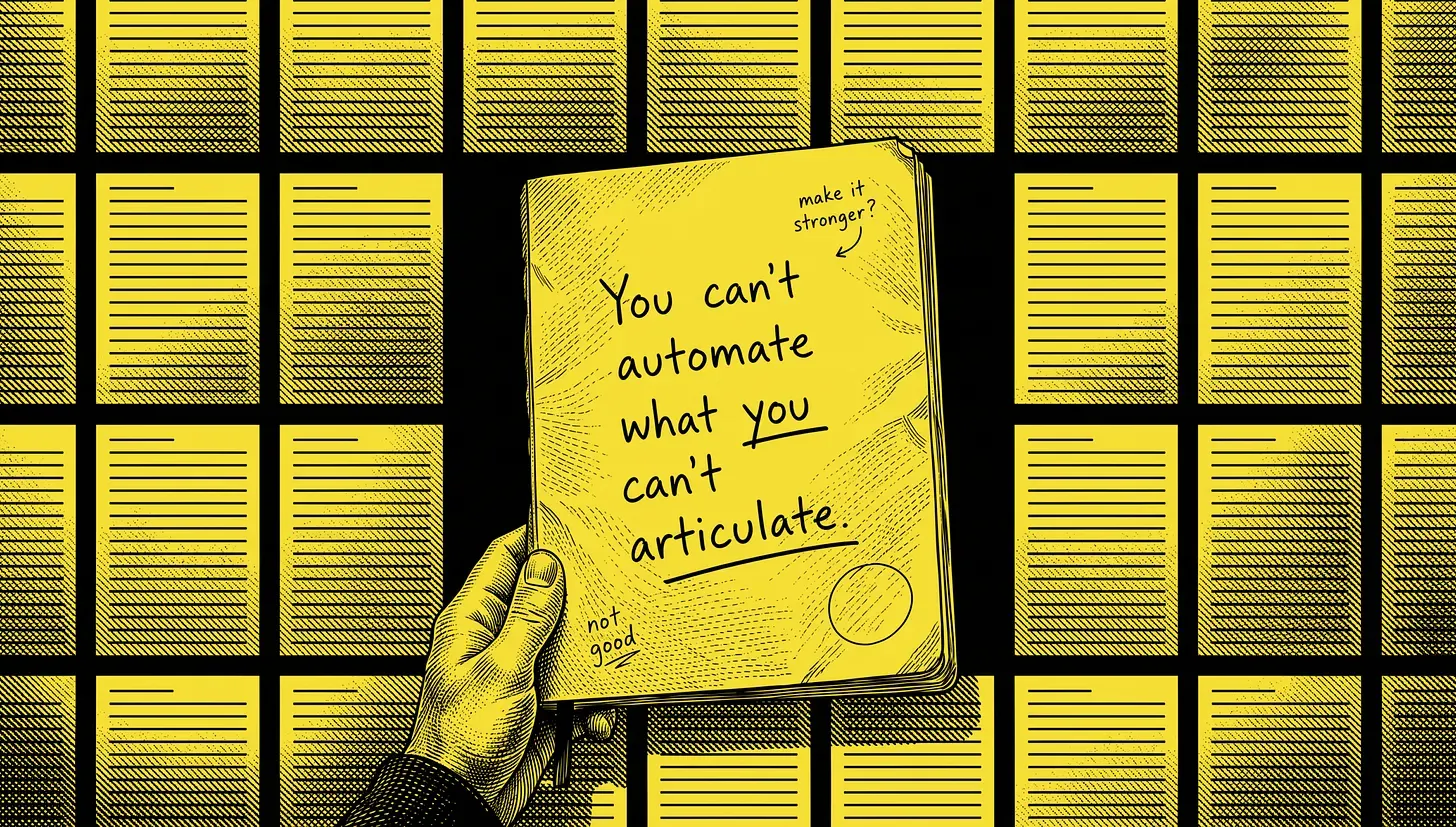
“你无法自动化你无法清晰表达的内容。”(You can't automate what you can't articulate.)
如果你对自己经历了什么、持有什么主张毫无头绪,直接要求 AI 替你完成思考,产出的必然是千篇一律的通用套话。
四、终极价值:走向真正的原创思考
区分通用常识与特质素材,不仅是为了写出一篇顺畅的文章,更是为了理清个人素材积累与思考深化的长期循环。
1. 个人素材库的复用循环
Cole 提出的“个人语言模型”(Personal Language Model)或“数字大脑”(Digital Brain),本质上是指个人长期积累、已由自己确认认可的文字与口述素材库,并非要求用户去训练一个新的技术模型。
这个循环不断重复:
- 记录与沉淀:将自己的经历、教训与认可的观点转化为文字。
- 机器复用:由 AI 协助将已知素材重组、排版并重复分发。
- 释放精力:人类作者摆脱重复码字,投入新生活与新思考。
新经历与新思考再回到记录环节,继续补充素材库。
除了供 AI 调用,这些素材如果选择公开,本身就是一种直接面向读者的高杠杆资产。在现实中,你可能需要在一对一的咖啡聊天中向不同的人反复讲述同一段故事或个人见解;而一旦将它们整理成公开素材,任何人都能在任何时间、任何地点异步访问你的“数字大脑”,无需你每次亲自重复沟通。
当写作者建立起这样一个素材沉淀机制后,旧有的故事和基本主张不仅能供读者直接查阅,还可以交由机器协助复用,写作者本人的时间则被释放出来,投入到更有价值的创造中。
2. 原创内容(Original Content)的两种路径
在通用常识和个人故事之上,写作的最高目标是产生原创内容。个人经历能够带来区分度,但真正的原创要求作者带来具有增量价值的新理解。
Cole 总结了实现原创思考的两种方向:
- 提出未曾出现过的新想法(Say something different):在深入钻研特定领域后,得出前人未曾阐述过的新论点或新视角。
- 用具有实质意义的新方式阐释已有想法(Say the same thing in a meaningfully different way):对大家都知道的道理,提供全新的论证证据、全新的结构框架或更具解释力的新模型。
原创思考无法通过频繁变换浅层话题来实现,它往往需要作者在少数垂直领域内持续深耕与写作。让人工智能去承担基础常识的重组与排版,其最终目的正是为了让人类有精力去推敲新想法、发现新联系,从而推动所在领域的知识增量。
五、可直接复用的实操工具箱(Takeaway Toolkit)
说明:本工具箱基于 Nicolas Cole 在原文中阐释的五大素材变量、雕塑家工作流以及通用常识与特质素材的结合方式改编设计,旨在帮助你在实际人机写作中直接提取使用。
适用场景说明:以下工作流尤其适合个人专栏、商业随笔、经验复盘和观点论述等高度依赖作者辨识度的内容。如果你正在撰写的是客观事实通报、标准技术手册或纯资料汇编,应以准确清晰传递信息为主,无需刻意套用个人故事。
工具一:个人特质素材自提清单(写作前花几分钟梳理)
在将任务交给 AI 之前,先快速梳理以下 4 个问题。允许回答“无”或“不涉及”;如果某些方面没有经历,直接留空,严禁为了故事性而编造。
## 写作主题:[例如:如何应对初次带团队的沟通压力]

1. 我的真实生活与工作事实 (Life Facts):
   - 我在什么场景下参与过这件事?(例如:刚转为小组组长半年,负责 4 人团队)
   - [若无特殊经历可直接写:按常规流程推进,无特殊背景]

2. 我在行业常识中的主动取向 (Opinions):
   - 面对这个主题,市面上常见的几种通用建议是什么?
   - 我个人倾向于认同哪一种?为什么?(例如:比起“增加一对一沟通频次”,我更认同“先理清任务界限”)

3. 一段包含情境的具体经历 (Stories & Insights):
   - 我在实际操作中经历过什么具体波动或突发情况?(交代时间、当时在场人员、原本设想与实际结果)
   - [若无明显波折,可记录一次日常具体协作的实际流程]
   - 这段经历让我更具体地理解了哪条道理?哪个细节支持这个理解?

4. 这一经历带来的做法改变 (Lessons):
   - 经过这件事后,我现在的做事方式或检查习惯与过去有什么具体不同?
工具二:“大理石雕塑法”人机协作提示词模板
将你在工具一中记录的要点或原始口述片段,粘贴至下方提示词中发送给 AI。该提示词的核心目的在于明确事实边界,防止模型凭空编造事实:
你现在的角色是一位专业的文本编辑与内容顾问。

【背景与目标】
我正在撰写一篇关于《[填入你的主题]》的内容。
我不希望这篇文章充斥泛泛而谈的套话。我希望基于我个人的实际经历与立场,形成一篇逻辑严密、叙事自然的深度分享。

【我的原始素材输入】
以下是我关于这个主题的要点记录(包含我的经历、观点与实际观察):
---
[在此粘贴你在工具一中梳理的内容,或直接粘贴一段你的口述逐字稿]
---

【处理规则与约束】
1. 严禁捏造事实与经历:文中涉及的所有个人经历、工作案例、具体数据和关键教训,必须严格基于我提供的【原始素材】。如果素材中有缺失或逻辑断层,请在提纲中向我提问或标注占位符,绝不可替我凭空编造未提及的生活细节、职场经历或经营数据。
2. 充当雕琢者:请梳理我的原始口述,去除前后重复冗余的表述,理清文章的逻辑递进关系。
3. 合理补充通用背景:为了保证文章的通顺与完整,你可以适度补充该领域必要的常识背景或常规框架,但必须将其作为绿叶,用来衬托和解释我的真实经历。
4. 语言风格:
   - 拒绝机械公文套话:避免使用“显而易见”、“总而言之”、“不可否认”、“双刃剑”等陈词滥调。
   - 保持自然清爽的对话感:多用主动语态和直接具体的表述。

请先输出文章的结构大纲与核心段落构想,由我确认后再展开正文写作。
工具三:文稿完成后的四步自检清单
在拿到 AI 生成或协助修改的稿件后,对照以下清单逐项检查:
- [ ] 遮挡姓名检查:如果隐去作者姓名,熟悉你的同事或朋友能否看出这是基于你的经验写出的文章?如果整篇内容放在任何同行业从业者身上都完全成立,说明文章仍缺乏具体的个人特质素材,需要补充你的具体情境。
- [ ] 虚构经历排查(极其关键):仔细阅读正文中的所有案例、时间节点、团队规模与因果故事,检查 AI 是否为了追求戏剧效果或句式顺畅,擅自添加了你未曾经历过的事情或未曾表达过的主张。如有发现,立即删改。
- [ ] 常识与特质的边界:通篇是否大部分都在重复人尽皆知的普遍常识?通用常识是否做到了精炼,并留出足够的篇幅展开你的具体做法和实际观察?
- [ ] 体裁匹配度确认:检查文章性质是否适合加入个人经验。如果是纯客观的研究总结或技术文档,应果断删去不必要的个人感悟,保证事实清晰与检索效率。
The Right Way To Write With AI
The value and ownership of writing in a world of infinite text-based Commodity Content.
If this essay resonates with you, and you’d like more tactical instruction on the right way to write with AI, come join our AI Writing Skool!
Just because you wrote it doesn’t mean you own it.
Language is an open-source operating system for communication. Words and sentences are like lines of code. No one owns, or is known for any individual word or letter. No one owns the letter “C” and no one owns the word “Catastrophe.” No one owns the name “Cole!” There are many people in the world named Cole. So despite these four letters, combined into a word, acting as my name representing my human identity, I do not own the name Cole. And if I write, “My name is Cole,” and someone else writes, “My name is Cole,” he is not plagiarizing me and I am not plagiarizing him. (Which is why we are all assigned Social Security Numbers.)
No person, or company, or government owns the alphabet. Nor do they own the vast majority of the words created from that alphabet. Nor do they own the vast majority of the sentences we speak and write that are strings of the open-source words derived from our open-source alphabet. The same is true for software. No one owns the line of code responsible for processing a payment, or changing the background color of a webpage.
So, where does ownership come from?
How do you know when something you’ve written, or said, or thought, is yours?
An uncomfortable truth the world is unconsciously grappling with in the age of AI is that most words and groupings of words derived from our shared language are Commodities.
When I started ghostwriting for Silicon Valley founders and C-level executes back in 2016, this is the vocabulary I would use. It was common for me to have two clients in the same industry (say “Marketing”) and for both clients on their respective content calls to say, “The key to marketing is knowing your customer.” But this sentence is Commodity Content. A world-renowned expert could say it, or a 22-year-old on Instagram could say it. As a result, this idea, expressed through this grouping of 8 words, derived from our open-source operating system for communication, the English language, possesses very little value. Not because the idea itself is bad, or unhelpful. But because it has no ownership, no unique association. Those 8 words are not identifiable to any one individual.
When people point to a piece of writing and call it “AI Slop,” what they are identifying (or trying to identify) is Commodity Content.
For example, when AI writes a newsletter about “How To Lose Weight,” the majority of the words and sentences and ideas on that topic are Commodities.
- “Track your food.”
- “Count your calories.”
- “Be sure to eat healthy.”
- “Prioritize going to the gym.”
That’s not to say these words and sentences and ideas have no (as in zero) value. Commodity Content in every industry has some value, especially for beginners. If you are brand new to the concept of losing weight and eating healthy, maybe you need to hear someone tell you, “The key to losing weight is to eat healthy.”
The reason this type of content now gets flagged as AI (either artificially with AI-detection software, or publicly by mobs of people trying to delineate between man and machine) is because a Commodity is something that is easily replicable. If you take that newsletter and cover the author’s name at the top, you have no way of knowing whose it is. You also have no way of knowing whether it was written by a human or a robot.
The next uncomfortable truth the world is grappling with, specifically writers across a wide-ranging spectrum of jobs and skillsets, is that Large Language Models are superior Commodity Content Machines.
I remember when I first started freelance writing in 2014. I was 24 years old, a year out of college, looking to make some extra money. A travel agency hired me to write 600-word SEO-optimized blog posts about popular hotels and restaurants in Chicago, Milwaukee, Ann Arbor, and other cities in the Midwest. I was paid $20 per blog post. At the time, I couldn’t understand why I was being paid so little. Those blog posts took work! They took effort! They took time! I didn’t know anything about these cities, hotels, or restaurants, so I had to look them up online, consume other people’s Commodity Content (blog posts written by other Commodity Writers), and then rewrite their words into something “new.”
Now, AI can do all of that work in 1/1000th of the time, with zero effort, for $20 per month—and in some cases, $0 per month.
This is disturbing for many people. And if I was a 24-year-old today, freshly graduated from college and thrown into the working-world, I imagine I would have a hard time reconciling my competition no longer being exclusively my peers (who went to superior schools, no doubt), but also hyper-fluent Commodity Content Machines. Finding a job, particularly an entry-level one to learn and build real-world experience, would be the equivalent of entering a chess competition and not knowing whether you should prepare to battle another human (a fellow student of the craft), or a supercomputer.
But the truth is, the declining trend of Commodity Content is nothing new. Commodity Content—keyword-stuffed, SEO-optimized blog posts; generalized How-To advice; technical walkthrough guides; medical questions & answers; etc.—has always been the least valued form of writing, and rightfully so. It requires the least amount of original thinking, the least amount of personality, and the least amount of skill. To write about topics I knew nothing about (like hotels and restaurants I couldn’t afford to visit in my early-20s), I would often read other people’s work online and repeat the same Commodity Ideas (otherwise known as “conventional wisdom”) but just swap groupings of words, trade adjectives, or accentuate the “voice” with colorful verbs and strategically placed adverbs. For example, I might take someone’s else’s Commodity Sentence—”If you want a fun night on the town in River North, Chicago, check out Osteria Via Stato.”—and repeat the same Commodity Idea in a “new,” slightly different way: “If you want to have some fun in River North, Chicago, and love Italian food, I recommend Osteria Via Stato.”
Which is precisely what Large Language Models do today, writing infinite Commodity Content out of open-source, unowned, non-specific language.
Just because you wrote it, meaning your fingers literally typed those words in that order, doesn’t mean those words are unique or different or yours.
You don’t own Commodity Content.
The rise of AI does not mean the fall of all content, and certainly not the skill of writing.
The rise of AI means the fall of Commodity Content, forcing writers and creators and thinkers across every industry to elevate out of the lowest-leverage, lowest-value form of writing.
- You cannot write Commodity Content better than AI, because AI has access to infinite information and you do not.
- You cannot write Commodity Content faster than AI, because AI can process and produce information at 70% the speed of light, whereas you are bottlenecked by the speed of your human brain connected to your human fingers (or voice).
- You cannot write Commodity Content cheaper than AI, because AI can work every minute of every day without stopping, whereas you cannot.
So, as the saying goes, “If you can't win the game, play a different game.”
Personality Content is the context that surrounds Commodity Content and gives Commodity Ideas increased (or decreased) perceived value. If Commodity Content is the “what” or “how,” then Personality Content is the “why.” It is the writer, creator, speaker, thinker, revealing personal details about who they are, how they learned what they’ve learned, and why they possess the opinions and beliefs and perspectives they do—which, in turn, amplifies the meaning and perceived value of their Commodity Ideas, and the Commodity Content that is fundamental to every topic and industry.
For example, you are more likely to heed the advice, “Don’t trade stocks with leverage, just buy the S&P 500 and hold for a decade” when it’s said by a certified financial advisor rather than a 23-year-old so-called day-trader on TikTok. Not because this is a differentiated insight (it’s not, many people have said it with varying degrees of credibility), but because of the context that surrounds the advice. Your credibility, your personal experience, your Personality is that context.
But, you are even more likely to heed this Commodity Advice when the financial advisor adds even more personal experience, more context, and Personality to their writing. This means going beyond their implied credibility (“a financial advisor wrote this”). For example, they might say, “Don’t trade stocks with leverage. This is a mistake I made when I was in my early-20s on Wall Street, before I went bald from stress. The most reliable way to build wealth is to just buy the S&P 500 and hold for a decade.” If you look closely, you will see the Commodity Content (the advice itself) remains unchanged. What has changed, and what makes the “content” more compelling is that it is now surrounded by Personality Content (we know this financial advisor is speaking from experience because he is admitting he has gone bald from stress). And the more Personality Content we add—the more stories, specific details, and deliberately chosen vocabulary—the more differentiated the whole piece of writing becomes (Commodity Content + Personality Content). So much so, that when pushed far enough, a strong piece of Personality Content by someone less credible can oftentimes outperform, command more attention, and be more enjoyable to read than a piece of Commodity Content by someone with immense credibility and no Personality. Scroll any social platform or major publication and you will see that more-personal Commodity Content almost always outperforms less-personal Commodity Content, meaning the details shared in the writing matter more than even the credibility of the author. And with the rise of AI, and the fall of Commodity Content, we should expect this divergence to not only continue, but accelerate.
Personality Content holds more “value” than Commodity Content because it is harder to replicate. The vast majority of human beings have not taken the time to write down or articulate out loud how they became themselves. They have not built a library of their life experiences: stories from their most formative experiences, mistakes made, lessons learned, etc. Which is why, when the average person uses AI, and AI hands them back a social post or newsletter or book chapter made of Commodity Content without any Personality Content to differentiate it, they call it “Slop.” They don’t see themselves in it. But how could they? AI is a Content Commodity Machine. It does not know you. And you, the human, have not taken the time to build your own library of human-generated Personality Content for it to leverage.
So what is the value of writing in a world of infinite text-based Commodity Content?
It’s writing the things AI cannot—not from a lack of skill, but a lack of context.
I have been preaching this idea for nearly two decades, but in the age of AI it is more relevant than ever.
The most valuable asset you can build for your life and career in the digital age is a library of Personality Content on the Internet. This is how you “scale yourself” out of the unscalable real world and into the infinitely scalable digital world. Instead of sharing one story with one person over one coffee meeting, and the same story with another person over another coffee meeting, you can simply write the story or insight or perspective once and share it with infinite people online across infinite “digital coffee meetings” online.
Over time, this library of Personality Content becomes an open-source Digital Brain for other people to access without needing your direct involvement—one of the highest-forms of leverage. Your Digital Brain is unconstrained by geography, time, and the laws of physics, allowing you to communicate asynchronously with anyone, anywhere in the world, at any time.
You should think of this Digital Brain as a repository of human-generated content—written or voiced—that captures non-commodity variables:
- Life Facts: There are facts about your life no technology or Large Language Model has access to unless documented somewhere. Where did you grow up? How many siblings do you have? What did you study in school? What hobbies have you had over the course of your life? These facts might seem value-less to you, but in a world of infinite text-based Commodity Content, they become meaningful differentiators and signals of ownership. There will be very few, if any, other humans whose cumulative life facts are identical to your own.
- Opinions: What do you feel strongly about? What Commodity Content, in the context of your life, career, or chosen industry, do you agree with or disagree with? If you were going to argue with someone over something, what would you argue about? What would be your stance? Opinions themselves are often Commodities (“I think stealing is bad”), but what is unique to your Personality is which opinions you claim as your own through intentional association (which AI does not know, and cannot know without your involvement).
- Insights: After ghostwriting for 300+ industry leaders, I can tell you from first-hand experience that most “insights” people have are Commodity Insights. “The key to leadership is to lead by example.” This is an example of a Commodity Insight. There is still value in Commodity Insights, especially for the masses and beginners new to an area of interest or industry. But what gives Commodity Insights “value” is your Personality—the examples and context you provide to add color.
- Stories: What have you experienced in your life? What happened? Where were you? How old were you? Who were you with? What did you hope would happen, and what happened instead? Each of us is an accumulation of stories, big and small, that can and should play a meaningful role in our digital lives (our Digital Brains, our Content Libraries, and ultimately our Personal Language Models), the same way they do in our real lives. But it is unreasonable for these stories, arguably the most important variables in our identities, to make their way into our leveraged-digital-selves if we do not take the time to articulate them in the first place. This is the modern-day, real-time equivalent of a grandparent passing before their son, daughter, grandson or granddaughter has the chance to interview them and accurately preserve their life. You must be that scribe for yourself.
- Lessons: And what have you learned? Every life experience forces us to grow in some way, and then we take those lessons and apply them to the next chapter of life, and so on. This is, fundamentally, the value of language—written or voiced. It is to entertain (through story), and to educate (through lessons), passed along from generation to generation.
These non-commodity variables are what make you and your writing “different.” And the more of these variables (or “personal details”) that exist inside your library of Content, the more unique your writing and the more differentiated your Digital Brain.
To make this explicit, imagine two people both write articles about how to cook eggs. The Commodity Content of this topic is universal and somewhat unavoidable: use a pan, add oil, cook, flip, eat. It is unlikely either writer will stray very far from these Commodity Ideas or Steps.
But then imagine both writers add some Personality Content, and both share they are single parents. That is one new data point, a new Personality Variable that instantly differentiates their writing from every other person writing about that same topic. But it is still only one data point, and surely there are many men, who are single parents, who write (or have written, or will one day will write) about how to cook eggs.
So next imagine one of the single dads writes about how they have a son, and the other writes about how they have a daughter. And the first dad tells a story about how he cooks eggs for his son every morning before school, and the second dad tells a story about how he cooks eggs for his daughter every day as an after-school snack. You can see how, with each new Personality Variable that gets added, each person’s writing becomes more specific to them, and more differentiated and unique relative to “the other.”
Differentiation, particularly when it comes to something as shared as language, very rarely, if ever, comes from a singular data point or lone variable—unless you have lived a one-of-one experience shared by no one else: the first man on the moon, Neil Armstrong; the first African American First Lady, Michelle Obama; etc. Only that person can write the words, “I was the first man on the moon” or “I was the first African American First Lady,” which fundamentally makes those 8 words the opposite of a commodity, and very hard to replicate without lying. When AI does this, we call it “hallucinating.”
But for the rest of us, and the masses who have not achieved a one-of-one outcome, differentiation and more importantly, “ownership,” comes through the cumulative collection of our Personality Details—some of which may be shared, some not, but all together amount to a new combination. Music is a helpful analogy here. No composer owns any individual key on the piano, or even Commodity Combinations of keys (scales, chords, ornamentations, etc.). But the longer each grouping of keys, forming distinctive melodies, and the more groupings and melodies in a piece, the more its cumulative whole is seen as different and associated with that individual composer—in turn, creating ownership.
The everyday person takes pride in the idea that a piece of writing is “theirs” when they are the one who physically writes it. And they shouldn’t.
As someone who has gone through the effort of writing and rewriting the same stories and insights and lessons and mistakes, manually, a thousand times in my chosen niche and topic (digital writing), I can tell you there is no nobility in repeating yourself. I shouldn’t have to be the one to rewrite the same story when I have already written that story ten times in ten different ways. And I sure as hell shouldn’t be the one to rewrite the same Commodity Content in my industry when I have already written a hundred different versions of that Commodity Content in slightly different groupings of words in slightly different orders. I should have a machine do the “repeating” for me, so that I can focus on writing the next net-new story, sharing the next net-new perspective, crystallizing the next net-new insight, further building my Personal Language Model and scaling my Digital Brain.
This is the higher-leverage, more creative work to be done.
But this is a painful paradigm shift for many, because it means divorcing effort from outcome, and activity from ownership. Just because you took the time to write it doesn’t mean you spent time writing the right thing (you didn’t add anything “new” to your Digital Brain); just because you had to “think” doesn’t mean you produced any net-new thinking; and just because you physically wrote the words with your hands doesn’t mean the majority of the words you wrote are yours—unique and associated with you and only you.
If you agree language is an open-source operating system for communication, and no one owns individual letters or Commodity groupings of words, then you should also agree it is inefficient and unnecessary for you to write anything that is not contributing to the cumulative and compounding value of your Digital Brain.
- Chosen Commodity Content: Of all the Commodity Ideas in your chosen industry, niche, or topic, which ones do you want to be associated with the most? Which ones do you believe are important to repeat? Commodity Content is infinite, which means the unique component is to decide which ideas you want attached to your identity. So if you’re going to write Commodity Content of any kind, meaning you are going to take the time to “add it to your Digital Brain,” the purpose of writing and re-writing Commodity Content should be to “train your brain” on your chosen ideas and identity. A simple example would be: “If you want to save money, skip buying your morning coffee” vs “Skipping buying your morning coffee might save you a few dollars, but won’t make you rich.” Both of these are Commodity Ideas in the world of personal finance, but hold two completely different points of view. So, which one do you agree with? Which one is a reflection of your identity and how you see the world? That is the value of writing, rewriting, and choosing the Commodity Content inside your Digital Brain.
- Personality Content: Anything that is specific to you and your individual life experience is a non-commodity variable—which means it holds increased value and differentiation. The more Personality Content you write, the more Personality Variables exist within your Digital Brain, the more of “you” can be scaled and shared in the digital world. The cumulative value of all these Personality Variables is the creation of your Personal Language Model, which is how you build differentiated leverage in the AI age of infinite text-based Commodity Content.
- Original Content: You cannot learn how to create truly Original Content by being a tourist of many topics. You can only discover, and ultimately share differentiated, unique, and “owned” ideas through a deep commitment to thinking, and then crystallizing that thinking by writing, in a small number of niches over a prolonged period of time. Those who do are rewarded disproportionally. They become “thought leaders” of their respective topic(s), capturing the most and most lucrative opportunities.
In the age of AI, your goal is to spend the least amount of time writing Commodity Content, and the majority of your time writing Personality Content, so that one day (after many years of thinking deeply and writing obsessively about a small number of topics) you might produce some truly Original Content—thoughts that haven’t been thought before.
That’s not to say you can’t, or shouldn’t write Commodity Content. I do all the time. There is value in repeating Commodity Ideas in your chosen niche for categorical association (becoming known for a niche you own); there is value in reminding readers of Commodity Ideas (particularly beginners); and there is value in writing and re-writing Commodity Ideas yourself for your own learning, and to build your Personal Language Model with many different variations of how you write and speak about these Commodity Ideas.
But at a certain point, you will cross a threshold of diminishing returns.
Each net-new, slightly different variation of the same Commodity Content will produce incremental learnings (you are no longer clarifying your thinking as you write, you are repeating things you have already thought about and know), and incremental leverage (you are not adding anything new to your Digital Brain). And since time is finite, your pride—being the one to manually type words you’ve already said in groupings nearly identical to the groupings in which you’ve already said them—throttles your creative potential.
When people say AI will unleash a wave of abundance in society, across every industry, I believe this is the hope: that we will forgo the pride we have as humans to “do everything ourselves,” and more closely examine what is worth doing in the first place.
And in the case of writing, Commodity Content past a certain point is not worth writing yourself.
Because it was never really yours to begin with.
So, where does your “voice” fall into all of this?
There is a misconception that when you write something, the mere fact “you” wrote it (as in, your fingers typed the keys) means it is in your voice—and that is not true.
Commodity Content has a universal Commodity Voice.
“I woke up, made myself a cup of coffee, and got to work.”
It should be obvious this sentence cannot be attributed to any individual person. That’s because there is nothing identifiable about it—neither from its content (what it’s saying) or its “style” (how it’s being said). And yet, the vast majority of people would like to believe that when they write these 13 words (as in, their fingers click-clack on their keys), not only are the words “theirs,” but they are in “their voice.”
But ask the average person to articulate what makes their voice “their voice,” and what you will often receive back is a word salad of bundled, non-specific terms and phrases:
- “It sounds like me.”
- “It’s to the point.”
- “It’s clean. I like it.”
- “That’s how I would say it.”
- “Because I wrote it!”
But none of these are correct.
“Voice” is a term we use to represent 3 smaller variables that show up in our writing and speech:
- Vocabulary: Your voice changes depending on whether you say, “cool” vs “exquisite” vs “dope.” That’s because vocabulary is a reflection of your identity, and sends all kinds of signals to readers and listeners about who you are and how you see the world. For example: choosing academic words over conversational words, or saying “Chi-Town” instead of “Chicago” in a sentence. These vocabulary choices often have little impact on the sentence’s meaning, but do change your perception of the writer or speaker’s identity—adding unspoken layers of communication.
- Rhythm: Your voice also changes depending on the cadence of your speech patterns. William Faulkner notoriously wrote in long, verbose sentences, whereas Ernest Hemingway more favorably wrote in short, terse sentences. Rhythm is the combination of sentence length, punctuation placement, and vocabulary—the three together creating what is known as “tone.”
- EDAN: Explanation, Description, Action, Narration. What is the purpose of your writing? Better yet, what is the purpose of each individual sentence? Your voice is not a static decision. Your voice can change sentence by sentence. Are you someone who likes to Explain (tell)? Do you prefer to Describe (show)? Do you speak in Action? Or do you hypothesize in Narration? Voice is the combination of what you say (content) and how you say it (style).
As a result, you do not “find” your voice (as many people would like to believe, forever on a quest of linguistic enlightenment).
You create your voice—the same way a painter creates new colors through different combinations of Red, Green, and Blue.
It’s not that it’s wrong, and it’s not that it’s “AI Slop.”
It’s simply Commodity Content written without any Personality Content, resulting in a Commodity Voice.
The same way you cannot expect AI to write non-Commodity Content without a library of Personality Content to pull from (your Personal Language Model), you cannot expect AI to write in a non-Commodity Voice when you haven't written in a non-Commodity Voice yourself (and then stored that writing inside your Digital Brain). That’s not to say you must learn to joust a pen like Jane Austen, but you should at least have some baseline awareness around the qualities of your distinctive voice should you ever hope to recreate it—either yourself, manually, or with the help of a robot, automatically.
That said, I have been teaching writing for over a decade. I have helped tens of thousands of people start writing online. And I find this fixation of voice in the writing world to be utterly unproductive. Just because “you” wrote it does not mean it has a voice. And just because a sentence has a Commodity Voice does not mean it’s bad—or worse, is “AI Slop.”
Commodity Ideas and Commodity Sentences are somewhat unavoidable across every industry and topic. There are only so many ways you can say the same Commodity Thing—just like, no matter how creative you get with dynamics and ornamentation, there are only so many ways to play a scale on the piano or film a scene of a movie. Voice is a minority element, and a much harder variable for differentiation.
The everyday person would be much better off acquiring unique life experiences (non-Commodity Content), and then writing about those unique life experiences (Personality Content).
You should think of each new piece of human-generated Personality Content as an investment in the ultimate compounding vehicle: your Personal Language Model.
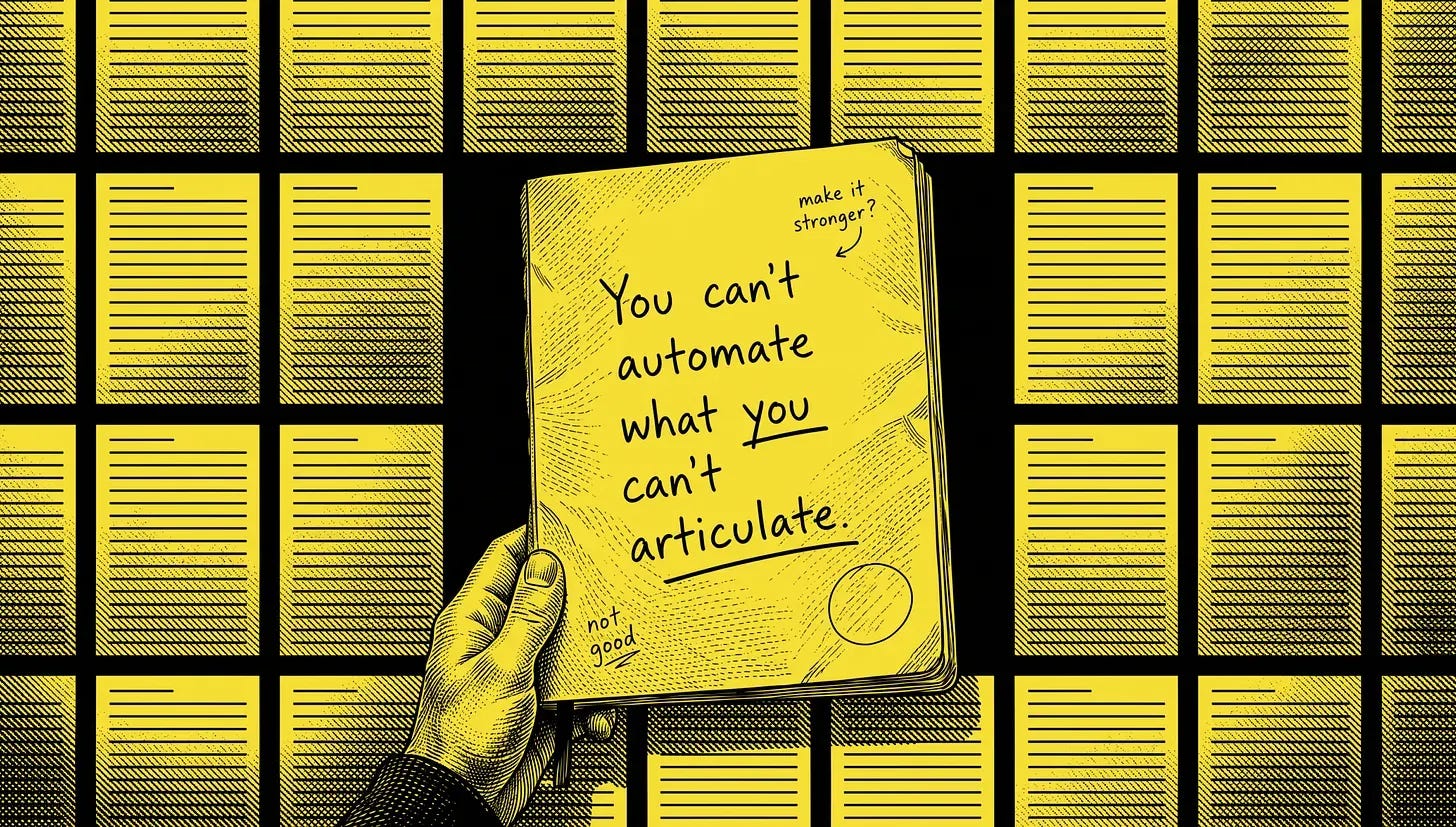
And when is your Personal Language Model complete? When you are finished living. As long as you are alive, you are accumulating new experiences and perspectives and learnings. But to properly leverage them, it is your responsibility to build the skill of articulating them in the first place. Because, as I say often in our writing programs: “You can’t automate what you can’t articulate.”
Those who fail to commit to this process, and do not prioritize taking the time to write “how they became themselves” in the form of Personality Content will be at a severe disadvantage in the digital world. They will have no Digital Brain! They will have failed to transform their human-lived experiences into a Personal Language Model—one of the only data sets AI companies and Large Language Models do not have and cannot easily create. As a result, and as AI continues to get smarter and faster and more capable at producing higher-grade Commodity Content across a wider number of industries and topics, these Digital Brain-less humans will extract the least amount of value from these new technologies. They will not have built the skill (maybe one of the only remaining and necessary skills) of articulating and crystallizing “how they became themselves.” As a result, and as AI technology adoption accelerates, the everyday Digital Brain-less person will continue to create both “Human Slop” and “AI Slop,” causing them to sound like everyone else—a mime to the machine, the cognitive equivalent of a teenager lip-syncing to someone else’s song on TikTok.
Which is why, as we embark into this next era of Writing With AI (not “writing without AI” in technocrat rebellion, or “letting AI write everything for me” in a pursuit of some cyberpunk delusionaltopia), I am on a mission to educate the world on the right way to write with this new technology. This requires helping people understand what is entirely acceptable to outsource (Commodity Content—which we have been outsourcing for centuries with varying degrees of leverage), and what is unacceptable to outsource (Personality Content), not because of some moral conflict, but because Personality Content is an unmade data set.
When people slander the industry of ghostwriting, for example, this is often what they believe is happening: a writer has been hired to “hallucinate” someone else’s Personality Content. As one of the highest-paid ghostwriters in the world, I can tell you the vast majority of the time this is not what’s happening. What’s happening is a smart, accomplished person simply does not have the time, or the skill, to sit down and do “the writing” (the manual labor of organizing thoughts into groupings of words) themselves. It’s too low leverage. So, they hire a ghostwriter (someone like me) to do that work for them. I am not “hallucinating” their Personality Content. I am not making up details about their life that are not real, or choosing Commodity Ideas they have not chosen themselves. And I am certainly not creating truly Original Content on their behalf. I am talking to them (usually on a recorded phone call or Zoom meeting), asking questions, and getting their Personality in their words, spoken aloud. I then take the words they’ve said, cemented into a transcript, and begin whittling it down the same way a sculptor would a block of marble. I remove tangents. I remove unnecessary words. I organize. And I add or subtract any necessary pieces of Commodity Content—which were not the client’s to begin with, and also not “mine.” These are industry-specific words and groupings of words, open-source and owned by no one.
Whether “I” am the one doing this work, or a robot, is somewhat irrelevant. Human beings provide labor leverage, and Large Language Models provide technology leverage. It’s not the form of leverage that matters. It’s the quality of the input. And in order to create a high-quality Digital Brain, it is still the person’s responsibility (the client, in this example) to articulate “how they became themselves,” first. Whether that articulation happens by way of a monologue recorded alone, by way of conversation, through writing yourself, or writing with the help of an editor, doesn’t matter. It also doesn’t matter if it’s a human or a robot who helps you organize the content thereafter. Quite literally the only thing that matters is that YOU provided the input. If you do, you are likely to stand by the quality of the output. (And if you don’t, then don’t be surprised when it doesn’t “sound like you!”)
This is the right way to write with AI. And the beginning of what I believe will be a multi-generational transition in collectively identifying what is worth doing in the first place. AI is not going to steal all the writing jobs (technology leverage). And the ghostwriting industry isn’t going anywhere (labor leverage), because even the most powerful technologies have yet to find a solution to human inaction. Leverage, in and of itself, does not remove the bottleneck of you getting in your own way. You must take the first step, and you must provide the input—and then, and only then, can labor leverage or technology leverage help scale “you.”
If language is an open-source operating system for communication, then most combinations of words and groupings of words are Commodity Content.
If Commodity Content was never yours to begin with, then spending your finite time here on earth manually writing and re-writing the same Commodity Ideas in slightly different variations out of pride for “doing it yourself” is not a symbol of purity, but a Scarlet Letter of stupidity. You are making the conscious choice to write the wrong things.
Personality Content is the unmade data set. It is also one of the only forms of differentiation, association, and “ownership” in the age of infinite text-based Commodity Content. Time spent writing and re-writing Commodity Content, past a baseline level of proficiency, is low leverage and unnecessary. Time spent writing and re-writing Personality Content is higher leverage and additive to the long-term value of your Digital Brain.
But when all conventional wisdom has been said, and “how you became yourself” has been sufficiently articulated in your library of content (your Personal Language Model), what is left? What do you say when there are diminishing returns in repeating yourself, and a machine can repeat the same stories, insights, opinions, and lessons from your Digital Brain, infinitely, without needing your continued involvement?
All that’s left is the creation of Original Content: thinking thoughts that haven’t been thought before, and making connections that haven’t been made before, to say things that haven’t been said before. And I would posit nothing would have a bigger impact on the collective intelligence of our society than having exponentially more people spending exponentially more time “thinking different thoughts,” opposed to endlessly repeating and manually writing the same Commodity Ideas over and over again in the hope of establishing their words as “theirs.”
You do not create something Original simply because your brain thought the thoughts, or your fingers clacked the keys. You also do not create something Original simply because your creation consumed time or effort. Original means additive. It’s new. It’s net-positive. It’s moving the world forward in some big or small way, identifiable to you.
- Say something different.
- Say the same thing in a meaningfully different way.
An example of the former would be Pythagoras saying, in 500 BC, “The earth is flat. Not round.” These are six Original words. Six words that fundamentally changed the way human beings perceived the world. Before Pythagoras, no one had “thought that thought.” As a result, we now (centuries later) still associate those six words with Pythagoras. This is the epitome of “ownership.”
An example of the latter would be Aristotle, a century and a half later in 350 BC, essentially saying “the same thing” but in a meaningfully different way. He proved Pythagoras’s round-earth theory through empirical and observational evidence—pointing to lunar eclipses, horizon lines, and changing constellations.
This is the art of writing.
It’s not to manually type words. It’s not to repeat Commodity Ideas (“conventional wisdom”) and call it your own. It’s to think deeply about a small number of topics and use writing as a mechanism for understanding. But as you understand each Commodity Idea, you should not remain attached to carrying the burden of repeating those chosen Commodities manually yourself. That’s what the robots are for. And you should feel empowered knowing you are continuing to focus on the next-highest-leverage task at hand: making new connections, forming new hypotheses, and thinking different thoughts, in pursuit of pushing your area of interest further than you found it, creating something Original.
Large Language Models are miraculous machines. But they are not going to replace the need for human beings to “think different thoughts.” And if writing is the most effective mechanism in human history for crystallizing one’s thinking, then AI is not going to replace writing as a skill anytime soon. Besides, in order to use AI, you have to know how to prompt. And in order to prompt, you have to know how to… what? You have to know how to write.
You can’t automate what you can’t articulate.
My hope is these Large Language Models will reduce the amount of time we spend as a society writing and re-writing Commodity Content, and give our Personality Content leverage, so we can spend more time thinking and writing what hasn’t been said yet.
I did.
But now that I’ve written it, and crystallized my thinking, and added another 6,500+ words of “approved language” to my Digital Brain, the robots can help me leverage these ideas, infinitely forever.
This is the right way to write with AI.
—Cole
Founder of Different Publishing (you can find my books here!)
Co-Founder of AI Writing Skool
Co-Founder of Ship 30 For 30
Co-Founder of Premium Ghostwriting Academy
Co-Founder of Typeshare
Co-Founder of Ghostbase
Co-Founder of Write With AI
No posts