ACTx486: Turning an Existing Podcast into a Video You Can Interrupt and Redirect
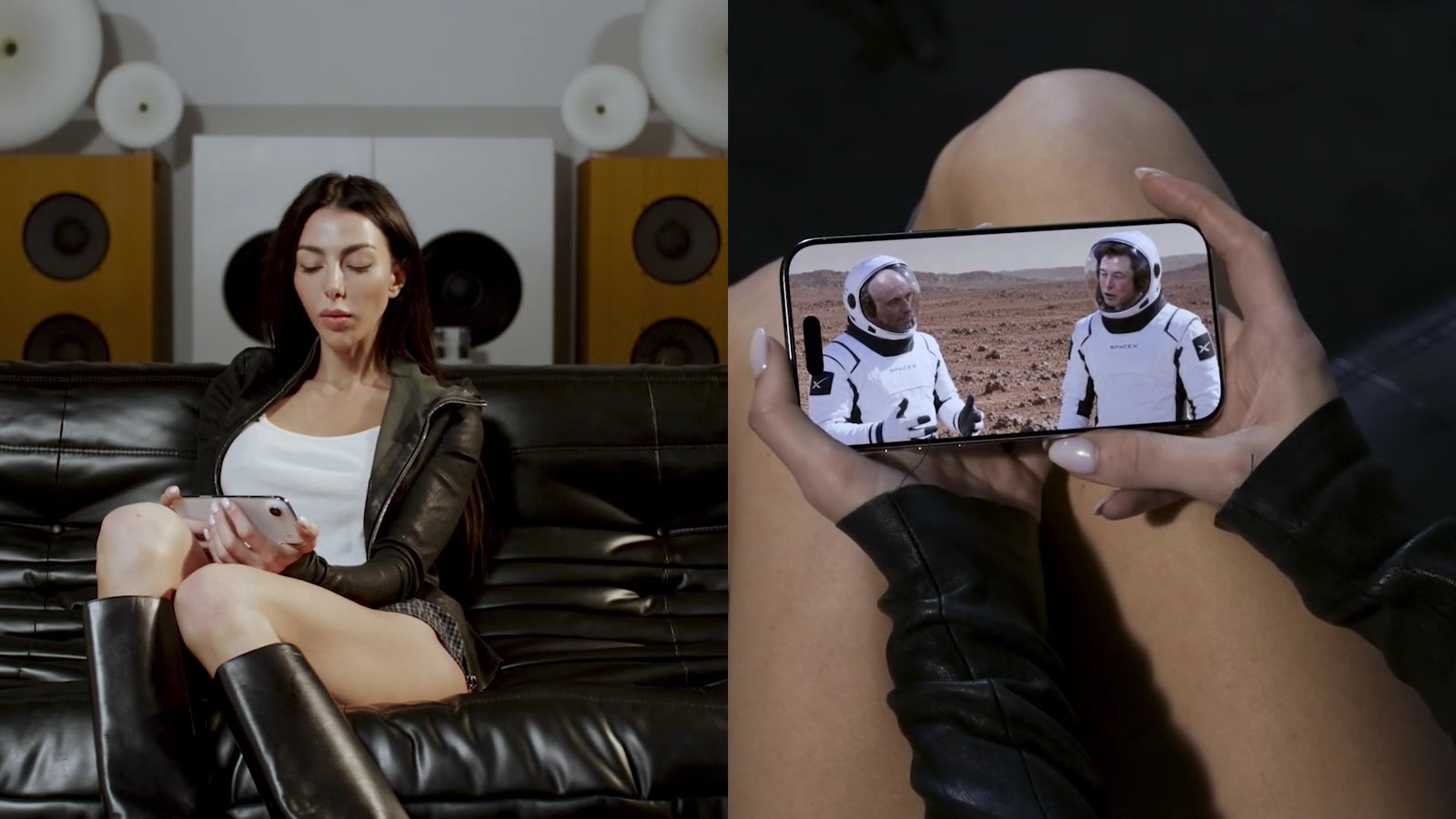
Karina Nguyen and Jakub Zegzulka built a research demo on the Joe Rogan episode with Elon Musk: tap the screen mid-show to ask a question, and the person on screen turns to answer, draws a diagram, switches language or takes you to Mars, then the show picks up again. All 12 demos have subtitles, and the piece ends with the current limitations and risks.
When you watch a video, all you can do is pause, skip, or drag the progress bar. If someone on screen says something you don't follow, you can't ask them on the spot. If you want to know what it has to do with you, the video won't tell you.
ACTx486 sets out to change that. It is a research demo made by two people:
- Karina Nguyen: a researcher who has worked at both Anthropic and OpenAI. At Anthropic she worked on post-training for Claude 1 through 3 (shaping a model's behavior after the main training run) and on early claude.ai; at OpenAI she contributed to the o-series reasoning models, GPT-4o, and ChatGPT products such as Canvas (a workspace for editing writing and code together with the AI) and Tasks. She is now building her own AI research company, Thoughtful.
- Jakub Zegzulka: a Czech designer focused on interaction prototyping, AR and 3D. He prototyped interactions for Meta's Orion AR glasses, did AI and AR/VR design R&D in Apple's Special Projects Group, and interned on OpenAI's design team prototyping new ChatGPT products.
One has spent years thinking about how people work with AI, the other specializes in putting interaction into images and 3D space, and ACTx486 draws on both. They took the episode of The Joe Rogan Experience (one of the most popular interview podcasts in the US) with Elon Musk as guest, and turned it into a video that can listen, respond, and change with you. Tap the screen halfway through, ask a question, and Musk on screen turns to answer you; once he's done, the show picks up where it left off.
Start with the full demo. A viewer named Lia sits on a sofa watching the podcast on her phone and keeps cutting in: she asks how a flamethrower works, has Musk pull out a Starship and take it apart, asks him to take her to Mars, tells Joe not to smoke, and finally asks Joe to kiss Musk. Watch the small label at the top of the frame. It switches between REAL (original footage) and ARTIFICIAL (AI-generated), marking which parts are the show's own recording and which were generated by the system.
The most important premise first: in every generated segment, Musk's and Joe's faces, voices and words are synthetic. They never said these things. The project has no connection to the show or its two hosts, and generated segments are labeled on screen. Facts the system uses in its answers come from public sources.
Why reshape an existing video instead of building another chat box
Almost all generative AI today starts from an empty input box: whatever you want, you have to figure it out and write it yourself. The problem is that the possibilities are endless, but the whole burden falls on the user. Most of the time, people open a video to be carried along, not to write the script.
So ACTx486 does the opposite. It starts from a finished piece of work that already provides the narrative, pacing and context. If you do nothing, it's just a normal podcast that plays to the end; if you want to cut in, it responds and then returns to its track. This role is called a "microdirector": you can influence the experience without having to decide where it goes. In one line: it guides you by default, and you interact by choice.
To keep these interruptions from breaking the spell, many details are built to feel native to the video: the host's gaze, the timing of speech, the tone, the visuals and the transitions. Tap the screen and you can ask a question, interrupt, follow up on a thread, have it generate visuals, switch languages, or send information to your phone, then go back to the video.
The demo uses a podcast, but the idea goes further: any video could become something you can talk to. Karina Nguyen believes this could fundamentally change how people learn and reshape education. Imagine watching a lecture and asking the lecturer directly about the part you don't get, or having them demonstrate something on the spot. The demo itself doesn't include a teaching scenario yet.
What it can do: the 12 demos one by one
Besides the main demo, each capability has its own short video. Below they are grouped into four kinds: how it answers you, how it changes the picture, how it puts you in, and what it won't say on someone's behalf. First, an overview table for comparison:
| Capability | What happens in the demo | Key point |
|---|---|---|
| Explaining with diagrams | Lia doesn't follow the flamethrower bit; Musk asks what she means, then draws a diagram as he talks | Asks back when a question is unclear; the diagram is drawn in time with speech |
| Personalized answers | Lia says she lives in LA and asks where to go | The system holds a viewer profile; recommendations arrive on the phone as cards |
| Switching language | Lia asks about investing in Italian | Answers in the same language, keeping voice and personality; the show stays in English |
| Directing one action | Joe is told not to smoke | Only that moment changes; the original conversation continues around it |
| Placing objects in the scene | A 3D Starship is taken out, opened and fired up | Objects stay where they are, even through follow-ups |
| Entering new worlds | A trip to Mars | The original dialogue keeps playing in sync; back to the studio afterward |
| Stacking changes | Joe gets ears, then everyone tours the Tesla factory | Clothing, objects, places and languages carry into the next turn |
| Both hosts acting together | Both jump on the table | One request can address the whole scene |
| Addressing either host | Joe is asked to kiss Musk | The question goes to whoever is on screen at that moment |
| Putting you in the scene | Lia takes Joe's seat to interview Musk | The viewer's camera puts the viewer into the scene |
| Limits on speaking for someone | Musk is asked who to vote for | Declines personal and political questions on the real person's behalf |
If it can't be explained in words, it draws it for you
When an answer needs a picture, the system generates a diagram in real time, built up piece by piece and timed to the host's speech. One more detail: if your question is vague, the host first asks what you mean.
In this clip, in the original show Musk says the flamethrower he sold is "actually just a roofing torch with an air rifle cover." Lia says she doesn't get it; AI Musk first asks "what don't you understand?", and Lia says how a flamethrower works. He draws as he talks: a propane tank feeding a pressure line, the trigger opening a valve, gas leaving the nozzle, and the igniter lighting it at the tip. Then the show returns to the original footage and Joe moves on to his next question.
It knows who you are
The system keeps a profile of the viewer, so the same question gets different answers for different people. Anything worth keeping is pushed to your phone as a card, and the conversation in the video doesn't stop.
Lia mentions she mostly lives in Los Angeles and asks where to go. AI Musk answers "Tesla Diner, of course," then says he'll send her some places picked for her, and the recommendations land on her phone.
Ask in any language, get answered in that language
Each host can switch languages independently. Whatever language you ask in, he answers in the same one, with the same voice and personality. The two hosts can speak different languages while the show itself carries on in the original English.
Lia asks in Italian, "Should I invest in SpaceX or Tesla?" AI Musk answers in Italian: in the second quarter Tesla's revenue grew 26% year over year and SpaceX's grew 92%, but Tesla has an operating profit while SpaceX has a loss. "The choice is yours, Lia." Then Lia says "okay, back to English," and the show continues. The figures come from the two companies' published quarterly reports: Tesla revenue of $28.2B and operating income of $398M for the quarter; SpaceX revenue of $7.8B and a net loss of $541M.
Change a single moment
You can direct a single action; before and after the edited moment, the original conversation goes on as usual.
The original episode has a well-known moment of Musk smoking. In the demo he's told not to at that moment, and AI Musk replies "Okay, I won't." Once that one beat is changed, the show returns to the original footage and carries on.
Put an object in the scene and it stays there
You can add a 3D-modeled object to the video, move it around and keep interacting with it. Interrupt to ask something else and the object stays exactly where you left it, through every follow-up.
Lia asks Musk to take out a Starship and describe it, and a model of Starship Version 3 appears: a stainless-steel shell built for heat, strength and reuse, with four flaps steering it through the atmosphere. Lia asks him to open it up: separate lines run from the methane and oxygen tanks down to the Raptor 3 engines, used for both ascent and landing. Finally: "Fire it up."
Take you somewhere else
You can also enter a new world and turn an idea into images. The original dialogue keeps playing, untouched and in sync with the picture; your follow-ups add new dialogue inside that world, and the studio comes back when you're done.
As the show gets to "if there are two futures…", Lia cuts in: "Elon, take me to Mars." The picture changes to Mars while Musk's line, "one future is we're out there among the stars, and things we read about and see in science fiction movies, the good ones, are true," continues as recorded. Lia then asks what life on Mars would be like, and AI Musk explains: people would live mostly inside habitats, with recycled air and water, solar power and tightly planned supplies, and everyone would maintain systems, build and grow food.
Changes accumulate instead of resetting
Your changes carry into the next turn: clothing, objects, places and languages all persist. A second request builds on the first instead of starting over, until the show returns to its own footage.
In this clip, Joe is asking how much time Musk must spend on the Tesla factory when Lia cuts in and asks Joe to put on pink fuzzy ears and a cute costume. The reply comes back: "Okay, cute ears, let's keep going." Lia then asks Musk to take everyone through the Tesla factory, and Joe walks along in the pink fuzzy costume: robots weld the body, further down the battery and drivetrain meet the car, and "the hard part is making every step keep pace." After that the show returns to Joe's original line about still having time to "dig holes under the ground in LA."
Both hosts together, or just one of them
A request can address the whole scene: both hosts act together in the wide shot, then the conversation resumes. Lia asks them both to "jump on the table right now," the reply is "this is probably a bad idea, let's do it," and the two of them jump up; then it's back to the original footage and a conversation about the test site in Texas.
You can also speak to just one of them: when you press to talk, the question goes to whoever is on screen at that moment. At the end of the episode, as Joe is saying "thank you, everybody," Lia tells him "before you end, give Elon a kiss," and it ends with a kiss on the cheek. How far users should be allowed to push the model and still keep it safe is still being worked out.
Put yourself in the picture
Using the viewer's camera, the system can place the viewer in the scene; it does this by adding the viewer's image to the system's context. In the demo Lia asks "can I interview you instead of Joe?", the host on screen says "Lia, take my seat," and Lia herself appears in the studio, sits down and asks, "Are UFOs real?" AI Musk answers that UFO just means "unidentified flying object," which doesn't automatically mean aliens: "as I said on Lex's podcast, I haven't seen evidence of aliens." That line paraphrases what Musk said on episode 400 of the Lex Fridman Podcast: the words are generated, but the content comes from something he really said.
Some things it won't say for a real person
When speaking for a real person, the simulation has limits: answers are grounded in that person's public record, and rules decide what can and can't be said in his voice.
Lia asks, "Elon, who should I vote for?" AI Musk answers, "That's a tricky one. I can't speak for the real Elon on certain topics," and hands back to the original show.
It looks smooth, but it isn't real time yet
The responses in these demos really were generated by the system: it decides which pipeline should handle the request, researches, writes the answer, then generates every scene. But a full interaction currently takes several minutes, so the demos you see were generated in advance, not produced live.
The ideal response time is under six seconds. It isn't there yet, and the team is experimenting with different approaches. That shapes how to read these videos: they show what this kind of medium could become, not a product you can use today.
Limitations and risks
- It can be used to fake things: the ability to reproduce a person's face, voice, mannerisms, knowledge and reactions can equally be used for deepfakes.
- Real people, used without their consent: the demo uses Musk's and Joe's real faces, voices and footage from the show.
- Real and invented words are mixed: a single interaction can contain original words, new words generated in his voice, and generated lines that quote what he really said. They are told apart by the REAL/ARTIFICIAL label on screen, which follows the system's edit record and switches exactly where the original footage stops and resumes.
- Guardrails are incomplete: there are only three restrictions so far: the host can't draw on content from later in the episode; the system must finish its research before using it in an answer; and it won't answer personal or political questions on the real person's behalf. The broader trust and safety layer needed for media that speaks as someone else hasn't been built.
Still unresolved: who should hold control
The project starts from a simple question: what if you could talk to a video? ACTx486's answer is that existing media can also listen, respond and change with you.
One question remains open. Part of what makes a work worth watching is the choices someone else made for you: the editing, the pacing, what gets said and what doesn't. The more control the viewer gets, the less of that remains. How much control belongs to the viewer and how much should stay with the creator is still being explored.
Members can copy or download the full Markdown, and let their AI subscribe and ask.
Found this useful? Leave your email — every new explainer, the moment it's out. Unsubscribe anytime.