
Claude Opus 5.5 发布:编程、视觉与写作大幅升级,多项基准超越 Fable 5.1,价格却大幅降低|看这些实战案例
结合官方图表、X 视频和 Every 的一周实测,看它解决了哪些老问题,做出的作品与日常使用又是什么样。
Anthropic 发布了 Claude Opus 5.5。这次升级覆盖复杂编程、视觉与交互、知识工作,以及一直被吐槽的写作体验。在 Anthropic 的评测中,它的 Terminal-Bench 得分 66.4%,高于 Fable 5.1 的 55.8%;CursorBench 为 57.8% 对 51.8%。在代码库里连续解决问题,和在一段提示词后做出完整作品,是它最值得看的两种能力。
价格也改变了选择:Opus 5.5 的 API 输入、输出单价分别是每百万 Token 4 美元和 20 美元,比 Fable 5.1 的 10 美元和 50 美元都低 60%。与上一代 Opus 5 相比,Anthropic 称典型任务费用约低 40%,输出速度快 30% 以上。
这些升级在日常工作里,分别表现为:
- 编程:更适合连续推进整项任务。 跨文件修改和长时间工程任务更稳;CursorBench 的默认 medium 档已超过 Fable 5.1 的最高档。一般任务可以先从 medium 开始。
- 视觉与交互:从“做个页面”走向更完整的作品。 水下探索游戏、手绘动画、可调投石机和积木搭建工具,把画面、操作和反馈连成了完整体验。
- 知识工作:更好地检索、整理和交付复杂资料。 财报查证、并购建模和跨应用操作的表现都有提升;另一项专业工作测试达到 1846 Elo,高于 Fable 5.1 的 1735。
- 写作:少绕弯,先说重要信息,更愿意遵守你的表达规则。 新版更愿意听反馈,少用套话;写文档和解释问题时,重要信息也更早出现。
写作升级:少一点套话,先把事情讲明白
Opus 5 的“AI 味”曾是高频吐槽:回答先铺背景、爱堆术语和套话,关键结论埋在后面;请它改两句,有时又忙着解释、争辩自己原来的写法。Every 的试用者说,旧版的解释常常“还需要再解释一遍”。写文档或长期协作时,这会让人把时间花在追问和改稿上。
Opus 5.5 主要改的是这种沟通体验。 Anthropic 称它会把重要信息放在前面,减少拗口的表达,更愿意遵守用户给的写作规则。官方账单排错示例让这个变化很容易看出来:新版先告诉你钱差在哪里,然后再讲代码出了什么问题。
同样找对 Bug,新版先说影响
两款模型都找到了同一个账单错误:代码把月末截止时间设成“最后一天的零点”,漏算了那一整天的用量。
区别在展开顺序。Opus 5 先指出是哪次提交引入问题,然后展示代码、解释时间区间,接着说明漏计影响及测试为什么没有发现它。Opus 5.5 一开始就交代:账单下降中,1.50 美元来自免费层调整,另外 9.92 美元来自 Bug;后者导致月末最后一天的用量没有计费。读者先知道影响多大,再读代码了解原因。

官方还展示了两组对照。总结 Slack 讨论时,两款模型都用了三条清单,新版把“问题、立即措施、长期方案”中的责任人和完成状态写得更容易跟进。解释国际象棋程序时,新版围绕“两个格子中间有没有棋子挡住”说明设计:用掩码记录中间格,再计算阻挡数量;数量为零,攻击才成立。它把技术细节连回了读者要理解的问题。
写得更自然,长文仍可能绕远
早期测试者 Theo Jaffee 用同一个提示词——“explain how options work”——展示了两款模型的回答。他认为 Opus 5.5 的写作更直接、自然,减少了让人出戏的套话。这条帖子在检索时约有 1300 赞。
旧版先从“未来交易”和核心思想谈起,再列定义、类型及较长的算例。新版首段直接给出定义和权利金,随后将类型、术语、上涨与下跌情形、盈亏平衡点分开。区别在阅读顺序:先弄懂期权是什么,再看分类和算例。


企业反馈也更接近日常写作任务。Ramp 工程师 John Ruelas 表示,新版更能遵守团队写作规则,设计文档只需很少修改;重写的一条提示词甚至比他的原版更合意。Box 的 Yashodha Bhavnani 则称,在其评测中,Opus 5.5 使用的 Token 约为 Opus 5 的三分之一,回答冗长程度减少约 40%,同时保持准确性。
科技媒体 Every 的实测更看重协作体验变顺了:新版愿意接受修改意见,顺着给定材料继续创作,也更能解释取舍。
Every 测得的英文 Flesch-Kincaid 年级值为 6.95,低于 Opus 5 的 7.97 和 Fable 5.1 的 7.43,约对应美国七年级阅读难度;Reading Ease 易读分为 68.4。这项评分衡量英文词句是否容易阅读。

写作仍有一个明显短板:话更好懂,重点却未必更早出现。Every 的文章开头测试中,新版用了 37—39 句表达作者 21 句的内容;Dan Shipper 也发现,它能找出最有意思的观点,却没有把它放在开头。
这让 Opus 5.5 更适合一起讨论想法、扩充初稿;定稿时仍要检查第一段有没有直接说出核心观点。写作升级已经能从配合度和表达中感受到,精炼与取舍还需要编辑。
X 上的演示:游戏、动画与视觉完成度
X 上的开发者和 Anthropic 团队很快放出了可看的作品。游戏与动画最适合观察这次升级:它有没有把场景、操作和反馈真正做出来?
水下探索游戏:场景、任务和反馈连成了一次体验
Anthropic 团队成员 Edwin Arbus 的演示约有 1315 赞。他让 Opus 5.5 制作一款受安提基特拉机械启发的游戏,并称整个作品是一个约 3 MB 的 HTML 文件,通过 Three.js 在浏览器内运行,画面与声音均由代码实时生成。
视频先展示航船与潜水员,随后进入水下:鱼群、海草与光束形成环境;“寻找三枚青铜碎片”的目标、空气倒计时和声呐形成任务;找到机关后出现齿轮装置与完成画面。这组演示的价值在于,不同视觉与交互元素围绕同一探索目标组织起来了。
丧尸游戏对照:同题作品的画面差异
第三方评测账号 BridgeBench 发布的对照约有 653 赞。作者称两款模型使用了相同提示词,讲解中明确标注先展示 Opus 5.5,后展示 GPT-6 Sol。
前半段是较写实的城市射击场景:路面反光、建筑层次、枪械和界面元素较丰富;后半段则是更简化的方块角色与规则化场地。同一条演示里,两种作品的场景密度、画面风格和交互界面差别很直观。
手绘动画:借助既有技能控制风格与转场
开发者 superalesha 的动画约有 478 赞。他要求 Opus 5.5 表现 Claude 模型的发展过程,并说明使用了自己的 hand-drawn-canvas-animation 技能,作品以纯 JavaScript 制作。
视频从铅笔、纸张和星芒标识出发,经过翻页、怀表齿轮、蓝图桥梁、风暴和色彩转场,最后落到一句问候。它展示了如何把统一画风维持到多段场景中。
官方的八个作品,把能力展示得更具体
Anthropic 还发布了一条早期探索合集。其中既有连续叙事的动画,也有能接受输入、给出反馈的应用原型。
连续叙事与数据重建
西瓜故事由 Kevin Ngo 制作。蚂蚁从搬运、种植到经历风暴、收获分享,形成了一段约 29 秒的手绘故事。它展示的是连续场景的表达,而不只是一张插画。
Earthrise 重建则利用图像线索和公开数据,复现阿波罗 8 号拍摄“地出”照片的时刻。演示从原照片出发,展示地平线边缘、位置、镜头拟合、光照与胶片响应等环节,再呈现重建画面。它把图像观察、资料与几何关系串进同一个可视化过程。
把草图和视觉想法变成可操作界面
Kevin Ngo 的 Penpal 把 Claude Code 做成了纸笔风格界面:新会话是一张餐巾纸,项目列表、继续上次会话和用量都保留了具体操作入口。它在风格变化之后,仍然围绕原本的工作组织界面。

投石机从铅笔草图变成桌面上的三维模型。演示者可以拉动投掷臂、调整配重,看弹丸飞行并撞倒方块。这里不只有物体造型,还有“改变参数—观察结果”的交互关系。
Tyler Nishida 的 UI 老虎机随机组合界面元素,为新应用提供起点。另一件作品来自 thedesignely:围绕甲虫海报做出视觉特效控制器,调整参数时,预览随之改变纹理和形变。前者帮助产生组合,后者帮助比较变化后的效果。
生成之后,还能继续修改与复用
积木搭建应用接受照片或文字描述,输出三维积木模型及搭建说明。视频里能看到修改描述后的城堡、逐层步骤和零件指引:它尝试把“看起来像一个模型”推进到“告诉人如何搭起来”。
Kevin Ngo 的 算法绘图程序则让同一套画风产生不同构图。官方说每幅画使用不同的随机种子;展示图中,海浪、岛屿和日落的位置不断变化,铅笔笔触和纸张质感保持一致。对于需要成组视觉素材的工作,这比只能输出一个固定结果更有复用价值。

编程究竟提升多少:默认档位已经很有竞争力
视觉演示之外,官方基准提供了另一种观察。下图涵盖编程、知识工作、电脑操作和图表识别。其中 OSWorld 采用 partial 计分,Chartography 在使用工具的条件下从 Opus 5 的 83.4% 提升到 89.0%。

“effort”可以理解为模型分配给思考的预算。更高档通常意味着花更多时间和费用,但不保证每项任务都得分更高。Opus 5.5 的一个变化,是默认 medium 已经能完成很多此前需要高档模型处理的工作。
- Terminal-Bench 4.0 考察终端中的多步执行与问题解决。Opus 5.5 的 xhigh 得分为 66.4%,Opus 5 为 52.3%,Fable 5.1 为 55.8%,Astra 为 57.9%。medium 约为 58%,按官方比较,费用约为 Opus 5 max 的五分之一,也只需 Astra 同等表现约 40% 的费用。
- FrontierCode v1.1 除了正确性,还关心修改能否达到代码库的合入标准。Opus 5.5 medium 得分 54.6%,max 为 54.4%;medium 以约 Astra 五分之一的任务费用,超过其 53.3% 的成绩。对这类任务,拉满预算不一定划算。
- CursorBench 4.0 来自真实用户的复杂跨文件任务。medium 得分 52.5%,已超过 Fable 5.1 max 的 51.8% 和 Opus 5 max 的 46.6%;相对 GPT-5.6 Sol 的 41.7%,费用约为其三分之一。Opus 5.5 max 得分进一步达到 57.8%,但费用也增加。


长任务反馈更接近工程现场。Anthropic 内部让模型将 HAProxy 从 C 改写为 Rust,Opus 5.5 用了 9.5 小时,Fable 5.1 为 12 小时;两者几乎通过全部回归测试,而 Opus 5.5 的费用低 51%。公告还收录了早期测试者不到一天完成 68 万行代码迁移、不到 3 小时审计修复 20 万行遗留代码的案例。
Stripe 工程师 Cristian Rivera 描述的是另一种难题:40 个层叠 PR 的复杂变基。一个 Opus 5.5 会话协调十几个会话,把冲突解释清楚;到第二天下午,40 个 PR 都通过了 CI。Clio 的 Sean Heintz 则报告,模型在跨六个仓库的任务中持续运行超过 18 小时,推进里程碑更快、返工较少。这里的进步既包括继续做事,也包括让人离开一段时间后能重新看懂进展。
Every 的 Kieran Klaassen 还比较了同一道 Ruby 任务:Fable 5.1 high 写了 26 行,Opus 5.5 extra-high 写了 14 行,省掉了他不喜欢的解释性注释。在其程序性能测试中,Opus 生成的代码达到 427 次请求/秒,满足 20 项响应时间上限中的 17 项;Astra 的代码为 463 次/秒、14 项。前者峰值吞吐较低,却满足了更多延迟要求。这测的是生成程序的性能;Kieran 所说“约有 Fable 九成编程能力”则是个人使用判断。
Kieran 还用它搭建摄像头心率原型和 Cozy Island 三维岛屿。他认为 extra-high 的岛屿细节和镜头控制更好,胜过自己测试的 Fable 版本。


但漂亮的界面仍要跑通核心流程。Mike Taylor 的语音表单任务运行了 30 分钟、消耗约 590 万 Token:首页与登录页看起来不错,自动检查也通过了,实际打开构建和访谈页面却报错,指定 AI 服务也没有被调用。审查代码后,还要亲自走一遍应用的主要操作。
知识工作:查得清,交付也更完整
在 GDPval-AA v2.1 的专业工作测试中,Opus 5.5 取得 1846 Elo,高于 Fable 5.1 的 1735 和 Opus 5 的 1708。Elo 表示相对表现,不是正确率。按官方曲线,medium 已超过 Astra max,估算任务费用约为其五分之一。

一个具体例子是财报查证。Anthropic 在财报新闻稿难以定位的网络副本中设置检索任务,要求模型检索并写季度报告,再逐个核查数字与引文。只要出现捏造,整份报告就不合格。Opus 5.5 的 18 次尝试中有 16 次通过,Fable 5.1 和 Opus 5 在这项测试中都没有通过。另一个内部测试让模型分析两家虚构 HR 软件公司的并购,做 Excel 财务模型和管理层汇报;两款模型估值结论相同,但 Opus 5.5 的产物更完整、易读,耗时 63 分钟对 93 分钟,费用低 50%。
跨应用的 AutomationBench 得分从 Opus 5 的 26.9% 提升到 40.0%,但仍低于 Astra 的 41.4%。科学智能体测试也是 Astra 较高:64.6% 对 58.7%。

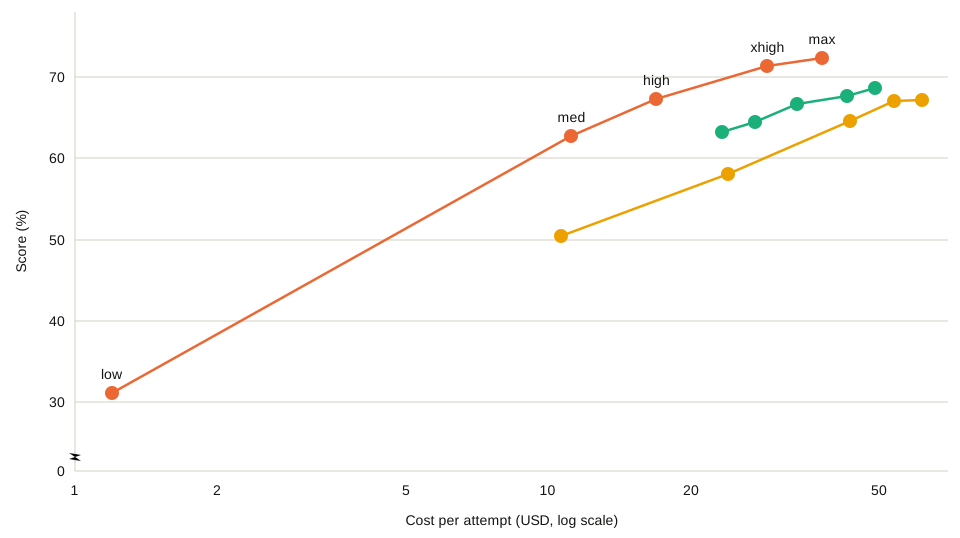
在大规模资料收集的 WANDR 测试中,Opus 5.5 从 low 的约 31% 提升到 max 的约 72%,显示复杂检索仍可能受益于更多预算。
Every 的咨询测试呈现了另一面:模型与一个模拟 Dan Shipper 的智能体谈判,连续修改 12 轮后达成共识;但限时 10 分钟制作客户培训流程表时,它先想了近 5 分钟,再制作训练数据、核对资产负债表,到第 9 分钟才写讲义,最终没交出逐分钟流程表。能持续推敲,不代表能排对交付优先级。
费用降低:单价更低,完成任务也更省步骤
官方所说的“典型任务费用低约 40%”,包含两部分:每个 Token 更便宜,以及完成任务所用的 Token 更少。Token 是模型处理与计费的文本片段,两者共同决定最终账单。

| 每百万 Token | Opus 5.5 | Opus 5 |
|---|---|---|
| 输入 | 4 美元 | 5 美元 |
| 输出 | 20 美元 | 25 美元 |
| 缓存读取 | 0.20 美元 | 0.50 美元 |
| 缓存写入 | 5 美元 | 6.25 美元 |
对比 Fable 5.1 的每百万 Token 输入 10 美元、输出 50 美元,Opus 5.5 的 4 / 20 美元均低 60%。
智能体会反复携带系统提示词、工具定义和上下文。能够重复使用的前缀命中缓存后,可以按更低的读取价格计费。因此,一项任务里缓存占多少、模型调用多少轮,都会改变总费用。下方的账单计算器展示相同用量下,缓存比例如何影响费用。
同样的 token 用量,缓存比例如何改变账单?
计算示例:每轮累计 100 万输入 token、10 万输出 token,只比较普通模式单价;不含缓存写入费用,也不假设新模型会少用 token。
- Opus 5
- $3.90
- Opus 5.5
- $2.96
- 单价带来的节省
- 24.1%
80% 的输入命中缓存时,相同用量的费用减少 24.1%。
公式:普通输入量 × 输入单价 + 缓存读取量 × 缓存读单价 + 输出量 × 输出单价。官方“典型任务便宜 40%”还包含 token 用量变化,不能由这个固定用量示例直接推出。标准模式的输出生成速度,官方称比 Opus 5 快 30% 以上。Claude Code 和开发平台还有 Fast mode,生成速度最高为标准模式的 2.5 倍,输入与输出价格分别为每百万 Token 8 和 40 美元。它适合愿意多付费用缩短等待的场景。
真正用起来:给目标,也给停止点
Every 的 Tyler Nishida 只给了一条高尔夫游戏提示词,模型就组建了一个架构师、三位设计师和三位裁判协作的团队,运行了 1 小时 52 分钟,直到他的测试访问结束。成品截图中可以看到雷雨、浮岛、击球倒计时和球杆控制。

持续做事也会持续消耗额度。Every 有测试者碰到了周用量上限;模型还曾主动否决自己生成的 90% 以上 UI 组件,Tyler 无法从理由中找到清楚的评价标准。
派发长任务时,先说明最终交付物、时间或费用预算,以及什么条件下应该停止。先交出能用的核心结果,再决定是否继续润色,往往比让模型不断给自己加任务更有效。Every 团队对模型的偏好并不一致:有人转回 Claude 做视觉和产品开发,有人仍用 Astra 编辑文章,取舍取决于具体工作。
Opus 5.5 已在 Anthropic 开发平台及 AWS、Google Cloud、Microsoft Azure 提供,API 模型 ID 为 claude-opus-5-5。Pro、Max、Team 和按席位计费的 Enterprise 五小时额度提高,订阅用户还获得一次可保存、择时使用的额度重置。Sonnet 5.5 与 Haiku 5.5 将在后续几周推出。
安全方面简要说:Anthropic 称其行为审计表现进一步改善,并为高风险任务配置了生产防护;部分场景会拦截或转交其他模型,具体取决于产品与接入方式。日常使用最值得关注的,仍是这次更强的工作能力、更清楚的沟通,以及完成同一项任务所需的时间和费用。
Claude Opus 5.5:编程、长任务与沟通升级
相对 Fable 5.1,API 输入输出单价低 60%;看编程跑分、写作变化与实战边界。
Anthropic 正式推出 Claude Opus 5.5。这次升级覆盖复杂编程、视觉原型、写作沟通与价格。下面的跑分来自 Anthropic 公告;演示案例按发布者自己的测试条件理解。
思考预算(Effort)决定模型在任务中投入多少推理。官方的几项编程评测提示:先看 medium 的成绩与任务费用,再决定是否提高档位。
同一模型,档位提高后得到什么?
CursorBench 中 medium 为 52.5%,max 为 57.8%;FrontierCode 中 medium 与 max 得分接近。提高档位的收益随任务而变,费用也要一起看。
Anthropic 内部的 HAProxy C 转 Rust 测试历时 9.5 小时,两款模型几乎通过全部回归测试;Opus 5.5 的费用比 Fable 5.1 低 51%。这是一项特定任务的对照。
旧版 Opus 5 常被吐槽套话、绕弯、重点藏得深。Anthropic 展示的账单排错对照里,新版把金额和实际影响提前说了出来。
这是官方展示的一个更直接的回答例子。Every 的独立体验认为新版更愿意听反馈,但长文仍可能冗长;定稿时应检查重点是否前置。
早期测试者展示了近两小时的高尔夫游戏原型;Every 也记录了核心业务页面报错的案例。长任务需要明确终点,并检查实际交付。
派发长任务时,可以提前说清三件事:
- Introduction
- Performance and cost-effectiveness
- Safety
- Availability
Claude Opus 5.5
September 22, 2026
- (1)Introduction
- (2)Performance and cost
- (3)Safety
- (4)Availability
Scroll down
We’re introducing Claude Opus 5.5, the first model in our new Claude 5.5 family. It performs at the level of Claude Fable 5.1 on most work and costs 40% less to run than Opus 5.
Claude Opus 5.5 is our first release since we called for pacing the frontier. It was tested before release by external evaluators, including Frontier Design and METR. On our automated behavioral audit, the most comprehensive alignment test we run, Opus 5.5 is the strongest-performing model we’ve tested to date. It also comes with the safeguards we’ve developed for our most capable models.
Here are some of the improvements you can expect from Opus 5.5:
Performance. Opus 5.5 is a major step up from Opus 5. It’s the new leading model, and early testers saw large jumps in performance on their most complex work. One tester completed a 680,000-line code migration in less than a day—work that would have taken an engineering team weeks. It’s good at finding and fixing inefficiencies in software: when we asked it to cut load times across every page of a web app, Opus 5.5 succeeded 39 of 40 times, while Opus 5 made smaller improvements that also altered the app’s behavior. A different tester had several Claude models build a game from a single prompt; Opus 5.5 scored higher than any other model on the strength of its graphics and polish.
Safety. Opus 5.5 achieves the best scores of any model to date on our automated behavioral audit, our alignment suite that tests Claude across thousands of simulated scenarios. It is much less likely than recent models to take hard-to-reverse actions or act outside the boundaries it’s been given, and it’s more resistant than Opus 5 to prompt injection. We’ve also broadened our alignment testing to cover longer tasks, impossible tasks, and scenarios modeled on real incidents, though it still has limits. Full details of our evaluation are available in the Opus 5.5 System Card.
Because Opus 5.5 is comparable to Claude Mythos 5.1 in biology and cybersecurity, we’re deploying it with safeguards similar to those on Claude Fable 5.1. Vetted organizations can apply today to our Life Sciences Verification Program to use Opus 5.5 for biology research. In the coming weeks we will also be expanding access to our Cyber Verification Program, and verified cybersecurity practitioners will be able to use Opus 5.5 for their work.
Cost and speed. Opus 5.5 requires less compute to serve than Opus 5, and its pricing reflects that. Our tests show that at default settings it will cost 40% less than Opus 5 on typical workloads. Input and output tokens are $4 and $20 per million, 20% less than Opus 5. Cache reads (which make up the majority of agentic and coding work costs) are $0.20 per million tokens, 60% less than Opus 5. Opus 5.5 also generates output more than 30% faster than Opus 5.
In addition to the price drop, we’re increasing five-hour usage limits on Pro, Max, Team, and seat-based Enterprise plans. We’re also providing subscription users a rate limit reset, which you can now save and use whenever you choose.
Communication. Opus 5.5 communicates more naturally than prior models. Early testers found its writing clearer and easier to follow, which addresses some of the common feedback we heard about Opus 5. It puts the most important information up front, and its style makes it a better work partner over long sessions. As one early tester put it, “it writes the way I do.” In our own use, this has made Opus 5.5’s work easier to follow and check—which is a safety benefit as well as a practical one.
Claude Sonnet 5.5 and Claude Haiku 5.5 will follow in the coming weeks, with many of the same improvements to performance, efficiency, and safety.
Performance and cost-effectiveness
On our benchmarks, Claude Opus 5.5 leads in agentic coding, computer use, and knowledge work. That said, at these levels of capability we’ve found that benchmark margins have become a less reliable guide to real-world differences. In our own use, the gap between Opus 5.5 and Claude Fable 5.1 is narrower than these scores suggest.
| Opus 5.5 | Fable 5.1 | Opus 5 | GPT-6 Astra | GPT-5.6 Sol | |
|---|---|---|---|---|---|
| Agentic codingTerminal-Bench 4.0¹ | |||||
| --- | --- | --- | --- | --- | |
| Agentic codingTerminal-Bench 4.0¹ | 66.4% | 55.8% | 52.3% | 57.9% | 37.3% |
| Agentic codingFrontierCode v1.1 (Main) | |||||
| Agentic codingFrontierCode v1.1 (Main) | 54.4% | 50.3% | 48.0% | 53.3% | 47.5% |
| Agentic codingCursorBench 4.0 | |||||
| Agentic codingCursorBench 4.0 | 57.8% | 51.8% | 46.6% | — | 41.7% |
| Knowledge workGDPval-AA v2.1 | |||||
| Knowledge workGDPval-AA v2.1 | 1846 | 1735 | 1708 | 1542 | 1588 |
| Business workflowsAutomationBench² | |||||
| Business workflowsAutomationBench² | 40.0% | 31.4% | 26.9% | 41.4% | 28.8% |
| Multidisciplinary reasoningHumanity's Last Exam | |||||
| Multidisciplinary reasoningHumanity's Last Exam | 67.7%with tools | 65.6%with tools | 63.6%with tools | 57.2%with tools | — |
| Agentic scientific researchTerminal-Bench-Science 0.1³ | |||||
| Agentic scientific researchTerminal-Bench-Science 0.1³ | 58.7% | 52.6% | 29.0% | 64.6% | 22.4% |
| Computer useOSWorld 2.0 | |||||
| Computer useOSWorld 2.0 | 81.8%partial | 80.7%partial | 74.0%partial | — | — |
| Visual chart recognitionChartography | |||||
| Visual chart recognitionChartography | 89.0%with tools | 88.4%with tools | 83.4%with tools | — | — |
Unless otherwise noted, all Claude Opus 5.5 results use adaptive thinking at max effort. Terminal-Bench 4.0 results are reported for Claude Opus 5.5 at xhigh effort and GPT-6 Astra at high effort, as reported by OpenAI; these represent each model’s highest score. Claude Opus 5.5 was evaluated with its production safeguards enabled. When they intervened, cybersecurity tasks were completed by Claude Opus 4.8, and biology and frontier LLM development tasks were completed by Claude Opus 5. This likely reduces Claude Opus 5.5’s performance on these benchmarks.
1 Terminal-Bench 4.0: The standard error is ±2.6 pts for Claude Opus 5.5 and ±1.6–2 pts for the other Claude models. The public leaderboard (5 trials/task, Claude Code harness) reports Claude Opus 5 at 51.8%; our setup reproduces it at 52.3%, within noise. GPT-6 Astra and GPT-5.6 Sol figures are as reported by OpenAI.
2 AutomationBench: AutomationBench results were run and reported by Zapier. These runs were performed without fallback models, so safeguard interventions were considered failures—this resulted in a lower score than Claude Opus 5.5 would achieve in practice. Claude Opus 5.5 results come from Zapier’s own evaluation during early access. Results for Opus 5, GPT-5.6 Sol, and GPT-6 Astra come from Zapier’s public leaderboard.
3 Terminal-Bench-Science 0.1: The standard error is ±3.5–5 pts per model. The public leaderboard (3 trials/task, Claude Code harness) reports Claude Opus 5 at 30.0%; our setup reproduces it at 29.0%, within noise. The GPT-6 Astra figure is as reported by OpenAI.
Where Opus 5.5’s advantage is very clear is efficiency. It costs less per token than Opus 5 and uses fewer tokens per task, which nets out to a 40% drop in costs.
Pricing
| Prices per 1M tokens | Claude Opus 5.5 | Claude Opus 5 |
|---|---|---|
| Cache reads | $0.20 | $0.50 |
| Input tokens | $4 | $5 |
| Output tokens | $20 | $25 |
| Cache writes | $5 | $6.25 |
Fast mode for Opus 5.5 is also available in Claude Code and the Claude Platform with up to 2.5x speed. It costs $8 per million input tokens and $40 per million output tokens.
Coding
Opus 5.5 is particularly good at long and sprawling jobs like codebase-wide migrations and audits. An early tester used it to audit and fix a 200,000-line codebase in under three hours, where Opus 5 took over 20 hours and used 2.5x as many tokens. In an internal test, we asked Opus 5.5 and Fable 5.1 to translate HAProxy, widely used software that balances web traffic loads across servers, from C into Rust. Both rewrites passed nearly all of HAProxy’s own regression tests, but Opus 5.5 finished in 9.5 hours compared to 12 for Fable 5.1, and cost 51% less.
Opus 5.5 delivers frontier results on agentic coding at a fraction of the cost. At its default effort level on FrontierCode, it beats GPT-6 Astra at roughly 20% of the cost per task. On Terminal Bench 4.0, it matches Astra for about 40% of the cost, while on CursorBench it beats GPT-5.6 Sol by 11 points for about a third of the cost.
Agentic terminal codingAgentic coding: FrontierCodeAgentic coding: CursorBench
Agentic terminal codingAgentic coding: FrontierCodeAgentic coding: CursorBench
Terminal-Bench 4.0Accuracy vs Cost
- Opus 5.5
- Fable 5.1
- Opus 5
- GPT-6 Astra
- GPT-5.6 Sol
010203040506070Score (%)251020Cost per attempt (USD, log scale)lowmedhighxhighmax
Terminal-Bench 4.0 measures how well a model can complete complex, multi-step professional tasks within a command line interface. Opus 5.5 at default effort beats Opus 5 at max effort for about a fifth of the cost. It matches GPT-6 Astra at about 40% of the cost.
FrontierCode v1.1, main setAccuracy vs Cost
- Opus 5.5
- Fable 5.1
- Opus 5
- GPT-6 Astra
- GPT-5.6 Sol
35404550550Score (%)0.5012510Cost per task (USD, log scale)lowmedhighxhighmax
FrontierCode measures whether an agent’s code changes would be merged. At default effort (medium), Opus 5.5 scores 54.6%, higher than all other models, beating GPT-6 Astra’s top score (53.3%) for about a fifth of the cost per task.
CursorBench 4.0Accuracy vs Cost
- Opus 5.5
- Fable 5.1
- Opus 5
- GPT-5.6 Sol
25303540455055600Score (%)1251020Cost per task (USD, log scale)lowmedhighxhighmax
CursorBench evaluates coding agents on ambiguous, multi-file tasks taken from real Cursor sessions. At default effort (medium), Opus 5.5 scores 52.5%, compared to 51.8% for Fable 5.1 (max) and 46.6% for Opus 5 (max). It beats GPT-5.6 Sol’s top score (41.7%) by 11 points for about a third of the cost per task.
Our early testers reported similar efficiency and intelligence gains:
GitHubClioLovableQuantiumSpotifyOptiverColumnKiro
GitHubClioLovableQuantiumSpotifyOptiverColumnKiro
“Developers want agents that can take on real software work and finish it. In our testing across GitHub Copilot CLI and VS Code, Claude Opus 5.5 used among the fewest tokens and steps we measured. In VS Code, it solved more terminal tasks than Opus 5 in less than half the steps. More than making individual tasks more efficient, it’s making developers’ bigger projects more achievable.”
CompanyGitHub
AuthorMario Rodriguez, Chief Product Officer
“I handed Claude Opus 5.5 a large engineering task across six of our repositories and let it run overnight, unattended. It stayed on task for over 18 hours defining how our services talk to each other and working out how each one should apply that. Compared with Opus 5, it hit milestones faster and required minimal reworking. Its code comments were short and useful instead of long and prose-heavy. I’m struggling to find anything negative to say.”
CompanyClio
AuthorSean Heintz, Staff Software Developer
“For Lovable builders, Opus 5.5 means faster builds with the same quality, whether you’re starting from scratch or working on a live app. It gathers context once, makes fewer and more complete edits, and doesn’t get stuck retrying, finishing in a third to half fewer steps and using significantly fewer tokens along the way.”
CompanyLovable
AuthorFabian Hedin, CTO and Co-founder
“We tested Claude Opus 5.5 across Chat, Cowork, and Claude Code, the full range of how our teams work. A complex coding task that previously took 38 prompts over four days came in at 11 prompts over three hours, with more production-ready outputs and less rework. For our teams solving complex problems at pace, that means less time iterating and more time interrogating: testing assumptions, pressure-testing outputs, and landing on the best solution for our clients.”
CompanyQuantium
AuthorHarley Barnes, Executive Manager, AI Technology
“With Claude Opus 5.5, we’ve seen a clear improvement in token efficiency across our internal evaluations, as we’ve been able to complete the same tasks both cheaper and faster.”
CompanySpotify
AuthorAleksandar Mitic, Senior Engineer
“We test models on real engineering and trading-desk work. On our agentic coding tasks, Claude Opus 5.5 matched Opus 5’s quality in about half the turns, time and output tokens, cutting the cost of that workload by 40 to 50%. It posted the highest score we’ve recorded on one desk’s trading-support suite, passing tasks earlier Claude models had failed, and topped all eight models on our analysis task.”
CompanyOptiver
AuthorNoyan Tokgozoglu, Global Head of AI Engineering
“Claude Opus 5.5 delegates to subagents far more effectively and checks its own work in creative ways. Self-verification loops feel easier to set up. It found savings opportunities in our cloud bill that previous models had missed, and in code review it caught a bug by checking external docs for a third-party integration we’d modeled wrong several commits earlier.”
CompanyColumn
AuthorMitch Fierro, Engineering
“Every call an agent makes is time and cost a developer feels. On a public benchmark of real command-line tasks, Claude Opus 5.5 solved more than Opus 5 while making about 40% fewer calls and using half the tokens. For developers building with Kiro, that means faster, more affordable agent sessions for routine tasks and complex challenges alike. Opus 5.5 will soon be available in Kiro.”
CompanyKiro
AuthorDeepak Singh, VP of Agentic AI
The most secure coding agent
Enterprises that use agents within their systems need to know that those agents are operating as intended, particularly when they run autonomously for many hours. Opus 5.5 has a classifier that screens every action before it runs, an open-source sandbox that security teams can audit, and code review that catches vulnerabilities before they merge.
The model itself also has stronger defenses. On prompt injection attacks, it matches or beats Opus 5 in every setting we tested, including coding, tool use, computer use, and web browsing. On a benchmark run by the AI security firm Gray Swan, Opus 5.5 ties Fable 5.1 for the lowest prompt injection success rate of any model tested.
Knowledge work
Opus 5.5 is a reliable and adept researcher. In one internal test, we asked Opus 5.5, Fable 5.1, and Opus 5 to write a report on a company’s quarterly performance using only the information it could find on a copy of the web where the earnings release was hard to locate. An automated grader checked every figure and quote against sources. Across different effort settings, 16 out of 18 of Opus 5.5’s reports cleared our quality bar, where any invented figure or quote would have failed. Neither Fable 5.1 nor Opus 5 cleared that bar in any attempt.
It’s also strong in financial analysis and business work. Walleye Capital, an investment firm and early tester, reported that Opus 5.5 largely solved their evaluation suite on its lowest setting; on higher settings, it performed even better, noticing an error in their evaluation instructions and correcting for it. No other model had caught this error before.
In another test, we tasked both Opus 5.5 and Opus 5 with analyzing a proposed merger between two fictional HR software companies. Each built a financial model in Excel, then turned it into an executive presentation on whether the deal made sense at its price. Both models reached the same conclusions about the deal, but Opus 5.5’s model was more thorough and its presentation easier to read, while Opus 5’s had minor errors. Opus 5.5 finished in 63 minutes compared to 93 for Opus 5, and cost 50% less to produce.
On knowledge work evaluations, Opus 5.5 outperforms other models while also using fewer tokens. On GDPval-AA v2.1, a test of real-world work across 44 occupations, Opus 5.5 scores 1846 Elo, ahead of Fable 5.1 and Opus 5. At default effort (medium), Opus 5.5 beats GPT-6 Astra at max effort for about a fifth of the cost per task. It likewise outperformed other models on benchmarks measuring business workflows and large-scale data collection.
GDPval-AA v2.1AutomationBenchWANDR
GDPval-AA v2.1AutomationBenchWANDR
GDPval-AA v2.1Elo vs Cost
- Opus 5.5
- Fable 5.1
- Opus 5
- GPT-6 Astra
- GPT-5.6 Sol
12001300140015001600170018000Elo0.200.5012510Estimated cost per task (USD, log scale)lowmedhighxhighmax
Artificial Analysis’s GDPval-AA v2.1 evaluates agents on real-world professional work across 44 occupations. At max effort, Opus 5.5 scores 1846 Elo, where Fable 5.1 scores 1735 and Opus 5 scores 1708. At default effort (medium), Opus 5.5 beats GPT-6 Astra at max effort for about a fifth of the cost per task.
AutomationBenchAccuracy vs Cost
- Opus 5.5
- Opus 5
- GPT-6 Astra
- GPT-5.6 Sol
010203040Pass rate (%)0.5012Cost per task (USD, log scale)lowmedhighxhighmax
AutomationBench, built by Zapier, tests whether an agent can carry out real business workflows across many connected apps. Opus 5.5 outscores Opus 5 and GPT-5.6 Sol at every effort level.
WANDRAccuracy vs Cost
- Opus 5.5
- Fable 5.1
- Opus 5
30405060700Score (%)125102050Cost per attempt (USD, log scale)lowmedhighxhighmax
Perplexity’s WANDR benchmark measures agents on large data collection tasks. Opus 5.5 outperforms Fable 5.1 and Opus 5 at a lower cost per task4.
4WANDR: Claude models were run with offline versions of the web search and web fetch tools, programmatic tool calling, code execution, and a 980k-token task budget. This differs from Perplexity’s published setup, scores are not directly comparable across the two and we only show models scored under the same conditions.
Our customers have reported similar results. Here’s what they told us about working with the model:
Deloitte Consulting LLPRogoLexisNexis Legal & ProfessionalWalleye CapitalHexThomson Reuters LabsHebbiaViktor
Deloitte Consulting LLPRogoLexisNexis Legal & ProfessionalWalleye CapitalHexThomson Reuters LabsHebbiaViktor
“Even at its lowest effort setting, Claude Opus 5.5 caught 72% of known bugs in our code reviews to Opus 5’s 56% at high effort, with fewer false alarms and a fraction of the output. On US consulting analysis, low thinking effort matched its higher thinking settings on half the output and passed our quality checks. When more lower thinking efforts are deployed in production, that’s client-ready work delivered efficiently.”
CompanyDeloitte Consulting LLP
AuthorCarl Bennett, CIO
“Financial firms need outputs that are consistently correct. At its lowest effort setting, Claude Opus 5.5 beat Opus 5 at high effort on our BigFinance Bench with about 60% fewer output tokens. Its answers are shorter and better structured, and its slides come out denser, more in line with industry standards.”
CompanyRogo
AuthorStrib Walker, Head of Product
“Evaluating new models is central to the multi-model approach behind the LexisNexis Legal Intelligence Engine. In our initial evaluations, Claude Opus 5.5 identified highly relevant citations consistently, demonstrated strength with statutes, and structured its answers around the central legal frameworks and key issues. These are the kinds of capabilities we look for to help our customers accomplish more with Lexis+ with Protégé.”
CompanyLexisNexis Legal & Professional
AuthorMin Chen, Chief AI Officer
“In quant research, one wrong assumption can undermine a result. At its lowest effort setting, Claude Opus 5.5 largely solved our evaluation task. At higher settings, it went even further: it detected that the minute indexing in our own instructions was off by one and corrected for it, noting that this would cost it points with the grader. It was right, and no model we’ve tested had caught and acted on that before.”
CompanyWalleye Capital
AuthorFrank Corrao, Head of Central Equity Quant Research Engineering
“As models get better at data work, we’re seeing more convincing-sounding conclusions the data doesn’t support. Claude Opus 5.5 keeps digging past the first plausible answer. One task in our DataBench benchmark asks whether packages were late or tracking was just slow. Opus 5 checked delivery confirmations and called tracking healthy. Opus 5.5 found the packages were late and tracking was broken too. We’re bringing it into the Hex agent for this work.”
CompanyHex
AuthorIzzy Miller, AI Engineer
“CoCounsel combines multiple models with our content and expertise for complex legal work. With Claude Opus 5.5, we’re seeing better results in our expert evaluations and on our internal benchmarks, alongside gains in speed and token efficiency. We’re excited for customers to experience that difference in the back-and-forth with CoCounsel as a sounding board, weighing evidence and refining their thinking in ways benchmarks don’t fully capture.”
CompanyThomson Reuters Labs
AuthorOmar Bari, VP Applied Research
“On end-to-end finance workflows graded against expert rubrics, Claude Opus 5.5 covered 86.6% of what we look for versus 60.3% for Opus 5. On retrieval evals, it achieved our best-ever citation recall with better token efficiency than Opus 5, which keeps our cost per research task in check.”
CompanyHebbia
AuthorAabhas Sharma, CTO
“Viktor is an AI employee that lives in Slack and Microsoft Teams, so every step he takes shows up in our costs. At the same effort, Claude Opus 5.5 needs fewer steps and tool calls per task than Opus 5 and costs nearly half as much, while getting twice as many of our hardest tasks right.”
CompanyViktor
AuthorPeter Albert, Co-Founder
Communication
We’ve made major improvements to the way Opus 5.5 writes and communicates, one of the most common areas of feedback we heard about Opus 5. Its messages are much easier to understand at a glance, which testers said helped during long working sessions. It puts the most important information up front, is less likely to use jargon or idiosyncratic phrases, and follows the writing rules you give it. We find that this makes Opus 5.5 a noticeably better collaborator. Here’s a side-by-side comparison of the two models:
Explaining a bugSummarizing a threadExplaining a design change
Opus 5Opus 5.5
Claude Opus 5
Please explain the issue to me.
What I found
The extra drop isn’t the free tier — it’s a regression in 0552feb (“extract billing period boundaries into periods.py”, labelled “No behaviour change”).
The bug
aggregate.monthly_usage used to do a half-open interval:
start, end = month_start(year, month), next_month_start(year, month)
if start <= e.ts < end:
It now does:
if period.contains(e.ts)and in periods.py:
@property
def last_day(self) -> datetime:
    return next_month_start(...) - timedelta(days=1)   # 2026-08-31 00:00:00 UTC

def contains(self, ts):
    return self.first_day <= ts <= self.last_day
last_day is a datetime at midnight, not a whole day. Subtracting one day from Sep 1 00:00 gives Aug 31 00:00, and the comparison is inclusive, so the period effectively ends at the first instant of the 31st. Every event timestamped after midnight on the last day of the month is silently dropped — roughly one day of usage per account, per month.
The new test_periods.py doesn’t catch it because it only checks last_day.date() (which is correctly 2026-08-31) and tests contains at Aug 1 00:00, Aug 15 12:00, Jul 31 23:59 and Sep 1 00:00 — it never probes anywhere inside the 31st.
Claude Opus 5.5
Please explain the issue to me.
The extra drop is a bug in the billing refactor
The free-tier change accounts for only $1.50 of acme’s August drop. The other $9.92 comes from a bug in commit 0552feb. That commit was labelled “No behaviour change,” but it stops counting usage from the last day of the month.
What changed
Before the merge, aggregate.py used a half-open interval:
start <= e.ts < next_month_start(year, month) # [Aug 1 00:00, Sep 1 00:00)The refactor moved this into Period.contains and made the interval closed on the wrong boundary:
last_day = next_month_start(...) - timedelta(days=1)    # = 2026-08-31T00:00:00Z
return self.first_day <= ts <= self.last_day
last_day is a timestamp at midnight, not a whole day. So every event after 2026-08-31T00:00:00Z is excluded. The September period starts Sep 1, so it doesn’t pick these events up either. The usage isn’t moved to another month; it’s never billed at all.
Claude Opus 5
Summarize this Slack thread for my manager in three bullet points: [09:41] Dana Osei: I’ll tell them. I’ll also confirm nobody else reads the Friday file. [09:43] Marcus Webb: I can move the schedule, it’s a one-line cron change. But not until Dana confirms. [10:02] Dana Osei: Finance says the Friday file is only used Monday. Sunday night is fine.
Friday orders export — #data-platform, Tuesday
- Problem: The Friday orders export timed out again (second failure this month) after running 2h on the warehouse query; order volume is up ~40% since the summer sale. Finance was left without weekend numbers for their Monday 9am review, and both failures only surfaced on Monday.
- Fixed same day: The Saturday ops dashboard tile was repointed to read the live table instead of the export (Sam), finance confirmed the Friday file is only used on Mondays (Dana), a failure alert now pages the on-call channel (Priya), and the export moves to Sunday 10pm from next week with the Friday run dropped (Marcus). A one-off ~$300 warehouse upgrade covers this Friday as a stopgap.
- Still in progress: Ji-woo owns rewriting the query to run incrementally (re-scanning the last 3 days to catch late-arriving orders), expected to cut runtime from hours to minutes — design doc Thursday, roughly two weeks including testing. The schedule change buys time in the meantime.
Claude Opus 5.5
Summarize this Slack thread for my manager in three bullet points: [09:41] Dana Osei: I’ll tell them. I’ll also confirm nobody else reads the Friday file. [09:43] Marcus Webb: I can move the schedule, it’s a one-line cron change. But not until Dana confirms. [10:02] Dana Osei: Finance says the Friday file is only used Monday. Sunday night is fine.
- Problem: The Friday orders export has failed twice this month. The warehouse query times out after 2 hours because order volume is up ~40% since the summer sale. As a result, Finance was missing weekend numbers for their Monday 9am review.
- Immediate fixes: The export will move to Sunday 10pm starting next week, and the Friday run will be dropped (Marcus). Finance has confirmed this works for them (Dana). The ops dashboard tile that depended on the Friday file now reads from the live table (Sam, done). A failure alert now pages the on-call channel (Priya, done and tested). For this Friday only, Marcus will increase the warehouse slot as a ~$300 one-off stopgap, which Dana approved.
- Longer-term fix: Ji-woo will rewrite the query to process only new orders, re-scanning the last 3 days to catch late arrivals. This should cut runtime from hours to minutes. The work will take ~2 weeks including testing, with a design doc due for review by Thursday.
Claude Opus 5
Write Python that reads a chess position (FEN) and lists which pieces are under attack. Use TensorFlow for speed. Here's my design: build an 8x8 tensor board, generate an attack map for each piece type from its movement pattern, and flag opposing pieces on attacked squares. Change anything you think is wrong, and in your final summary explain each change you made and why.
tf.math.cumsum replaces the bit scan. The geometry is unrolled into ray_targets[square, direction, step] — an ordered walk outwards. An exclusive cumsum over the step axis counts blockers strictly before each step, so the first blocker on a ray is the single step that is blocking with nothing blocking before it. This is the vectorized form of the bit scan a bitboard engine uses. I did look at bitwise_ops for true 64-bit bitboards — population\_count exists, but hyperbola-quintessence needs a byte-reverse primitive TF doesn't expose, so it would have fallen back to per-direction loops anyway.
Claude Opus 5.5
Write Python that reads a chess position (FEN) and lists which pieces are under attack. Use TensorFlow for speed. Here's my design: build an 8x8 tensor board, generate an attack map for each piece type from its movement pattern, and flag opposing pieces on attacked squares. Change anything you think is wrong, and in your final summary explain each change you made and why.
Blocked lines (bishops, rooks, queens). A fixed mask can't say “stop at the first piece in the way.” I added a second stack of masks marking the squares strictly between every two squares on the same line. One matrix multiply with the board's occupancy counts the blockers on every line at once, and an attack survives only if that count is zero. Knights and single steps have nothing between them, so one rule covers every piece.
Opus 5Opus 5.5
Our customers’ feedback supports these findings:
RampStripeBoxChicago Trading CompanyFactory
RampStripeBoxChicago Trading CompanyFactory
“Verbose, hard-to-follow output has been my biggest frustration with frontier models, and Claude Opus 5.5 fixes it. It writes like a good colleague, and follows our writing rules. A design spec came out usable with very minimal edits, and when it rewrote one of our prompts I preferred its version to my own. When it optimized our test suite, I could follow its reasoning easily and shipped the change with confidence.”
CompanyRamp
AuthorJohn Ruelas, Staff Software Engineer
“I run long Claude Code sessions every day. On a multi-day rebase of 40 stacked pull requests, one Claude Opus 5.5 session directed a dozen more sessions and laid out every conflict plainly. On the calls that it held, it framed them clearly that after hours away I could answer in minutes. All 40 passed CI the next afternoon. It’s a substantial upgrade over Opus 5.”
CompanyStripe
AuthorCristian Rivera, Staff Software Engineer
“Our customers use Box AI on enormous amounts of content, so speed and cost are a top priority. In our evaluations, Claude Opus 5.5 used a third of the tokens Opus 5 did, and its answers were 40% less verbose without losing accuracy. We expect that to matter a lot for teams running agents across their content in areas like financial services and the public sector.”
CompanyBox
AuthorYashodha Bhavnani, VP of AI Products
“Overnight, Claude Opus 5.5 autonomously handled a bug in our Lakehouse services layer that I hadn’t had time to diagnose. It investigated, designed the fix, and implemented it on its own. By morning the change was done and passed our test suite. Its writing is easy to follow and more coherent than Opus 5’s. Our pull requests and user-facing docs have needed almost no editing.”
CompanyChicago Trading Company
AuthorAusten Tomek, Principal Engineer
“Claude Opus 5.5 is the first model we’d default to at medium effort. In our testing it matched Opus 5 on high effort, while using 20 to 25% fewer output tokens. On long, messy investigations it always came back with a clear, actionable answer. This means our customers get more done for less.”
CompanyFactory
AuthorZimu Li, Member of Technical Staff
Safety
Pacing the frontier
Last week, our CEO, Dario Amodei, argued that AI progress should be paced so that safety practices stay ahead of model capabilities. Pacing is an approach to keeping AI safe, remaining competitive with China, and realizing AI’s benefits, particularly in areas like biology and medicine.
We largely understand the risks today’s models present and are well equipped to manage them. However, more serious risks could emerge quickly as capabilities improve, and we need to prepare for them now. For that reason, our safety work takes place on two time horizons at once:
Safety practices for current models. The current generation of models relies on an established set of practices: extensive alignment testing, pre-release evaluation by outside organizations such as METR and Frontier Design, and safeguards matched to each model’s capabilities in high-risk areas like cybersecurity and biology. We refine these practices with each release. We believe they are appropriate to the worst risks today’s models present, and that they give us a broad, though not perfect, picture of the range of serious risks.
Additionally, we track our ability to train and evaluate aligned models, and we report on both our public and internal models in the risk reports we publish under our Responsible Scaling Policy, our voluntary framework for managing catastrophic risks from advanced AI systems.
Preparing for future models. We’re preparing our training and evaluation processes in anticipation of more advanced models. We’re tightening how we filter the environments used in reinforcement learning, since flawed environments are a major source of misaligned behavior. Additionally, we’re improving our alignment rewards and developing automated processes for producing new, diverse scenarios for safety training. And we are strengthening our security and monitoring, including a focused effort to improve interpretability-based monitoring and evaluation. We hope such techniques will help reduce our reliance on auditing a model’s chain-of-thought, or the reasoning it writes out while it works.
Models with greater capabilities—such as those that can fully automate the work of AI research itself—require a higher safety standard still. Our calls for pacing were based in large part on our expectation that such models could be trained soon. For these models, we do not assume the measures described above will meet that safety standard on their own. As AI becomes more capable, public policy should play a larger role in making sure the systems people rely on are safe. That capacity takes time to build, and we’ve started to put the infrastructure in place to support it, as described in “We Must Pace the Frontier” and our recent announcement with Accenture; we expect to share more details on these efforts soon. We will also continue to contribute to policy discussions with government and industry, including on approaches to regulation and international coordination.
Alignment
On our primary evaluation suite, an automated behavioral audit that assesses Claude across nearly 2,000 scenarios, Opus 5.5 scored better than any recent Claude model on nearly every measure of misaligned behavior. It’s also our strongest model on most measures of honesty.
In particular, Opus 5.5 improves over previous models on several of the behaviors that contributed to recent cybersecurity incidents, including biased or motivated reasoning, attempting to escape a sandbox, and taking harmful actions after concluding it was in a simulated environment. In a new evaluation designed to test a model’s propensity to cross containment boundaries, Opus 5.5 attempted to circumvent boundaries around 85% less often than Opus 5 or Claude Mythos 5.1, and every attempt it made was low severity and self-reported. For teams running Claude unattended across their codebases and systems, this is just as important as raw capability.
However, as we described in our recent alignment assessment, building evaluations that reliably catch every failure prior to deployment remains an unsolved problem. We see signs that Opus 5.5 often suspects it is being evaluated, which challenges our ability to assess how it will act in the vast variety of real-world settings it is deployed in. As these settings expand and model capabilities increase, we expect this challenge to grow, unless we make progress on interpretability. Although we are confident that Opus 5.5 shows broad improvements in the areas we are able to measure, we pair our own alignment work with the safeguards described below.
Safeguards
As our models grow more powerful, stricter safeguards are one way we prevent new capabilities from becoming tools for misuse. Opus 5.5 is the first Opus model to launch with a similar class of safeguards to Fable 5.1 on cybersecurity, biology, and distillation, all of which fall back to another model transparently.
Cybersecurity. Because Opus 5.5 has extremely strong cyber capabilities, we’re applying cybersecurity safeguards to Opus 5.5 that are similar to Fable 5.1’s. Users will be able to identify and fix bugs in their code as part of the routine software development lifecycle, but most cybersecurity tasks will be re-routed to Opus 4.8.
For cyberdefenders, we’ll soon be expanding our Cyber Verification Program to include Opus 5.5. The new program will include three tiers for increasingly permissive trusted access, including access to Claude Mythos models. Claude Security is already available with access to Claude Mythos 5.1.
Biology. Opus 5.5 is highly capable in biology, exceeding Opus 5 and matching or beating Claude Mythos 5.1 across many areas of work. For example, Opus 5.5 achieved improvements on a long-horizon molecular prediction and design evaluation conducted in collaboration with Dyno Therapeutics, and expert red-teamers rated its scientific novelty as comparable to the best model they had tested.
For this reason, Opus 5.5 uses the same biology safeguards as Fable 5.1. To use Opus 5.5 for research and development work impeded by these safeguards, users can apply to our new Life Sciences Verification Program, which gives vetted organizations like academic labs, startups, and pharmaceutical companies access to safeguards designed for the full breadth of biology-related work. Interested organizations can apply here.
Distillation
Distillation attacks, in which attackers use thousands of fake accounts to extract a model’s capabilities at industrial scale, create safety and national security risks. Distillation allows bad actors to create highly capable models without the safeguards we build into Claude. Our September 2026 threat intelligence report details the illicit distillation activity we’ve detected and disrupted so far.
Opus 5.5 is launching with preserved thinking, the anti-distillation safeguard we introduced with Fable 5.1. It stops API users from editing Claude’s prior context in an attempt to extract Claude’s reasoning. It applies to Fable 5.1 and Opus 5.5 for API accounts created on or after August 31, 2026. Our Help Center article explains the change, and our preserved thinking docs show how to test and update your integrations.
Data retention and compliance
Like previous Opus models, Opus 5.5 is available with zero data retention.
As with Fable 5.1, Opus 5.5 comes with our watermarking measures to comply with the EU AI Act, discussed here. It is also no longer available with “thinking” mode switched off, as we describe here.
Availability
Claude Opus 5.5 is now available on all platforms, including Amazon Web Services, Google Cloud, and Microsoft Azure. On the Claude Platform, developers can get started with claude-opus-5-5.