Mistral 发布 Large 4 预览版:万亿参数,瞄准企业复杂工作
从安全应急、工业画面定位到跨页核对文档,Mistral Large 4 把看图、查证与工具使用接起来。相对旧模型,跨应用工作流明显提升;开放权重则让企业有机会按自己的政策运行关键能力。
Mistral 推出了旗舰大模型 Mistral Large 4(代号 ML4,团队内部戏称为“le Chonk / 大胖子”)的公众预览版 API。官方宣布计划在月底开放模型权重(目前权重尚未发布,具体许可细节也未提供),并介绍了其在欧洲自建数据中心、由 3,800 张英伟达 Grace Blackwell GPU 构筑的自主基础设施。
这款模型总参数量达到 1.05 万亿(1.05T),采用稀疏混合专家架构(MoE),在每个 Token 的计算步骤中只激活约 490 亿参数(49B);在产品定位上,它将指令遵循、推理与多模态 Agent 能力整合于单一模型中。Mistral 将企业可控能力作为重点发布方向,聚焦在网络安全实战、复杂代码工程、长流程 Agent 工具使用,以及金融与法律专业工作流等对数据与运行政策有严格要求的场景。
架构与体量:为什么叫“大胖子”(le Chonk)?
在模型卡和官方发布中,Mistral 幽默地把 ML4 叫做“le Chonk”(网络流行语,形容圆滚滚、体量巨大的动物)。从规格上看,它确实是个庞然大物,其工程架构的设计取舍十分明确:
- 总参数 1.05 万亿,激活参数 490 亿:它采用颗粒度更细的混合专家架构(Granular MoE)。总参数与激活参数的区别在于:总参数是整个模型的完整知识网络,部署系统仍需存储完整权重;而激活参数则是模型在每步生成单个 Token 时,由门控路由挑出参与当前浮点运算的特定专家模块。MoE 架构虽然减少了每个 Token 计算时参与运算的参数量,但服务器依然需要存储 1.05 万亿参数的庞大总权重,减少参与计算的参数,并没有让总权重变小;实际速度与部署开销还取决于硬件、精度和服务配置。
- 原生视觉编码器与 1M 上下文:模型集成了约 16 亿参数(1.6B)的原生视觉编码器,并支持 100 万 Token 的上下文窗口(1M Context)。这两项是相互独立的规格:1M 上下文允许容纳长篇文档或多轮历史,但面对超高分辨率卫星图像或复杂机械图纸时,模型并不能仅凭单次输入自动看清所有微小细节,仍需要配合视窗缩放、局部裁切等外部工具才能完成跨层级核对。
- 多语言与欧洲自主运营:训练数据覆盖超过 160 种语言,囊括欧盟全部官方语言。Mistral 与金融、工程制造、物流、医药等领域的企业合作训练 ML4,并使用了向客户提供的同款训练、定制与强化学习环境(Mistral Forge)。这把通用模型研发与企业按业务任务进行定制联系起来:客户使用的训练工具,也用于 Mistral 自己的旗舰模型。模型在欧洲本土由 Mistral 自建数据中心内的 3,800 张英伟达 Grace Blackwell GPU 从头训练,预览版也部署在该基础设施上;Mistral 强调其在欧洲法律管辖下提供端到端自主运营,避免依赖其他云服务商,但企业本地的独立自部署仍需等待后续权重与许可的具体开放。
网络安全实战:正当漏洞复现受阻,开放权重怎么解?
在网络安全运维中,防御团队经常遇到一个实际问题:要修补一个系统漏洞,往往需要先在受控环境中复现该漏洞的触发条件。然而,部分云端商业大模型设置了较严格的通用安全风控机制,在处理涉及漏洞利用特征或渗透指令的输入时,某些正当的漏洞复现与应急响应任务可能会触发服务商层面的安全策略拒绝(Safety Refusal)而无法继续。Mistral 强调,在安全事故处置中途失去某项模型能力,本身也可能成为重大安全风险:已经依赖模型推进的排查、复现与修补可能被迫停下来。自主运行的价值因此还包括应急连续性——组织可以按自己的政策安排和审计安全工作,减少对服务商临时决定的依赖。开放权重与自部署目前仍是计划,当前公众预览服务由 Mistral 托管。

在 Mistral 公布的第三方机构 Artificial Analysis Cyber Index 评测数据中,展示了不同模型在网络安全测试中的表现:
- 综合指标(Cyber Index):在汇总了多项安全评测的综合指标中,原图将任务成功率与安全阻断率并列呈现。ML4 取得了 50% 的成功率;相比之下,Qwen3.8 2.4T A95B 出现了 63% 的安全阻断(成功率为 13%),Claude Opus 5.5 与 GPT-6 Astra 也分别记录了 38% 的安全阻断(成功率分别为 29% 与 33%)。因此,这张图衡量的既有解题能力,也有模型愿不愿意执行相应任务。
- 真实漏洞复现与修复(CyberGym-E2E):作为 Cyber Index 中的一个特定单项,该测试要求模型在真实开源软件中复现漏洞并生成修复补丁。ML4 在该单项中取得 82% 的得分,高于 MiMo-V2.6-Pro(79%)、GLM-5.3(74%)与 Kimi K3(58%)。Mistral 指出,Claude Opus 5.5 与 GPT-6 Astra 在该单项中由于直接拒绝执行复现任务,得分接近零;拒绝造成的低分,与尝试后没有解决问题,是两种不同的失败。
- 40 道 CTF 安全竞赛(Cybench):在由 40 道竞赛题组成的 Cybench 测试中,ML4 解出了 93% 的题目,在公布的开放权重模型中位居前列。此外,在官方公布的内部 CTF Speedrun 演示中,包含 19 道内部安全挑战题目,ML4 完成了其中的 18 道(同场对比中 GLM-5.2 完成 16 道、Kimi K3 完成 15 道、GLM-5.3 完成 14 道、DeepSeek V4.1 Flash 完成 14 道、DeepSeek V4 Pro 完成 10 道);这套 19 题内部演示与前述 40 题 Cybench 是不同任务集。
逆向工程不是“一键神话”:56 轮轨迹交互的实操过程
在官方公布的一段对未知二进制可疑文件 sample.bin 进行分析的演示中,模型经历了 56 轮轨迹交互(Trajectory turns,而非单纯 56 次工具调用),展示了逐步推进的排错过程:
- 静态特征分析:模型首先调用工具查看文件格式、导入表和字符串列表。
- 反编译与载荷解码:随后对可疑代码进行反编译与字节读取,从中提取并解码出一段 892 字节的加密有效载荷(Payload)。
- API 哈希反查受挫:模型尝试反查 Windows API 哈希以明确系统调用行为,但中途多次反查失败。
- 转向规则编写与验证:在哈希反查未果后,模型转向根据已解出的代码逻辑编写 YARA 特征检测规则;该规则编译后成功命中样本,并在给定的 683 个纯净文件测试集中确认误报率为 0。
- 补齐证据与完成交付:在提交最终分析报告时,后台检查系统连续三次因“结论缺少对应数据支撑”退回报告。模型通过工具返回的声明标识(Claim IDs)逐项修复报告中的证据引用,最终交付了包含 17 项已证实结论、2 项合理推断和 1 项未确认结论的 20 项主张报告。
这种在长链条中通过工具试错与纠错的能力,是安全 Agent 落地的重要前提。正当任务能够复现漏洞并不意味着模型解除了安全限制:在面对恶意攻击请求时,模型依然会执行拒绝。在 Mistral 公布的恶意网络请求拒绝评测中(综合 JailbreakBench、StrongREJECT 与 AgentHarm 三项测试),ML4 的平均拒绝率达到 95.3%;在防御间接提示词注入(Indirect Prompt Injection,指网页或文档中夹带隐藏指令诱导 Agent 偏离任务)的 Lakera B3 测试中,ML4 录得 93.3% 的攻击抵抗率,与 GLM-5.3 并列最高;在用户交互责任表现的 KORA 评测中,ML4 得分为 1.691 分(满分 2 分)。此外,官方提到的“减少安全过滤、开放扩展网络安全能力”版本,目前仅提供给审定的合作伙伴、安全机构与政府红队用于联合演练,并不代表公共 API 或未来的常规调用没有任何安全约束。
代码与 Agent 协作:基准测试中的实际表现
在软件工程与 Agent 工作流方面,Mistral 公布了多项基准测试数据。汇总代码修复、终端操作与仓库问答的综合指标 Coding Agent Index 中,ML4 得分为 49.8%,高于 DeepSeek V4 Pro 0813 与 Qwen3.8 Max。各单项评测结果如下:
| 基准 | 测什么 | ML4 结果 | 与图中模型对照 |
|---|---|---|---|
| DeepSWE 1.1 | 软件工程代码库缺陷自动修复 | 61.7% | Kimi K3 (68%)、GLM-5.3 (61%)、DeepSeek V4 Pro 0813 (57%)、Qwen3.8 Max (51%)、DeepSeek-V4.1-Flash (44%) |
| Terminal-Bench 4.0 | 复杂终端与命令行环境操作 | 28.3% | GLM-5.3 (40%)、Kimi K3 (21%)、Qwen3.8 Max (17%)、DeepSeek V4 Pro (10%) |
| SWE-Atlas-QnA | 大型代码仓库全局架构理解与问答 | 59.4% | DeepSeek V4 Pro 0813 (66%)、Kimi K3 (62%)、Qwen3.8 Max (62%)、GLM-5.3 (59%)、DeepSeek-V4.1-Flash (33%) |
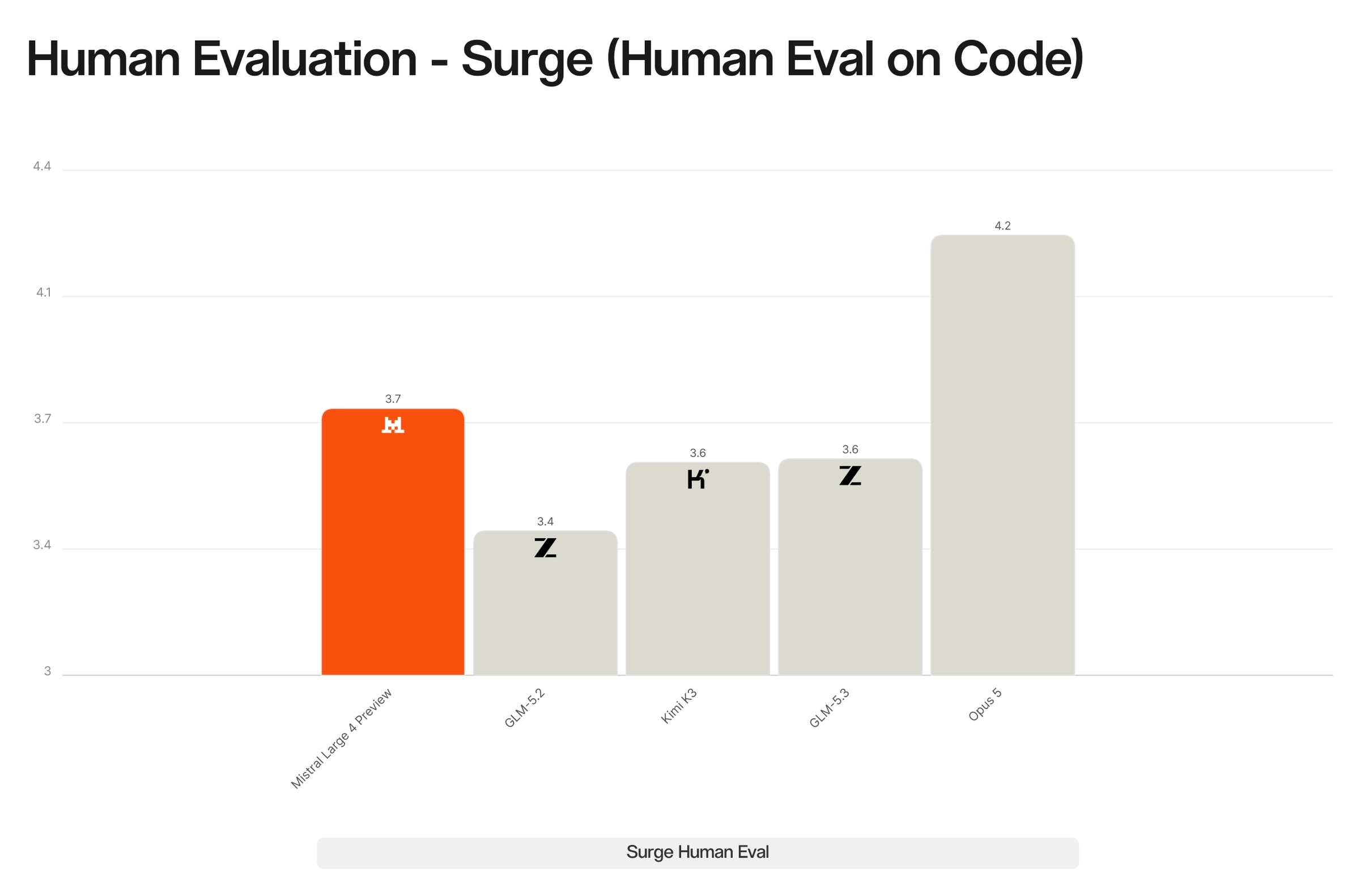
| Surge AI 人工盲评 | 专业标注员在隐藏模型身份下对代码质量评分(1–5 分) | 3.74 分 | 在参评的 5 款模型中排第 2:低于 Claude Opus 5 (4.22),高于 GLM-5.3 (3.60)、Kimi K3 (3.59)、GLM-5.2 (3.40) |
| AutomationBench | 跨 657 个日常应用工作流(表格/邮件/Slack等)执行 | 59.9% | GLM-5.3 (62.2%)、Kimi K3、MiMo-V2.6-Pro、DeepSeek V4 Pro |
| AA-Briefcase | 长期知识工作交付(生成文档、表格、幻灯片等) | 1,393 Elo | 高于 DeepSeek V4 Pro(此项为 Elo 评级,非百分比成功率) |
从各项数据来看,ML4 在不同代码任务中表现不同:例如在 DeepSWE 与命令行测试中领先部分开放权重模型,但在 Terminal-Bench 上落后于 GLM-5.3,在代码库问答上也略低于 DeepSeek V4 Pro 与 Qwen3.8 Max。比较时还要看测试框架(Harness)及工具配置:图中部分模型使用不同代码工具,部分 Artificial Analysis 成绩来自框架公开前的私下评测,分数差距不能直接换算成生产环境效果。
从 Medium 3.5 到 ML4:工作流能力提升了多少?
与竞品比较之外,Mistral 自家模型的前后变化也值得看。官方图表把 Medium 3.5 与 ML4 放在同一组任务里比较:
工作流从 6.3% 提升到 59.9%,增加 53.6 个百分点。同图中,金融 Agent 得分从 32.1 到 54.7,财会表格从 36.7 到 67.4;科学编程单次通过率从 70% 到 91.8%,图表问答得分则从 55.4 到 63.1。
| 任务 | 旧模型 | ML4 |
|---|---|---|
| 跨应用工作流 | 6.3% | 59.9% |
| 金融 Agent | 32.1 | 54.7 |
| 财会表格 | 36.7 | 67.4 |
| 科学编程 | 70% | 91.8% |
| 图表问答 | 55.4 | 63.1 |
旧模型为 Mistral Medium 3.5。五项依次对应 AutomationBench、Finance Agent V2、FinWorkBench、SciCode-Verified 与 ChartQA Pro;分数按各自基准口径,不能跨行比较高低。
在这套测试中,新模型能完成的跨应用任务明显更多;金融表格与科学编程也有较大进步,图表问答的增幅则较小。对已有 Mistral 使用者,这些变化更直接地回答了“换到新模型,有哪些工作值得重新测试”。这些分数没有单独揭示前代模型为什么失败,也不能换算成执行速度或全部归因于 RL。
垂直领域场景:法律、财务与多模态图纸
通用大模型进入垂直业务,核心在于能否胜任严谨的专业流程。在法律责任界定、财务审计与工业工程图纸分析中,评测往往围绕具体的业务工作任务展开。

1. 法律与金融实战:面向业务工作任务
在第三方评估机构 vals.ai 组织的行业评测中,考察的是模型处理专业工作流的能力,而非宽泛的通识问答:
- 法律 Agent 评测(Harvey’s Legal Agent Benchmark):在 Mistral 公布的结果中,ML4 获得 15.8 分(该项为绝对得分,非百分比),高于 Kimi K3(12.9)、Qwen3.8 Max(10.4)、GLM-5.3(8.3)与 GPT-6 Astra(5.4)。
- 金融业务与表格处理:在 Finance Agent V2 评测中,ML4 得分为 54.7,高于 GPT-6 Astra(53.5),略低于 GLM-5.3(55.9);而在涉及真实财会表格创建与编辑的 FinWorkBench 测试中,ML4 取得 67.4 分,与 DeepSeek V4 Pro(67.4)同分,低于 Kimi K3(77.3)。这些分数反映了模型在特定工具调度与业务流中的处理能力,但不能以此代替专业法务或审计人员的人工审查。
2. 财务报表检索演示:跨年度附注信息核对
在官方展示的一项跨年份财报分析演示中,系统给出了一个针对性的查询任务:
“默克集团(Merck KGaA)因剥离生物类似药业务产生的或有对价资产,在 2022 年底和 2023 年底的账面价值分别是多少?当时分别采用了多高的税后折现率?两年账面价值的同比变化是多少?”
或有对价资产(指企业在出售业务后,根据后续研发或商业化里程碑等约定未来有权收取的款项)的核算通常深藏于财务报表附注中。在该项演示中,多个受测模型均检索到了核心事实并完成了计算,但各自记录的轨迹交互轮数有所不同(ML4 为 16 轮,GLM-5.3 为 28 轮,DeepSeek V4 为 38 轮,MM3.5 为 42 轮),这反映了本次演示中具体检索路径的差异,不能直接推断为普遍的时间、成本或准确率优势。在这次演示中,ML4 核对了 2023 与 2024 年度的报表附注:
- 确认该资产属于第三层级公允价值计量(Level 3 Fair Value);
- 查出账面价值从 2022 年底的 2.19 亿欧元减少至 2023 年底的 1.18 亿欧元,计算出同比减少 1.01 亿欧元(变动率为 -46.12%);
- 提取出税后折现率由 2022 年底的区间范围(6.3%–7.3%)变为 2023 年底单一的 6.6%,并依据年报披露指出账面价值减少主要源于年内收到了买方支付的里程碑款项。
3. 多模态理解与工程图纸演示
在多模态评测方面,不同基准展示了不同的能力切片:在密集目标视觉定位评测 Dense 200 中,原图显示 ML4 得分为 42.0%,略高于 GPT-6 Astra 的 41.5%(相差 0.5 个百分点);在图表问答 ChartQA Pro 中,ML4 得分为 63.1%,低于 GPT-6 Astra 的 65.1%;在长文档图表问答 GDP.pdf 测试中,ML4 得分为 18.6,低于 Kimi K3 的 22。
在官方公布的机械图纸演示中,模型展示了读取标注与辅助计算的过程:
- 装配关系辨析:面对机械截面剖视图,询问“压缩弹簧是否与滑动轴承直接接触?”模型通过放大零件明细表(BOM)核对零件编号,再定位到截面图引出线,确认两组部件之间存在一根真空销(Vacuum pin),得出“二者不直接接触”的结论。
- 公差标注读取与计算:在读取图纸中的配合标注
Ø25 p6后,演示展示了模型读取公称尺寸 25mm 对应的下偏差(+0.022mm)与上偏差(+0.035mm),并计算出极限尺寸为 25.022mm 至 25.035mm(ISO 286 属于国际标准)。该演示体现了结合图像局部放大与尺寸计算的辅助能力,但实际工程中此类输出仍需严格按规范进行工程审查。

放大核对:零件表与剖面图
两幅局部都来自上方官方装配图。模型在演示中将零件表、编号与剖面对应起来,得出弹簧与轴承被真空销隔开的结论。
4. 工业画面:把答案落到具体位置,也能回答“没有”
官方视觉演示还展示了工程图之外的定位任务:风电场里查询前排风机的叶片,锻造车间里查询赤热钢条,模型用旋转边界框(OBB,能沿物体方向旋转的框)标出这些倾斜目标;电路板案例则定位“GND”印刷文字、红色电容与变压器。连续视频的定位结果还被组织为跨帧轨迹,让人能追踪同一目标的位置变化。
这种输出让“图里有什么”进一步变成“它在图的哪里”。分析人员可以把定位框与实际画面对照,而不必仅凭模型的一段描述判断它是否找对了对象。
橙子分拣传送带的演示展示了另一种有价值的结果。同一段视频,查询“橙子”会返回定位框;查询“苹果”则返回空结果,原始记录中没有检测帧或轨迹。模型没有在相似的水果里硬挑一个当苹果。目标不存在时保留空结果,有助于避免把错误定位交给后续流程;这个示例展示的是一次负例处理,并非实际产线的误报率测量。

- 查询:找橙子
- 返回画面中的橙子定位框
- 查询:找苹果
- 返回空结果,没有定位框
对照苹果查询的画面
5. PDF:先找到证据,再把图表与正文接起来
能源展望报告中的一个问题同时问两件事:图表里,哪个部门对美国售电量增量贡献最大?正文里,得州电网 ERCOT 在两年内新增多少太阳能发电量?官方演示先在 12 页上下文中寻找证据,再读取同一相关页面的图表与文字:图表中商业部门的贡献最大;正文给出 2026 年新增 18 BkWh、2027 年新增 20 BkWh,合计 38 BkWh(380 亿千瓦时)。
这道题不能只读图或只做加法。找页、辨认图例、提取对应年份的数字,最后才是 18 + 20。另一项原油停产查询也按这条路径推进:从表格同一行读出沙特阿拉伯的估计停产量 3,550 千桶/日和基期产量 10,500 千桶/日,计算 3,550 / 10,500 ≈ 33.8%。数字能回到原始表格核对,计算也有明确的分子、分母。

6. 卫星图:逐级放大,找到屋顶的 H
釜山港案例要求寻找原图左下角的直升机坪。演示先定位港口左下区域,再收窄至边缘建筑群,最后放大到塔楼屋顶,定位圆形区域里的 H 标记。人可以沿同一条缩放路径复查它找到的是不是目标。
原图为 6,144 × 4,096,约 2,517 万像素;这张演示图与发布概述提到的十亿像素影像能力是不同层面的材料。这个具体例子展示的是利用工具缩小搜索范围、核对细节的过程。
这些官方演示记录使用了内部模型版本,展示了可核对的位置和计算过程;公共 API 预览的表现仍需在自己的任务中检验。
科学计算与数学推理:代码生成与领域偏好
在面向科研计算与数学建模的任务中,Mistral 展示了模型编写科学工作流代码与数理推理的能力:

- SciCode-Verified 科学编程基准:该测试重点考察模型编写代码求解物理、数学、材料与生物等学科复杂问题的能力。在单次通过率(pass@1)上,ML4 达到 91.8%;在同图展示的对比模型中,Qwen3.8 2.4T A95B 为 93.8%,GLM-5.3 为 92.5%,MiMo-V2.6-Pro 为 91.9%,闭源模型 GPT-6 Astra 为 94.2%。在实际案例中,模型展示了单次生成哈特里-福克数值模拟(Hartree–Fock,用于求解多电子系统电子结构的经典量子化学数值模拟任务)代码的能力,但这属于代码生成层面的演示,生成的程序仍需经过实际运算与实验数据比对,并不等于所得出的科学结论无需核验。
- 领域专家评估偏好:在 Mistral 组织的内部专家评估中,标注员将 ML4 与 GLM-5.3 的输出进行对照打分。在不同领域中,专家对 ML4 的加权偏好率分别为:STEM 领域 68%(STEM 是科学、技术、工程和数学)、计算机辅助设计(CAD)62%、金融 50%、代码 48%。这些比例表示专家更偏好哪款模型的输出,不是答题正确率。
- 数学形式与应用推理的定性演进:在数理逻辑方面,官方叙述强调 ML4 在形式推理与应用数学上取得了更强表现,在内部人工评测中展现出比 GLM-5.3 更严谨的结构性推理能力,并能维持长流程、深涉特定学科的应用数学任务(例如涉及前沿理论物理的相关计算推演)。
强化学习与训练工程:当前 3,000 卡集群上的规模化 RL
ML4 的预训练在 Mistral 位于欧洲自建数据中心的 3,800 张英伟达 Grace Blackwell GPU 上进行,当前的公共预览服务也运行在该基础设施上。而在后训练(Post-training)阶段,Mistral 投入了当前规模约 3,000 张 GPU 的集群进行大规模强化学习(RL)。

后训练阶段的大规模强化学习机制主要包括以下几个方面:
- 大规模尝试与训练数据生成:在由 3,000 张 GPU 组成的强化学习集群中,一组自动扩缩的执行节点(Actors)并发生成数万条探索轨迹(Rollouts,即模型在任务环境中自主尝试探索的实际解题过程),模型参数更新则异步进行。随着基座模型能力提高,传统的人工标注示例已不足以提供足够的挑战,因此需要让模型在自身尝试的结果上进行强化学习,并随能力提升不断加大任务难度。该管线每天生成约 330 亿总 Token,经过筛选和掩码处理后,提取出约 160 亿可用于策略更新的模型生成 Token(Trainable completion tokens)。
- 模块化可组合验证环境:为了适应多样化的真实任务,训练环境提供了统一的可组合接口,使单次强化学习训练运行能够同时覆盖单轮对话、复杂科学问题求解、安全对齐、事实性检验以及长程工具使用等多种任务类型。这些训练环境共享了代码沙箱、网页搜索与外部 API 等脚手架;在验证反馈环节,系统根据任务类型将奖励模型、单元测试、大模型裁判和静态检查按需组合,以此评估模型尝试的成败并提供训练信号。
- 长轨迹策略稳定性:在包含多轮工具调用与长程交互的复杂任务中,异步训练会导致生成探索轨迹时所使用的模型策略落后于后台正在更新的最新策略(即策略陈旧性与策略漂移,Staleness & Off-policy drift),这会影响长轨迹训练的稳定性。Mistral 表示其采用了跨阶段优化方法以减轻陈旧性与漂移,使得训练能够支持达数百万 Token 的探索预算(Rollout budget,这是训练阶段允许模型多次压缩后使用的探索总预算,与推理时的 1M 上下文窗口是不同概念)。
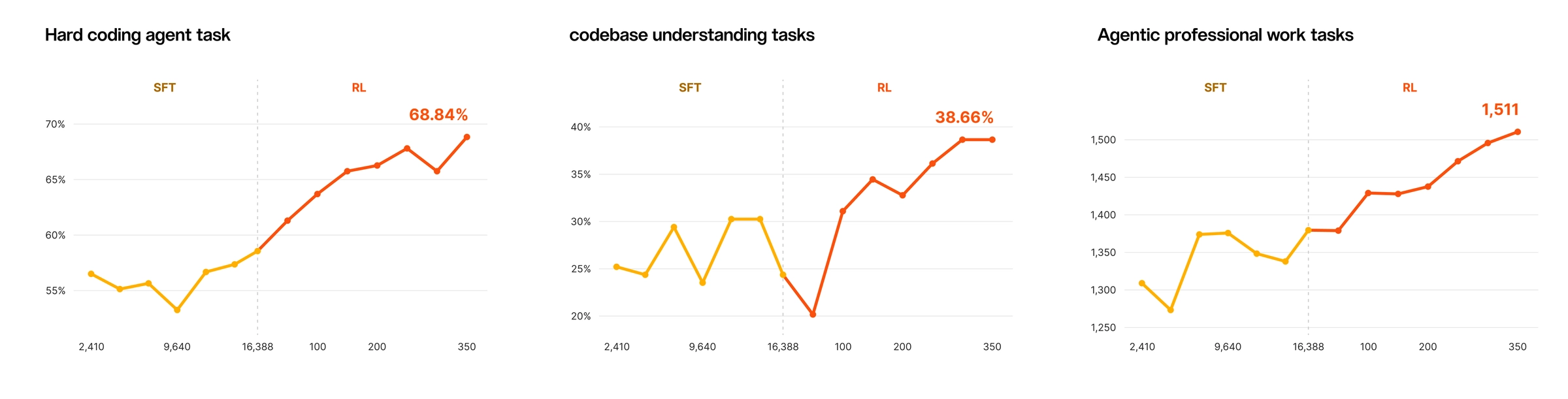
- 阶段演进与评测区分:Mistral 表示,训练环境里的改善也迁移到了下游评测,最终能力由 SFT 与 RL 两个阶段共同贡献。三条内部下游任务曲线中,复杂代码 Agent 指标从 SFT 结束时约 58.5% 到 RL 结束时 68.84%;代码库理解从约 24% 到 38.66%(RL 初期曾回落到约 20%);专业交付任务指标从约 1,380 到 1,511。图中未注明具体基准,不能将 1,511 当作 AA-Briefcase 的 1,393 Elo,也不能将 68.84% 当作 DeepSWE 的 61.7%。
训练奖励上涨,说明模型更会完成训练环境按规则计分的任务;下游评测改善,才进一步说明学到的策略能帮助它完成其他评估任务。两类图一起看,才能理解这套训练是否带来了环境之外的收益,而不是只在训练题里拿到更高奖励。
- 01组合任务环境聊天、代码、科学计算、跨应用工作流
- 02模型实际尝试调用沙盒、搜索或 API,留下执行轨迹
- 03检查尝试结果按任务组合测试、静态检查与评分模型
- 04用结果更新模型过滤与掩码后,选出可训练的生成内容
成本与落地考量:API 定价与评估维度
对于关心实际调用与接入的开发者与企业客户,需要厘清价格体系与落地考量:
1. API 调用价格
官方发布页面公布的公开预览版标准 API 资费为:
- 输入价格:$1.36 / 百万 Token
- 输出价格:$4.18 / 百万 Token
开发者在进行前期预算测算时,应以公布的标准调用价格为准。
2. 评估与选型考量
- 从自有任务与工具失败率进行检验:面对涉及“文档检索、图像查验、多步骤工具调用”的长流程工作流,开发者应建立针对自身业务的验收测试,重点考察模型在面对调用失败、参数报错时的纠错韧性以及最终交付成果的可用性,以此检验模型表现。
- 自部署需等待权重与许可发布:对于需要严格数据主权与私有化运行的企业,官方计划在月底开放模型权重。具体的许可条款、硬件要求与资源配置规范尚未披露;由于模型总参数量达到 1.05 万亿,部署时仍需完整存储庞大权重,目前无法单纯由 49B 激活参数来推估具体的服务器规格与显存门槛。
- 轻量常规任务无需盲目追大:对于常规的文本摘要、基础对话或单文件代码补全,不应单纯依据总参数体量来判断性价比,而应综合权衡端到端延迟、多轮工具调用产生的总体 Token 成本以及实际产出质量。
Mistral 表示,ML4 将作为其新一代专用与优化模型的基座。目前预览版背后的强化学习训练仍在持续推进,后续的算力扩充则依托其近期完成的 30 亿欧元 D 轮融资(欧洲科技公司规模最大的股权融资轮次),未来将有更多位于欧洲本土数据中心的算力投入运行。按照月底开放权重的计划,Mistral 正在向企业客户展现一种明确的方向:不仅在网络安全、金融与代码等关键生产力领域提供具备前沿水准的模型能力,更通过开放权重与欧洲本土自主运营,让企业有机会掌握模型的运行环境与使用政策。
Mistral 发布 Large 4 预览版:万亿参数,瞄准企业复杂工作
这款企业多模态模型把看图、找证据和工具使用接起来。API 已开放预览;开放权重计划在月底发布,目前权重与许可仍待公布。
架构与体量:为什么叫“大胖子”(le Chonk)?
在模型卡和官方发布中,Mistral 幽默地把 ML4 叫做“le Chonk”(大胖子)。从规格上看,它确实是个庞然大物,其工程架构的设计取舍十分明确:
采用颗粒度更细的混合专家架构(Granular MoE)。在每步生成单个 Token 时,门控路由仅挑选特定专家模块参与浮点运算,减少单步参与计算的参数。
MoE 架构虽然减少了每个 Token 计算时参与运算的参数量,但服务器依然需要存储 1.05 万亿参数的庞大总权重,减少参与计算的参数,并没有让总权重变小;实际速度与部署开销还取决于硬件、精度和服务配置。
此外,模型集成了约 16 亿参数(1.6B)的原生视觉编码器,并支持 100 万 Token(1M)的长上下文窗口。这两项是相互独立的规格:1M 上下文允许容纳长篇文档或多轮历史,但面对超高分辨率卫星图像或复杂机械图纸时,模型并不能仅凭单次输入自动看清所有微小细节,仍需要配合视窗缩放、局部裁切等外部工具才能完成跨层级核对。
换到 ML4,哪些任务值得重新测试?
同一组官方图表中,跨应用工作流完成率由 Medium 3.5 的 6.3% 到 ML4 的 59.9%,增加 53.6 个百分点。
金融 Agent:32.1 → 54.7;财会表格:36.7 → 67.4;科学编程:70% → 91.8%;图表问答:55.4 → 63.1。各项口径不同,不能跨项比较;这些变化也不代表速度提升,或全部由 RL 造成。
网络安全实战:正当漏洞复现受阻,开放权重怎么解?
在网络安全防御中,要修补系统漏洞往往必须先在受控环境中复现触发条件。然而,部分商业云端模型设置了严苛的通用风控,在处理包含攻击特征的输入时可能触发安全策略拒绝(Safety Refusal)。在 Artificial Analysis 综合测试中,Qwen3.8 出现了 63% 的安全阻断,Claude Opus 5.5 与 GPT-6 Astra 也各记录了 38% 的安全阻断;而 ML4 取得了 50% 的综合成功率,在开源漏洞复现单项(CyberGym-E2E)中拿下 82% 得分。
应急连续性与逆向排错链路:按组织政策运行,减少临时失去工具的风险
Mistral 强调,在安全事故处置中途失去某项模型能力,本身也可能成为重大安全风险:已经依赖模型推进的排查、复现与修补可能被迫停下来。自主运行的价值因此还包括应急连续性——组织可以按自己的政策安排和审计安全工作,减少对服务商临时决定的依赖。
sample.bin 格式、导入表与字符串列表。专业垂直流程:将答案钉在可核对的证据上
通用大模型进入严肃生产力,不在于宽泛回答,而在于能不能胜任严谨的专业审核流程。在 Harvey 法律 Agent 基准测试中 ML4 获 15.8 分;在默克集团(Merck KGaA)跨年份财报分析演示中,模型经历 16 轮交互查出深藏于附注中的第三层级或有对价资产,核对账面价值从 2.19 亿欧元降至 1.18 亿欧元(同比变动 -46.12%),并提取出税后折现率从 6.3%–7.3% 变为 6.6%。
面对剖面截面图,通过放大零件表(BOM)核对引出线,确认压缩弹簧(#10)与滑动轴承(#8)之间被真空销(#3)隔开而不直接接触;读取标注 Ø25 p6 计算出 25.022mm 至 25.035mm 极限尺寸。
针对倾斜物体输出带角度定位框。在橙子分拣流水线中,查询“橙子”返回定位框,查询“苹果”则返回空列表,没有在相似水果中强行指认,展示了一次负例处理;并非产线误报率测量。
能源展望报告中,先定位商业部门对售电量增量贡献最大,从同一页正文提取得州电网 2026 年(18 BkWh)与 2027 年(20 BkWh)增量,计算出 38 BkWh,数字均可回溯到原始段落。
在釜山港 6,144 × 4,096 卫星原图中,模型调用外部缩放工具,顺次完成“港口左下大区 → 边缘建筑群 → 塔楼屋顶”,逐级锁定圆形区域内的“H”标志,展示层级化视窗工具链价值。
这些视觉与文档案例使用官方内部模型版本。公共 API 仍需用自有任务检验,专业答案也需人工复核。
训练工程:3,000 卡集群上的规模化 RL
ML4 的预训练在欧洲自建的 3,800 张英伟达 Grace Blackwell GPU 上完成,而后训练中的强化学习(RL)当前使用规模约 3,000 张 GPU 的集群开展训练。
执行节点每天生成约 330 亿总 Token,经筛选掩码后提取出约 160 亿用于策略更新的可训练模型 Token。
统一接入代码沙箱与外部 API,按任务按需调度奖励模型、单元测试与 LLM 裁判形成评估闭环。
异步生成轨迹时,生成所用模型会落后于正在更新的模型。Mistral 用跨阶段优化减轻策略陈旧与漂移,支持数百万 Token 的训练探索预算。
内部下游曲线:代码 Agent 约 58.5% → 68.84%,代码库理解约 24% → 38.66%。图中未注明具体基准,不能当作 DeepSWE 或其他公开评测成绩。
成本账本与企业选型指南
当前公众预览版标准 API 资费公布为:输入 $1.36 / 百万 Token,输出 $4.18 / 百万 Token。对于计划在实际业务中落地的技术决策者,需要把握三个核心界限:
- 不要混淆激活与显存规格:由于模型总参数量达到 1.05 万亿,部署时仍需完整存储庞大权重,目前无法单纯由 49B 激活参数来推估具体的服务器规格与显存门槛。
- 根据工具失败率与纠错能力验收:多步骤长流程任务中,应在自有真实业务环境中测试模型在面对报错、沙盒超时、证据不齐时的纠错能力,并核对最终成果是否可用。
- 轻量任务无需盲目追大:对于基础文本摘要或简单对话,应综合评估端到端延迟与多轮 Token 累计成本,再判断大模型在当前任务中的收益。
Introducing Mistral Large 4
The most powerful AI platform for enterprises. Customize, fine-tune, and deploy AI assistants, autonomous agents, and multimodal AI with open models.
Le Chonk
Today, we’re launching a public preview of Mistral Large 4. Unofficially ML4, very officially: le Chonk. ML4 pushes the frontier of open-weight performance. You can try the preview API today on Mistral Studio. Weights drop end of this month.
Frontier performance
ML4 is a 1 trillion-parameter natively multimodal model with 49 billion active parameters. It is our largest and most capable model to date, and it continues to improve rapidly as we refine it.
The model demonstrates exceptional performance across coding, agentic workflows, and multimodal understanding. It already achieves performance competitive with the strongest open-source models globally, while significantly outperforming any open-weight model developed in the US or Europe. On critical enterprise workloads, including cybersecurity, finance and law, we find it to be state-of-the-art among open models. In some domains such as visual grounding, it goes further still, surpassing even frontier closed models.
We will release the weights by the end of the month. Until then, we are red-teaming the model in real-world settings with cybersecurity leaders, vetted partners, and state authorities, who will access the same model with reduced moderation and expanded cyber capabilities.
Forged in Europe. Built for AI sovereignty.
ML4 was trained from scratch on 3,800 NVIDIA Grace Blackwell GPUs in Mistral’s own datacenters in Europe. The public preview is served on that same infrastructure. It is a significant milestone in our long-term investment across infrastructure, research, and product development: state-of-the-art performance in critical verticals, delivered through open weights, designed to give customers control over their AI.
This is particularly important in cybersecurity, where provider-level refusals can block legitimate vulnerability research and incident response, and where losing access to a capability mid-incident can itself become a critical security risk. ML4 pairs top-tier cyber performance with open weights and self-deployment, giving organizations both the capability and the autonomy to run advanced security work under their own policies.
The model will be available across multiple regions worldwide, including a European deployment that Mistral operates end-to-end, independently of other digital service providers and under European law. Fun fact: a significant share of ML4’s training data was multilingual, spanning more than 160 languages, including every official language of the European Union.
We’ve been working closely with leading enterprises across the world in finance, engineering, manufacturing, logistics, pharmaceuticals, science, shipping, public sector, and other mission-critical industries to train ML4. In fact, the model uses the same training, customization, and RL environment we offer our customers through Mistral Forge.
Try it today
There is still more to come. As we work toward releasing the weights, we will share further details on the model architecture, additional benchmarks, and our post-training methodology.
This model will also serve as the foundation for a new generation of specialized and optimized Mistral models. In the meantime, we invite you to try the preview API and share your feedback with us on social media.
Capabilities deep-dive
Cybersecurity
ML4 is one of the world's strongest AI models for cybersecurity. On the Artificial Analysis Cyber Index, an independent evaluation of how well AI models find and fix security flaws in real software, it ranks among the top five models globally and leads open-weight models developed outside China by a wide margin. On one of the index's tests, which asks a model to reproduce a real vulnerability in open-source software and then patch it, ML4 scores 82%, the highest of any model. It also solves 93% of the challenges in Cybench, a set of 40 exercises drawn from security competitions, one of the highest scores reported for an open-weight model.
That top score reflects a practical advantage. Several leading closed models, including Claude Opus 5.5 and GPT-6 Astra, score near zero on the same test because they refuse to perform the task. Yet defending software often starts with proving that a flaw is real, exactly the kind of work safety filters in closed models can block. This matters even more as threat actors increasingly jailbreak those same models to support offensive cyber activity: defenders need systems that can match those capabilities without being constrained by the same refusals. ML4 can do that work, and its capabilities extend beyond what it was explicitly trained for: in internal testing, it proved useful for analysing malware, prioritising vulnerabilities, and writing detection rules. For organisations that need sovereign, auditable AI for security operations, it will be able to run on private cloud or on-premise.
ML4 against the field : efficiently reasoning over diverse complex challenges
Malware reverse-engineering: solving an out-of-distribution investigation task
Agentic coding
ML4 excels across software engineering, repository understanding, and complex terminal workflows, scoring 61.7% on DeepSWE v1.1, 59.4% on SWE-Atlas-QnA, and 28.3% on Terminal-Bench 4. Its combined Coding Agent Index score of 49.8% places it ahead of DeepSeek V4 Pro 0813 and Qwen3.8 Max.
We also ran a blind human evaluation with Surge AI on coding quality: professional annotators rated model outputs on a 1–5 scale, with model identities hidden. ML4 Preview ranked second of five models (3.74), ahead of Kimi K3 (3.59), GLM-5.3 (3.60) and GLM-5.2 (3.40), and behind only Claude Opus 5 (4.22).
Agentic Workflows
ML4 runs general-purpose agents that gather information, use tools, and produce finished deliverables across complex workflows. On AutomationBench — 657 business workflows across apps like Gmail, Google Sheets, Slack, and Salesforce — it scores 59.9%, ahead of Kimi K3, MiMo-V2.6-Pro, and DeepSeek V4 Pro.
It's just as strong on the professional deliverables that knowledge work actually produces: spreadsheets, slides, and PDFs. On AA-Briefcase, which evaluates long-horizon knowledge work, it reaches 1,393 Elo, ahead of DeepSeek V4 Pro.

Multimodal
ML4 is a step change in the ability of our models to understand images. It reasons powerfully across complex documents, charts, and natural images, and brings vision to the industries where perception is critical such as engineering, manufacturing, and earth observation.
The model can further combine visual grounding with agentic capabilities: from inspecting gigapixel satellite imagery — helping disaster-response teams act when time counts — to analyzing engineering-drawings — zooming in, inspecting, and verifying until the answer is exact. In our demos above, ML4 grounds dense natural scenes, verifies mechanical parts in technical drawings, retrieves evidence from PDFs, and scans massive geospatial images for the hardest-to-find objects.
On visual grounding particularly, we find ML4 to be one of the most capable models we tested, for instance surpassing GPT-6-Astra on Dense 200 (42% vs 41%).
Science and Math
ML4 brings strong scientific capabilities, built by combining AI-driven methods with our researchers' expertise in mathematics, physics, and chemistry.
It's highly proficient at agentic coding for scientific tasks such as data analysis, modeling, and simulating physical reality, which lets researchers focus on the questions rather than the plumbing. In benchmarks, ML4 is state of the art on SciCode-Verified among open-weight models. In practice, it can generate a full Hartree–Fock simulation in one shot — a complex, multi-step chemistry task built from a series of advanced routines.
ML4's math is stronger too, in both formal reasoning and applied mathematics. In our human evaluations it reasons more precisely and with more structure than GLM-5.3, and it can sustain long, domain-specific applied-mathematics tasks, including work relevant to frontier theoretical physics.
Together, these capabilities make ML4 a strong research assistant across the full technical workflow — from the first question to the final result.
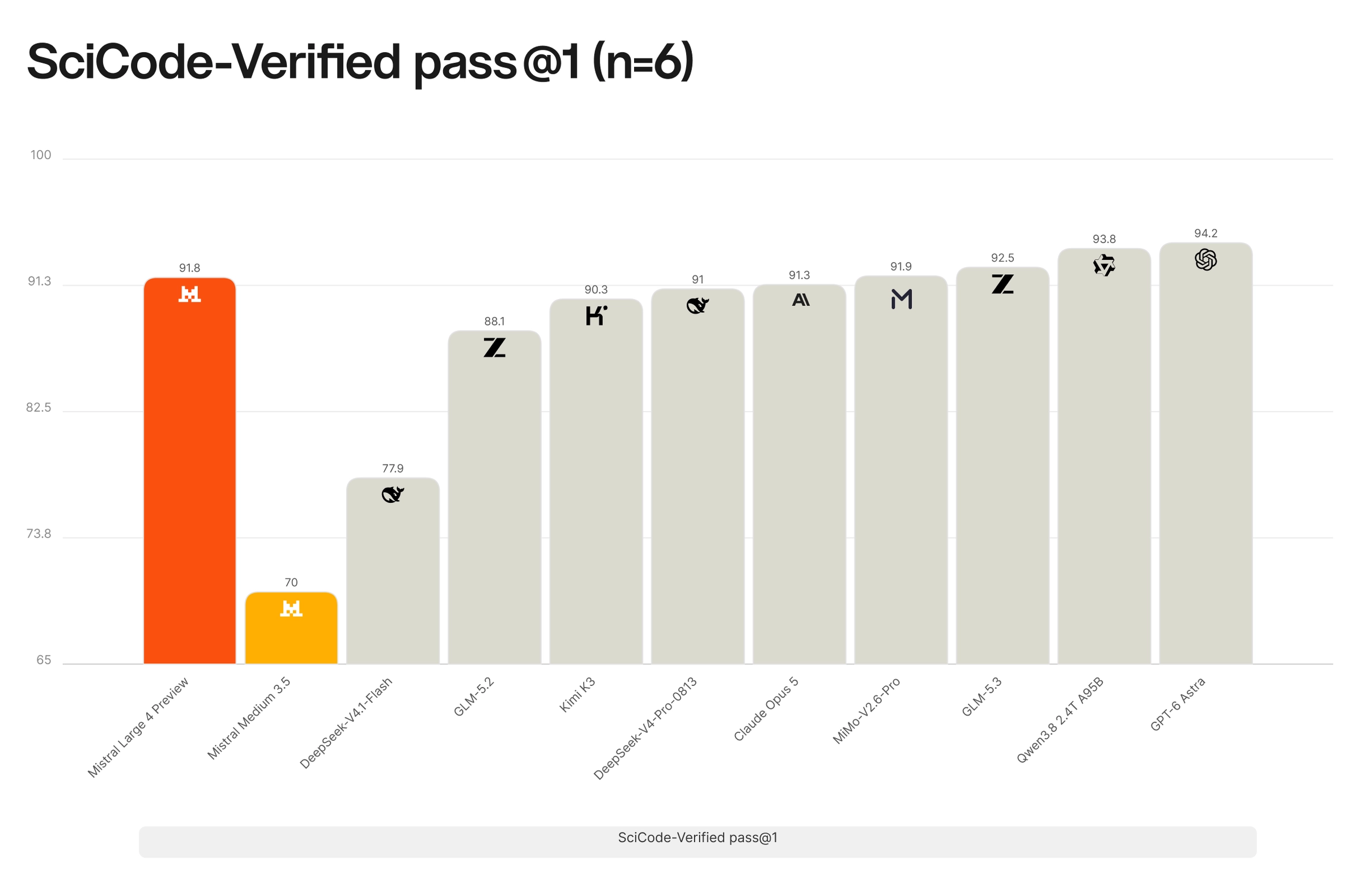
SciCode-Verified tests the capabilities of models to implement complex scientific workflows in code for domains such as physics, mathematics, material science and biology.

Internal eval on STEM tasks (math and physics) of ML4 against GLM5.3
Knowledge Work
ML4 is our most capable model for the real-world tasks which professionals handle every day. It can create, edit and fix complex spreadsheets and documents, showing exemplary performance on both legal and financial benchmarks.
Notably, we evaluated ML4 through third party evaluators (vals.ai) on representative tasks for both legal and financial tasks, finding the model exceeds GPT-6-Astra in both cases. On HarveyAI’s Legal Agent benchmark, ML4 outperforms all open-source models.
FinWorkBench tests model capabilities at creating/editing spreadsheets on real life Finance and Accounting use cases.
Financial analysis demands precision and the ability to synthesize information from multiple sources, a process that remains time-consuming at many financial institutions today. In this demo, ML4 compared to other top OSS models take on the same multistep corporate finance challenge, searching through public company filings and financial reports, such as those available via EDGAR and equivalent European databases. An animated semantic map traces each model's journey toward a solution, highlighting every document retrieved along the way. Each track's position reflects the evidence gathered, the results of calculations, and the questions that remain unresolved. Viewers can follow how the investigations unfold and compare the distinct paths each model takes before arriving at its final answer.
Model Safety
ML4 has saturated our benchmarks on robustness to indirect prompt injections, putting it at the frontier of OSS models (compared to GLM-5.2, GLM-5.3, Kimi-K2.6, Kimi-K3, DS-V4-Pro-0813). On Lakera’s public B3 AI Security Benchmark, ML4 resists 93.3% of attacks – we see no higher scores among competitors.
ML4 also engages more responsibly with users than any of our previous models. We highlight our results on the KORA Benchmark, where ML4 again sits at our highest measured score among OSS models (1.691, with 2 being the maximum denoted as “Exemplary”).
Of particular relevance is the model’s propensity to refuse malicious requests regarding cybersecurity. Despite strong performance on Cyber benchmarks, the average refusal rate of the model on cyber prompts from JailbreakBench, StrongREJECT, and AgentHarm is higher than all OSS models.
Human Evaluation
We ran an internal evaluation in which expert annotators across coding, computer-aided design (CAD), finance, mathematics and physics compared Mistral Large 4 with GLM-5.3. ML4 was preferred in CAD and STEM, while performing on par or close to GLM-5.3 in finance and coding.

Reinforcement learning at scale
Base models are improving fast, and our post-training has to keep pace. A recipe tuned for yesterday's model leaves capability on the table with today's frontier, because ground truth samples that once pushed a model to its limits won’t anymore. We use Reinforcement Learning (RL) because it adapts as the model does: we train on the outcomes of the model's own attempts, and we can raise the difficulty and the breadth of the tasks as it gets stronger.
Our RL library was designed to make new environments easy to add and train at scale. A shared, composable interface allows a single training run to combine tasks ranging from single-turn chat and complex scientific problem solving to safety alignment, factuality, and long-horizon tool use. These environments share scaffolds and resources such as code sandboxes, web search, and external APIs. The same composability extends to verification, with reward models, unit tests, LLM judges, and static checks combined as needed for each task.
At runtime, an autoscaling fleet of actors generates tens of thousands of rollouts in parallel while model training proceeds asynchronously. The generation and training pipeline is optimized for long trajectories, supporting rollout budgets of millions of tokens across multiple compactions while keeping staleness low. Novel methods and optimizations across both stages minimize off-policy drift and enable stable RL over long horizons.
At our current scale (3k GPUs), a single training run produces roughly 33 billion tokens per day, of which around 16 billion are trainable completion tokens after filtering and masking. We can see the run progress directly in the training rollouts: training rewards rise across several representative environments as the policy learns to solve increasingly complex tasks. Below are a few examples.

The improvements are not specific to the environments we train on; they transfer to downstream evals, and the final model owes them to both post-training stages (supervised fine-tuning and RL), as shown in the charts.
What comes next
This is only the beginning. ML4 is the first milestone on the roadmap funded by our €3 billion Series D — the largest equity round ever raised by a European technology company. That capital is already being put to work: we are significantly scaling up our compute capacity in our own European datacenters, and much more is coming online in the months ahead.
More compute means more training. The reinforcement learning run behind this preview is still in flight, and the model is showing no signs of saturation — there is substantial headroom ahead. As we scale up training on our expanded infrastructure, we expect large and rapid improvements in the weeks and months to come.
We will release the weights by the end of the month, along with more details on the architecture, additional benchmarks, and our post-training methodology. And ML4 is only the foundation: it will serve as the base for a new generation of specialized and optimized Mistral models, built for the industries and workloads our customers care about most.
The pace of progress from here will be fast. Stay tuned.