Claude Fable 5.1 解开沉睡了 370 年的历史密码谜题:只用了 44 分钟
Claude Fable 5.1 用书中相邻文本解开 64 个数字,并把更大的 285 数字密码推进到只剩九个未知字母。真正值得理解的是它如何选中可验证的问题、找到索引规则,又在哪里停下来。
Vals AI 的 Geby Jaff 把一道沉睡三个多世纪的历史密码交给 Claude Fable 5.1。44 分钟、176k tokens、没有人工插话之后,模型从 64 个数字中还原出一首保皇派祈祷诗。它没有发明什么高深的新算法,真正做对的是把密码放回原书中阅读:钥匙一直藏在密文前面的书页里。
这次结果的价值不只是一道古老谜题被解开。它展示了一类适合智能体的研究任务:答案必须能够自证,搜索过程允许大量试错,真正稀缺的资源是持续投入的注意力。与此同时,Fable 对另一份更长密码的处理也留下了清楚边界——285 个数字中仍有 9 个字母不能确定,数字文本无法替代实体版本核验。

破解的核心谜题是什么?
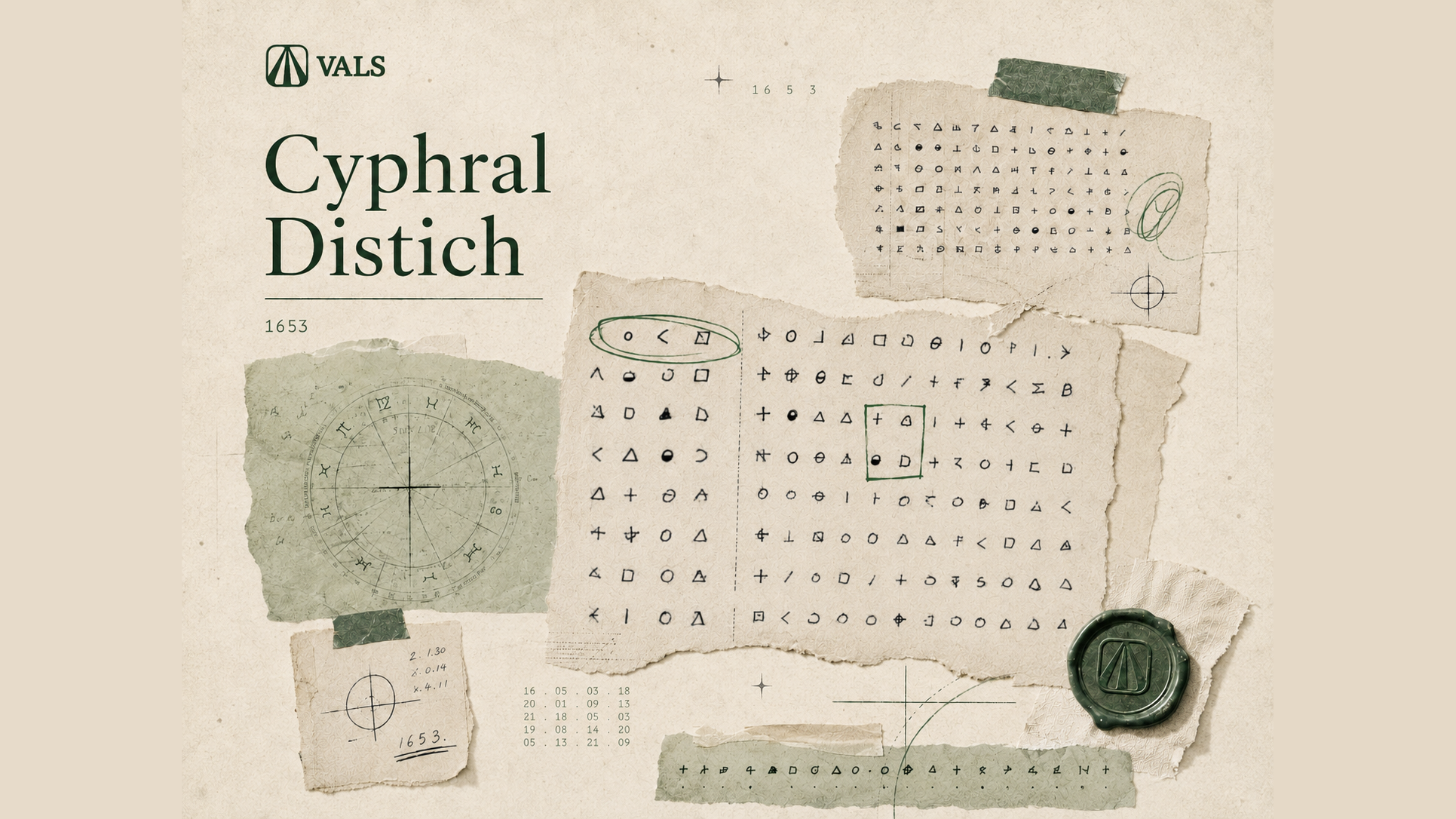
主谜题:两行,共 64 个数字。 这份密文叫 Cyphral Distich,出现在苏格兰作家 Sir Thomas Urquhart 的《Logopandecteision》末尾。Distich 指两行诗;可在解开之前,人们看到的只有两行各 32 个数字:
5.3.27.38.32.14.21.8.66.8.70.39.5.9.12.18.2.3.56.5.1.7.3.2.13.19.3.25.9.3.16.6.
25.15.13.6.11.20.5.1.2.12.1.20.20.49.20.20.35.33.4.6.8.35.5.33.5.5.18.10.3.11.32.42.
真正缺失的是密钥。 64 个数字没有告诉读者它使用哪类密码、以什么材料为底本,甚至不能保证只存在一个看似通顺的答案。
过去的尝试卡在了方向上。 这道题在 1899 年被《Notes and Queries》作为开放问题提出,后来又进入 20 世纪的密码学文献,并被历史密码研究者 Klaus Schmeh 列入 50 个未解加密信息。频率分析、普通替换和同音替换等路径都没有奏效。
这些失败隐含了一个方向错误:人们把数字当成一个独立密码系统,试图从外部重建字母表或数字到文字的固定映射。但如果数字指向的不是一套外部密码表,而是这本书本身,脱离上下文分析密文就等于主动丢掉钥匙。
AI 是怎么破案的?关键解题思路
Fable 没有先寻找更复杂的密码算法,而是把密文放回原书。三个“32”和一个 wishes 把钥匙指向前文;接下来只需建立索引,再让答案反过来验证规则。整个破案过程可以拆成三个连续动作。
第一步:三个“32”和一个 wishes,把钥匙指向前文
第一组线索来自位置和数量。Cyphral Distich 紧接在 32 个 Proquiritations 之后;Urquhart 还特意强调过,找不到比 “two and thirty” 更适合的数字。密文第一行有 32 个数字,第二行也有 32 个数字。于是,每行的第 1 个数字都可能对应第 1 个 Proquiritation,第 2 个数字对应第 2 个,依此类推。
第二组线索来自措辞。伴随密文的诗说,诚实的读者会在其中找到 “his own heart’s wishes, and the Author’s minde”。前面的 Proquiritations 又反复以 “is the desire”“wish” 或 “hope of” 一类表达收束。位置、数量和 “wishes” 指向了同一批文本。
第二步:位置选段,数值选词
把两组线索合起来,规则可以写成四步:
- 取密文一行中的第 i 个数字。
- 打开第 i 个 Proquiritation。
- 把这个数字当作该段中的单词序号。
- 取这个单词的首字母。
例如,第一行的第一个数字是 5,就到第一个 Proquiritation 里找第 5 个词并取首字母;第二个数字是 3,就到第二个 Proquiritation 里找第 3 个词。这里没有页码、行号或通用替换表:位置 i 决定使用哪一段,数字的值决定使用该段里的哪个词。
继续执行 32 次,开头便得到 O G O D …
位置选择段落,数字选择单词;这是两层索引,不是数字直接替换字母。
其中一个坐标还要把拉丁短语 “hinc inde” 视为一个整体,否则就会偏移一位。这种微小差异说明,书本密码的规则即使正确,底本文本如何分词仍会影响结果。
第三步:明文反过来验证解法
按上述规则依次提取首字母,两行明文是:
O GOD UPHOLD KING CHARLS THE SECOND AND
MAKE HIM THE SUPREME RULER OF THIS LAND
它大意是:上帝啊,请扶持查理二世国王,让他成为这片土地的最高统治者。
这份答案有三重自验证。第一,每行恰好都是 32 个字母,与 32 个数字逐位对应;第二,两行分别以 AND 和 LAND 结尾,押韵并符合 “distich” 的两行诗形式;第三,内容与 Urquhart 的保皇派立场一致。这些约束同时成立,使结果远强于一段仅仅“看起来通顺”的猜测。
这套解法高度自洽、可以复验,但目前公开材料没有提供独立学术评审或同行复核证据。因此可以说 Fable 给出了一套可信的破解方法,还不能进一步写成“已经获得学界确认”。
“顺手牵羊”:再解开第二道更大的谜题
同一思路,映射单位从段落变成页面
Urquhart 还在 1652 年的《The Jewel》中留下了更大的 Cyphral Octastich。它包含八行诗和一个 Decagram,共 285 个数字。Fable 找到的仍是“数字指向书中单词,取首字母”的思路,但映射单位换了:
- 《The Jewel》恰有 284 个编号页,而密码共有 285 个数字;
- 从头连续数,第 k 个数字以第 k 页为底本,把数字当作该页的单词序号,再取首字母;
- 在 275 个可读位置中,231 个位置恰好命中该页以目标字母开头的第一个词;其余 44 个位置与它相差 1–3 个词。
这 44 处小偏差都能对应到具体的转录口径:页首被断开的词、带连字符的复合词、&、段落编号,以及一段没有被转录的希腊语。也就是说,这不是靠随意移动索引把结果“凑”出来;大多数位置有极强的首次出现规律,例外也对应可识别的文本处理差异。
近完整明文是一首 ABABABCC 韵式的 ottava rima,也是一篇写于 1652 年 3 月伦敦的保皇派祈祷文。可确定的内容依次祈求上帝维护以查理二世为首的王室,提到在英格兰、苏格兰和爱尔兰出生的人、被篡夺的权力、继承先王的位置,以及让查理二世成为唯一的君主与保护者。最后的 Decagram 解作 AMEN, SO BE IT.。第五行中间仍有九个字母留白,前后虽然连着 “AND” 与 “THIS USURP'D AUTHORITIE”,也不能用上下文擅自补出两者之间的动作。
诗中的 SWEIGH 也不是随意拼出的怪词。它对应苏格兰语 swey,意为 sway 或 controlling power。DOST 记录了约 1600 年 “to bear the swey” 的用法,它还与诗中的 familie、authoritie 押韵。
解到九个未知字母时,为什么必须停下来
Octastich 的状态是 “solved, all but nine letters”,下面四项限制决定了为什么不能称为完整破解。
第一,第 4 行对应第 127–130 页的位置实际拼出 I-R-S-H。它可能是 IRISH 的漏字,也可能是刻意缩写;有意思的是,Irsh 会让这一行恰好保持十个音节。现有材料不能在两种解释之间定案。
第二,第 5 行第 4–12 个字母实际得到 C-O-N-E-R-T-H-T-O。九个位置中有八个都严格命中对应页面中目标首字母的第一次出现,说明这确实是 TCP 文本给出的结果,可它不能组成可读英语。Fable 尝试过页码平移、漏字、数字误印和字典格路径等假设,仍没有得到可信答案。问题可能来自 Urquhart 本人的失误,也可能来自印刷数字错误。
第三,从第 159 个位置开始,后续数字都要索引第 k−1 页才能顺利解出。这可能意味着某一页被使用了两次,也可能是第五行印出的连续 5.5 中有一个属于重复抄写。此后第 6–8 行及 Decagram 在这项偏移下能够干净解开。
第四,目前没有找到 1652 年版《The Jewel》的免费页面图像。Google Books、HathiTrust、Internet Archive 和 NLS 都没有提供所需页面;Octastich 所在的最后一个书帖 3*² 又不在 TCP 副本中,尽管其他副本的正文和页码一致。要确认这些正负一位的索引和九个字母,仍需查阅实体副本或 1983 年 Jack 与 Lyall 的版本。
这些限制没有削弱结果,反而说明一份可信研究应该怎样停下来:能由材料支持的部分给出规则和逐位验证,超出数字底本分辨率的部分保持未知。
提示词与引导技巧:怎样让 AI 做到?
这项实验此前持续了几个月;在同一批尝试中,其他前沿模型没有产出经过验证的解。但这不意味着其他模型必然无法解决 Cyphral Distich。线索本身非常简单,Fable 做得好的一点,是识别出这道题比其他候选更容易取得进展。
公开记录没有给出一段可以直接复制的逐字提示词,只能还原目标如何设定、鼓励如何提供,以及选题范围如何收紧。因此这里能复用的是引导结构,不能把下面几点包装成未经公布的“原版 Prompt”。
这套引导结构可以压缩成三个动作:
- 先给一个可验证的开放目标。 让模型去解决真正尚未破解的密码,同时给予鼓励,要求它参考 Fable 以往的强项,创造性思考并认真分析障碍。
- 主动排除死胡同。 避开已有公开答案、可能产生许多貌似合理却无法核验的谜题,也暂时绕开 Kryptos K4 这类已有大量个人乃至 CIA 投入、对当前模型可能过于困难的目标。
- 允许模型止损换题。 模型可以先浏览多个问题;在一个方向上没有进展时及时停止,把时间投入线索更强、更可能验证的候选。
这里形成了一套不同于传统基准题的评价标准:问题应当足够开放,让答案不太可能来自背诵;又要足够可验证,让成功不依赖研究者主观认可;还要处于适当难度,使持续搜索有机会产生回报。
核心价值与启示
这个案例的意义需要分成两层理解:它真正展示出了什么工作价值,又有哪些能力仍不能由一次成功推出。
把注意力瓶颈交给智能体
同样的工作方式还可以扩展到数学之外的历史谜题、被遗忘的猜想和档案问题。过去许多难题的瓶颈,是没有人愿意持续花数小时或数天阅读冷门材料、追踪引用、试验不讨好的路径。智能体可以把这种注意力成本显著降低。
但 Cyphral Distich 仍只是一个案例。它没有证明模型已经普遍具备历史研究能力,也没有证明 Fable 在密码分析上完成了超常算法突破。恰恰相反,最终规则非常简单;困难在于不断寻找、判断何时放弃错误方向,并在正确材料里注意到三个“32”和 wishes 的呼应。
把证据边界留给人类
这也给智能体应用划出一条更实际的路线:优先寻找那些被人类注意力长期忽略、同时拥有强自验证结构的问题。模型负责扩大搜索广度与持续时间,人类则需要继续核对来源、版本和无法数字化消除的物理证据。Fable 找到的不是一把适用于所有密码的万能钥匙,而是一种更值得重视的研究能力——在大量可能无果的寻找中,坚持到真正能自证的线索出现。
Claude Fable 5.1 解开沉睡了 370 年的历史密码谜题:只用了 44 分钟
一道在 1899 年被提出、困扰历史密码界一个多世纪的 64 位数字谜题,被 Claude Fable 5.1 在 44 分钟内零人工干预解开。它展示出智能体攻克冷门历史研究任务的特殊优势:答案高度自证、过程允许海量试错,而真正稀缺的资源是对冷门原始文献的持续投入。
百年卡顿的根源:寻找外部替换表,反而丢掉了钥匙
苏格兰作家 Sir Thomas Urquhart 在其著作《Logopandecteision》末尾附上了两行数字,称为 Cyphral Distich(密码双行诗)。百年来,密码学者尝试过频率分析、普通替换和同音替换等路径,均以失败告终。这些尝试默认数字代表一套外部独立系统;脱离原书语境去重建映射,就等于主动丢掉了钥匙。
密文原貌仅为 64 个阿拉伯数字(两行各 32 个),既没有提示使用的密码类型,也没有附带任何解码算法:
5.
25.
破案关键:三个“32”和一个 wishes,把钥匙指回前文
它没有发明什么高深的新算法,真正做对的是把密码放回原书中阅读:钥匙一直藏在密文前面的书页里。Fable 敏锐捕捉到了两组隐蔽线索:密文每行 32 个数字,恰好紧跟在书中的 32 篇段落(Proquiritations)之后;而题记诗中的 wishes 又与每段结尾的愿望句型反复呼应。
原书双坐标索引:位置选段落,数值选单词
试图从外部寻找通用字典或频次映射;脱离底本上下文,使密文完全沦为无法破译的乱数。
位置 i 决定使用哪一段,数字的值决定使用该段里的哪个词。取该词首字母拼装成诗。
明文自验证:不是凑出来的猜测,而是三重严密约束
按照这套规则逐一提取首字母,破译出的完整明文是一首向君主效忠的双行祈祷诗:
O GOD UPHOLD KING CHARLS THE SECOND ANDMAKE HIM THE SUPREME RULER OF THIS LAND从段落到页面:第二道长诗密码与边界的守住
同套方法被 Fable 进一步推广到 Urquhart 另一部作品《The Jewel》末尾的 Cyphral Octastich(285 个数字的八行诗)。这里的映射单位从段落变成了页面:第 k 个数字索引第 k 页的单词首字母。在 275 个可读位置中,有 231 个恰好命中该页以目标字母开头的第一个词。
为什么遇到 9 个未知字母时必须停下来?
在破译第五行时,出现 C-O-N-E-R-T-H-T-O 连续 9 位无法拼成可读英语的字符。Fable 试过页码平移、漏字、数字误印等假设,仍没有得到可信答案,于是把这 9 个字母保留为未知,不用上下文擅自补出:
启示:把注意力瓶颈交给 AI,把证据边界留给人类
这项实验此前持续了几个月,可复用的是这套引导结构:先给可验证的开放目标、主动排除缺乏自证条件的死胡同、并允许模型止损换题。
Claude Fable 5.1 Solves the Cyphral Distich
Explore Claude Fable 5.1's proposed solution to Sir Thomas Urquhart's Cyphral Distich, a centuries-old cipher, with the reasoning behind the result.
Problem
We gave Claude Fable 5.1 an open task: solve Sir Thomas Urquhart’s Cyphral Distich. It appears to have actually solved it, and the solution is quite embarrassing for humans in hindsight.
At the end of Urquhart’s Logopandecteision is a cryptogram consisting of two lines of 32 numbers each, called the Cyphral Distich. A cryptogram is a short message deliberately encoded so it can’t be read without knowing the rule that produced it. Here the entire puzzle input is these 64 numbers, and the goal is to recover the hidden plaintext:
5.3.27.38.32.14.21.8.66.8.70.39.5.9.12.18.2.3.56.5.1.7.3.2.13.19.3.25.9.3.16.6.
25.15.13.6.11.20.5.1.2.12.1.20.20.49.20.20.35.33.4.6.8.35.5.33.5.5.18.10.3.11.32.42.
This cipher has remained seemingly unsolved for centuries. It was posed as an open problem in Notes and Queries in 1899, appeared again in 20th-century cryptography literature, and was later listed by historical-cipher researcher Klaus Schmeh among his Top 50 unsolved encrypted messages.
Various people attempted to decipher it, but it seems they were missing one crucial hint. They tried methods like frequency analysis, substitution, and homophonic substitution, and none of these approaches worked.
That’s because they missed one easy clue.
Solution
After 44 minutes, 176k tokens, and zero interjections from me, Fable 5.1 arrived at a solution. It tried a few approaches, but was finally able to solve it with two central realizations.
First: the cryptogram is printed immediately after Urquhart’s 32 Proquiritations, and Urquhart even goes out of his way to emphasize that number. I know, surprising. He says:
“there can no number like that of two and thirty … be pitched upon”
Second: the poem accompanying the cipher promises that an honest reader will find in it “his own heart’s wishes, and the Author’s minde.” The Proquiritations themselves repeatedly conclude with formulations like “is the desire,” “wish,” or “hope of.”
If you put these clues together:
32 Proquiritations. 32 numbers in the first cipher line. 32 numbers in the second. “Wishes.”
Most historical attempts assumed the key was external: a cipher alphabet, or some mapping of numbers to letters or words, that had to be reconstructed from outside the text. But the key was not an external cipher alphabet at all. The key was the book itself.
The rule was simple: for the i-th number in a cipher line, go to the i-th Proquiritation, use that number as a word index, and take the first letter of that word.
With this, you get:
O GOD UPHOLD KING CHARLS THE SECOND AND MAKE HIM THE SUPREME RULER OF THIS LAND
And the result is extremely self-verifying. Each line contains exactly 32 letters and ends and / land (a rhyming 2 line verse), consistent with the promised distich. It also makes historical sense: Urquhart was a committed Royalist. Hiding a prayer for Charles II in the text is entirely consistent with his politics.
Urquhart left a second, much larger cryptogram in the same style — the Cyphral Octastich in The Jewel (1652), 285 numbers instead of 64, and just as unsolved. From this, Fable 5.1 was also able to decipher it:
Result: the Cyfral Octastick is solved (all but nine letters)

Rule. The Jewel (1652) has exactly 284 numbered pages, and the octastick + decagram contain 285 numbers. The k-th number (counting straight through the eight lines and the Decagram) is a word index into page k of the book; take the word's first letter. Same idea as the Distich (number i → Proquiritation i), with pages instead of paragraphs — and, as in the Distich, Urquhart almost always picked the first word on the page starting with the letter he needed (231 of 275 readable positions are exact first-occurrence hits in the EEBO-TCP text; the other 44 are 1–3 words off for identifiable transcription reasons — hyphenated words at page tops, hyphenated compounds, "&", paragraph numbers, an untranscribed Greek phrase).

Plaintext (ottava rima, ABABABCC — a royalist prayer written in London, March 1652):

GREAT LORD, MANTAINE THAT REGAL FAMILIE
WHEREOF KING CHARLS THE SECOND IS THE HEAD,
AND GRANT THAT HE MAY BEARE THE SUPREME SWEIGH
WHERE ENGLISH, SCOTS AND IR[I]SH ARE BORNE AND BRED,
AND [·········] THIS USURP'D AUTHORITIE
REIGNE IN HIS ROYAL PREDECESSORS STEAD;
LET HIM BE OUR SOLE CESAR, ARTUR, HECTOR,
OUR EMPEROUR, KING, MONARCH AND PROTECTOR.
                        AMEN, SO BE IT.   (the Decagram)

Sweigh is Scots swey "sway, controlling power" — DOST records the exact idiom "to bear the swey" (c. 1600), and it rhymes with familie/authoritie.

Caveats, stated plainly:
- Line 4 is enciphered I‑R‑S‑H (pages 127–130): a slip for IRISH, or a deliberate contraction — "Irsh" gives the line exactly ten syllables.
- Line 5, letters 4–12 (pages 149–157) come out C‑O‑N‑E‑R‑T‑H‑T‑O — eight of the nine are exact first-occurrence hits, so this is genuinely what the TCP text yields, and it isn't readable. I tried page-shift, dropped-letter, misprinted-number and dictionary-lattice hypotheses; none gives English. Either Urquhart slipped here or numbers of this line were misprinted. The rest of the line (THIS USURP'D AUTHORITIE) is certain.
- From position 159 onward every number keys to page k−1: one page was used twice (or the printed "5.5" in line 5 is a dittography). Lines 6–8 and the decagram decode cleanly with that shift.
- No free page images of a 1652 Jewel exist (a subagent checked Google Books, HathiTrust, IA, NLS; the octastick sits on the final quire 3*² that the TCP copy lacks, but the main text and pagination are the same in all copies). Confirming the ±1 positions and the nine letters needs a physical copy or the 1983 Jack & Lyall edition.

Files: verify_octastick.py (prints all 285 positions with page/word/letter/offset; output in octastick_verification.txt), jewel_pages.py (page parser), firstocc.py/lattice.py (analysis tools), SOLUTION.md and FAMOUS-CIPHERS-STATUS.md updated, memory updated.

Sources: DOST swey(e n. (https://www.dsl.ac.uk/entry/dost/sweye_n), SND swey (https://dsl.ac.uk/entry/snd/swey), ESTC R203867 (via CERL) (https://datb.cerl.org/estc/R203867), Cipherbrain thread on the poems (https://scienceblogs.de/klausis-krypto-kolumne/2019/07/28/revisited-thomas-urquharts-encrypted-poems/), HCPortal record (https://www.cryptograms.hcportal.eu/web/#/ciphers/8).
Elicitation
I’ve actually been trying for the past few months to elicit models into solving an important but unsolved cipher. Across those months, no other frontier model I tried produced a verified solve.
How I elicited Fable 5.1 was quite simple. I gave it a goal of sorts. I asked it to solve an unsolved cipher. I gave it some encouragement. I told it to look online at some of Fable’s strongest feats, especially the math problems it has solved, and that something like this should be easy in comparison. I told it to think creatively and really analyze the problems it encountered.
I gave it two constraints. First, I asked it to avoid ciphers that already had solutions or could support many plausible answers. I suspect a lot of historical unsolved ciphers aren’t quickly verifiable and may be vague in the sense that their creators are long dead, so we might never truly know whether a proposed answer is correct.
Second, I steered it away from the absolute hardest problems—ones where thousands of humans, or even organizations like the CIA, had already put in serious effort. For example, Kryptos K4 might be a little too hard and convoluted for current models. That might be a future experiment, but I don’t think Fable 5.1 could solve it in a reasonable amount of time yet.
Fable 5.1 spent some time looking over different problems. It knew when to stop. It knew when a problem wasn’t budging. And when it found this particular problem, it noticed the clue almost immediately.
Now, I don’t think other frontier models would necessarily fail to solve this problem. The clue is actually extremely simple. I think what Fable did well was notice that this particular problem stood out as unusually tractable.
Takeaways
I think this demonstrates that models can solve problems not just in mathematics, but also historical mysteries, forgotten conjectures, archival puzzles, and things like that.
Historically, many of these problems were bottlenecked by human attention. Someone had to care enough to spend hours or days reading obscure material, testing unpromising ideas, tracing references, and trying things that might go nowhere.
That bottleneck is seemingly disappearing.
And the interesting thing about Claude solving this is that it didn’t perform some extraordinary feat of cryptanalysis. It’s actually the opposite.
The answer was simple in hindsight. It just kept looking until it found it—and that persistence might show up in many other areas.
Sir Thomas Urquhart, Logopandecteision (London, 1653), in The Works of Sir Thomas Urquhart of Cromarty, Knight (Edinburgh: Maitland Club, 1834), Proquiritations, pp. 412–417; “The Cyphral Distich,” p. 417. archive.org
*Minor counting note: one coordinate depends on treating the Latin expression “hinc inde” as a single unit; otherwise that position is shifted by one.