
Runway Solaris:把视频模型变成实时生成界面的操作层
点击和拖拽直接决定下一帧画面,界面从预制页面变成持续生成的视觉空间。
- 发布了什么:Solaris,Runway 公布的首个界面世界模型。
- 它是什么:根据当前画面和用户动作实时生成下一帧,新画面仍能继续接受操作。
- 能做什么:直接拖动物体、改变材质、组合食材和切换场景,不必逐项预写交互规则。
- 核心机制:逐帧自回归、少步蒸馏和自输出训练;LLM 做决策,世界模型做渲染。
- 影响:界面呈现从预写组件变成连续生成,视频模型开始承担显示层和一部分交互层。
Runway 发布了 Solaris,一种用视频模型实时生成软件界面的研究系统。它也是 Runway 公布的首个“界面世界模型”(Interface World Model),研究对象从一段视频扩展到了可以持续操作的画面。
用户可以直接在画面里点击、拖拽或输入。Solaris 根据当前画面和这次操作生成下一帧,新画面随后继续接受操作。普通视频模型交付一段供人观看的内容,Solaris 让视频生成进入持续运行的交互循环。
它会改变界面开发的分工。材质、空间变化和连续运动可以由模型现场生成,开发者无需为演示里的每一种行为预写前端事件规则;身份、权限、事实数据、文字、审计和失败恢复由结构化软件负责。
Solaris 目前是研究原型,研究页提供 Early Access 申请。下面这段 82.752 秒的官方发布视频集中展示了它目前能做什么。
界面从“调用预制页面”变成“生成下一帧”
今天的软件会先保存结构化状态,再由代码把状态渲染成按钮、文字、图片和动画。点击一个按钮时,事件处理器执行开发者已经写好的规则,改变状态,界面随后重新渲染。即使 AI 根据提示生成了整个网页,它最终交付的通常仍是 HTML、CSS、JavaScript 或某种组件树。
传统路径把可发生的状态和操作预先写进系统,同一状态可以被读取、搜索、审计和复现,权限与错误也能在结构化系统里处理。开发者没有定义的行为不会自动出现;视觉设计还要被翻译成代码能表达的元素,细腻的材质、空间和连续运动经常在翻译中损失。
Solaris 改变的是最后这段路径。当前画面不再只是代码的输出,它也成为模型预测下一帧的状态。点击、拖拽和文字指令与这张画面一起送入模型,下一帧由模型现场生成。Runway 用“没有中间表示”描述这一变化:演示中的界面行为无需逐项翻译成预先编写的前端规则,模型服务、数据连接、权限和底层计算继续留在系统中。
- 结构化状态
- 预写事件规则
- 代码渲染
- 确定的下一界面
得到:可复现、可审计、低成本
- 当前整帧
- 点击、拖拽、语言
- 世界模型生成
- 现场出现的下一帧
得到:视觉连续、开放式响应
这使同一件事出现两种生产方式。传统软件把可能发生的状态预先写进代码,Solaris 则在交互发生时生成更多现场变化。
点击怎样进入视频模型
Solaris 建立在 Runway 的 Gen-4.5 视频生成模型之上,并沿用 GWM-1 的路线。世界模型根据当前环境和动作预测后续状态;GWM-1 已经能够逐帧生成,并接受相机姿态、机器人指令和音频等动作条件。Solaris 把这种动作条件化转向鼠标、触屏和文字输入。
用户点中一件衬衫时,系统不会查找“衬衫按钮”的固定事件。当前画面、点击位置和交互语义成为下一帧的条件。模型从已经发生的动作学习视觉后果,因此同一个拖拽在不同场景中可以移动物体、改变材质或触发场景转换。
普通视频扩散模型会对整段视频反复执行几十步去噪,几秒甚至几分钟的等待可以用于内容生产,却无法支撑连续操作。Runway 对 Solaris 做了三步实时化改造:先改为逐帧自回归生成,每一帧只依赖已经出现的历史;再把多步去噪蒸馏成少数几步;最后让快速模型继续学习自己的输出,降低长时间生成时的画质漂移。
- 当前帧 + 用户动作 只使用已经发生的点击、拖拽、输入与画面历史
- LLM 解释与决策 判断原地变化还是转场,并生成渲染提示
- Solaris 少步生成 逐帧自回归,用蒸馏后的少数去噪步骤产生下一帧
- 新帧进入历史 显示结果同时成为下一次操作的状态
语言模型与世界模型在循环里承担不同工作。语言模型解释用户请求,判断当前场景应该原地变化还是切换到新场景,并产生引导 Solaris 的提示;Solaris 负责把决定连续画成可操作的帧。推理与渲染分开后,语言模型不必用代码重建每个像素,视频模型也不必独自理解完整任务。
Runway 认为交互延迟接近半秒时,体验就会开始脱离“实时”。研究页称 Solaris 已达到交互速度、比标准视频扩散模型便宜数个数量级,并把画质维持在 720p。
四段演示显示了哪些新交互
Solaris 的演示可以归到三个变化:界面完全视觉化、场景持续存活、交互范围由模型能力决定。
虚拟试衣里,人物参考图、衣架和衬衫处在同一场景,用户把衣服直接拖到自己身上。沙拉演示没有“配料列表—确认—生成结果”这条固定流程,食材被拖进碗里的过程就是操作。客厅里的光线、家具和材质会在连续画面中变化,界面不会只在点击结束后替换成另一张静态页面。燃烧教学允许用户把不同材料放进火焰,观察模型生成的后续反应。
四类场景覆盖试穿、空间设计、食物组合和科学教学。同一套生成循环不需要切换成不同的菜单、表单和确认页,场景里的对象、位置与连续变化本身就构成操作语言。
两组评测分别证明了什么
Runway 先测试了从截图重建界面时会丢掉多少信息。GPT-4o、Gemini 2.5 Pro 和 Claude Fable 5 接收单张截图,再重建对应界面。评测使用 DINOv3 特征相似性、CLIP 相似性和结构相似性,覆盖普通网页、幻灯片、图形设计和自然场景。三种模型的分数都会随着视觉内容变复杂而下降,Fable 5 的整体分数更高,自然场景的重建分数最低。


读法:视觉越接近自然场景,三种模型的重建分数都越低;Fable 5 的整体分数更高。
结果显示,把丰富画面先压进语言或代码、再重建成界面,会在布局、材质和空间关系上持续损失信息。Solaris 直接在像素空间延续当前画面,正是为了避开这段压缩与还原过程。
第二组实验比较 Solaris 与 Claude Opus 5 生成的编码界面。两者从同一张图和同一条交互要求出发,250 名参与者对 30 个示例作出约 7,500 次成对判断,分别回答哪种结果更遵循指令、哪种结果在场景中更自然。
点击任意元素后,它保持形状并缓慢上浮。
镜头从灯塔阳台平滑向右、向下移动,最后落到海岸浪花。

读法:图表给出 62% 更偏好 Solaris 的指令遵循、72% 更偏好场景自然度。
偏好图汇总 250 名参与者约 7,500 次判断:62% 选择 Solaris 的结果更符合指令,72% 认为 Solaris 在场景中表现得更自然。两段并排视频展示了参与者看到的具体交互:点击海底物体后,物体保持形状并持续上浮;灯塔场景则沿阳台、海岸和浪花连续移动镜头。
生成模型与现有软件如何分工
Solaris 把界面呈现从“代码调用预制组件”改成“模型生成下一帧”,软件栈也会出现新的分工。生成模型负责材质、空间、连续运动和开放式视觉响应;结构化系统负责身份、权限、产品数据、交易、日志和可搜索文字。
Runway 还提出了多模型协作方式:语言模型理解意图并决定场景变化,图像模型处理暂停时的清晰文字和静态画面,视频模型生成连续运动。产品数据、文档和账户状态通过结构化服务接入,三类模型共同组成可持续操作的界面。
Solaris 怎样训练 AI Agent
Solaris 还有一条不直接面向普通用户的用途:训练电脑操作 Agent。今天的 Agent 经常在固定网页上记住按钮位置,一旦酒店网站换了布局、弹窗遮住目标或信息在中途刷新,成功率就会快速下降。
Solaris 可以不断生成没见过的布局与交互,让 Agent 在同一任务上面对更多视觉变化。训练目标也能从“找到坐标并点击”转向“理解场景中的对象、动作和后果”。这与世界模型训练机器人的思路相似:先在可大量生成的环境里经历变化,再把能力迁移到真实系统。
OSWorld 2.0 展示了这类训练面对的任务规模。该基准包含 108 个长时真实工作流,每项任务由人完成的中位时长约 1.6 小时;在 500 步的二元完成指标上,论文报告的最佳系统只完成 20.6%。这类任务会不断切换页面、弹窗与中间状态,正适合用可持续生成的界面扩充训练变化。
在训练系统中,结构化服务记录任务目标、正确状态和反馈,Solaris 负责生成布局、对象和视觉变化。同一任务因此可以快速出现不同按钮位置、弹窗、遮挡和场景刷新,让 Agent 练习理解对象、动作与后果,而不是记住坐标。
Solaris 可能先改变哪些产品
从官方演示可以看到四类直接用法:
- 交互原型。 一张概念图可以直接变成能点击、拖拽和持续变化的界面,用来展示设计方案和品牌空间。
- 购物与配置。 服装、家具、材质和商品可以在同一个场景里直接组合,选择过程和视觉结果同时发生。
- 教学与探索。 学习者可以移动对象、改变条件并观察连续反应,把一段说明变成可以操作的场景。
- Agent 训练。 同一任务可以生成大量布局和过程变化,为电脑操作 Agent 提供持续变化的练习环境。
Solaris 把视频模型从内容生成器推进成实时界面引擎:它持续接收人的动作,现场生成可操作的下一帧。界面呈现由一次性编码结果变成连续生成过程,视频模型开始承担软件的显示层和一部分交互层。
Solaris:界面开始实时生成
点击、拖拽或输入不再只触发预先写好的页面状态,而是成为模型生成下一帧界面的条件。
从“切换页面”到“生成下一帧”
普通界面先写好按钮、状态和跳转;Solaris 在交互发生时,根据当前像素和用户动作决定画面接下来如何变化。
开发者预先写好组件、状态与规则;操作命中已有分支。
画面本身就是界面;每次操作都成为下一帧的生成条件。
一个不会结束的交互循环
语言模型理解意图和场景变化,Solaris 负责把变化渲染成画面;新画面继续等待下一次操作。
系统读取此刻屏幕中的人物、物体、文字和空间。
点击、拖拽或文字输入成为新的条件。
LLM 解释变化,Solaris 生成后续视频帧。
生成结果不是终点,而是下一轮操作的新起点。
同一个模型,三种界面
Solaris 不只生成按钮反馈,也能让材质、光线、空间和物体状态随操作连续变化。
试穿衣物、调整商品外观,结果直接出现在人物和场景中。
拖拽家具、替换材质、改变灯光,画面随选择重构。
操控沙拉制作或燃烧条件,观察过程而不是只读说明。
官方内部偏好测试给出两个信号
约 250 名参与者完成约 7,500 次成对判断;配图显示,Solaris 在指令遵循和场景自然度上更常被选中。
更偏好 Solaris 的指令遵循结果。
更偏好 Solaris 在场景中的自然行为。
最现实的方向是混合架构
生成模型擅长开放的视觉响应;需要精确、可验证和可追踪的部分,仍交给结构化软件。Solaris 目前是研究原型,开放 Early Access 申请。
材质、空间、动作、试穿、模拟和开放式视觉反馈。
身份、权限、产品数据、交易、日志、可搜索文字与无障碍接口。
原型演示、购物配置、互动教学和用于训练智能体的可变界面。
当屏幕不再等程序员写完
程序员点击 A 显示 B,拖到 C 再切 D……每条路都得先写。
传统界面先定义组件、状态和跳转,再等待用户触发。
活屏幕这条分支……没有人写过。
预编码界面只能响应已有规则。
Solaris把现在的画面和你的动作给我,我来生成接下来发生什么。
当前像素与点击、拖拽或输入共同决定下一帧;新画面继续等待下一次操作。
光标换件衣服、移动沙发、再把氧气调低。
官方演示覆盖试穿、空间设计、食物制作与互动教学。
活屏幕材质、空间和动作交给我。
控制室身份、数据、交易和记录交给我。
更现实的产品形态是生成模型与传统软件共同工作。
程序员界面可以生成,但软件责任不能消失。
Solaris 是 Runway 的首个界面世界模型,目前仍是研究原型。
Introducing Solaris
Introducing Solaris: the first model in a new family of AI systems we call Interface World Models.
Today, we're sharing Solaris: the first model in a new family of AI systems we call Interface World Models. Solaris starts with a question: what happens when an operating system generates apps and websites as you use them?
Every operating system, from early terminals to Linux and macOS, has dictated what's rendered on screen and what happens when a person or program acts on it. Applications get built on top, and stay fixed until someone pushes an update. Solaris instead renders that layer directly. It's a real-time interactive model that generates the interface itself, frame by frame. Every frame is synthesized as you interact, allowing the interface to respond continuously to your actions.
Design is more visual than ever, with pixel-perfect mockups and image models that can generate entire screens that are nearly indistinguishable from finished products. But images don’t run like a website or app. Every piece of software built today still requires a translation: the visual design must first be converted into an intermediate representation (e.g. code) before it can do anything.
That intermediate representation limits what an interface can be, and how it responds to human and agent interaction. Every behavior has to be explicitly defined and implemented ahead of time, so software ships as a lossy compression of the space of possible interactions, frozen before any user arrives. The same translation process also sacrifices visual fidelity. Once a design is reduced to a simplified representation, the interface can respond quickly, but only by giving up much of the richness of the original design.
Solaris handles rendering and interactions jointly, removing many of the tradeoffs we associate with design today. A single world model generates every frame and every response to user input, eliminating the need for an intermediate representation. Because there’s no conversion step, there’s no loss, and the entire frame becomes the interface.
We think Solaris opens up new ways of building websites, apps and other online interfaces. But it’s also a new way to train agents, in much more dynamic environments. Even the best LLMs today struggle to complete basic computer use tasks, like booking a hotel or ordering groceries. Because text-based models are being trained to use coded interfaces, they tend to learn the specific layout they were trained on, and can’t adapt to a slightly different interface (say, two different hotel websites). By collapsing the space between action and response, Solaris lets agents train against interfaces that are constantly changing, and layouts that may never have existed before.
What’s New
Solaris brings three new capabilities to software.
First, Solaris is entirely visual. When an image becomes the application itself, there is no need for a second implementation step hidden beneath the visuals that a user sees. Imagine browsing a virtual clothing store where the showroom itself is the interface. Using a single image of yourself as a reference, you can pick up a shirt from a rack, drag it onto yourself to try it on or rearrange the display as naturally as you would in a physical store.
Second, it is alive. Because the application is continuously rendered, it is always evolving rather than waiting for the next user action. Reflections shift with the lighting, and objects respond naturally as they're manipulated. A user can say something as simple as: "Move the table so I can see how it looks" or “Change the color of the couch.” The result is software that feels less like navigating through scripted pages and more like interacting with a living environment.
Finally, it is open-ended. Traditional interfaces are limited to the interactions developers anticipated during development, but Solaris can support entirely different behaviors in the same scene, reacting to user interactions in real-time. This flexibility decouples the interface from predefined workflows, instead leaving the capabilities of the driving world model to determine what is possible.
Solaris turns an interface into an interactive experience rather than a sequence of pages. Instead of selecting options from menus, users interact directly with the scene itself. Building a salad is as simple as dragging ingredients into a bowl, with the interface responding naturally as each ingredient is added.
Why Hasn't This Existed Until Now?
Digital interfaces are built on two systems, which until now have lived in different worlds.
- The systems that know things (e.g., search engines and AI assistants) answer with static content: text, an image, maybe an embedded video.
- The systems that respond in real time (e.g., JavaScript/CSS, game engines and more recently, interactive world models) create rich, interactive experiences, but they know nothing about your products, your task or what you're trying to accomplish.
We've traditionally thought of software interfaces as deterministic programs and world models as generators of visual content. An Interface World Model has to be both at once: a system that understands your intent while continuously rendering an interactive world around it.
Once you try to build one, three engineering challenges immediately appear:
- Speed. Interactions stop feeling interactive somewhere around half a second of delay. Video diffusion models take seconds or minutes to produce a clip, which is acceptable for content creation but too slow for an interface. To cross that threshold, the model has to generate frames sequentially, with each frame depending only on what came before, cheaply enough to keep up with the user.
- Staying coherent. An interface has to remain consistent across an entire session, not just a single clip. The things it needs to preserve (e.g., text, layout, the identity of objects) are the same things generated video has historically struggled to maintain, and small errors compound the longer generation continues.
- Cost. Generating every frame is still more expensive than serving a page that was built once. The same work that made Solaris real time also made it orders of magnitude cheaper to run than a standard video diffusion model, and the cost curve continues to improve.
Solaris is our bet that these conceptual and technical barriers can be overcome. We built it with three focuses: real-time interaction, coherence over an entire session and visual quality that holds at 720p.
How Solaris Works
Solaris builds on our Gen-4.5 video generation model, which we adapted to (1) understand interaction and (2) respond in real time. It follows the path we opened with GWM-1, our general world model.
Learning interaction. Solaris treats user input as conditioning for the next frame, the same way it treats text or images. The model observes clicks, drags and other interactions as it generates, using them as signals for what comes next. Because the model only ever sees interactions that have already happened (never future ones), it learns the relationship between user actions and visual outcomes. This means that it knows what should happen when something is clicked, dragged or modified, without requiring those interactions to be explicitly programmed.
Running in real time. Standard video diffusion models refine an entire clip over dozens of denoising steps, a process that is far too slow for dynamic user interaction. We converted Solaris into a real-time engine in three stages. First, we taught it to generate frames autoregressively, with each frame depending only on what came before. Next, we distilled the many-step denoising process into just a few steps. Finally, we trained the fast model on its own outputs so visual quality remains stable over long interactions. The result generates frames at interactive speeds while preserving the visual quality of the original teacher model.
Reasoning and rendering. Solaris generates the interface one frame at a time, while a language model determines how that interface evolves. The LLM interprets user requests, decides when interactions should modify the current scene versus transition to a new one, defines the behaviors that make the world feel alive and produces the prompts that guide Solaris as it renders each state. Together, the language model and world model separate reasoning from rendering: one decides what the application should do next, while the other generates how that behavior appears and responds in real time.
Continuous generation. You provide a starting state (e.g. a brand environment or product scene) and the model streams frames in real time. As the user clicks, drags or types, those interactions are incorporated into the next generated frames, and the scene responds in place. There are no predefined screens and no templates to fall back on. Instead, text prompts specify what clicks, drags and other interactions mean in a particular scene.
Redefining the mouse. Once interactions are described in natural language instead of programmed, they no longer have to be fixed in advance. Every object in the scene can become a new kind of tool. Click on a cat, and your next clicks apply its fur color and texture to whatever you touch. Click on a painting, and you might begin drawing in its style.
Evaluating Solaris
The Cost of Translation
Earlier, we argued that translating interfaces into an intermediate representation inevitably degrades information. To measure that loss, we tested how faithfully today's multimodal language models can recreate an interface from a screenshot.
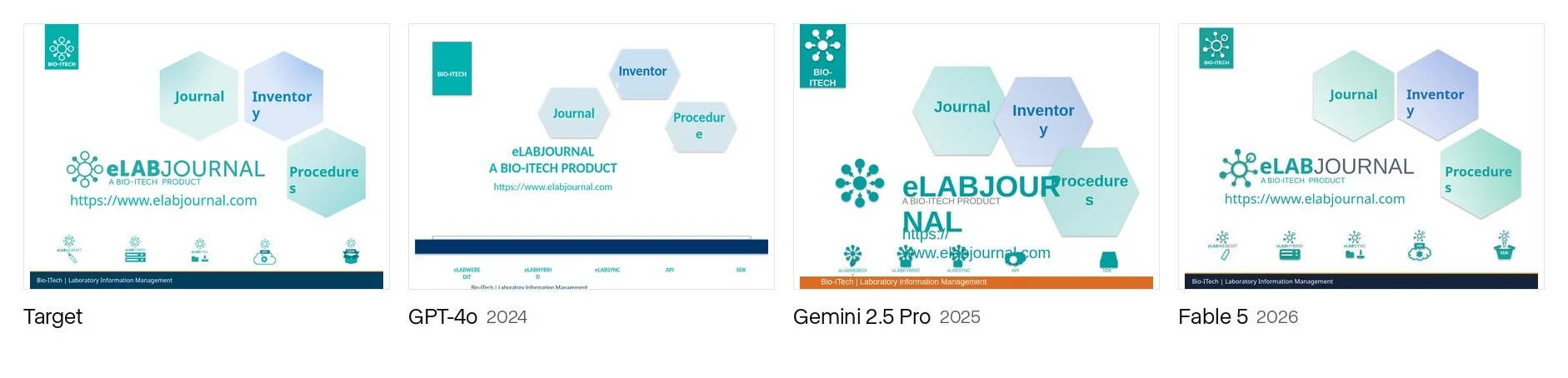
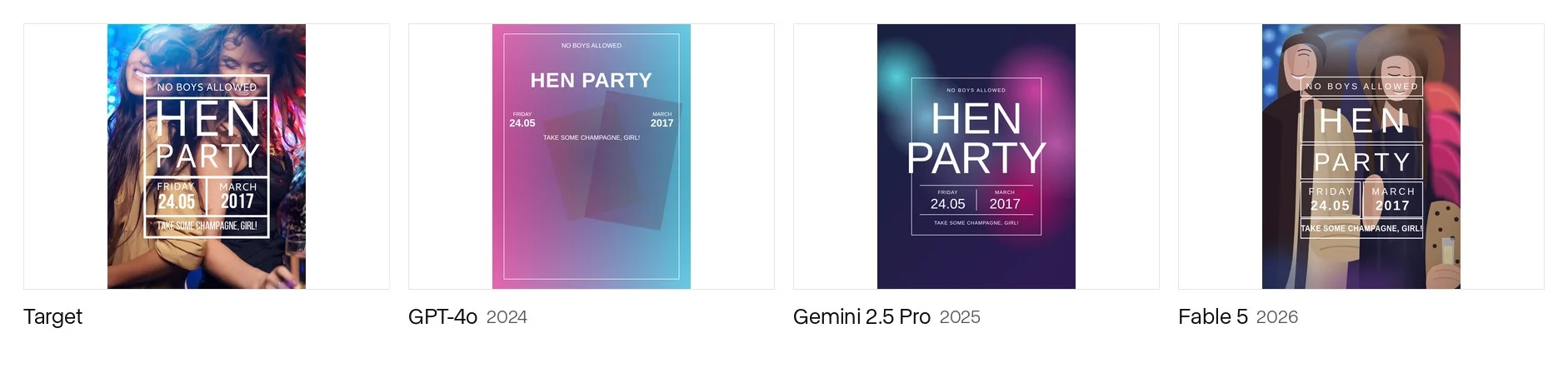
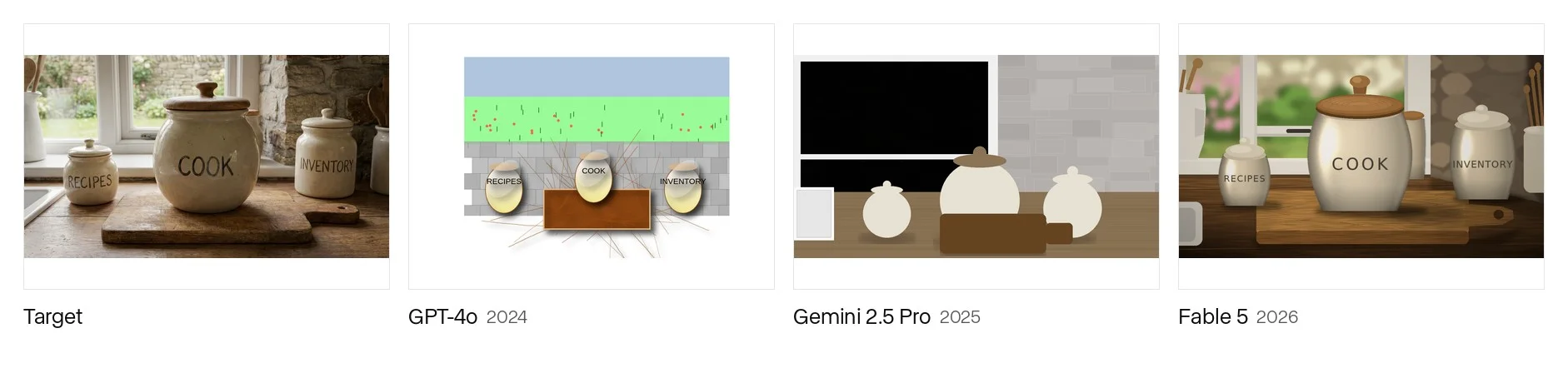
To measure this, we evaluated state-of-the-art multimodal language models, including Claude Fable 5, on the task of recreating website interfaces from a single screenshot. We evaluate across a diverse collection of 30 interfaces, ranging from simpler plain webpages to image-heavy webpages and natural images, which evaluate different aspects of visual understanding.
We measure information preservation in two complementary ways. First, structural similarity (SSIM) compares the reconstructed interface to the original in place, capturing how faithfully the visual appearance is reproduced. Second, we compare each region of the original with its most similar region anywhere in the reconstruction using DINOv3 features, measuring whether the underlying visual content survives even when elements move or the layout changes.
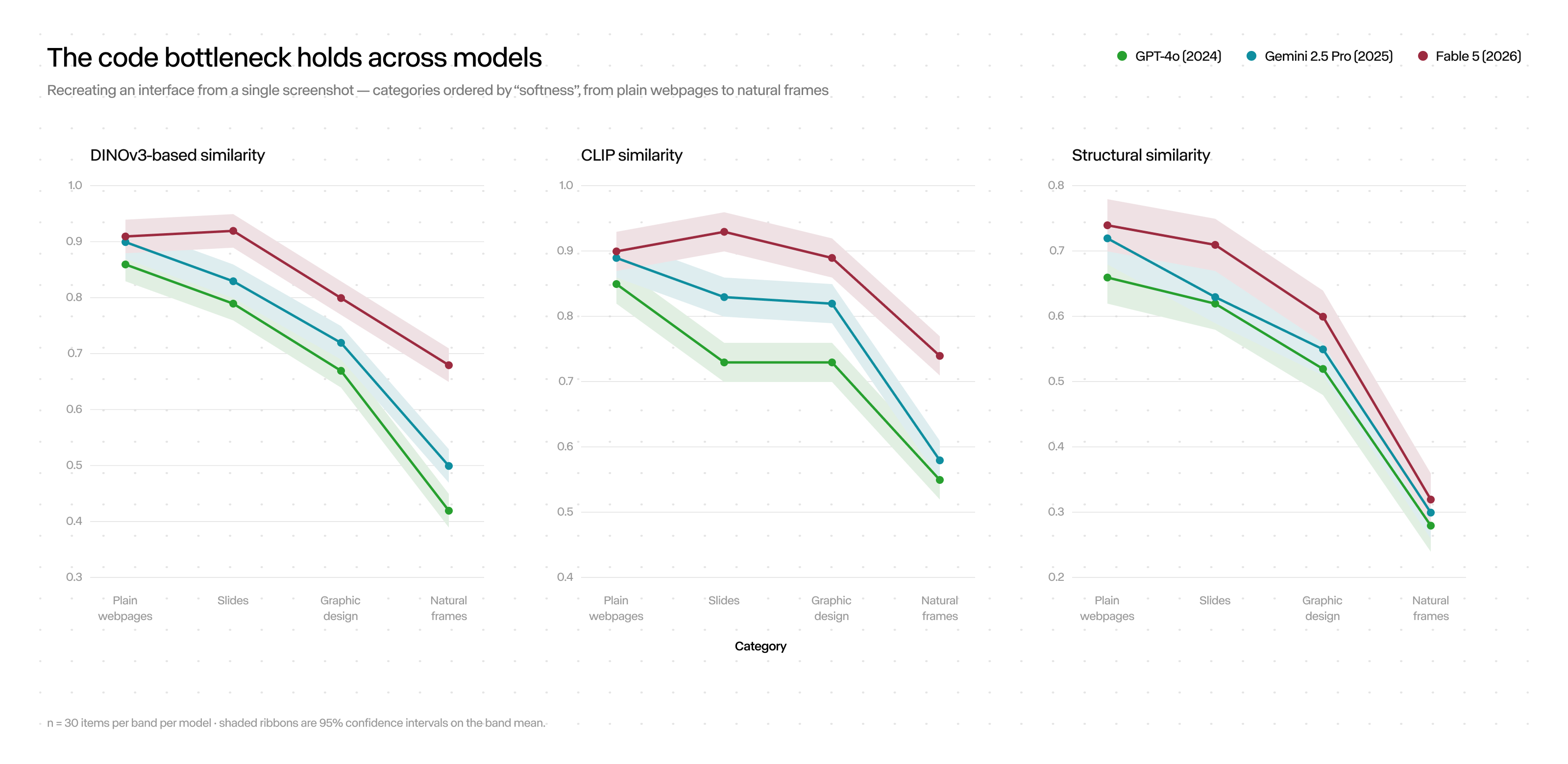
Reconstruction fidelity across increasing visual complexity. Even as multimodal language models continue to improve, reconstruction quality consistently degrades as visual complexity increases, revealing the information lost when interfaces are translated through language.
Despite rapid progress in recent years, every language model loses information during reconstruction. Natural images are affected most because rich visual detail cannot be represented accurately in language. As interfaces become more complex, even small changes to text, layout or structure can fundamentally alter how the interface behaves.
Rather than translating an interface into language and reconstructing it again, Solaris operates directly on the visual interface itself. By eliminating the intermediate representation, it preserves the complete visual and semantic state of the interface from the very first frame.
Solaris vs. Coded Interfaces
Our reconstruction benchmark measures how much information is lost when an interface is translated into code. We next ask: given the same interface and the same user interaction, which approach produces the better result? Can a coded interface recreate the same sense of a living, responsive environment as an interface generated by an interface world model?
Comparisons. While both systems respond to the same interaction request, Solaris preserves the coherence of the entire scene, producing interactions that feel more natural and physically grounded.
To answer this, we compared Solaris against a state-of-the-art language model (Claude Opus 5). Both systems started from the same image and received the same interaction requests, and we recorded how each responded. We then conducted a user study with 250 participants across 30 interaction examples, collecting nearly 7,500 pairwise judgments. For each comparison, participants answered two questions: “Which result better follows the given instruction?” and “Which behaves more naturally within the scene?”
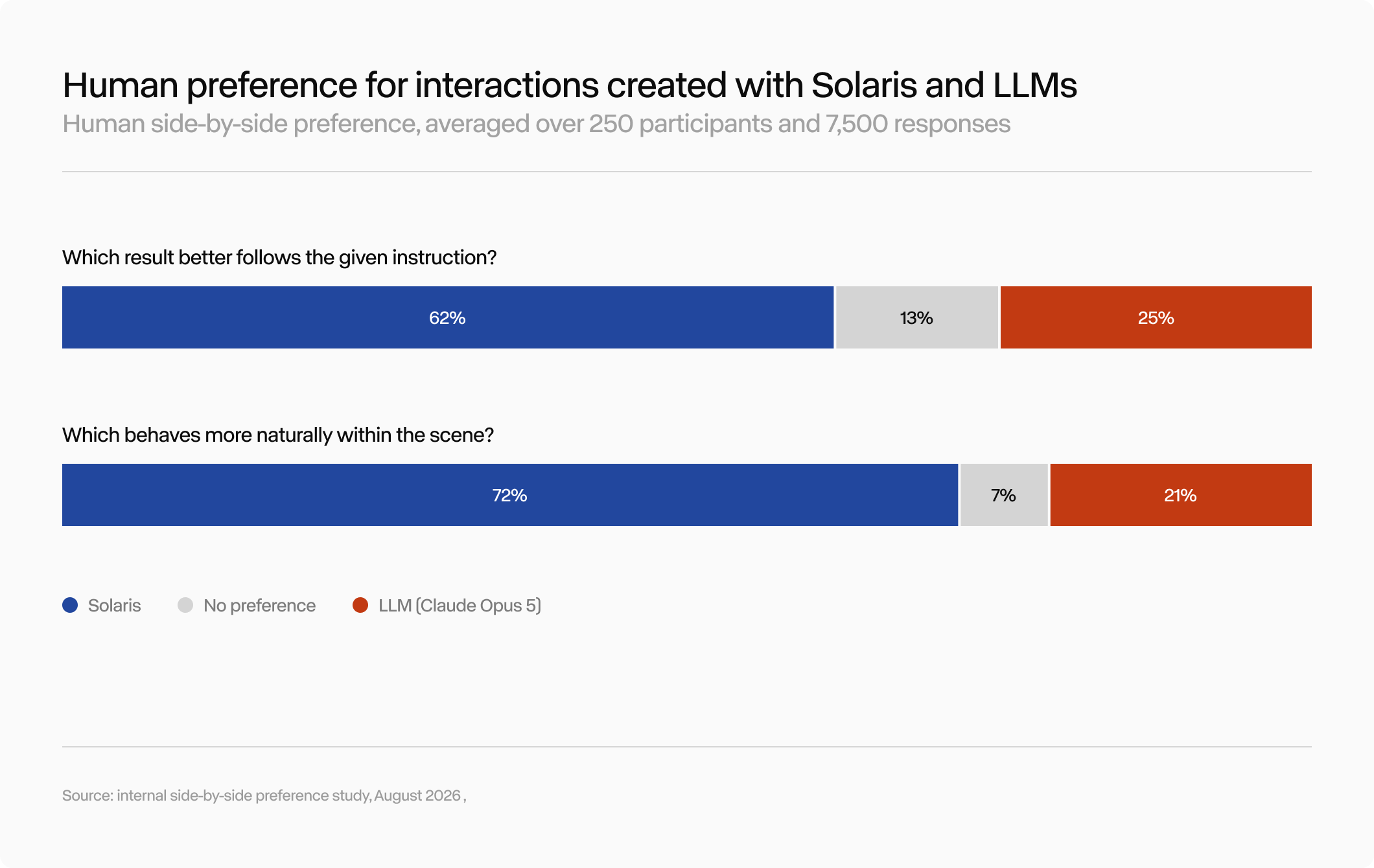
Participants preferred Solaris on both measures. For following the requested interaction, Solaris was preferred in 61% of comparisons compared to 24% for the coded result, while 13% were rated as equivalent. The difference was even larger for natural behavior, where Solaris was preferred in 71% of comparisons compared to 21% for the coded website, with 6% rated as equivalent.
The second result highlights the broader difference between the two approaches. A coded interface can often reproduce the requested change, but it treats the interaction as an isolated update to the interface. With Interface World Models, because the model already understands how objects, materials and environments behave, it can generate interactions that feel coherent within the scene rather than treating each UI action as an isolated element.
What It Can't Do Yet
Solaris is strongest at ambient motion, click-and-drag interactions and scene transitions. Several important challenges remain:
- Text. Stable, legible text remains one of the hardest problems in video generation, yet interfaces depend on it more than almost any other visual domain. One practical path is a hybrid system in which image models render text-heavy views whenever a brief pause is acceptable, while video models handle continuous interaction. Fully real-time generated text remains an open challenge.
- Trust. For instructional or commercial experiences, a convincing wrong answer is worse than no answer. Today, Solaris stays anchored through what you give it. The starting frame can be composed from real product imagery and reference material, which grounds the scene in things that actually exist. Conditioning generation on richer verified context as the session unfolds (reference images, product data, documents) is an active research focus.
- Long sessions. Maintaining visual and semantic coherence over extended, open-ended interactions remains an active area of research.
- Accessibility and integration. A generated interface still needs to work inside the rest of the software stack, including assistive technologies such as screen readers and accessibility APIs, so that flexibility doesn't come at the expense of usability.
These challenges reflect the current frontier of real-time generative models, and we expect them to improve alongside the underlying models themselves.
New Kinds of Interfaces
Solaris is an early step toward a new operating layer, and we see several new interaction patterns emerging.
- The app stops being the unit you interact with. Today, getting something done means opening the pre-built app made for it – one for shopping, another for news, another for restaurant reservations. If the operating system can generate useful interfaces, no matter what the user wants to do, there's less reason to sort software into a fixed catalog of apps. What you need simply shows up, customized to you.
- Interface World Models remove the need to translate between a visual idea and an intermediate representation. Instead of working through UI frameworks, components and code, any visual concept can become an interactive interface.
- A storefront is no longer a fixed layout that every visitor sees. It becomes a generated environment that preserves the brand's identity while adapting to each individual. Products, layouts, colors, materials and recommendations reshape around your intent in real time, allowing your brand and products to remain recognizable within hyper-personalized experiences.
- Tutorials no longer replay the same sequence for everyone. Instead, they render the next step in your own context, adapt as you make progress and recover naturally when you go off script.
We expect interface generation to follow the same trajectory as image and video generation: every model generation will become faster, more coherent, more controllable and more capable. The challenges that once made generated interfaces seem impractical now look increasingly like solvable engineering problems.
Solaris is our first Interface World Model, and we're excited to continue exploring what generated software can become, from richer interactions, stronger grounding and longer-lived experiences to entirely new kinds of interfaces that don't exist today. We’re working with key partners to launch Solaris publicly. Fill out the form below to request early access.