
Anthropic 内部就业报告:初级技术招聘占比从27%降至9%,员工开始管理 Agent
AI先接走一部分任务,再改变人的工作重心。沿着销售、文案与研发的真实变化,看懂招聘、协作和新人成长正在承受什么影响。
Anthropic公布了自己公司的就业研究:过去一年,员工总数增至原来的三倍,但技术部门新聘员工中,初级人员的占比却从27%降到了9%。与此同时,销售开始自己搭软件,工程师花更多时间管理AI,员工开会的时间也增加了。
这些看似分散的变化,其实连着同一个问题:当Claude和能调用工具、执行任务的AI Agent接走越来越多工作以后,公司还需要人来做什么?报告结合内部用工、代码、会话、日历和面试评价数据,以及17次员工访谈,让我们可以沿着实际工作过程理解这种变化。
AI接走部分日常工作,员工转向新的任务
一个岗位通常要完成好几类工作——它既包含撰写草稿、填报系统、查找缺陷等重复执行工作,也包含识别真实需求、在信息不全时权衡取舍以及建立人际信任等决策工作。
在报告里的案例中,AI接走了这些工作中的一部分执行环节:
- 销售代表的日常工作:销售既要写跟进邮件、更新客户管理软件里的记录,也要与客户交流需求。一位Anthropic客户主管说,Claude自动化承担了邮件草拟、客户管理系统对接等事务,替代了自己原先约20%的工作任务。另一位销售表示,类似工具释放了时间,让自己能与比过去多30%的客户交谈。两人的经历说明,部分执行事务可以交给AI,节省的时间则用于接触更多客户。
- 产品文案团队的职能转型:一个曾专门负责编写客户端日常提示语(比如“夜猫子你好”或“来杯咖啡和Claude聊聊?”)的设计团队,把相关背景与指引组织成上下文图谱,用来引导Agent撰写这类文案。当Agent能够在这些指引下生成产品文案后,团队转向编写提示词与模型评测,也就是检查模型的表现——过去用语言去引导人类用户行为的文案写作者,如今转用语言去引导和评测AI的行为。
这两类变化说明,任务自动化之后,人的工作可以随之重新组合:销售把更多精力放到客户身上,文案团队则把语言能力用于引导和检查模型。原来的任务减少,并不自动等于整个岗位消失;关键还在于组织能否找到新的工作,以及是否愿意让原有员工转过去。
公司还在扩招,招聘却更偏向有经验的人
当执行类任务被持续分流,企业对不同经验层次人才的需求结构也可能改变。过去一年,Anthropic最引人注目的变化之一,正是整体用人规模扩张与初级技术招聘占比下降的并存。

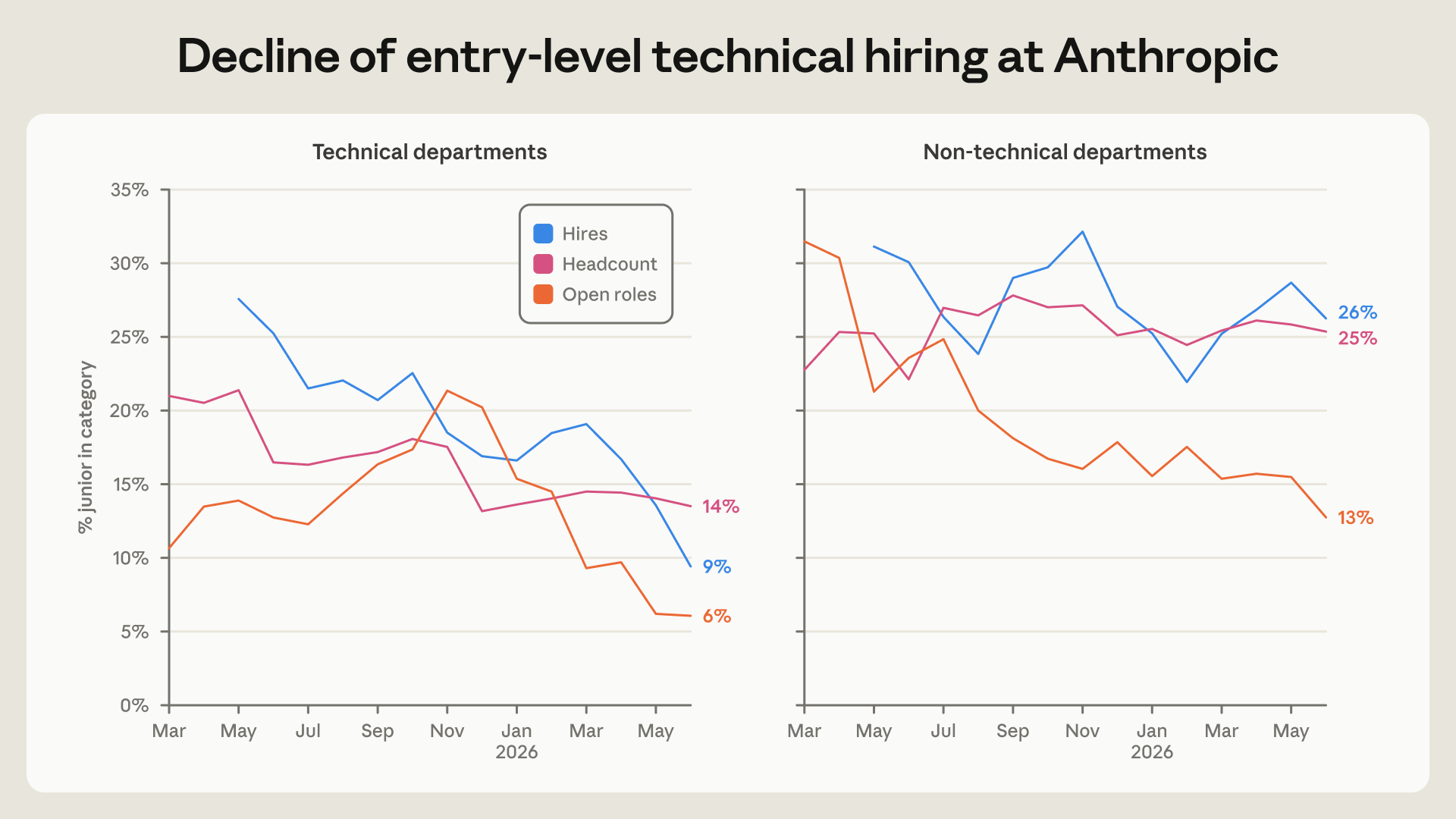
同期非技术部门在职初级(约25%)与新聘(约26%)相对平稳,但技术开放岗位中初级比例仅余6%,非技术开放岗位降至13%。
数据清晰记录了技术团队内部招聘构成的改变:
- 初级新聘比例收缩:在技术部门的所有新入职员工中,初级(Junior)技术人员的占比从观察期初的27%大幅下滑至9%;
- 初级在职比例走低:技术部门现存员工中,初级人员占比从21%降至14%;
- 初级开放岗位稀缺:到观察期末,技术部门对外开放的所有空缺岗位中,初级岗位仅占6%(非技术部门的开放岗位中初级也降至13%)。
为什么在公司总人数增至三倍、技术岗位绝对招聘人数仍在增加的情况下,初级技术人员的比例却在下降?
内部问卷中,约三分之一的机器学习经理和五分之一的软件工程经理表示,自己因AI减少了招聘。这些回答说明,部分经理已经把AI能力纳入用人安排;至于因此少招了多少人,调查没有给出人数估计。
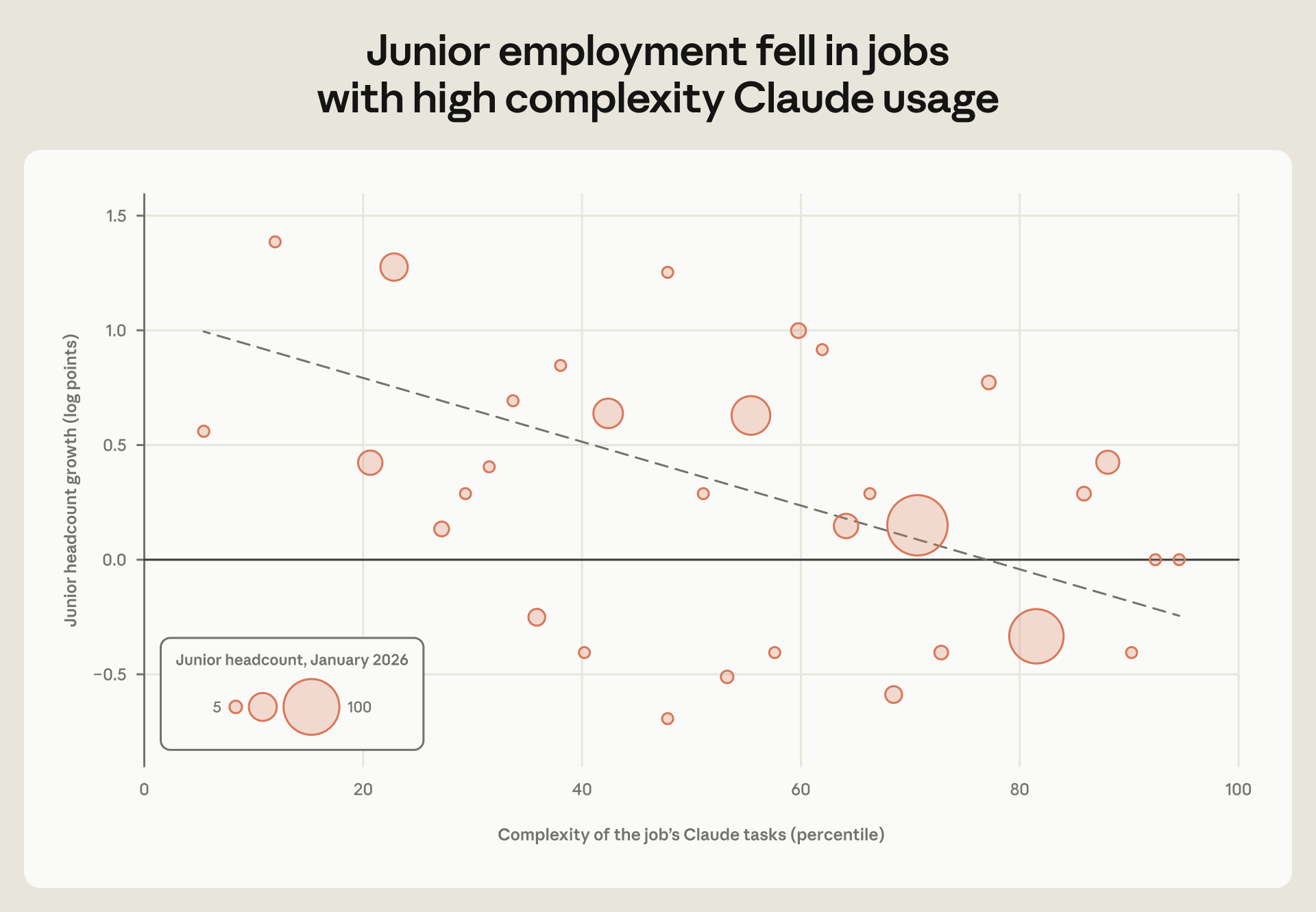
报告还观察到:一个岗位交给Claude处理的任务越复杂,随后初级员工人数的增长整体越慢。这是岗位之间的相关性,并不能单独证明AI导致了岗位减少。

每个圆代表一种岗位,越靠右表示任务复杂度排名越高,越靠上表示初级人数增长越快,圆越大表示起期初级人数越多。黑色横线以上仍在增长;虚线是整体趋势,不是每个岗位都会减少,也不能单独证明因果关系。
理解这组变化,需要把“公司要完成多少工作”和“每份工作要多少执行人力”分开看。
例如,一个团队原先把写常规代码、找bug等任务分给几名成员。如果Agent能接走其中一部分,同样规模的工作就可能不再需要照原样补人。另一方面,公司的客户与项目还在增加,又会产生新的用人需求。两股力量同时发生,公司就可能一边扩招,一边减少初级人员在新聘员工中的份额。
Anthropic的人均创收也达到同样成立五年时谷歌与Meta的2至4倍(经通胀调整)。这提供了高增长公司的背景,但跨公司比较还受商业模式等差异影响,不能直接当成AI创造的效率倍数。
这是对报告中变化的一种解释,单凭招聘占比还不能算出AI究竟少创造了多少岗位。但它提示了一种值得关注的趋势:就业压力可能先表现为“新机会变少、招聘更偏向有经验的人”,而不必先表现为大量裁员。 对已经入职的人来说,公司仍在扩张;对想进入行业的新人来说,入口却可能变窄。
销售也能自己做软件,一个人能做的事更多了
伴随编程Agent的普及,技术的应用边界开始向非技术部门快速外溢。在过去一年中,Anthropic技术部门占全公司的人数比例从61%降至56%,销售、财务、招聘等业务团队的扩充速度反超了技术团队。
公司扩张本来就会带来销售、财务和招聘需求。与此同时,报告里的具体案例还显示,业务人员也在借助Agent自己做工具:
- 一位销售代表借助自然语言与工具连接协议MCP,在三到四个小时内就为自己的业务搭建了一套专属的数据看板与处理流水线。在以往,设计界面和串联不同系统的数据接口超出了他过去能独立完成的范围。
- 在基线时期没有代码提交记录的非技术员工群体中,以编程为核心的Agent交互会话,在观察期内从平均每人每月2次暴增至90次。
- 财务经理搭建了采购请求自动化审查工具,行政助理搭建了邮件日程分流Agent,将精力从初级杂务抽离,转向类似幕僚长的高阶工作。行政支持职能的增长较慢,也与工单服务外包等安排有关。
这类变化让业务人员能够更直接地把自己的需要变成工具:不必等到每一个小需求都有人专门排期开发,自己也能先做出一个可用的版本。
但做出看板,和做出对业务有用的看板,仍然是两件事。以销售工作为例,得有人先决定要追踪哪些客户信息、什么信号值得跟进,再检查看板的数据是否可信。AI降低了把想法写成软件的门槛,这些关于业务目标和结果的判断仍需要人来做。专业经验的作用,也会更多体现在提出对的问题、识别不对的结果上。
同时,技术团队内部的分工界限也在重构。在技术部门内,过去30天内没有代码提交记录的人员占比,在一年间减少了近一半;工程师与产品经理的比例拉大到约17比1,管理者的代码提交量也翻了一倍。协调者和管理者也更多地直接下场参与交付。编程工具更容易使用以后,业务理解与亲手实现之间的距离缩短了。它说明岗位边界在移动,不能据此认定工程师或产品经理已失去价值。
AI产出越来越多,人却来不及检查
当越来越多员工开始调动Agent执行任务时,机器的工作时间迅速超越了人类工时。
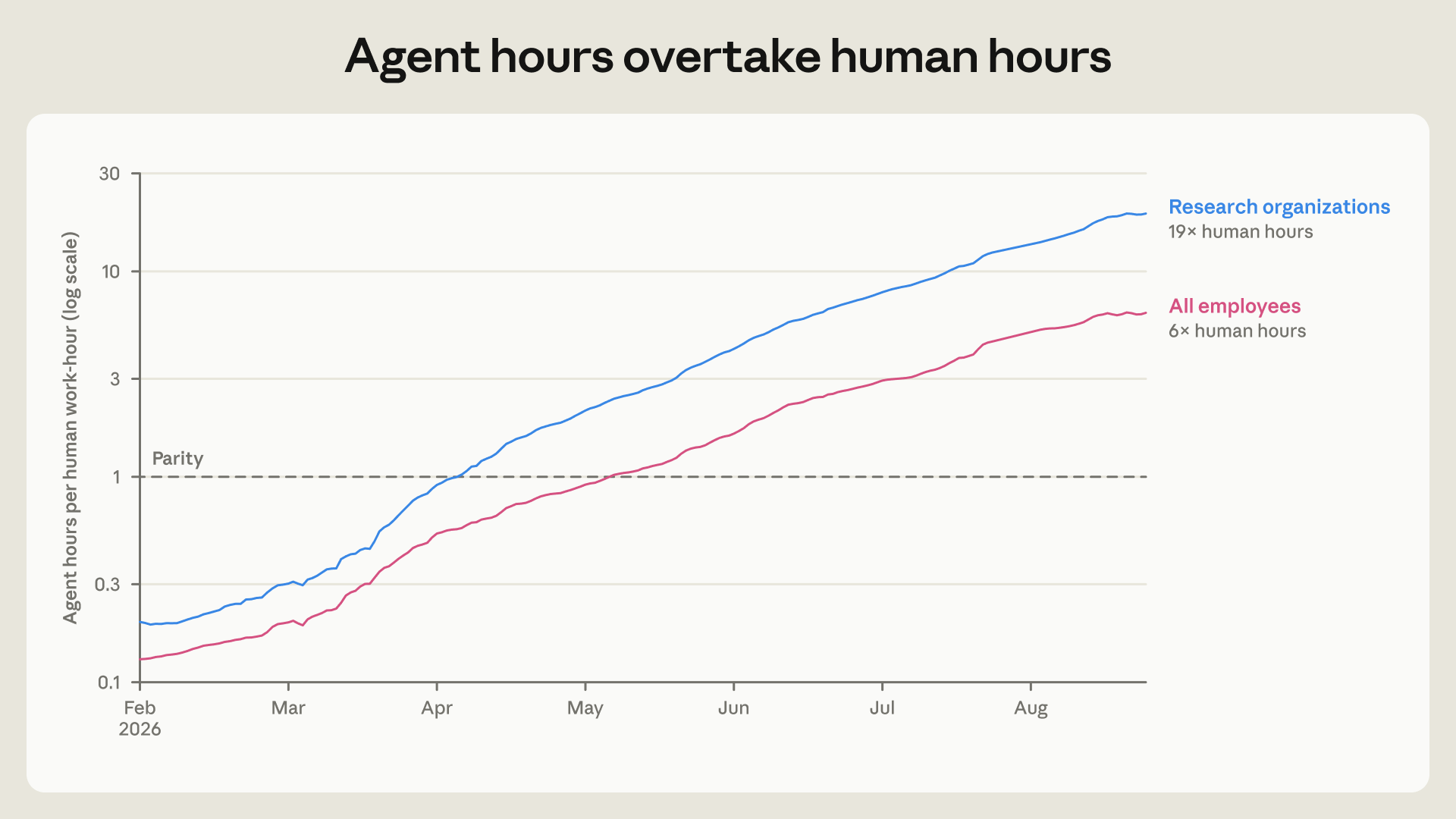
在Anthropic,仅计算员工直接调用的交互式协同会话,Agent累计运行的时间就达到了全体员工估算工作时间(按每周40小时测算)的 6 倍,在研究团队内部更是达到了 19 倍。这些工时把并行Agent的运行时间加在一起,不能直接换算成人类效率或被替代的人数。

蓝线为研究组织,粉线为全体员工;虚线1表示两者时间相等,纵轴采用对数刻度。这里只计算交互式Agent运行,人类按每周40小时估算;并行运行时间相加,不代表效率提高同样倍数。

数据经Loess平滑,反映业务爆发期各职能人均产出快速上升,包含了公司整体商业增长红利。
同一时期,人均产出也上升了:以半年前为基期(设为100),工程师的人均代码提交量指数达到基期的 5.1 倍;数据科学家的查询量与法务人员审核的合同量达到 3.1 倍;销售代表完成的签约单量达到 1.7 倍;应付账款发票处理与每位招聘人员完成的录用人数也达到 1.4 倍。
这些增长里同时包含业务扩张的影响。模型产品卖得更好,销售自然也更容易成交。为进一步观察工具使用与产出的关系,研究跟踪了192名采用代码Agent的工程师与74名同期未采用者,比较同一个人使用前后的变化,并与同一月份未采用工具的人作对照。采用后,工程师的代码新增量明显上升;但谁先用工具并不是随机决定的,因此仍不能把全部变化都归功于AI。

右侧代码质量检验中,代码删除率、bug修复与整笔撤回等指标的95%置信区间均覆盖零点,这些指标未检出明显差异,仍不足以证明长期质量与商业价值相同。
完全自主Agent的使用者在采用之前,产出就已处于上升轨迹。这意味着一部分变化可能来自这些人原本正在推进的工作,而不能全算到工具头上。图中右下角还显示,销售代表采用Agent后,成交客户数增加。不过,也可能是手头销售机会更多的人更愿意使用工具。
代码写得更多,也还要看是否有用。研究比较同一人在同一个月、同一个代码目录里,直接编写和由Agent编写的代码,未在后续90天的删除、修复bug导致的删除、整笔撤回等指标上检出明显差异。这些检查提供了一些质量线索,但AI错误也可能更难被发现;单靠代码量和这些代理指标,还不能判定长期质量与商业价值。
工具变强后,员工还会给它更难的任务。新模型推出后,超过旧模型任务难度90百分位的任务,占比从10%升至13%。换成直白的说法:原先属于最难一档的工作,被交给新模型的比例增加了。工具省下的时间,未必都会变成空闲,也可能被用来接下更难的活。
员工也感受到工作流程带来的帮助:两次采用相同问法的内部调查中,认同工作流程让自己“尽可能高效”的比例从44%升至58%。这与忙碌并不矛盾——工具更好用、能完成的事更多,仍可能伴随着更密集的任务和更高的交付期望。
任务增加、产出变快后,另一种压力开始突出:人来不及审阅和验收。
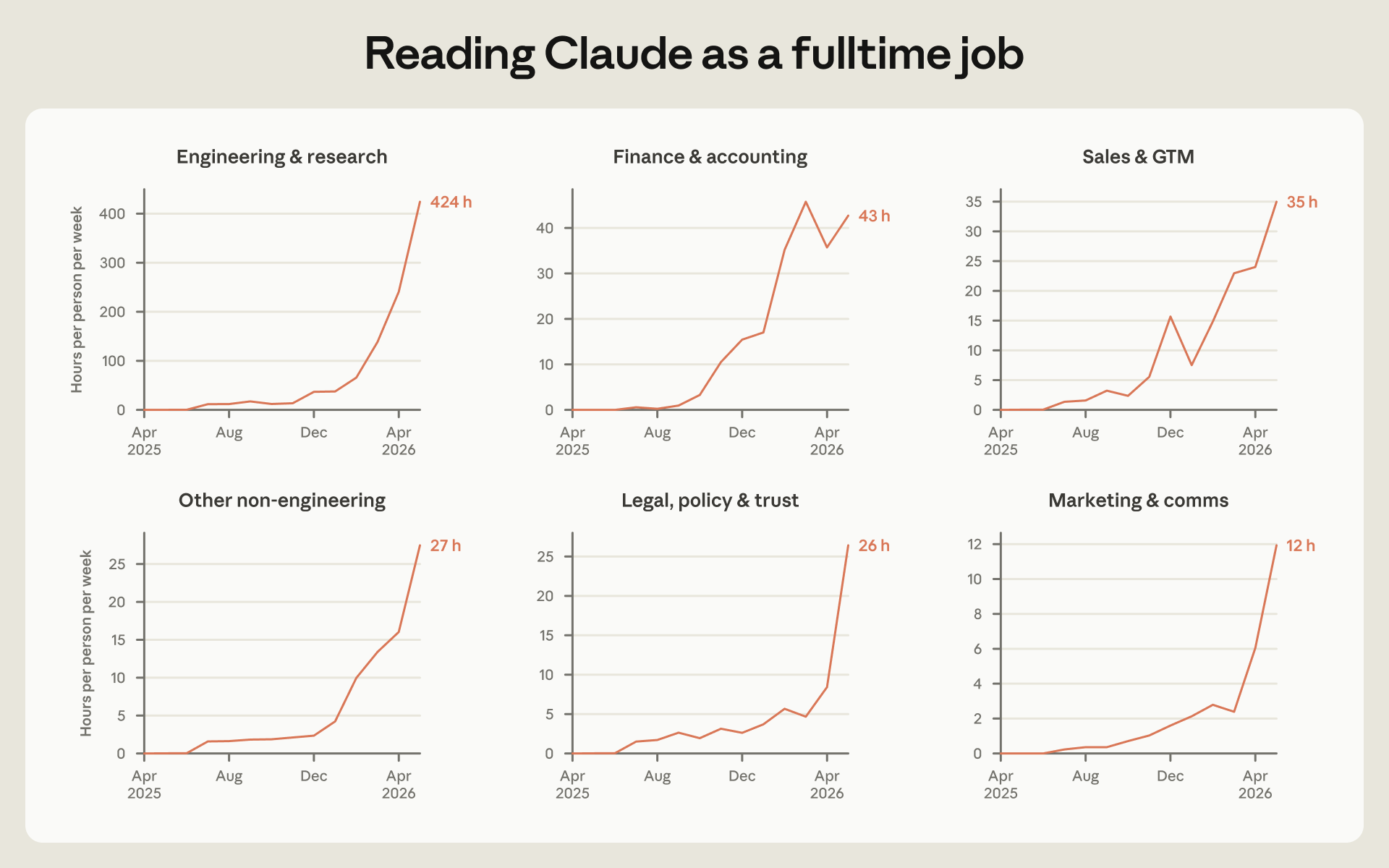
如果员工试图逐字通读交互式Agent生成的全部文本,工程与研究团队的人均理论阅读量每周高达 424 小时;即便在非技术职能中,财务与会计团队每周也达到 43 小时,销售团队达到 35 小时,法务、政策与信任团队达到 26 小时,其他非工程职能为27小时,市场传播为12小时。这是按每分钟250个英文词估算的“读完全部输出要多久”,不是员工实际花了这么久。多数非技术组的估算也超过半个工作周,逐字通读就会挤占大量其他工作。
把 Agent 输出换成阅读时间
原报告按每分钟 250 个英文词估算。选择部门,或调整阅读速度,看看同一批输出需要占用多少时间。
原报告的同一估算口径
每人每周,按 250 词/分钟。以下基准值不会随控件变化。
- 工程与研究424 h
- 财务与会计43 h
- 销售与市场拓展35 h
- 其他非工程职能27 h
- 法务、政策与信任26 h
- 市场与传播12 h
来源:原报告图 6,输出量按 0.75 英文词 / Token 换算。这是读完全部输出的负担估算,不是员工实际阅读时长。调整后的小时数=图中基准小时数 × 250 ÷ 假设阅读速度;40 小时仅作比较基准,未计入其他工作。速度变化是教学假设,不代表实测。
一名工程师用“看护孩子”来形容这种处境:一个孩子大喊着自己的果汁盒打不开了,另一个孩子手指被割破正在流血,但在呼救时,他们发出的紧迫感几乎一模一样;屏幕前并发运转的各个Claude,也都在以同样高度紧迫的提示争夺人类的注意力。
遥测还显示,在多轮交互会话的自然时间中,Agent有约 80% 的时间处于闲置等待人类反馈的状态。在这些交互中,人的反馈速度会限制Agent继续推进。只增加Agent数量,并不能自动解决人看不过来、来不及选择和决策的问题。
员工开始管理AI,人与人也要更多协作
面对大量生成内容,仅靠员工一条条看,处理能力很难跟上。在内部关于AI如何改变日常工作的开放式问卷回答中,有27%的回答提到了工具带来的生产力收益,另有20%的回答表示自己的角色正从实际动手转为管理Claude。员工开始花时间调整工作方法:从“亲自做具体工作”,转向“设计让工作能够顺利完成的规则与流水线”。
在Anthropic的研究中,这类工作被称为 “元工作(Meta-work)”。它在日常工作中具体表现为一系列明确的管理与系统构建动作:
- 写清任务要求:先把复杂任务的目标、边界和分工写清楚,让Agent知道要完成什么、该在哪里停下来;
- 引入Agent互审与请求分流:为了克服人类阅读瓶颈,搭建自动化流水线,让一个专门的审查Agent去复核另一个生成Agent的产出;对于各种Agent请求都在争夺注意力的问题,一位工程师还建立了Agent“幕僚长”,先为其他Agent发来的请求做分流;
- 积累长期可用的规则:员工编写的长期规范指令集在一年内从几百条增长到了8,500条;
- 调整Agent沟通和查资料的方式:有员工专门为自己的Claude虚拟团队撰写“沟通风格复盘”,法务人员则将一部分工作转向编写容易被检索到的法律框架,方便客户方的Agent找到这些指引。
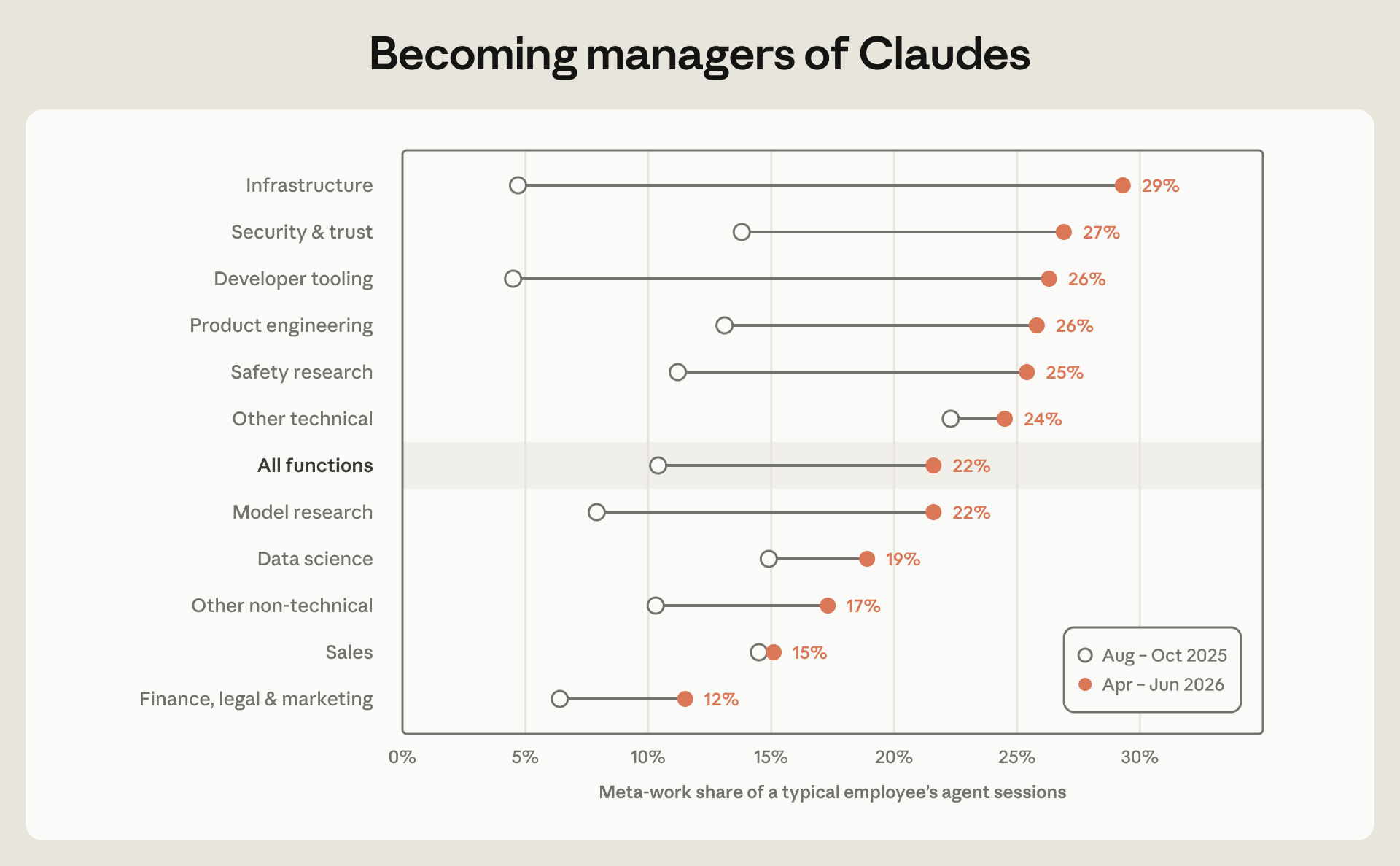
研究根据2,000条会话摘要自动分类发现,典型员工交互会话中,聚焦于此类Meta-work的比例从约10%升至 22%。在基础设施团队中,这一比例更是达到了29%,安全与开发工具团队也达到26%至27%。

基于2,000条会话摘要自动分类;基础设施(29%)与安全及开发工具(26%~27%)居首,财法市场等职能约为12%。
令人意外的是,执行工作交出去了、元工作搭建起来了,组织内部的人际沟通反而变多了。
日历数据显示,Anthropic的中位数员工在会议中度过的时间同比增加了 20%,技术岗位中不担任管理职务的员工,会议时间也增加了 16%。其中一部分与公司变大、非技术职能扩张有关,不能全部归因于AI。
管理Agent的员工变多了,公司的经营决策仍主要由人掌握。报告说,从公司战略到具体的团队决策,主要通过Slack里的书面讨论与面对面会议来决定,Agent很少参与。
这些需要人一起决定的事情,具体是什么?
- 需要人权衡的问题仍然存在:当常规代码编写和初步信息检索由AI快速搞定后,追查问题仍可能触及积累已久的系统缺陷、跨团队的目标冲突和职责归属。工具可以帮助找问题,但该改哪一层、由谁负责、哪些目标优先,仍需要相关的人讨论和决定。
- 决定还要留下Agent能读取的记录:对一个大型部门公共Slack频道的分析显示,Agent交互线程明显增多,主要围绕单个员工形成各自的协作群;人类原有的沟通结构和密度变化很小。然而,Agent需要了解相关任务的最新背景,如果团队在私下会议或私信里达成了新决策却没有形成清晰的公开文档,Agent就会继续按照过时的规则行事。曾有一名员工的名字停留在数月前的一份周边礼品文档中,导致Agent在此后很长一段时间里不断找他索要文化衫和马克杯——只因他的职责调整没有被Agent“看到”。为了让自动化流程不脱轨,团队需要及时记录相关决策、反馈与责任变化,让Agent能查到更新后的信息。
蓝点是员工,橙点是Agent线程与会话,灰线表示共同参与同一线程或会话。画面仅来自一个大型部门的公共Slack网络;橙点不代表独立的“AI员工”人数。约15秒,无声。
公司更看重判断力,培养新人却成了新难题
这些工作变化,也体现在招聘评价里。对数千份招聘面试评分卡的自动分类分析,能看到面试官越来越关注什么:
- 技术岗位重在“自主性”与“判断力”:在技术面试评语中,对候选人自主性与判断力的强调增幅最为显著,而针对某一具体细分领域技术知识的讨论份额则相对缩减。一位研发负责人指出,当前各领域的AI模型能力分布常常是参差不齐的,他希望团队成员能跨领域工作。
- 非技术岗位重在“使命感与客户导向”:非技术面试中关于具体“执行技能”的讨论份额下降,客户与使命导向的讨论增加。
- 创造性使用AI的经历更受关注:面试评语提及这类经历的比例,技术岗从约5%增至原来的约3倍,非技术岗从约7%增至原来的约4倍。
结合前面的工作变化,招聘中更重视的自主性与判断力,可以理解成更具体的责任:目标还不清楚、没有现成答案时,你能不能独立决定“先做什么、后做什么”;面对AI给出的多个方案,你能不能检查依据、发现问题,并判断结果是否可交付;当多方诉求冲突时,你能不能准确判断何时该推进、何时该找人协商。
这也带来一个人才培养上的矛盾:企业越来越需要具备高阶判断力的人,但一部分用来积累这种经验的日常工作,也正在交给AI。
新人常常是在具体工作中形成判断力的:修改一处代码,看到测试为什么失败,再顺着问题理解系统。能检查AI结果的经验,也需要从实际任务和反馈中积累。
报告也提到,随着自动化推进,部分在职员工正在逐渐远离最初建立其专业技能的具体工作。如果一部分基础实践交给AI,新人通过什么任务来积累判断经验?企业如果希望持续招到有判断力的人,就需要考虑怎样给新人保留实践、反馈和承担责任的机会;这也是培养方式需要重新安排的地方。
给老员工转岗,还帮不到没被招进来的人
面对岗位和任务的变化,Anthropic在组织机制上也展开了一系列试验:
- 正在建立岗位变化预警机制:把AI能力和使用情况,与各类岗位的用人需求、产出变化放在一起看,及早发现哪些工作正在改变;
- 优先推动内部人员重新配置:对于那些任务被AI显著接管的在职员工,优先在内部寻找新的匹配岗位。在公司工作满一年的员工中,后一年每个月跨部门流动的概率相比前一年提升了50%;
- 让员工分享收益:广泛的员工持股让员工能分享公司发展的收益,从而缓解员工将自己的专业经验“编码进Agent”时所产生的利益对立。
这些做法希望让员工参与工作重组时,也能保有新的工作机会和收益。对内部在职员工的重新安置承诺,可以促使管理层将精力放在利用AI开辟新业务和新任务上,而不是仅仅滑向用技术替代人工以削减微薄成本的“平庸自动化(So-so automation)”。
这些办法也有代价和局限。 首先,承诺保护在职员工,可能会让企业在对外招聘新员工时变得更谨慎,这反过来可能进一步收紧外部新人的准入门槛;其次,内部重新安置和股权分享主要帮助的是已经在职的员工,它无法惠及那些从一开始就没有被录用的求职者。
因此,正如研究作者所警示的,企业内部的安排还不足以解决所有就业冲击。面向劳动者的再培训支持与兜底性的收入保障政策,也是需要考虑的应对方向。
从Anthropic可以看到,AI的影响可能沿着一条具体的路径展开:先改变一个岗位内部的任务,再改变团队需要怎样的人,继而影响招聘、协作与人才培养。一个人能够完成更多工作,并不自动意味着公司总人数减少;如果业务扩大、出现新任务,也可能继续增加招聘。反过来,公司仍在增长,也不保证每一类求职者的机会都一起增加。
这是一家高速成长、自己开发AI的公司的内部研究,不能据此预测所有企业的岗位数量。它提供的趋势信号是:工作中的执行环节越来越容易交给AI,而定义问题、核验结果、协调责任的分量正在上升。 随之而来的问题,也包括怎样让人分享收益,以及让新人有机会练出企业需要的经验。
Anthropic内部就业报告:初级技术招聘占比从27%降至9%,员工开始管理Agent
过去一年,Anthropic员工总数增至原来的三倍,但技术部门新聘员工中,初级人员的占比却从27%降到了9%。与此同时,销售开始自己搭软件,工程师花更多时间管理AI,员工开会的时间也增加了。
这些看似分散的变化,连着同一个问题:当Claude和能调用工具、执行任务的AI Agent接走越来越多的常规执行工作,公司到底还需要人来做什么?
理解这种反差,关键在于把“公司要完成的总业务量”与“单项任务需要的执行人力”分开看。例如,同样规模的项目中,Agent如果接走部分常规代码和排错工作,就可能不再需要照原样补人。业务扩张又会带来新需求,两股力量可以同时发生。
Agent运行得更多、更快,员工还会交给它更难的任务。产出增加以后,人来不及逐项审阅与验收,注意力与反馈速度开始限制工作推进。
仅算员工直接调用的交互式会话,Agent累计运行时间达到估算人类工时的6倍,研究团队达到19倍。这里把并行Agent运行时间相加,不代表人的效率提高同样倍数。
以半年前为基期,工程师人均代码提交量达5.1倍,数据查询与法务合同处理达3.1倍;其中也有业务增长的影响。工程研究员工若逐字读完Agent全部输出,每周理论需424小时(250英文词/分钟),并非实际用时。
在多轮交互会话的自然时间中,Agent有约80%的时间处于闲置等待人类反馈的状态。更多Agent同时提出请求,会继续占用人的注意力;增加Agent数量不能自动解决这一问题。
一名工程师形象地用“看护孩子”来比喻这种处境:一个孩子大喊果汁盒打不开了,另一个孩子手指流血,呼救时的紧迫感却一模一样;并发运行的各个Agent,都在以高度紧迫的提示争夺人类有限的注意力。
面对大量产出,员工开始调整工作方法,从“亲自做具体工作”,转向“设计让工作顺利运转的规则与流水线”——即 元工作(Meta-work)。
基于2,000条会话摘要自动分类,典型员工交互会话中,Meta-work占比从约10%升至22%(基础设施团队29%)。这是会话占比,不是工时。具体动作包括:
同期,中位数员工的会议时间增加20%,非管理技术岗增加16%;公司规模和职能构成变化也有影响。系统缺陷、跨部门目标冲突和权责归属,仍需要人协商。公司战略到团队决策主要由Slack书面讨论和面对面会议推动,Agent很少参与。
招聘评价也在变化,而这牵出了新人的成长难题。
技术岗位面试评语中,对具体领域知识的讨论份额下降,对自主性与判断力的强调上升;非技术岗位更关注客户与使命。人的责任更多体现为:决定先做什么、核查AI方案的依据,以及判断何时交付、何时找人协商。
判断力常在具体工作和反馈中积累,例如修改代码、看测试为何失败。部分基础任务交给AI以后,企业也需要重新安排新人的实践与反馈机会,才可能持续培养有判断力的人。
Anthropic正在建立岗位变化预警、优先推动内部转岗,并通过广泛员工持股分享收益。满一年员工后一年每个月跨部门流动的概率,比前一年高50%。这些安排主要帮助在职者,帮不到未被录用的人;保护在职者也可能令新增招聘更谨慎。
How employment is changing at Anthropic
Nathan Wilmers, Regina Catipon, Maxim Massenkoff, Peter McCrory
How has AI restructured work and employment at Anthropic? As a company at the frontier of AI adoption, Anthropic could be a leading indicator of how AI will shift work organization, hiring, and labor demand across the economy.
Key findings
- Anthropic has been hiring for a smaller share of junior technical positions. This occurred as hours worked by AI agents relative to employees rapidly expanded. By August interactive AI agent hours outnumbered employees’ 6 to 1.
- As AI agents diffused through the company, Anthropic began producing more code per person, closing more sales per rep, and processing more contracts. Following the same employee over time, output rose as they adopted new AI tools.
- This acceleration makes human attention the bottleneck for agent output. Even among non-technical employees, reading all the output of their Claude agents would take half their work week. In response, employees turn to “meta-work,” of building visibility tools and monitoring agent pipelines.
- Changes in work organization are reflected in shifting priorities among hiring managers, who increasingly emphasize autonomy and judgment, relative to technical domain expertise and implementation.
Introduction
What transformations of work and employment can we expect under increasingly powerful AI? Anthropic is worth studying because it has thoroughly molded its workflows around AI. Agents flit through Slack chats and schedule meetings. They autonomously fix bugs and collectively tackle huge engineering projects. Agent hours worked outnumber human hours 6 to 1. Changes happening at Anthropic now give advanced signals about a possible future of work and employment.
This report draws on comprehensive internal Anthropic data covering employment, AI use, output metrics, employee surveys, internal communication patterns, employee calendar data, and hiring decision records. It contextualizes these quantitative data with 17 employee interviews.
We find that even as the company grows, relative hiring in junior technical positions has slowed. Productivity for both engineers and non-technical employees has leapt up and did so sharply when they adopted coding agents. Hiring managers increasingly emphasize applicants’ autonomy and judgement relative to specific technical expertise. A defining feature of working in an AI-heavy organization is constant pressure to streamline oneself out of this bottleneck position when possible. One engineer described work as facing “an army of Claudes, with every one asking for my attention.” Employees at Anthropic remain critical. But the nature of their contributions has changed.
Anthropic has responded to these changes by setting up an early warning system to track jobs at risk of disruption, and as jobs evolve the company has prioritized internal redeployments. These actions, taken at the frontier of both AI development and workplace change, show how specific organizational commitments can shape the impact of AI on employment. But they also raise difficult questions about exactly what those commitments should be.
Labor demand at the frontier
Anthropic has expanded rapidly. But it has hired less per dollar of revenue than an earlier generation of large tech companies. At five years old, Anthropic takes in between 2–4 times as much revenue per employee as Meta and Google as they crested in their own rapid growth.1
What jobs are missing? Within Anthropic, discussion of a decline in demand for junior technical employees emerged in core technical functions in January 2026. The teams that relied most heavily on Claude in their own work found that writing code and finding bugs could increasingly be offloaded to Claude. Newly capable models accelerated this perception: “the thing that raised eyebrows was the uplift for performance engineers in particular and it basically overnight changed what we were looking for.”
By April, engineering and research teams had deemphasized hiring for lower band technical positions. When surveyed in the same month, a majority of managers described hiring for a different set of skills due to AI. Around a third of ML and a fifth of SWE managers reported hiring less due to AI.
The shift in employment shares is striking. Figure 1 shows that the share of junior-level employees in technical departments at Anthropic slipped from 21% to 14% since early 2025. The proportion of junior technical hires fell even faster, from 27% to 9%. Postings for juniors have fallen particularly sharply since December 2025.
At the same time, the overall employment share of technical departments within Anthropic has fallen, from 61% to 56% in the last year. As the company expands, technical hiring has continued growing in absolute terms, but intensive hiring in sales, finance, and recruiting has outpaced it. Part of this shift is the natural expansion of business functions as the company scales. Part could reflect coding tools increasingly allowing non-technical employees to make software themselves. For example, a sales representative designed a custom dashboard and pipeline tailored to their work: “a build like this was out of my wheelhouse, especially with the UI, connecting all the tools, the MCPs. But I built this probably in three to four hours, just iterating on it.” Coding-focused AI agent sessions for non-technical employees (identified as those with no code commits at baseline, excluding new hires) leapt from 2 per month in August 2025 to 90 in May 2026.
Yet this shift in hiring composition is not only a story about automated coding allowing it to diffuse to other domain experts. Within technical departments, the share of employees not actively coding (defined as those making no code commits in the prior 30 days) fell by almost half over the year through April 2026. Part of this is due to a thinning share of non-engineers: the ratio of engineers to product managers, for example, sits at around 17 to 1 and has increased since 2025. The number of commits from managers has also doubled. The supervising and coordinating roles within technical teams increasingly involve building and shipping code.
One area in which non-technical hiring has not accelerated is in the administrative functions that typically scale with a company’s size. A combination of agent assistants, automated review and ticket service outsourcing has left Anthropic clerical-light even as it has grown rapidly. A financial manager built a purchase request review agent and explained to colleagues “it's just trying to find the things that take a lot of hours so they can focus on the other stuff.”
Even clerical work tightly connected to in-person interaction has grown slowly. An executive assistant, who built a personal assistant agent for scheduling and email triage, explained: “I think we've already moved past the point of Claude augmenting away the really entry-level admin type role,” and instead focused their work on higher-order “chief of staff” tasks.
These changes have already involved reallocation: employees working at the company for at least a year were 50% more likely to move across departments each month in 2026 than they were in 2025. Whole teams have also been reallocated as they handed off their work to agents. Consider one product design team, which wrote content like the greetings on Claude.ai: “Hello night owl;” “Coffee and Claude time?” In spring 2026, the team developed a context graph that effectively guided agents to write compelling product content. This “scaled the team out,” its manager explained, but also raised the question of what was left for human writers. The team then rotated into agent prompting and began writing model evals and prompts for Claude. “Writers who used language to drive human behavior are now using it to drive Claude behavior.”
Is AI driving productivity increases at Anthropic?
Are these shifts attributable to AI? At Anthropic, humans are a thin layer atop a growing contingent of AI agents. Based on agent session telemetry, in March 2026, the sum of autonomous and interactive agent work hours leapt past human work hours for the first time. Part of this is fleets of agents conducting industrial scale software engineering, filling in myriad routine tests and checks, conducting maintenance on a growing mass of infrastructure code, and driving concerted campaigns to translate massive codebases. But even narrowing in on the agents deployed by individual employees, as in Figure 2, by August the agents worked 6 times as many hours as their human handlers.
Anthropic is a software producer, and the vast bulk of tokens flowing through these agents is spent producing software code. Dashboards monitor fleets of agents operating across the company. But personal assistant agents also monitor employee calendars and messages, scheduling, sending to-do lists accumulated from incoming messages, and automatically briefing employees on the people and purpose of their upcoming meetings. Tokens touch a growing range of everyday work tasks.
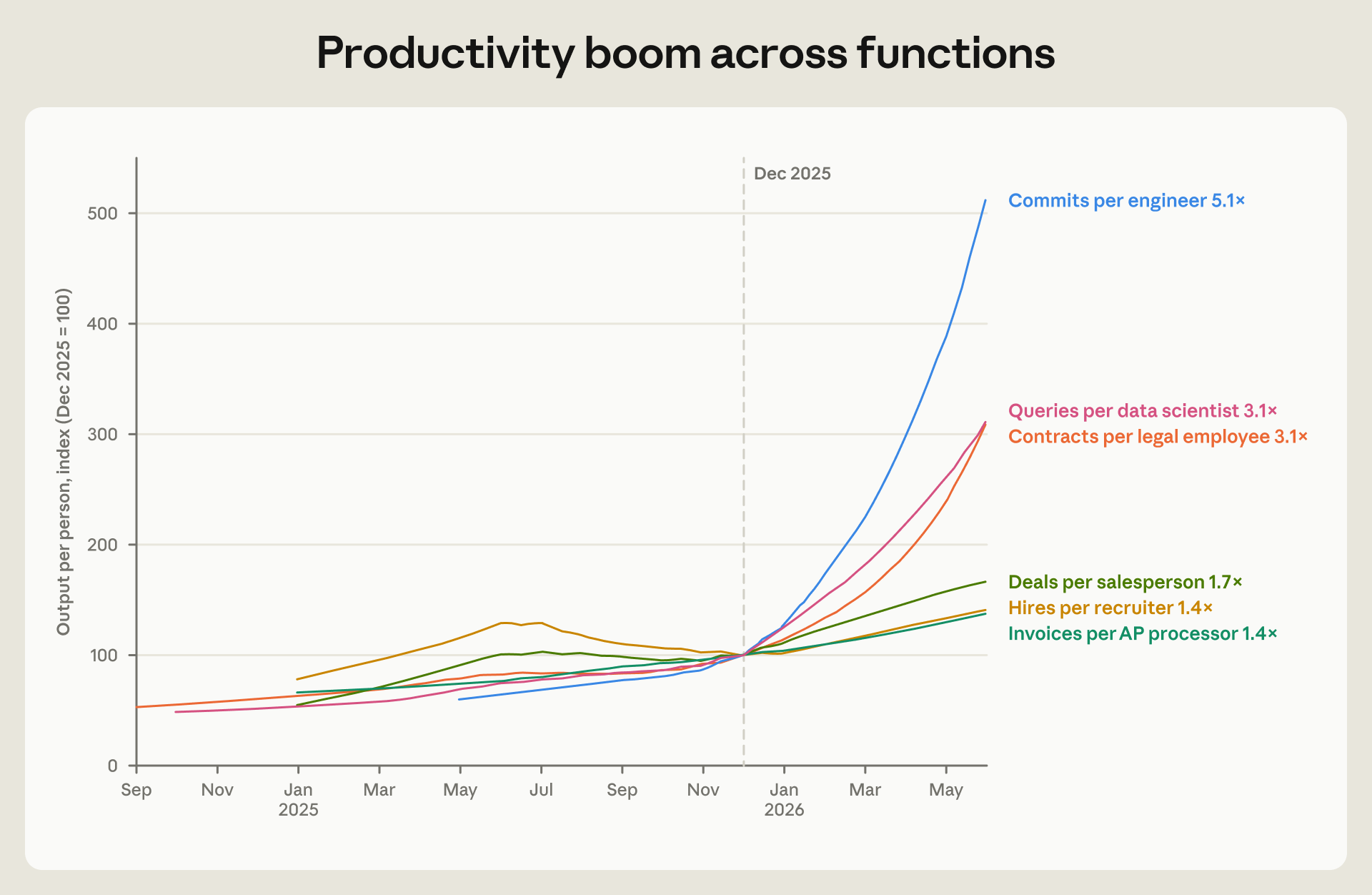
What do all of these tokens amount to? Figure 3 plots output over time for a range of job functions with measurable output. Consistent with prior reports surveying Anthropic engineers and describing automation of model training and research, code commits per engineer have risen the fastest, coming in at 5x their velocity as 6 months ago. Data scientists are also querying the growing mass of Anthropic data more, asking Claude agents to get real-time metrics to dashboards and decisionmakers. But Figure 3 shows that even non-technical employees saw output rise as coding agents diffused: lawyers processed more contracts; accounts payable ushered through invoices; salespeople closed more deals.
But is all of this due to Claude usage? During this same period, the company saw explosive business growth. It is easier to close deals when you sell a strong model. To assess the independent effect of AI, we compare the output of employees who adopt agentic coding tools to those who have not yet adopted the tools. This lets us compare employees working in the same month at the company, and therefore exposed to a similar business context, but approaching it with different tools. Note however that tool adoption is not random: if employees on the cusp of driving some big new project decide to tool up for it, for example, this would bias our estimates.
We follow 192 engineers over time as they adopt coding agents, compared to 74 engineers who do not adopt agents during the period studied. Figure 4 shows that in the months following adoption, the amount of code that engineers add rises sharply. More code does not necessarily mean better code or business impact. To test for AI code slop, we study code commits made at Anthropic. We compare code committed by the same employee, in the same month, in the same coding directory, but written by coding agents rather than written directly by the human employee. There are many dimensions of code quality, and AI errors may be harder to identify than human ones. But we find no difference in rates of lines of code subsequently removed or reverted.
Figure 4 also looks at what happens after an engineer adopts their first fully autonomous agent. Those who adopt were already on a steeply upward trajectory compared to non-adopters. This suggests that employees shifting toward fully autonomous agents were already ramping up their output.
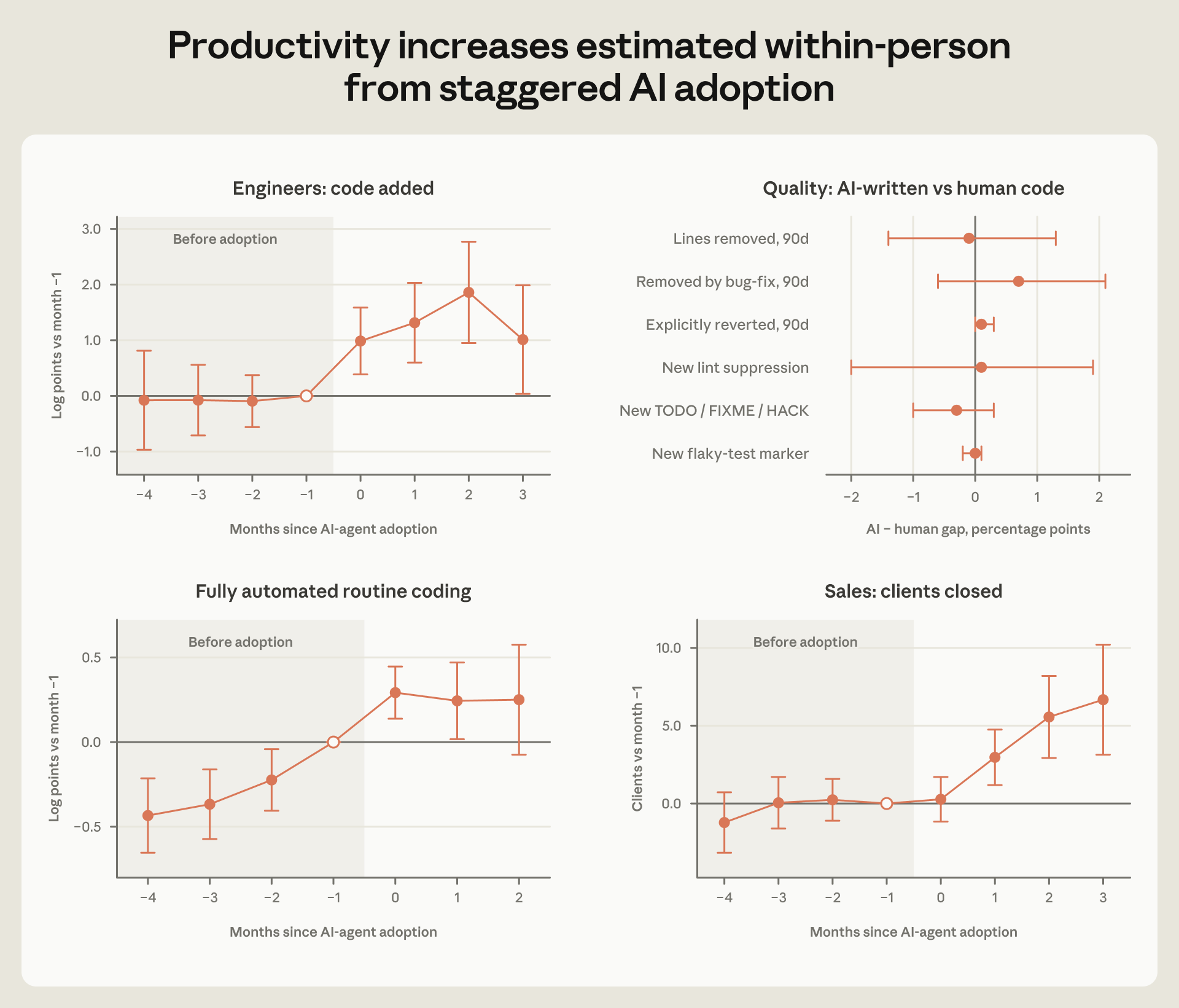
Do these patterns go beyond coding, into a broader transformation of knowledge work? Anthropic sales representatives steadily adopted AI agents starting last September. Figure 4 shows that after sales representatives adopt agents, they close deals with more clients. Part of this pattern could be driven by representatives with more sales opportunities selecting into automation. But it could also reflect automation of logging and routine communication. One account executive explained that Claude automations handled email drafting and customer management software integrations, replacing around 20% of their prior work tasks. Another noted that similar automations freed them up to focus on face-to-face time, letting them talk to 30% more of their customers than was previously possible: “anytime you do anything a second time, you're kind of like, okay, how can I use Claude to make it so that I don't have to do it a third time?”
Beyond sales, an Anthropic lawyer built a series of Claude automations to scan risks and opportunities, triage legal questions and take first passes through public-facing copy for legal review. A recruiter used Claude to help with candidate sourcing, tracking applications and an analysis that would have taken “maybe a couple of weeks,” freeing him to redesign outdated interview questions and meet with more applicants.
All of this suggests that as AI capabilities improve, it impacts a wide range of jobs across Anthropic. Descriptively, we see junior employment slowing in jobs that use Claude for the most complex tasks (Figure 5).
Bottlenecks and process: new and old tasks in an AI-intensive workplace
Heavy AI adoption reshapes more than employment and productivity. It also drives continual changes in work processes, generating new tasks and shifting employees’ perceptions of their workplace. One employee described this as the “eternal pressure at Anthropic to move as fast as possible and use Claude for everything” and another that “things we expect in a week are things that would take three months elsewhere.” An internal employee survey asked whether work processes at Anthropic made respondents as productive as possible: 44% of employees agreed in late 2024; 58% by November 2025 (in April 2026, 75% answered yes, but the question weakened by dropping “as possible”). As of August, employees at Anthropic expected that AI will be able to do 75% of their work by 2030, compared to 28% for other Americans.
These ratcheting productivity expectations are dramatized by the cadence of internal model releases. As soon as a new model is available, Anthropic employees start tackling harder problems in interactive coding agent sessions. We measure this with an automated Claude grader rating deidentified sessions’ task demands based on depth, scope and number of systems implicated. The share of tasks above the 90th percentile of difficulty for the old model rises sharply by around 30% (from 10% to 13% of all tasks) and stays elevated in the weeks following model releases. The easy end of tasks given to agents changes little.
Spiraling agent productivity translates into output pitched across humans’ screens and attention. One engineer compared this to babysitting:
They're like, I need my juice box opened and it's an emergency that my juice box is opened. And that is voiced with the same level of concern as the one who has sliced their finger and is bleeding. [...] When you are babysitting, every child brings to you concerns with an equal demand for your attention and the various [Claudes] also do that.
In the April 2026 survey, an open-ended question about how AI has impacted day-to-day work, 27% described productivity gains from Claude tools and 20% described their role shifting from actually doing work to managing Claudes.
Amid this model-driven acceleration, human attention is a constant bottleneck. In interactive, multi-turn sessions, the vast majority of agents’ session time is not spent working at all, but spent waiting. We track idle time by subtracting each agent’s active working time from each interactive session’s total wall-clock time. Claude sessions amount to around 80% idly waiting for human input. As one engineer put it, people are “bottlenecking the agents.”
How much time exactly would be needed to read all of Claude’s output from interactive sessions? For each interactive session, we convert each session’s agent output token to word count, assuming average human reading speed. Figure 6 shows that technical functions have seen the volume of coding agent output leap up over the last 6 months. But even for non-technical groups, interactive Claude sessions are outputting enough content to take up over half of the work week. The deluge of Claude text needs organizing.
One solution to this deluge is rising automation. But this requires work of a different kind. Written standing instructions for agents grew from a few hundred in July 2025 to 8,500 a year later. One engineer set up an agent chief of staff to triage agent requests. Another wrote a performance review for their Claude team: “Hey, let’s talk about what is and is not working about our communication style.” Recruiters built integrated dashboards with agents surfacing problems and initiating actions. A lawyer shifted their attention from reviewing legal questions to doing “SEO for legal advice, you need to write frameworks that [clients’] agents discover.”
Figure 7 shows that this kind of meta-work leapt from 10% of the average employee’s interactive Claude sessions in fall 2025 to 22% in spring 2026. Much of this rise was due specifically to agent management: writing specs for multi-agent runs, looping one agent to review another’s output, and monitoring pipelines. Across functions, human involvement increasingly abstracted from a particular piece of code or writing to the tooling necessary to get agents to do their tasks effectively.
Despite increases in agent reliability and these significant investments in tooling to supervise them, human trust and accountability remains critical. One employee explained that, increasingly, chasing down bugs “uncovers these organizational or systemic or tech debt things that actually require some amount of human convening and decision-making and governance to solve.” In interview after interview, employees described face-to-face coordination as indispensable. Based on calendar data, the median employee spends 20% more time in meetings than a year ago. Part of this reflects the growth of the company, and a shift toward meeting-intensive non-technical roles. But even among employees in technical individual contributor roles, meeting time is up 16% over the past year. Big picture strategic questions touch a broad range of leveraged positions, and typically require debate and engagement with others. A break from managing the agents typically looks like jumping into a meeting.
Broadly, both technical and non-technical roles have seen implementation parts of their job automated (writing code, identifying bugs, logging progress, drafting emails). Engineers described becoming leaders and managers of agents; non-technical employees described doing more and more of the strategic parts of their job: “that 20% that was strategic becomes 90% of the job.” But for many non-technical roles, core implementation work is also interpersonal: a sales call, an interview, cross-functional alignment on a complex problem. All of this remains human.
Consider too the Slack channels that provide both the front page and backchannels of Anthropic communication. Agents diffused through Slack and eventually appeared in nearly half of active, public channels. Figure 8 zooms in on the communication network of a single large department, drawing on all public Slack channels that department members interacted through. It links both human and agent participants by whether they participated in a Slack thread. The figure shows the remarkable rise of agents, as orange dots blossom and dominate the network.
Agents appear disproportionately in dedicated channels for Claude-human interactions, rather than messaging a lot in incumbent human channels. The underlying structure and density of human communication changes little. Agents did not replace human interaction, but rather added to it: human threads in this department sustained the same number of human responses, while additionally layering on agent responses. Agents become teams for a single employee, rather than nodes with high connectivity to many employees at once.
As humans work amid a growing fleet of AI agents, they face pressure to shift human work into agent-visible channels. If a decision is made in an in-person meeting, and no notes or report-out appears, agents are missing crucial context for updating their goals and assumptions. An employee explained how having their name on a months-old document about Claude swag meant agents kept bringing requests for t-shirts and mugs, long after their responsibilities had changed. Private work, in unlogged meetings and direct messages, is invisible, confusing and discouraged in an AI-heavy workplace. One researcher described this default toward openness as critical to Anthropic’s thoroughgoing integration of AI: “most organizations do not run that way and I think that's a big shift because leaders have to defend feedback out in the open.” The need to feed AI context requires observability of human work and decisions.
Who will thrive in a workplace like this? Shifts in the content of work at Anthropic also show up as changes in the skills that hiring managers prioritize in hiring decisions. We used an automated coder to process hiring manager interview score cards for thousands of employees hired at Anthropic since 2024. These comments are qualitative reactions by interviewers assessing candidates’ performance. The clearest change is increased emphasis on whether candidates have demonstrated creative use of AI tools. In 2024, hiring managers noted candidates' track record on AI tooling in around 5% of assessments for technical roles, and 7% for non-technical roles. By 2026, these rates had tripled for technical roles and quadrupled for non-technical roles. Hiring managers increasingly focus on whether candidates effectively use AI.
Deeper changes in assessment are also visible. Among interviews for technical candidates, the single biggest increases were in comments on applicants’ autonomy and judgment. Discussion of domain expertise shrank as a share of overall assessment. As one manager explained, “I expect models to continue to be jagged, so for my team I want them to be fungible across domains.” Similarly, for non-technical candidates, customer and mission orientation increased, while discussion of execution skills fell. Increasingly, hiring managers assess applicants based on their judgment and commitment, rather than the domain-specific skills and execution automated by AI tools.
What employers can do
The deep adoption of AI at Anthropic makes it a useful case. As AI diffuses and improves, the organization of work could shift as it has in prior waves of technological change. The railroads gave us the managerial corporation, steam power allowed factories, and personal computers delivered the startup. What new organizations will tool-using, reasoning LLMs require, and what will be our role in them? One possibility is single-person start-ups, each with a human founder steering swarms of agents to rake in billions in revenue. Another is companies built by AI genius CEOs employing human agents only to wield pipettes and testify before congress.
Anthropic does not look like either of these. It has tripled in size in the last year. It is no longer a small startup. It has also not ceded executive control to its models. Written Slack debates and in-person meetings steer everything from company strategy to team decisions, with little input from AI agents. Keeping human work visible across the company ensures autonomous agents reason from fresh context. Individual contributors orchestrating teams of agents look more like managers in terms of the knowledge they need and the interdependencies in their work. Working and deciding in the open is critical at an AI-intensive organization.
As employees increasingly see their work as managing teams of Claudes, they spend more time building the tools needed to do this effectively in their own distinctive domains. This experimentation means that employees are continually automating their own tasks away. In some roles, they are increasingly removed from the object-level work that originally built their skills. As agents sprint through workflows, human attention and judgment are a bottleneck that the system strains against. From sales to legal, human employees are expected to do more and different tasks. Roles broaden to include building products, managing agents and tackling the strategic and interpersonal work that remain beyond the scope of the best LLMs.
These changes in the organization and content of work have appeared alongside declining shares of junior technical roles in headcount, hiring, and posting. Hiring managers increasingly focus on applicants’ autonomy and judgment, rather than execution and narrow expertise. Overall, Anthropic’s revenue growth relative to its employment growth has sped past even the rapid early productivity growth of a prior generation of technology companies.
Reading these patterns forward and out across the economy suggests that AI diffusion could risk worker displacement. Prior work also finds that AI-native start-ups and AI-adopters are flatter and employ fewer entry-level employees.. What can we learn from Anthropic about how to manage AI upheavals in a way that serves the humans working around them?
Here we want to proceed carefully. There are many parts of Anthropic’s employment practices that cannot be replicated across the economy.
But three features stand out. First, widespread stock ownership gives employees a strong interest in the company’s success. Of course, this is an easy posture for a company that has seen substantial increases in valuation. For many firms, shared ownership may be insufficient or otherwise undesirable. But it is difficult to imagine a version of pro-worker AI adoption in which workers do not hold a financial stake in successful rollout. If individual contributors are expected to “manage agents,” “make VP level decisions” and be “their own business line,” as interviewees put it, then aligning their interests with the organization is crucial. The post-World War II union-management settlement forged in the 1950s rested on exactly this kind of bargain: labor unions like the United Auto Workers and the United Steel Workers allowed management prerogative over work reorganization (and even intensification) in return for pay increases tied to productivity increases and to a rich array of benefits. Whatever the new deal between AI-affected employees and their employers, a mechanism to share benefits of adoption is essential. At Anthropic, workers codify their expertise for the machine, see their work routines constantly roiled and disrupted, and have seen a large part of their job become speedreading the output of their AI collaborators. They do not do this for free.
Second, Anthropic is standing up an ongoing early warning system to monitor jobs facing AI-driven transformation. A series of role-level metrics for demand and productivity are read against AI capabilities and use. These aggregate metrics help flag where work is shifting. An early warning system allows the company to start reallocating affected employees to jobs with a skills fit that may be less immediately at risk. As companies across the economy reorient to an accelerated pace of work reorganization, effective systems for guiding internal employee reallocation will become increasingly valuable. Turning to the external labor market to meet every new task demanded by AI advances will be a stronger bottleneck the faster AI advances. In this report, we found increased mobility between departments, changing work content, and employees shifting to new tasks as old ones were automated. Building systems to flexibly reallocate workers internally will be critical for AI-intensive organizations.
This commitment to internal worker reallocation raises important tradeoffs. A well-functioning labor market should shift workers into their most productive positions, whether that is at their current employer or another one. Commitments to reallocate incumbent workers could make employers hesitant to take a risk on hiring new employees. In normal economic conditions, particularly intensely competitive ones, such commitments could be costly.
But prioritizing reallocation forces AI-adopting companies to consider ways that AI can create new tasks for new products and new markets, rather than funneling AI applications into replacing human workers to save on labor costs. This could help employers resist the temptation of ‘so-so’ or ‘inefficient’ automation in which AI or other technologies just barely outcompete human workers: employers replace human workers, imposing substantial social costs in lost income for displaced workers, while delivering minimal productivity benefits.
From what we see in Anthropic, both novel and persistently human tasks remain alongside intensive AI use. Uncertainty about the future set of these tasks should recommend preserving a flexible workforce. As one Anthropic executive noted, “a workforce that is anxiously worried is not a workforce doing its best work.”
None of these actions will prevent powerful AI from disrupting jobs. And indeed none directly address the slowdown in junior hires documented in this report. Employment protections for incumbents will not benefit those not hired to begin with. Private action on the part of employers must come alongside farsighted government policy around retraining and income support. Such policy should be guided by a clear picture of the scale of workplace transformation that AI can bring.
Suggested citation
@techreport{wilmers2026employment,

author = {Nathan Wilmers and Regina Catipon and Maxim Massenkoff and Peter McCrory},

title = {How employment is changing at Anthropic},

institution = {The Anthropic Institute},

type = {Technical Report},

year = {2026},

month = oct,

url = {https://www.anthropic.com/research/employment-at-anthropic}

}
Acknowledgements
We are grateful to the Anthropic employees who gave time for interviews about how their work has changed. For very helpful comments and assistance, we thank Kate Astbury, Shehzad Bashir, Zoe Blumenfeld, Scott Booth, Henry Brill, Yena Cho, Henry de Valence, Adam Farina, Johannes Hermle, Zoe Hitzig, , Hasnain Lakhani, Eva Lyubich, Kerry Persen, Kristina Pham, Sarah Pollack, Hannah Pritchett, Georg Rilinger, Santi Ruiz, Szymon Sacher, Florian Scholz, Meg Tong, Monika Tuchowska, Helen Wang, Kim Withee, Charles Yang, and Jack Clark.
Works cited
Acemoglu, Daron, and Pascual Restrepo. 2019. “Automation and New Tasks: How Technology Displaces and Reinstates Labor.” Journal of Economic Perspectives 33 (2): 3–30. https://doi.org/10.1257/jep.33.2.3
Beraja, Martin, and Nathan Zorzi. 2025. “Inefficient Automation.” Review of Economic Studies 92 (1): 69–96. https://academic.oup.com/restud/article-abstract/92/1/69/7612958
Demirer, Mert, Leon Musolff, and Liyuan Yang. 2026. “Writing Code vs. Shipping Code: Productivity Effects Across Generations of AI Coding Tools.” NBER Working Paper 35275. https://doi.org/10.3386/w35275
Ewens, Michael, and Xavier Giroud. 2025. “Corporate Hierarchy.” NBER Working Paper 34162. https://doi.org/10.3386/w34162
Favaro, Marina, and Jack Clark. 2026. “When AI Builds Itself.” The Anthropic Institute. https://www.anthropic.com/institute/recursive-self-improvement
Hitzig, Zoe, Maxim Massenkoff, Eva Lyubich, Shaoyi Zhang, Ryan Heller, and Peter McCrory. 2026. “Agentic Coding and Persistent Returns to Expertise.” Anthropic, June 16. https://www.anthropic.com/research/claude-code-expertise
Hosseini Maasoum, Seyed Mahdi, and Guy Lichtinger. 2025. “Generative AI as Seniority-Biased Technological Change: Evidence from U.S. Résumé and Job Posting Data.” SSRN Working Paper 5425555. https://papers.ssrn.com/sol3/papers.cfm?abstract_id=5425555
Huang, Saffron, Bryan Seethor, Esin Durmus, Kunal Handa, Miles McCain, Michael Stern, and Deep Ganguli. 2025. “How AI Is Transforming Work at Anthropic.” Anthropic, December 2. https://www.anthropic.com/research/how-ai-is-transforming-work-at-anthropic
Kim, Hyunjin, and Rembrand Koning. 2026. “AI-Native Firms.” Harvard Business School Working Paper 26-090. https://www.hbs.edu/ris/Publication%20Files/26-090_96f92aa0-37d9-4789-beaa-5c0cb87a4032.pdf
Roodman, David, and Maxim Massenkoff. 2026. “An Evidence Review of Subsidized Job Training.” The Anthropic Institute Working Paper 2026-01. https://www.anthropic.com/research/reviewing-the-evidence-on-worker-retraining-programs